If you’re shopping for a diamond and notice fluorescence on the grading report, you may wonder whether it’s a problem.
The short answer is no, you don’t automatically need to avoid a diamond with fluorescence.
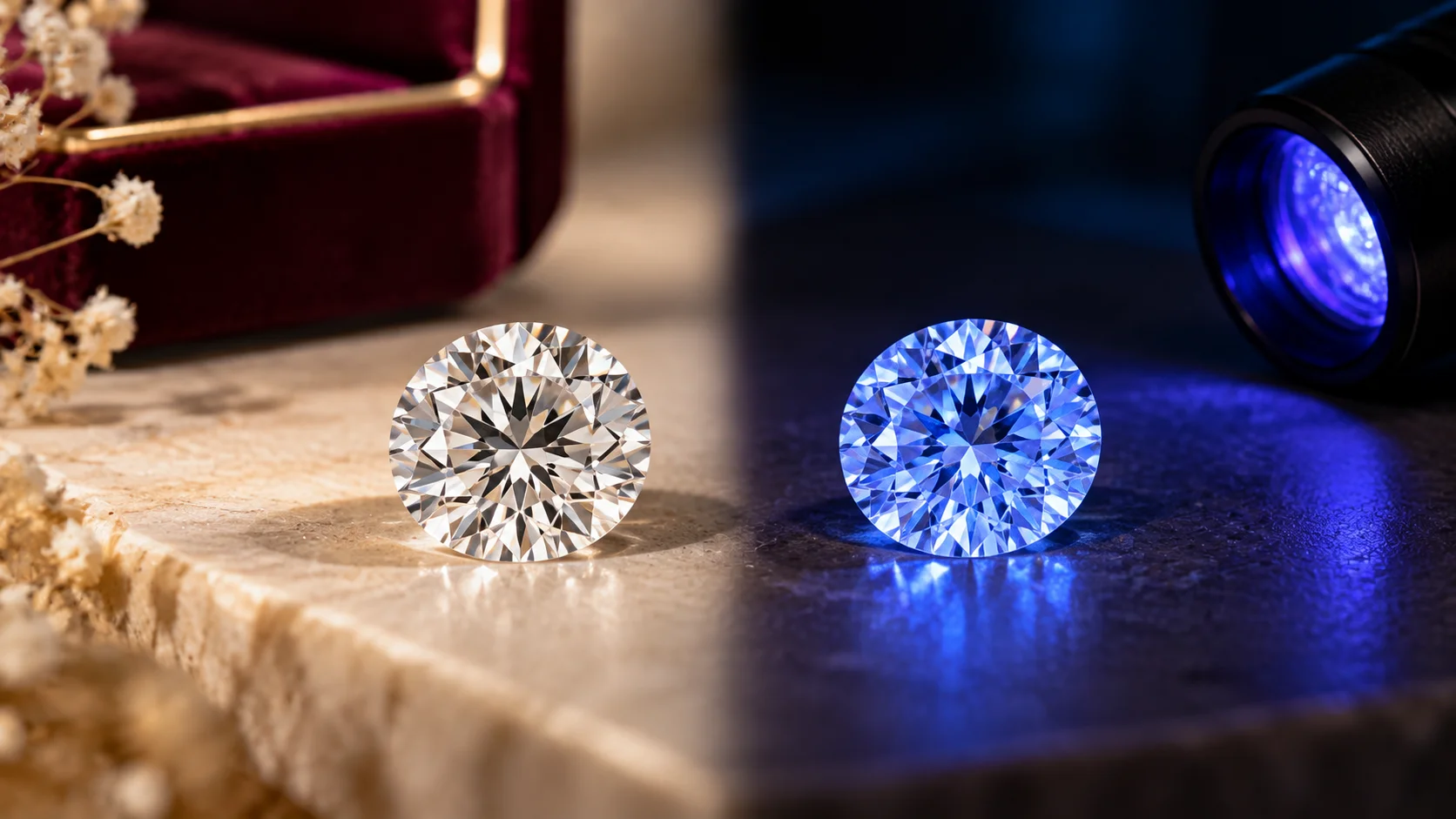
Fluorescence is simply the visible glow some diamonds produce when exposed to ultraviolet (UV) light. Most fluorescent diamonds show blue fluorescence, and for the majority of stones, it has little to no noticeable effect on appearance.
In fact, a diamond with fluorescence can sometimes offer an attractive combination of appearance and price.
The important thing is to judge the individual diamond, rather than treating fluorescence as automatically good or bad.
Quick Answer: Should You Buy a Diamond With Fluorescence?
Yes, if you like how the diamond looks and the price makes sense.
Fluorescence is not one of the 4Cs, and it does not make a diamond weaker or less durable. GIA research has found that the average observer generally does not see a consistent difference between diamonds with and without fluorescence.
However, very strong fluorescence deserves closer inspection, particularly if the diamond has a high color grade or shows any haziness.
A good rule is:
Don’t reject a diamond just because it fluoresces. Look at the diamond, compare it with similar stones, and decide based on its appearance and overall value.
What Is Diamond Fluorescence?
Diamond fluorescence is the visible light emitted by a diamond when it is exposed to ultraviolet radiation.
UV light is present in sunlight, which is why fluorescence can sometimes be observed outdoors or under other UV-containing light sources. Once the UV source is removed, the fluorescence stops.
About 25% to 35% of diamonds submitted to GIA show some degree of fluorescence. More than 95% of fluorescent diamonds exhibit blue fluorescence, although other colors can occur.
Fluorescence is reported separately from the traditional 4Cs:
- Cut
- Color
- Clarity
- Carat weight
A grading report can describe fluorescence as None, Faint, Medium, Strong, or Very Strong.
For Medium, Strong, and Very Strong fluorescence, the fluorescence color is also reported.
If you want a broader explanation before evaluating whether fluorescence is right for you, see our Diamond Fluorescence Guide.
Is Fluorescence Bad in a Diamond?
No. Fluorescence is not inherently bad.
One of the biggest misconceptions about diamond fluorescence is that it automatically makes a diamond lower quality.
It doesn’t.
A fluorescent diamond has the same structural integrity as a diamond without fluorescence. The presence of fluorescence does not mean the diamond is damaged, fragile, or unsuitable for an engagement ring.
Fluorescence is also not a reliable indicator of whether a diamond is beautiful or unattractive.
The effect depends on the particular stone, its color, its clarity characteristics, the strength and color of the fluorescence, the lighting, and what you personally see when you examine it.
That’s why two diamonds with the same fluorescence grade can look different.
When Can Fluorescence Be a Good Thing?
There are several situations where fluorescence can make a diamond worth considering.
1. You like the way it looks
This is the most important reason.
If a diamond with Medium or Strong blue fluorescence looks beautiful to you in normal viewing conditions, there is no reason to reject it simply because the grading report mentions fluorescence.
GIA research has found no systematic effect on face-up appearance for the average observer.
2. You’re buying a lower-color diamond
Blue fluorescence can sometimes make a diamond with a warmer color appear more colorless under UV-containing light.
This can be particularly relevant when comparing diamonds toward the lower end of the D-to-Z color scale.
Blue and yellow are complementary colors, so blue fluorescence can visually offset some yellow coloration under the right conditions.
However, fluorescence does not change the diamond’s official color grade.
A diamond graded K remains K even if its blue fluorescence makes it look somewhat whiter in certain lighting.
For more information, see our Fluorescence and Diamond Color article.
3. The diamond offers better value
Fluorescence can influence how a diamond is priced.
Some buyers prefer diamonds without fluorescence, particularly in higher color grades. As a result, a fluorescent diamond can sometimes be priced attractively compared with a similar-looking stone without fluorescence.
That doesn’t mean every fluorescent diamond is a bargain.
Compare diamonds based on their actual appearance, grading information, proportions, and price rather than assuming fluorescence automatically means a discount.
Our Fluorescence and Diamond Price article explores this relationship in more detail.
When Should You Be Careful With Fluorescence?
The main reason to inspect a fluorescent diamond carefully is appearance, not durability.
Very strong fluorescence can occasionally be associated with a hazy or oily appearance in certain diamonds.
Importantly, fluorescence itself does not create this haziness. GIA explains that fluorescence can intensify an existing light-scattering characteristic in rare cases.
This effect is uncommon. GIA reports that fewer than 0.2% of fluorescent diamonds submitted to it exhibit this hazy or oily appearance.
Still, if you’re considering a diamond with Strong or Very Strong fluorescence, it’s sensible to inspect the stone carefully.
Pay particular attention to:
- Transparency
- Face-up appearance
- Contrast
- Overall brightness
- Whether the diamond looks hazy in daylight
- Whether it looks different from comparable diamonds without fluorescence
If the stone looks clear and attractive, the fluorescence notation by itself shouldn’t scare you away.
Fluorescence by Diamond Color Grade
Fluorescence can be more relevant depending on the diamond’s color grade.
D to H color diamonds
With higher-color diamonds, fluorescence may deserve closer consideration.
Very Strong fluorescence can sometimes carry a pricing penalty in this range because some buyers prefer high-color diamonds without fluorescence.
That doesn’t mean a fluorescent D, E, F, G, or H diamond is automatically worse.
It simply means you should compare the stone carefully rather than paying a premium for a diamond solely because it has a high color grade.
If the diamond looks excellent and is priced attractively, fluorescence may actually create an opportunity.
I to M color diamonds
Blue fluorescence can be more interesting in lower-color diamonds because it may reduce the visual impact of yellow coloration under certain lighting conditions.
This doesn’t replace a good color grade, and it doesn’t guarantee that the diamond will look whiter.
But if two diamonds have similar overall quality and one has fluorescence that improves the appearance to your eyes, it can be a useful characteristic rather than a drawback.
Very strong fluorescence
Very Strong fluorescence is the category where inspection becomes particularly important.
Don’t automatically reject it.
Instead, make sure the stone does not show an undesirable hazy, oily, or less-transparent appearance.
Does Fluorescence Make a Diamond Look Cloudy?
Usually, no.
This is another common misconception.
Fluorescence itself does not cause a diamond to become cloudy. In rare diamonds with light-scattering characteristics, strong fluorescence can make an existing hazy appearance more noticeable.
For most fluorescent diamonds, this is not an issue.
If you’re buying online, look for high-quality photographs and videos and, where possible, a viewing or return policy that allows you to inspect the stone yourself.
For a deeper explanation, see Does Fluorescence Make a Diamond Look Cloudy?.
Does Fluorescence Affect Diamond Sparkle?
Fluorescence is not what determines whether a diamond sparkles.
A diamond’s sparkle is primarily related to its cut and how effectively its facets interact with light.
This is important because shoppers sometimes see fluorescence on a grading report and worry that it will make the diamond look dull.
There is no reason to assume that.
A well-cut diamond with fluorescence can be highly brilliant, while a poorly cut diamond without fluorescence can still look disappointing.
When comparing two diamonds, prioritize the overall visual performance of the stones rather than focusing on fluorescence alone.
Does Fluorescence Make a Diamond Less Durable?
No.
Fluorescence does not make a diamond structurally weaker.
The microscopic characteristics responsible for fluorescence do not inherently compromise the diamond’s durability.
So if you’re worried that a fluorescent diamond is more likely to chip or break, fluorescence itself is not the reason to be concerned.
As with any diamond, durability should be considered in the context of the diamond’s shape, cut, inclusions, and setting.
Can Fluorescence Save You Money?
It can, but there is no universal discount.
The effect of fluorescence on price depends on factors such as:
- Color grade
- Fluorescence strength
- Fluorescence color
- Diamond shape
- Cut quality
- Clarity
- Overall appearance
- Seller pricing
Some buyers actively avoid fluorescence, particularly in certain higher-color diamonds. That preference can sometimes create a pricing difference between otherwise comparable stones.
This is where shopping strategically can help.
Instead of deciding that every diamond must have None fluorescence, compare several diamonds with similar specifications.
If a fluorescent diamond looks just as good to you but costs less, you may have found a better value.
How to Buy a Diamond With Fluorescence
If you’re considering one, use this process.
Step 1: Check the fluorescence on the grading report
Find the fluorescence section and note both the intensity and, when reported, the color.
For example, the report might state:
Fluorescence: Medium Blue
This gives you useful information, but it doesn’t tell you exactly how attractive the diamond will look.
Step 2: Look at the diamond in normal lighting
The diamond should look good in the lighting where you’ll actually wear it.
Don’t judge it solely under a UV lamp.
Fluorescence becomes visible under UV radiation, but an engagement ring will spend most of its time in ordinary lighting.
Step 3: Check it in daylight
Daylight contains UV radiation, so it is particularly useful when evaluating a fluorescent diamond.
Look for any unusual haziness, milkiness, or loss of transparency.
Step 4: Compare it with a similar non-fluorescent diamond
This is one of the easiest ways to determine whether fluorescence matters for the stone you’re considering.
If possible, compare:
- Similar color
- Similar clarity
- Similar carat weight
- Similar cut quality
- Similar shape
- Similar proportions
Then ask yourself which diamond actually looks better.
Step 5: Compare the prices
Once you’ve established that you like the appearance, compare the price with similar diamonds.
The goal isn’t to find the diamond with the “best” fluorescence grade.
The goal is to find the diamond that gives you the best combination of appearance, quality, and price.
Step 6: Don’t let fluorescence distract you from cut quality
If you’re choosing between a beautifully cut diamond with Medium fluorescence and a poorly performing diamond with None fluorescence, the fluorescence notation shouldn’t make the decision for you.
Look at the diamond as a whole.
Should You Avoid Strong or Very Strong Fluorescence?
Not necessarily.
Strong and Very Strong fluorescence simply deserve more scrutiny.
The important question is whether the individual diamond shows any undesirable appearance.
If it looks transparent, bright, and attractive in different lighting conditions, there is no rule saying you cannot buy it.
On the other hand, if you can clearly see a hazy or oily appearance and it bothers you, choose another diamond.
This is why buying decisions should be based on the stone itself rather than a blanket rule such as “never buy strong fluorescence.”
Is Medium Fluorescence a Good Choice?
Medium fluorescence can be a perfectly reasonable choice.
For many diamonds, the fluorescence will not be obvious under normal viewing conditions.
It can also provide an opportunity to compare stones that may be priced differently from otherwise similar diamonds.
If you prefer a diamond with Medium fluorescence and it looks good to you, there is no inherent quality problem that should stop you from buying it.
Is No Fluorescence Always Better?
No.
“None” is not automatically better than “Faint,” “Medium,” or “Strong.”
Fluorescence is not a 4C, and the absence of fluorescence doesn’t guarantee superior sparkle, transparency, or beauty.
A diamond with None fluorescence can still have poor proportions, undesirable inclusions, or weak visual performance.
Likewise, a diamond with Medium fluorescence can be beautiful.
The right comparison is between the actual diamonds you’re considering.
Final Words
Yes, you can buy a diamond with fluorescence.
For most shoppers, fluorescence should be treated as a characteristic to evaluate rather than a red flag to avoid.
A fluorescent diamond can be an especially interesting option when:
- You like its appearance
- The fluorescence is blue
- The diamond has a lower color grade and the fluorescence complements its appearance
- The stone is priced attractively
- You have compared it with similar non-fluorescent diamonds
- It remains clear and transparent in different lighting conditions
The main situation where you should slow down is when considering Strong or Very Strong fluorescence and you notice any haziness or unusual appearance.
Ultimately, the best diamond is not necessarily the one with the fluorescence grade you expected.
It’s the one that looks beautiful to you, performs well, and represents good value for your budget.
Frequently Asked Questions
Is it OK to buy a diamond with fluorescence?
Yes. Fluorescence does not inherently damage a diamond or make it less durable. For most diamonds, it has little noticeable effect on appearance.
Is diamond fluorescence a bad thing?
No. Fluorescence can be neutral, beneficial, or occasionally undesirable depending on the individual diamond and how it looks.
What fluorescence should I avoid in a diamond?
There is no universal fluorescence grade that everyone should avoid. Strong and Very Strong fluorescence deserve closer inspection, especially if the diamond shows haziness or an oily appearance.
Does fluorescence make a diamond cheaper?
It can affect pricing, but there is no fixed discount. The effect depends on the diamond’s color, fluorescence strength, shape, quality, and market demand.
Does blue fluorescence make a diamond look whiter?
It can make some lower-color diamonds appear more colorless under UV-containing lighting, but it does not change the diamond’s official color grade.
Does fluorescence affect diamond sparkle?
Fluorescence is not the primary factor determining sparkle. Cut quality has a much more important role in how a diamond handles light.
Does fluorescence make a diamond cloudy?
Usually not. Fluorescence itself does not cause cloudiness. In rare cases, strong fluorescence can intensify an existing light-scattering characteristic that makes a diamond appear hazy.
Is Very Strong fluorescence bad?
Not automatically. A Very Strong fluorescent diamond should simply be inspected carefully to make sure it doesn’t show an appearance you dislike.
Is Medium fluorescence good?
It can be. Medium fluorescence is common enough that it should not automatically be viewed as a disadvantage. Judge the individual diamond and compare its appearance and price with alternatives.