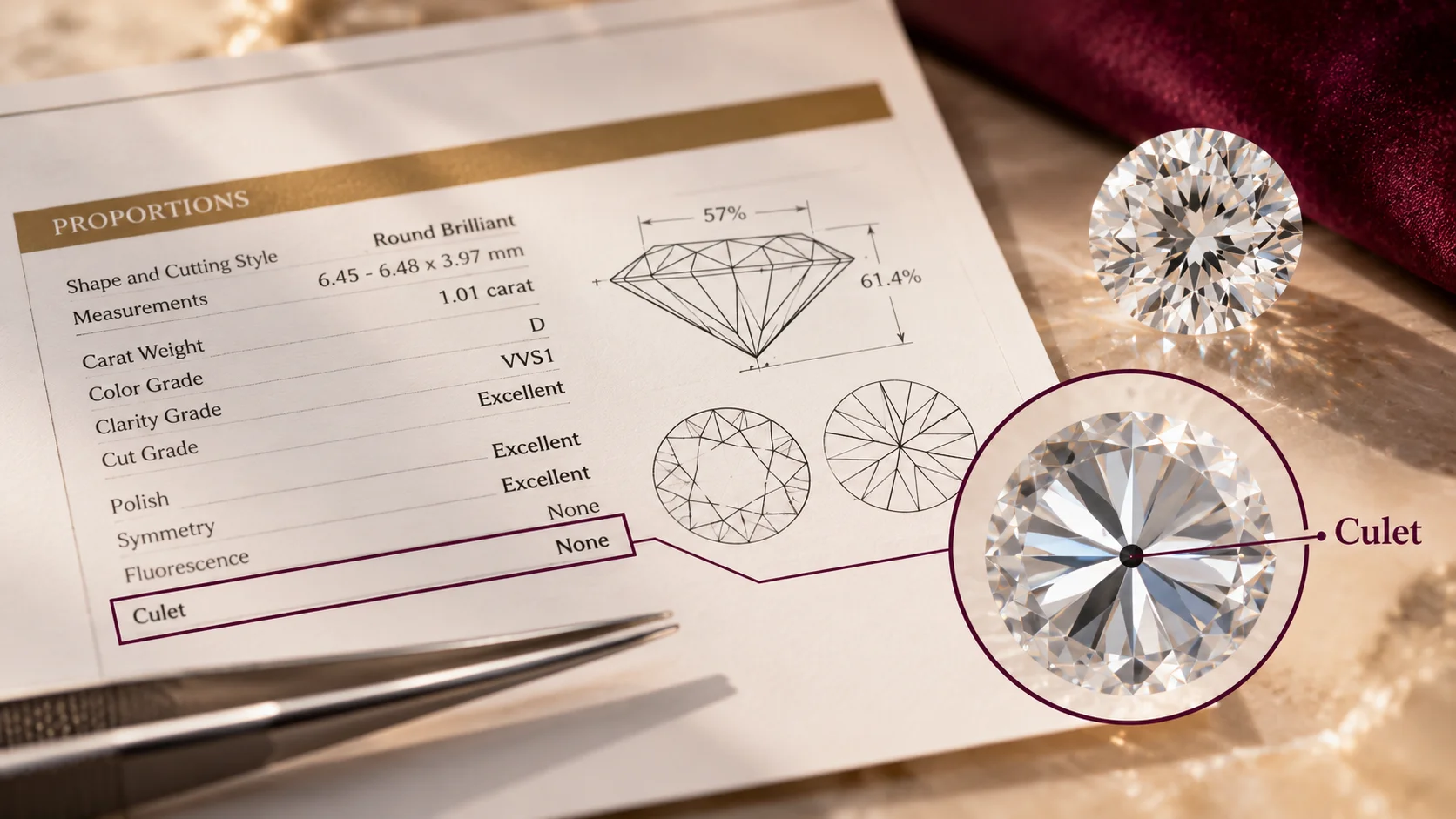
If you are reading a diamond grading report, you may notice a section labeled “Culet” among the diamond’s proportions and finishing details. This entry tells you whether the diamond has a culet facet and, if it does, how large that facet is.
For many modern diamonds, the certificate may simply say “None” or “Pointed.” Others may be described as Very Small, Small, Medium, Large, or another size category.
Understanding this entry can help you interpret a diamond certificate more confidently and understand whether the culet could influence the diamond’s appearance.
Where Is the Culet Listed on a Diamond Certificate?
The culet is generally listed with other proportion and finish information on a diamond grading report.
Depending on the laboratory and report format, you may find it near details such as:
- Table percentage
- Crown height or crown angle
- Pavilion depth or pavilion angle
- Girdle thickness
- Total depth
- Polish
- Symmetry
- Fluorescence
A GIA diamond report provides information about the diamond’s 4Cs as well as its proportions and other grading details. For standard round brilliant diamonds, the report also includes a cut grade.
The exact layout varies by laboratory, so the culet may not appear in exactly the same position on every certificate.
What Does the Culet Entry Mean?
The culet is the area at the bottom of a diamond, opposite the table. A traditional culet is a small polished facet near the bottom point of the stone.
GIA describes culet size according to the width of the culet facet relative to the diamond’s average girdle diameter. Its categories include:
- None
- Very Small
- Small
- Medium
- Slightly Large
- Large
- Very Large
- Extremely Large
The exact terminology you see depends on the grading laboratory and the type of report.
So if your certificate says “Small” under Culet, it does not mean the diamond has a flaw. It is describing the size of a facet at the bottom of the diamond.
What Does “None” Mean on a Diamond Certificate?
If the certificate says “None,” the diamond does not have a conventional culet facet.
In a modern round brilliant diamond, the pavilion facets can meet at a point instead. This is often described as a pointed culet.
GIA notes that when there is no culet facet, the size is reported as None. When the eight main pavilion facets meet at the point, the diamond may be referred to as having a pointed culet.
This is extremely common in modern diamonds.
It does not mean that the bottom of the diamond is missing or damaged. It means there is no separate polished culet facet.
What Does “Pointed” Mean?
Some diamond reports, particularly reports from certain laboratories, may use “Pointed” rather than “None.”
For example, an IGI report can list “Culet: POINTED” in its additional grading information.
In practical terms, a pointed culet means the bottom of the diamond terminates in a point rather than having a distinct culet facet.
This is different from a diamond that has a Very Small or Small culet, where a separate facet exists at the bottom.
What Do Very Small and Small Culets Mean?
A certificate showing Very Small or Small indicates that the diamond has a small culet facet.
These sizes are generally subtle. GIA notes that culets described as None, Very Small, or Small on a GIA report fall within the range associated with excellent cut quality for round brilliant diamonds.
That does not mean every diamond with one of these descriptions will look identical. Diamond appearance depends on the interaction of many proportions and finishing characteristics.
The culet should therefore be considered as one part of the overall diamond rather than as an isolated quality score.
What Does a Medium or Large Culet Mean?
A Medium, Large, or larger culet indicates a more substantial culet facet.
As the culet becomes larger, it can become more noticeable when viewing the diamond face-up. GIA explains that larger culets can negatively affect the face-up appearance by affecting the diamond’s visual pattern and can contribute to a lower cut grade in round brilliant diamonds.
This is one reason the culet entry is worth checking when comparing diamonds.
A larger culet is not automatically evidence of a poor-quality diamond, however. The significance depends on the diamond’s shape, proportions, cutting style, and overall appearance.
Does Culet Size Affect Diamond Cut?
Yes, particularly for round brilliant diamonds graded under the GIA cut-grading system.
Culet size is one of the parameters considered when evaluating the cut of a standard round brilliant. GIA’s cut-grading materials specifically identify culet size as one of the factors that can influence face-up appearance and the resulting cut evaluation.
A large culet can sometimes be visible through the table and alter the visual pattern of the diamond.
However, it would be a mistake to judge cut quality solely from the culet entry.
Other proportions, including the table, crown, pavilion, depth, girdle, and facet relationships, also contribute to the diamond’s appearance.
How to Read the Culet Alongside the Rest of the Certificate
The best way to interpret the culet is to read it together with the diamond’s other grading information.
For example, when evaluating a round brilliant, you might look at:
- Cut grade: The laboratory’s overall assessment of cut quality
- Table: The percentage represented by the table facet
- Depth: The diamond’s total depth relative to its diameter
- Crown: The crown height and angle
- Pavilion: The pavilion depth and angle
- Girdle: The thickness around the diamond’s outer edge
- Culet: The presence and size of the culet facet
- Polish: The quality of the diamond’s surface finish
- Symmetry: How consistently the facets are arranged
Looking at these characteristics together gives you a much better understanding of the stone than focusing on one line of the report.
Is a Diamond With “None” Better Than One With a Small Culet?
Not necessarily.
For a modern round brilliant, a certificate showing None is common and may be preferable if you want the traditional modern appearance of a pointed culet.
A Very Small or Small culet is also not inherently undesirable. GIA notes that these descriptions can fall within the excellent range for its round-brilliant cut grading system.
The important question is whether the diamond’s overall proportions and appearance work well together.
If two otherwise similar diamonds are being compared, the one with the more desirable visual performance may be the better choice regardless of a small difference in culet description.
Do Vintage Diamonds Usually Have Different Culet Descriptions?
They can.
Older diamond cuts were often produced with larger culets than modern round brilliant diamonds. This is particularly relevant when evaluating antique and vintage-style stones.
That means a larger culet is not automatically a negative feature on an older diamond. In some vintage cuts, it can be part of the characteristic appearance and cutting style.
If you are considering an antique-style stone, it is useful to understand the context of the cut rather than applying modern round-brilliant expectations to every diamond.
For more background, see our guides to culet on vintage diamonds, culet on Old Mine Cut diamonds, and culet on Old European Cut diamonds.
Does a Larger Culet Make a Diamond Look Different?
It can.
A larger culet may become visible through the diamond’s table when viewed face-up. GIA notes that eye-visible culets can disrupt the face-up pattern of a diamond.
The visual effect depends on the diamond’s proportions and cutting style.
This is particularly important because the culet is located at the bottom of the stone. You may not notice it when looking at the diamond from the side, but its reflection can influence what you see when looking down through the table.
If appearance is your priority, comparing the actual diamond visually is valuable in addition to reading the certificate.
GIA vs. IGI: Can the Culet Be Listed Differently?
Yes.
Different grading laboratories can use different report layouts and terminology.
GIA uses a culet-size scale that includes None, Very Small, Small, Medium, Slightly Large, Large, Very Large, and Extremely Large.
IGI reports can use terminology such as Pointed, as shown in its report information.
This means you should not assume that two different words necessarily represent a major difference in diamond quality. Always interpret the terminology according to the laboratory that issued the report.
Should You Avoid a Diamond With a Culet?
Not automatically.
For a modern round brilliant, a None or very small culet is generally straightforward to understand and is unlikely to be a concern by itself.
A larger culet deserves closer attention because it can influence the diamond’s face-up pattern and, depending on the proportions, its cut assessment.
For antique or vintage diamonds, however, a larger culet can be part of the intended cutting style.
The right approach is to consider:
- The diamond’s shape and cutting style
- The culet description
- The overall cut or proportions
- Whether the culet is visible face-up
- The diamond’s overall visual performance
- How the diamond compares with other stones at a similar price
Frequently Asked Questions
Where is the culet shown on a diamond certificate?
It is typically listed with the diamond’s proportion and finishing information. The exact location varies by grading laboratory and report format.
What does “None” mean for culet?
It means there is no separate culet facet. The pavilion can meet at a point instead, which is commonly described as a pointed culet.
Is a small culet bad?
No. A small culet is not automatically a negative characteristic. GIA notes that None, Very Small, and Small can fall within the excellent range for its round-brilliant cut-grading system.
Is a large culet bad?
Not necessarily. A large culet can affect face-up appearance and cut evaluation, but whether it is desirable depends on the diamond’s overall proportions and cutting style.
What does “Pointed” mean on an IGI report?
It indicates that the diamond has a pointed termination rather than a separate culet facet. IGI reports can list the culet as “POINTED.”
Should I choose None or Small culet?
For a modern round brilliant, either can be perfectly reasonable. Rather than choosing based on the culet alone, evaluate the diamond’s overall proportions, cut quality, and appearance.
Final Words
The Culet entry on a diamond certificate tells you whether the diamond has a culet facet and, when present, how large it is.
For modern round brilliant diamonds, you will commonly see None, Very Small, or Small. Larger categories can have a more noticeable effect on face-up appearance and may influence cut grading.
The key is not to treat the culet as an isolated pass-or-fail characteristic. Read it alongside the diamond’s cut grade, proportions, polish, symmetry, and overall appearance.
If you are comparing diamonds, the certificate gives you useful technical information, but the goal is ultimately to find a stone whose proportions and visual performance work well together.