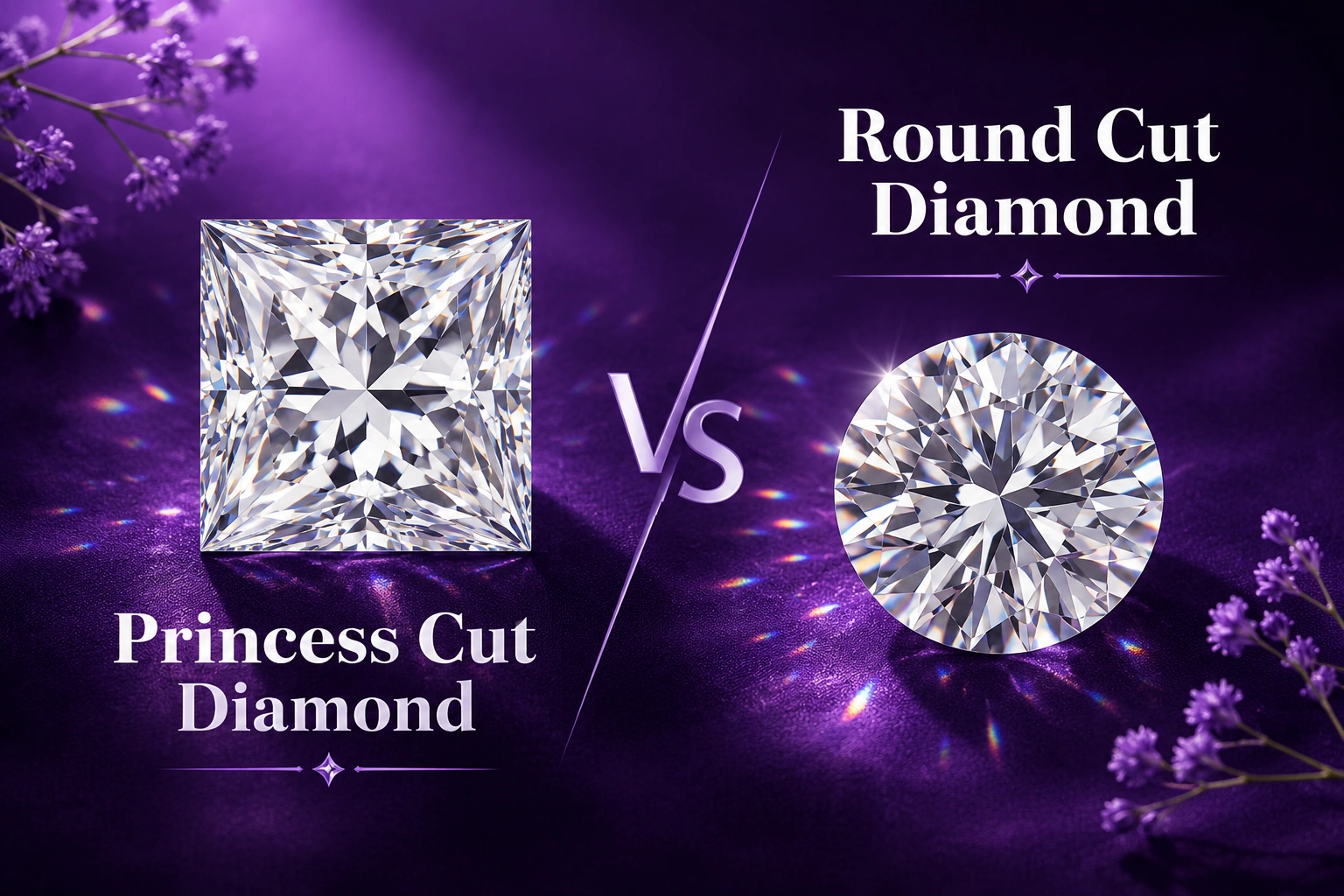
Choosing between a princess cut vs round cut diamonds often comes down to one simple question: do you want a diamond with a classic, brilliant look or a square shape with a more modern edge?
Both are popular choices for engagement rings, but they create a very different visual impression. A round brilliant is known for its exceptional light performance and timeless appeal, while a princess cut offers crisp corners, a square or rectangular outline, and a contemporary style.
The right choice depends on what matters most to you: sparkle, price, face-up size, durability, setting, or personal style.
So, when it comes to a princess vs round cut diamond, which one wins?
Let’s compare them point by point.
Princess Cut vs. Round Cut Diamonds: Quick Comparison
| Feature | Princess Cut Diamond | Round Brilliant Diamond |
|---|---|---|
| Shape | Square or rectangular modified brilliant | Round |
| Sparkle | Bright and lively, depending on faceting and proportions | Known for strong brilliance, fire, and scintillation |
| Brilliance | Can offer excellent light performance, but varies by stone | Highly predictable light performance when well cut |
| Price | Often less expensive per carat than comparable rounds, though prices vary | Usually commands a premium |
| Face-up size | May appear smaller for its carat weight because of its deeper pavilion | Often presents a larger face-up outline for its weight |
| Durability | Corners need protection because they can be vulnerable to chipping | No pointed corners, making it practical for everyday wear |
| Style | Modern, geometric, clean | Classic, timeless, versatile |
| Best settings | Solitaire, halo, three-stone, bezel and protective settings | Solitaire, halo, three-stone, pavé and many others |
| Best for | Buyers who love square shapes and modern styling | Buyers who prioritize classic sparkle and established cut grading |
One key difference is that GIA classifies princess cuts as fancy-shape diamonds, while its official cut-grading system applies to standard round brilliant diamonds. That means you should evaluate a princess diamond individually rather than assuming a grading label alone tells you how well it will perform.
Princess Cut Diamond
A princess cut diamond is generally a square or rectangular modified brilliant cut. GIA describes it as a square modified brilliant and notes that princess cuts can also have rectangular or tapered outlines.
Unlike a round diamond, a princess cut has four corners that create its signature geometric appearance. From the top, it looks crisp and architectural, making it a natural choice for shoppers who want something more contemporary than a traditional round.
The faceting pattern can vary considerably between princess cut diamonds. As a result, two stones with the same carat weight can look noticeably different in terms of brightness, scintillation, and overall appearance.
GIA also points out that the princess cut can carry significant weight in its pavilion. Because of this, the finished diamond may look smaller from the top than another diamond of a similar carat weight.
That is why princess cut diamond dimensions matter. Don’t judge the stone by carat weight alone. Check the actual length and width measurements, examine the stone from the top, and pay attention to its symmetry and light performance.
Round Cut Diamond
When people talk about a classic round diamond, they usually mean the round brilliant cut.
The standard round brilliant has 57 or 58 facets, depending on whether the culet is counted. Its carefully designed facet arrangement allows it to interact strongly with light, creating the combination of brightness, fire, and scintillation that makes round diamonds so recognizable.
The round brilliant also has one major advantage when shopping: GIA provides an official cut-grading system for standard round brilliant diamonds. This gives buyers a standardized way to assess aspects of cut quality, from Excellent through Poor.
In simple terms, the round brilliant is the familiar classic. It works with almost every engagement ring style and has decades of gemological research behind its cut evaluation.
Key Differences
Shape and Appearance
The most obvious difference between a princess cut vs round diamond is the outline.
A round diamond has a circular shape that feels traditional and universally recognizable. A princess cut has straight sides and pointed corners, giving it a more structured and modern appearance.
If you like clean lines and geometric jewelry, a princess cut may be more appealing.
If you prefer a timeless look that will still feel familiar decades from now, the round brilliant has the advantage.
There is no objectively “better” shape here. Your personal style is doing most of the talking.
Sparkle and Brilliance
The question of princess cut vs round cut sparkle needs a little nuance.
Round brilliant diamonds have a strong reputation for brilliance because their facet arrangement and proportions have been extensively studied. GIA’s round brilliant cut system specifically evaluates factors connected to brightness, fire, and scintillation.
A well-cut princess diamond can also be highly brilliant and lively. However, princess cuts have greater variation in facet arrangements and proportions, so their appearance can differ significantly from one stone to another.
So, which diamond cut sparkles more?
In a direct comparison, a well-cut round brilliant is generally the safer choice if your top priority is maximizing predictable brilliance and scintillation.
However, that doesn’t mean every round diamond will outperform every princess diamond. A poorly chosen round can disappoint, while a beautifully cut princess can look fantastic.
The individual diamond still matters.
Price and Value
When comparing princess cut vs round diamond price, round diamonds often cost more per carat than comparable fancy-shape diamonds.
One reason is cutting efficiency. A princess cut can often retain more of the original diamond rough than a round brilliant, which requires more material to be removed to create its circular outline. This can contribute to differences in pricing.
However, don’t assume that every princess diamond is automatically cheap or that every round diamond is dramatically more expensive. Prices depend on multiple factors, including carat weight, color, clarity, cut quality or proportions, certification, and market conditions.
So, are princess cut diamonds cheaper than round diamonds?
Often, yes, when comparing similar quality and carat weight. But the actual price difference depends on the individual stones.
If you’re working with a specific budget, compare the princess cut diamond price vs round options side by side rather than relying on a general rule.
Face-Up Size
The princess cut vs round diamond size comparison can be surprising.
Carat weight measures weight, not the visible surface area you see when looking at a diamond from above.
GIA notes that princess cut diamonds can carry considerable weight in their pavilion, which may make them appear smaller face-up than another diamond of the same carat weight.
A round diamond’s face-up appearance also depends heavily on its proportions. GIA explains that measurements such as table size and depth influence how a round diamond appears from above.
Therefore, the answer to which diamond looks bigger isn’t simply “princess” or “round.”
Look at the actual millimeter dimensions.
A well-proportioned diamond with a larger visible surface can sometimes appear bigger than a heavier diamond that carries more weight below the girdle. In other words, the number on the certificate isn’t the whole story.
Durability and Corner Protection
Durability is another important part of the round vs princess diamond durability comparison.
A princess cut has four pointed corners. Those corners can be more vulnerable to damage than the rounded edge of a round diamond, particularly if the setting leaves them exposed.
This doesn’t make princess cut diamonds unsuitable for everyday wear. It simply means the design of the ring matters.
Princess cut diamond corner protection is especially important when choosing a setting. Protective designs that cover or shield the corners can reduce their exposure to accidental impacts.
A round diamond doesn’t have pointed corners, so it avoids this particular vulnerability.
That gives the round brilliant a practical advantage for buyers who want a simple, low-concern option for everyday wear.
Still, all diamonds can chip under a sufficiently hard impact. A diamond is extremely hard, but hardness and toughness are not the same thing.
Color and Clarity
Color and clarity can also influence the appearance of both shapes.
Because princess cuts have different facet arrangements and often show a large, open face-up area, inclusions and color may be more noticeable in some stones than others.
The same principle applies to round diamonds, although their brilliant faceting can help create a lively appearance that may make certain imperfections less obvious.
Rather than choosing a specific clarity or color grade simply because it is popular, look at the actual diamond.
Your budget may be better spent on a beautifully cut stone with eye-clean clarity than on a higher clarity grade that makes little visible difference to your eye.
And remember: certification matters. A reputable grading report helps you understand the diamond’s characteristics and gives you an independent record of what you are buying.
Which Sparkles More?
If sparkle is your number-one priority, the round brilliant vs princess cut comparison leans toward the round.
Round brilliant diamonds have a standardized facet design and an established cut-grading system. GIA’s research and grading methodology focus on how proportions and facet relationships affect brightness, fire, and scintillation.
Princess diamonds can also sparkle beautifully, but their faceting patterns vary more widely. That makes individual evaluation especially important.
So, for the diamond cut with the most sparkle, a well-cut round brilliant is usually the safer choice.
But if you love the square outline of a princess cut, don’t dismiss it. Look for strong symmetry, attractive light and dark patterns, and a stone that performs well when viewed in person or through reliable imaging and video.
Which Diamond Looks Bigger?
The answer depends on the diamond’s actual dimensions and proportions.
A princess cut can look substantial because its square outline fills the finger differently from a round diamond. However, GIA notes that princess cuts may appear smaller face-up for their carat weight because of their deeper pavilion.
When comparing princess cut face up size with round diamond face up size, check the measurements in millimeters.
Don’t compare a 1-carat princess and a 1-carat round based only on weight. Compare their length, width, and visible surface area.
That’s the smarter diamond shape size comparison.
Which Is More Affordable: Princess or Round?
If budget is a major concern, a princess cut often offers an attractive alternative to a round brilliant.
The princess cut vs round diamond price difference can make it possible to put more of your budget toward carat weight or other quality factors.
However, price isn’t the only measure of value.
A round brilliant may cost more because of demand, cutting considerations, and its highly standardized cut evaluation. If exceptional sparkle is your priority, that premium may feel worthwhile.
On the other hand, if you want a larger-looking square diamond without paying the typical premium associated with a round, a princess cut can make a compelling case.
The most affordable diamond cut isn’t automatically the best value. The best value is the diamond that gives you the appearance and performance you want at a price you’re comfortable with.
Princess Cut vs. Round Engagement Ring: Which Is Better?
For a princess cut vs round engagement ring, the decision usually comes down to style and priorities.
A round cut engagement ring is the classic choice. It suits solitaire, halo, three-stone, pavé, and many other designs. Its circular shape also makes it easy to pair with different wedding band styles.
A princess cut engagement ring feels more contemporary. Its square outline looks especially striking in clean solitaire designs and geometric settings.
If you want a traditional engagement ring that will always look familiar, choose round.
If you want something crisp, modern, and slightly less conventional, choose princess.
Best Setting for a Princess Cut Diamond
The right setting should complement the square outline while giving the corners appropriate protection.
Good options can include:
- Solitaire settings with protected corners
- Halo settings
- Bezel-style designs
- Three-stone rings
- Channel or pavé designs
The exact choice depends on the diamond and the design.
For a princess cut, pay close attention to how the setting protects the four corners. This is one area where aesthetics and practicality need to work together.
Best Setting for a Round Diamond
Round diamonds are exceptionally versatile.
A round brilliant works beautifully in:
- Solitaire settings
- Halo rings
- Three-stone rings
- Pavé settings
- Bezel settings
- Vintage-inspired designs
That versatility is one reason the round brilliant remains such a popular choice for engagement rings. GIA identifies the round brilliant as the most popular shape and cutting style for diamond engagement rings.
Pros and Cons of Princess Cut Diamonds
Pros
- Modern square or rectangular appearance
- Strong brilliant-style sparkle
- Often offers attractive value compared with round diamonds
- Distinctive geometric look
- Works well with contemporary engagement ring designs
Cons
- Pointed corners need thoughtful protection
- Face-up size can be smaller than expected for the carat weight
- No standardized GIA overall cut grade
- Faceting and light performance can vary considerably between stones
Pros and Cons of Round Cut Diamonds
Pros
- Excellent potential for brilliance and scintillation
- Timeless and versatile appearance
- No pointed corners
- Works with almost any engagement ring setting
- GIA provides an official cut-grading system for standard round brilliant diamonds
Cons
- Usually carries a higher price premium
- Can require more rough diamond material to be removed during cutting
- May feel too traditional for shoppers seeking a distinctive geometric shape
Which Should You Choose: Princess or Round?
The best choice in the princess cut versus round cut debate depends on what you value most.
Choose a princess cut if you want:
- A square or rectangular diamond
- A modern, clean aesthetic
- A potentially lower price per carat
- A distinctive alternative to the traditional round
Choose a round brilliant if you want:
- Maximum emphasis on classic sparkle
- A timeless engagement ring style
- A versatile diamond shape
- The reassurance of GIA’s standardized round brilliant cut grading system
If you are still stuck between a princess cut or round cut diamond, start with your priorities rather than the trend.
Do you want the brightest classic sparkle? Round is a strong choice.
Do you love a square shape and modern styling? Princess may be the better fit.
There is no universal winner. The best diamond is the one that looks beautiful to you, fits your budget, and works with the ring design you actually want to wear.
Frequently Asked Questions
Is a princess cut diamond better than a round cut?
Neither is universally better. A round brilliant is generally the stronger choice for buyers who prioritize proven light performance and classic style. A princess cut may suit buyers who prefer a square shape, modern appearance, and potentially better price per carat.
Which sparkles more, princess or round cut?
A well-cut round brilliant generally offers more predictable brilliance and scintillation because its facet design is standardized and supported by GIA’s cut-grading system. Princess cut diamonds can also sparkle beautifully, but their faceting varies more from stone to stone.
Are princess cut diamonds cheaper than round diamonds?
Often, yes. Princess diamonds commonly cost less per carat than comparable round brilliants, although the actual price depends on carat weight, color, clarity, proportions, certification, and other factors.
Which diamond shape looks bigger?
There is no universal winner. Compare the actual millimeter dimensions rather than carat weight alone. Princess cuts can carry more weight in depth, which may reduce their face-up size relative to their carat weight.
Is a princess cut diamond good for an engagement ring?
Yes. Princess cuts are popular for engagement rings and offer a modern alternative to the classic round brilliant. Just make sure the setting provides suitable protection for the pointed corners.
Are princess cut diamonds more likely to chip?
Their pointed corners can be more vulnerable to damage than the rounded edge of a round diamond. A well-designed setting that protects the corners can help reduce this risk.
Which diamond cut is the most popular?
The round brilliant is the most popular diamond shape and cutting style for engagement rings, according to GIA.
Is a round diamond worth the extra cost?
For many buyers, yes, particularly if sparkle, versatility, and a standardized cut-grading system are priorities. However, a princess cut can offer a different look and potentially better value per carat. Whether the premium is worthwhile depends on your budget and preferences.
Final Verdict: Princess Cut or Round Cut Diamond?
The Princess Cut vs Round Cut Diamonds debate isn’t really about finding one winner. It’s about finding the right match for your style, budget, and expectations.
A round brilliant is the classic choice for maximum emphasis on sparkle, versatility, and established cut evaluation.
A princess cut is an excellent option for shoppers who love a square silhouette, modern design, and potentially lower pricing compared with a comparable round.
Before you buy, compare the actual diamonds rather than relying only on carat weight or shape. Review the certification, examine the proportions, consider the face-up measurements, and pay attention to how the diamond performs in light.
After all, choosing a diamond isn’t a mathematics exam. The numbers matter, but the moment you see the right stone and think, “That’s the one,” matters too.