Choosing between step cut vs brilliant cut diamonds often comes down to one question: do you want a diamond with a sleek, mirror-like appearance or one that puts on a bigger light show?
Both styles can look stunning in an engagement ring. However, they interact with light differently, reveal clarity and color differently, and create very different personalities on the finger.
The biggest mistake is assuming that one style is simply “better.” It isn’t. The right choice depends on what you want your diamond to look like and how much you value sparkle, clarity, elegance, or visual impact.
In this guide, we’ll explain the difference between step cut and brilliant cut diamonds, compare their sparkle, brilliance, fire, clarity, and appearance, and help you decide between a step cut diamond engagement ring and a brilliant cut diamond engagement ring.
Step Cut vs Brilliant Cut Diamonds: The Quick Answer
The easiest way to understand the difference is to look at the facet pattern.
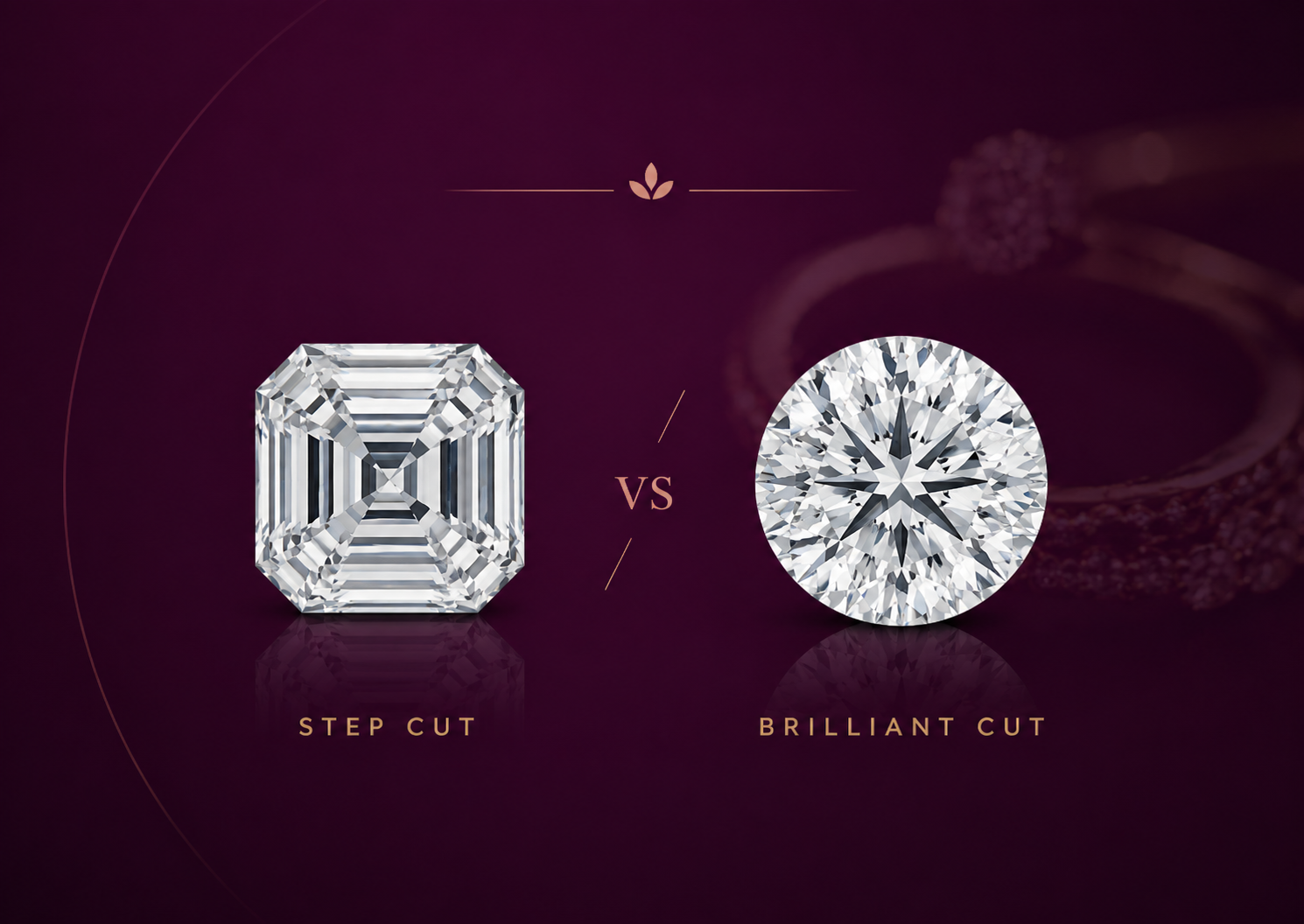
Step cut diamonds use broad, long, typically rectangular or trapezoidal facets arranged in concentric rows. This creates a clean, reflective appearance often described as a “hall of mirrors” effect.
Brilliant cut diamonds use numerous smaller facets designed to reflect and return light in a more complex pattern. This creates the lively sparkle and flashes of light that many people traditionally associate with diamonds.
Classic examples of step cuts include the emerald cut and Asscher cut. The round brilliant is the best-known brilliant cut, while other shapes can also use brilliant-style faceting.
According to GIA, it’s important to distinguish between a diamond’s shape and its cut style. Shape describes the outline you see from above, while cut style describes the arrangement of the diamond’s facets. This means that terms such as emerald, round, oval, and Asscher can describe shapes, while brilliant and step describe facet arrangements.
| Feature | Step Cut Diamonds | Brilliant Cut Diamonds |
|---|---|---|
| Facet pattern | Long, broad, orderly facets | Numerous smaller facets |
| Overall look | Sleek, elegant, mirror-like | Bright, lively, sparkling |
| Light performance | More reflective and subtle | Stronger visual sparkle and flashes |
| Clarity visibility | Inclusions can be easier to notice | Faceting can help mask small inclusions |
| Color visibility | Color may be easier to see | Faceting can help disguise some color |
| Best for | Clean, sophisticated style | Maximum sparkle and movement |
| Common examples | Emerald, Asscher | Round brilliant and many modified brilliant styles |
Step Cut Diamond
A step cut diamond has facets arranged in parallel rows that resemble a staircase. Instead of creating a busy pattern of small flashes, the broad facets reflect light in larger sections.
The result is a sophisticated appearance that can feel calm and architectural.
The classic step cut emerald diamond is perhaps the most recognizable example. The step cut Asscher diamond offers a similar faceting concept in a square outline, creating a more geometric look.
The broad facets are a major part of the appeal. They allow you to see deeper into the diamond, which is why step cuts often have a distinctive glassy or mirror-like appearance.
GIA describes step cuts as having concentric rows of facets and notes that emerald and Asscher diamonds are examples of this style. The organization also points out that not every rectangular or square diamond is a step cut. Some, such as radiant and princess cuts, use brilliant-style faceting instead.
That distinction matters when you’re shopping. A rectangular diamond does not automatically mean an emerald cut, and a square diamond does not automatically mean an Asscher cut.
Brilliant Cut Diamond
Brilliant cuts are designed around a different goal: maximizing lively light return and sparkle.
These diamonds typically feature many smaller facets that create a more complex pattern of reflections. As the diamond moves, you may see rapid flashes of white light and spectral colors.
The round brilliant cut is the most famous example. However, brilliant-style faceting also appears in several other diamond shapes.
GIA explains that brilliant cuts are characterized by numerous smaller facets that help create brilliance and fire. Their more complex facet pattern can also make small inclusions and some color characteristics less noticeable than they might be in a step cut.
So, if a step cut whispers “quiet luxury,” a brilliant cut is more likely to say, “Yes, I am the diamond. You may admire me now.”
Both have their place.
Step Cut vs Brilliant Cut Sparkle: Which Shines More?
If your priority is step cut vs brilliant cut sparkle, brilliant cuts generally have the advantage.
But there is an important detail: sparkle is not one single thing.
GIA describes three key aspects of a diamond’s light performance:
- Brightness or brilliance: White light reflected from the diamond.
- Fire: Flashes of spectral colors created when white light disperses.
- Scintillation: The flashes of light and dark you see as the diamond or viewer moves.
A well-cut brilliant diamond can produce a dynamic combination of these effects. Its smaller, more numerous facets create many opportunities for light to reflect and return to the viewer.
Step cuts behave differently.
Their broad facets create larger reflections and a more organized pattern of light and dark. Instead of the intense, rapid sparkle associated with many brilliant cuts, you may notice broad flashes and reflections that contribute to the famous step cut diamond hall of mirrors effect.
So, when comparing step cut vs brilliant cut sparkle, the question isn’t simply which one sparkles more. It’s what kind of sparkle you prefer.
If you want maximum movement and lively flashes, a brilliant cut may be the better fit.
If you prefer broad reflections and a sleek, understated glow, a step cut may win your heart.
Step Cut vs Brilliant Cut Brilliance and Fire
The terms brilliance and fire are often used interchangeably in casual diamond shopping, but they describe different visual effects.
Brilliance refers to white light, while fire refers to flashes of spectral colors.
Brilliant cuts are generally associated with stronger visual sparkle because their facet arrangements are designed to create complex light return. This makes them a popular choice for shoppers searching for a diamond cut with the most sparkle.
Step cuts take a more restrained approach.
Their broad facets can produce striking reflections, but the overall visual effect is usually less busy than a brilliant cut. You may see fewer rapid flashes, but the reflections themselves can look larger and more defined.
This is why the step cut vs brilliant cut fire comparison is not really a competition with one universal winner. The visual experience depends on the diamond’s proportions, facet arrangement, symmetry, polish, lighting environment, and movement.
GIA notes that cut quality plays a major role in how a diamond interacts with light, including brightness, fire, and scintillation.
Step Cut vs Brilliant Cut Clarity: Which Shows Inclusions More?
This is one of the most important differences when comparing step cut vs brilliant cut clarity.
Step cut diamonds tend to reveal clarity characteristics more readily.
Why?
Their larger, broader facets provide a clearer view into the stone. Inclusions may stand out more easily, especially when they are located in prominent areas.
Brilliant cuts, on the other hand, have many smaller facets and a more complex pattern of reflections. This can help disguise some small inclusions.
GIA specifically notes that inclusions are typically harder to see in brilliant cut diamonds because their greater number of facets creates a more complex visual pattern. By comparison, step cut diamonds have larger and fewer facets, which can make clarity characteristics more noticeable.
This does not mean that every step cut diamond needs the highest possible clarity grade.
Instead, it means you should judge the individual diamond carefully.
A diamond’s clarity grade is based on factors such as the size, number, nature, position, and visibility of its clarity characteristics. Two diamonds with the same clarity grade can still look different to the naked eye.
If you’re shopping for a step cut diamond, pay close attention to the actual stone rather than buying a clarity grade blindly.
Do Step Cut Diamonds Show Flaws?
The short answer is: they can show inclusions more clearly than many brilliant cuts.
That doesn’t make them inferior. It simply means the diamond’s broad facets provide fewer visual distractions.
For this reason, shoppers looking for a best step cut diamond should pay close attention to eye visibility. A stone with an attractive appearance to the naked eye may offer better value than automatically choosing the highest clarity grade available.
The same principle applies to brilliant cuts, although their facet patterns can be more forgiving.
GIA recommends considering the actual visibility and characteristics of inclusions rather than relying only on the clarity grade. The location, relief, nature, and size of an inclusion can all influence how noticeable it becomes.
In other words, don’t let a tiny abbreviation on a grading report make the entire buying decision for you.
Look at the diamond.
Step Cut vs Brilliant Cut: What About Diamond Color?
The same visual principle applies to color.
Because step cuts have larger facets and a more open appearance, the diamond’s body color can sometimes be easier to notice.
Brilliant cuts tend to create more visual activity, which may make some color less obvious.
However, the final appearance depends on several factors, including the diamond’s actual color grade, size, proportions, lighting, and the metal used in the ring.
So, if you’re deciding between a step cut diamond or brilliant cut diamond, don’t evaluate color in isolation.
Look at the stone in person or review high-quality images and videos before making a decision.
Emerald Cut vs Round Brilliant Diamond
The emerald cut vs round brilliant diamond comparison is one of the clearest ways to understand the difference between the two faceting styles.
An emerald cut is a classic step cut. It usually has a rectangular outline with cropped corners and broad, linear facets.
A round brilliant uses a brilliant facet arrangement designed for strong light return and sparkle.
The visual personalities are completely different.
An emerald cut often feels refined, sleek, and understated. Its broad reflections can give it a sophisticated, almost architectural character.
A round brilliant tends to feel energetic and bright, with more visible sparkle and movement.
Neither is objectively better.
The emerald cut may appeal to someone who loves clean lines and a modern-classic appearance. The round brilliant may suit someone who wants a traditional diamond look with lots of sparkle.
Emerald Cut vs Brilliant Cut Diamond: Which Is Better?
The answer depends on what you value most.
Choose an emerald cut if you prefer:
- Broad, mirror-like reflections
- A clean and elegant appearance
- A sophisticated, understated style
- A diamond that showcases its clarity characteristics more openly
- A rectangular silhouette
Choose a brilliant cut if you prefer:
- Strong visual sparkle
- More active flashes of light
- Greater scintillation
- A more traditional diamond appearance
- A facet pattern that can help hide some small inclusions
The emerald cut vs brilliant cut diamond decision is ultimately a style decision as much as a technical one.
Asscher Cut vs Brilliant Cut Diamond
The Asscher cut vs brilliant cut diamond comparison follows a similar pattern.
The Asscher cut is a square step cut known for its geometric appearance and concentric facets. It can create a distinctive hall-of-mirrors effect and often has a vintage-inspired personality.
A brilliant cut typically creates more visual sparkle through its numerous facets and complex light pattern.
If you love symmetry, geometry, and a bold architectural look, an Asscher cut could be a strong choice.
If your dream ring needs to sparkle every time your hand moves, a brilliant cut may be more suitable.
The choice is personal, but the faceting style creates a very real difference in how each diamond interacts with light.
Step Cut vs Brilliant Cut Engagement Ring: Which Is Right for You?
When choosing a step cut vs brilliant cut engagement ring, start with your personal style.
A step cut engagement ring may suit you if you like:
- Minimalist jewelry
- Clean architectural lines
- Vintage-inspired elegance
- A sophisticated, understated look
- Emerald or Asscher shapes
A brilliant cut engagement ring may be better if you want:
- Maximum sparkle
- Strong light and dark contrast
- A lively appearance
- A traditional diamond look
- Round, oval, pear, or other brilliant-style shapes
Your lifestyle and setting also matter.
For example, a step cut center stone can make clarity selection especially important because its larger facets may make inclusions easier to notice. A brilliant cut can be more forgiving visually, although you should still inspect the individual diamond carefully.
GIA also emphasizes that cut quality and craftsmanship have a significant effect on a diamond’s appearance. For fancy shapes, there is no standardized GIA cut grade equivalent to the grading system used for standard round brilliant diamonds, so shoppers should pay close attention to the stone’s proportions, symmetry, polish, and overall visual appearance.
How to Choose a Diamond Cut
If you’re still wondering should I choose step cut or brilliant cut, use this simple approach.
Choose a step cut if you love elegance over intense sparkle.
Look for a diamond with attractive proportions, strong symmetry, good polish, and clarity characteristics that are not distracting to your eye.
Choose a brilliant cut if sparkle is your top priority.
Focus on the diamond’s cut quality, proportions, symmetry, polish, and overall light performance.
Always judge the actual diamond.
Two diamonds with identical grades can still look different. This is particularly important with fancy shapes and step cuts.
Consider clarity carefully.
If you choose a step cut, inspect the stone closely for visible inclusions. With brilliant cuts, you may have more flexibility, but the individual diamond still matters.
Don’t confuse shape with cut style.
An emerald cut is a shape and a step-cut style. A round brilliant describes both a round shape and a specific brilliant facet arrangement. Other shapes can also use different facet styles.
This distinction will make shopping much easier.
Step Cut vs Brilliant Cut Diamonds: Which Is Better?
There is no universal winner in the step cut vs brilliant cut debate.
If your definition of “better” means more sparkle, stronger scintillation, and a lively light show, a brilliant cut is likely the better choice.
If “better” means elegant reflections, clean lines, and a sophisticated hall-of-mirrors appearance, a step cut may be exactly what you’re looking for.
For shoppers who want a step cut diamond engagement ring, the emerald and Asscher cuts are excellent places to start.
For shoppers searching for a brilliant cut diamond engagement ring, the round brilliant is the classic choice, while other brilliant-style shapes offer different silhouettes and personalities.
The best diamond is ultimately the one that looks beautiful to you.
Frequently Asked Questions
What is the difference between step cut and brilliant cut diamonds?
Step cut diamonds use long, broad facets arranged in a staircase-like pattern, creating a reflective hall-of-mirrors appearance. Brilliant cut diamonds use a more complex arrangement of smaller facets designed to return more light and create stronger sparkle, brilliance, and fire. Emerald and Asscher cuts are classic step cuts, while the round brilliant is the best-known brilliant cut.
Are step cut diamonds less sparkly than brilliant cut diamonds?
Generally, yes. Step cut diamonds produce a different type of light performance, with broader flashes and mirror-like reflections. Brilliant cut diamonds typically create more noticeable sparkle and scintillation because of their facet arrangement. However, a well-cut step diamond can still have beautiful light performance. The two styles simply create different visual effects.
Do step cut diamonds show inclusions more easily?
Yes. Step cut diamonds typically have larger, more open facets that allow you to see deeper into the stone. As a result, inclusions can be easier to notice than they are in many brilliant cut diamonds. This is why it’s particularly important to examine the individual diamond carefully when choosing a step cut stone.
Which diamond cut has the most sparkle?
Among traditional diamond cuts, brilliant-style cuts are generally associated with the strongest sparkle and light return. The round brilliant is especially well known for its brilliance and scintillation. However, sparkle depends on more than the facet style alone. The diamond’s proportions, symmetry, polish, and overall cut quality also influence its appearance.
Do brilliant cut diamonds hide inclusions better?
Brilliant cut diamonds can make some inclusions less noticeable because their numerous facets create a more complex pattern of reflections. However, this does not mean every brilliant cut diamond can hide every inclusion. The size, location, type, and visibility of the inclusion still matter, so you should evaluate the actual diamond rather than relying only on its clarity grade.
Does a step cut diamond have fire?
Yes. Step cut diamonds can show flashes of light, including some fire, but their overall appearance differs from brilliant cuts. Instead of the intense, lively sparkle typically associated with brilliant faceting, step cuts are known for broader flashes and reflective, mirror-like patterns. The exact light performance depends on the individual diamond’s cut and proportions.
Should I choose a step cut or brilliant cut engagement ring?
Choose a step cut engagement ring if you prefer a sophisticated, clean, geometric appearance with broad flashes of light. Choose a brilliant cut engagement ring if your priority is strong sparkle, brilliance, and scintillation. Looking at both styles side by side is one of the best ways to determine which appearance you prefer.
Which is better for an engagement ring: emerald cut or round brilliant?
An emerald cut may be better for someone who prefers understated elegance, clean lines, and a hall-of-mirrors effect. A round brilliant may be better for someone who wants maximum sparkle and a more traditional diamond appearance. Neither is objectively better; the right choice depends on your personal style and preferred light performance.
What clarity should I choose for a step cut diamond?
There is no single clarity grade that is best for every step cut diamond. Because step cuts can make inclusions easier to see, shoppers should carefully inspect the individual stone and prioritize eye-clean appearance. Rather than choosing a clarity grade automatically, compare the diamond’s actual visibility, inclusion location, and overall appearance.
Final Takeaway
The real difference between step cut and brilliant cut diamonds comes down to how their facets handle light.
Step cuts create broad reflections and a distinctive hall-of-mirrors effect. Brilliant cuts create more complex light return, resulting in stronger sparkle, brilliance, and scintillation.
Step cuts also tend to reveal clarity characteristics more clearly, while brilliant cuts can help disguise some small inclusions through their more complex faceting.
So, which should you choose?
Choose a step cut if you want sophistication, symmetry, and understated elegance. Choose a brilliant cut if you want maximum sparkle and lively light performance.
And before you buy, remember one golden rule: don’t choose a diamond based on its grade alone. Look at the actual stone, understand how it performs, and pick the one that makes you stop scrolling for a second.
That’s usually a pretty good sign.