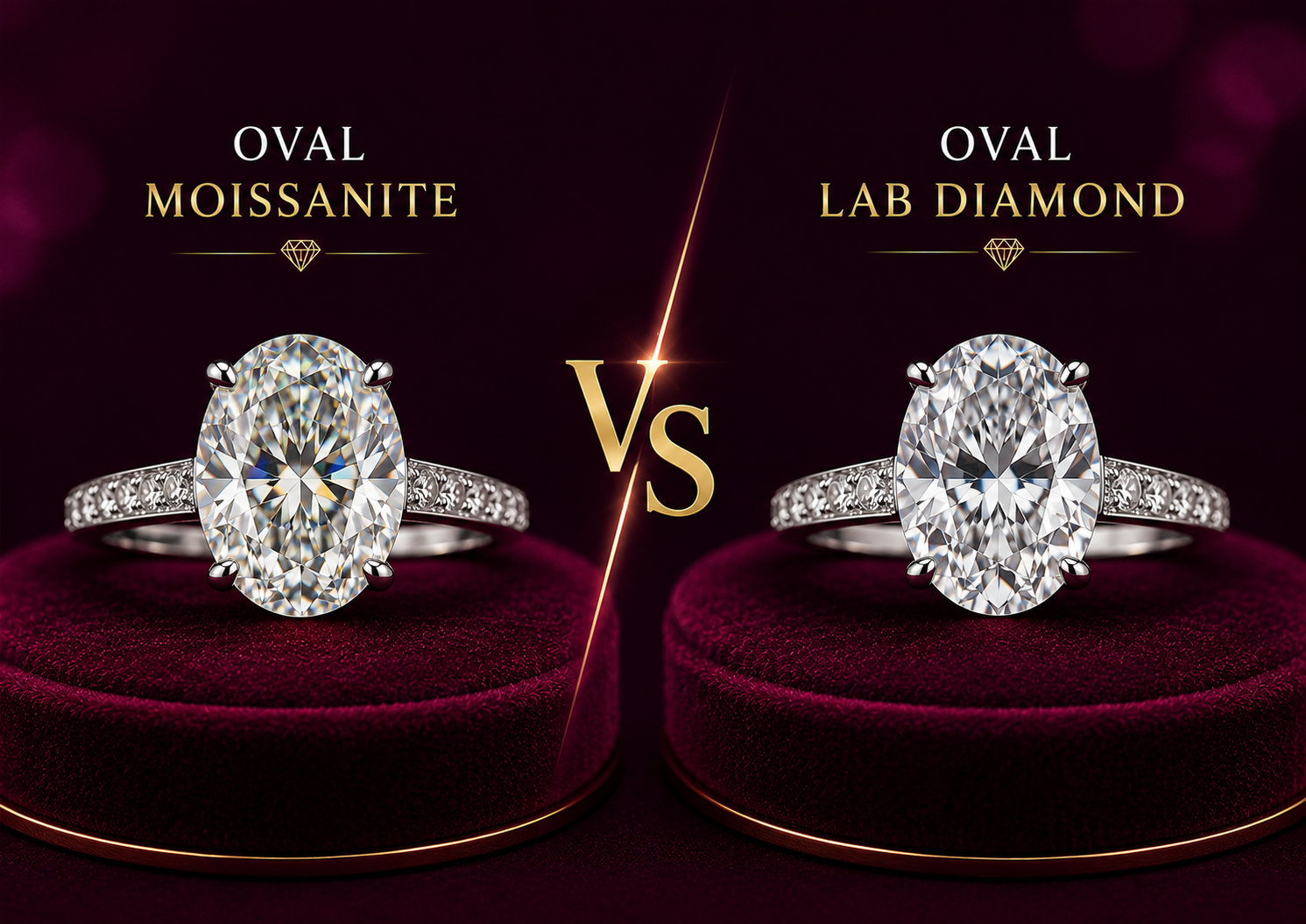
Choosing an engagement ring is exciting, but picking the center stone can feel overwhelming. If you’ve narrowed your options to an oval moissanite vs oval lab diamond, you’re already looking at two of today’s most popular choices.
At first glance, they can look surprisingly similar. Both offer impressive sparkle, modern appeal, and a more ethical alternative to mined diamonds. If you’re also comparing lab-grown diamonds with mined stones, our guide to lab-grown vs. natural diamonds explains how they differ in origin, composition, and value. However, moissanite and lab diamonds are not the same gemstone.
So, which is better: oval moissanite or oval lab diamond?
The answer depends on your priorities. If your goal is maximum sparkle on a smaller budget, moissanite may be the better fit. If you want a stone with the same physical and optical properties as a natural diamond, a lab-grown diamond is the clear winner.
This guide compares oval moissanite vs oval lab diamond engagement rings side by side using trusted gemological facts from organizations such as GIA and IGI, helping you make an informed decision.
Oval Moissanite
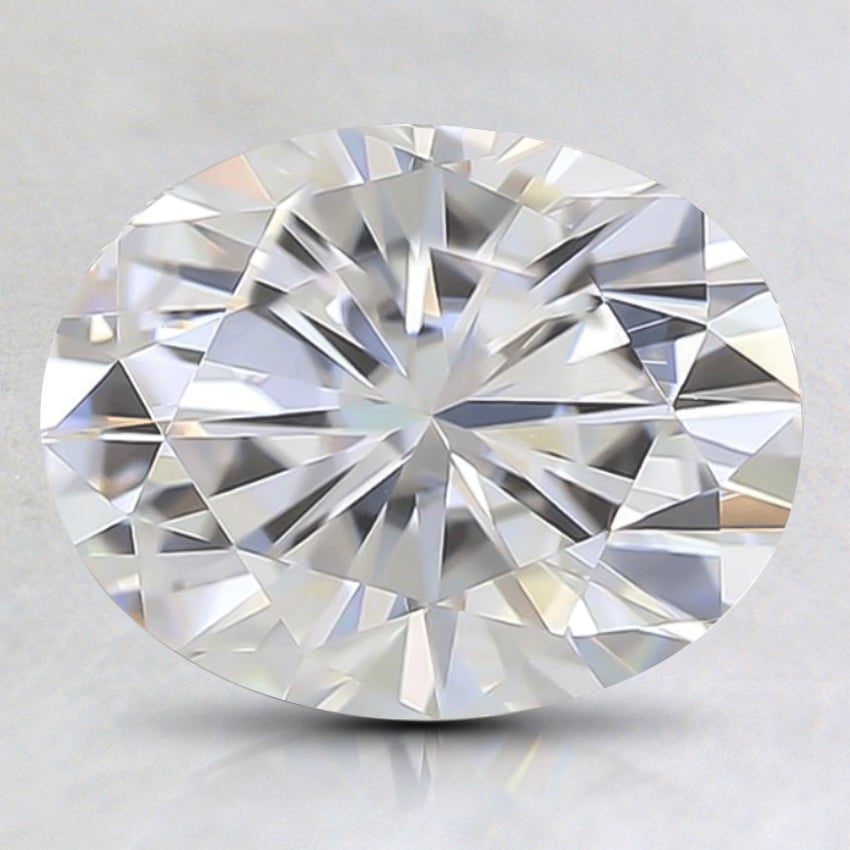

Oval moissanite is an oval-cut version of moissanite, a gemstone made from silicon carbide (SiC). Natural moissanite is extremely rare, so nearly every moissanite used in jewelry today is created in laboratories.
Although people often compare it to diamonds, moissanite is not a diamond. It is a completely different gemstone with its own chemical composition and optical properties.
One reason many buyers choose an oval moissanite engagement ring is its exceptional brilliance. Thanks to its high refractive index and strong light dispersion, moissanite produces more colorful flashes – often called rainbow fire – than a diamond.
Modern manufacturers also offer several facet styles, including:
- Brilliant cut oval
- Crushed ice oval moissanite
- Hybrid oval cut
Each style creates a slightly different appearance, allowing buyers to choose between bold sparkle or a softer, diamond-like look.
If you’re deciding between the two most popular looks, our guide to brilliant vs. crushed ice moissanite explains how their facet patterns affect sparkle and overall appearance.
Oval Lab Diamond
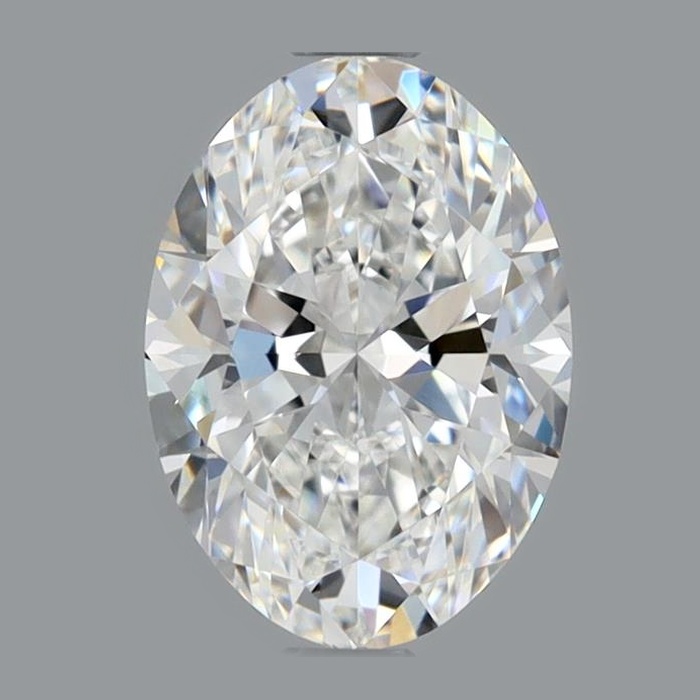
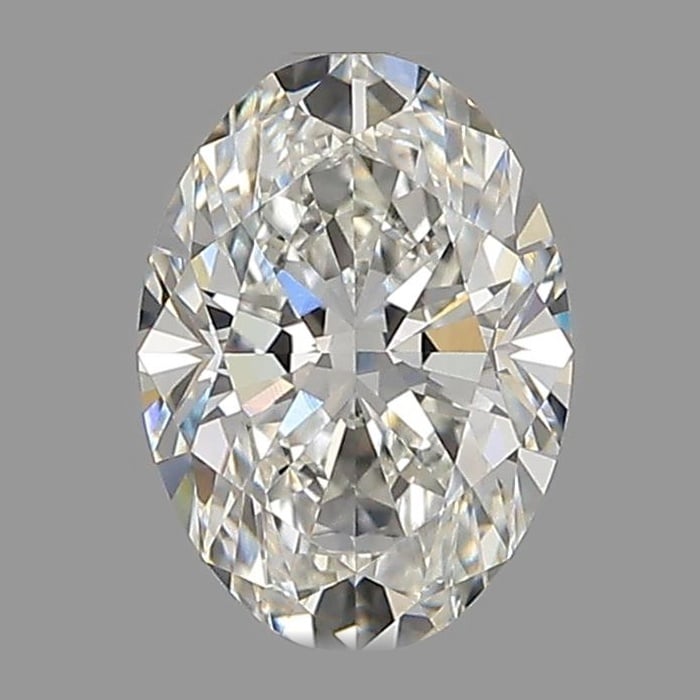
An oval lab-grown diamond is a real diamond created inside a laboratory rather than mined from the earth.
It has exactly the same:
- Carbon crystal structure
- Hardness
- Chemical composition
- Optical performance
as a natural diamond.
Lab diamonds are produced using either:
- CVD (Chemical Vapor Deposition)
- HPHT (High Pressure High Temperature)
Both methods create genuine diamonds that can be graded by respected gemological laboratories such as IGI and GIA.
Unlike moissanite, a lab diamond shows the same balance of white brilliance, fire, and scintillation found in natural diamonds.
For buyers who want the classic diamond appearance while reducing environmental impact and cost, an oval lab diamond engagement ring is often the preferred choice.
Oval Moissanite vs Oval Lab Diamond Side-by-Side Comparison
| Feature | Oval Moissanite | Oval Lab Diamond |
|---|---|---|
| Composition | Silicon Carbide | Carbon Crystal |
| Hardness | 9.25 Mohs | 10 Mohs |
| Created In | Laboratory | Laboratory |
| Diamond? | No | Yes |
| Sparkle | More Rainbow Fire | Balanced White Brilliance |
| Diamond Tester | Usually No | Yes |
| Price | Lower | Higher |
| Durability | Excellent | Excellent |
| Appearance | Slightly More Colorful | Same as Natural Diamond |
Both stones perform well for daily wear, but they create noticeably different visual effects.
Oval Moissanite vs Oval Lab Diamond Sparkle
One of the biggest questions buyers ask is:
Which sparkles more, oval moissanite or oval lab diamond?
Technically, moissanite produces more sparkle because it has a higher refractive index and significantly greater dispersion than diamond.
This means it creates stronger flashes of rainbow-colored light.
Many people love this vibrant look because it appears lively under direct lighting.
However, if you’re looking for the traditional diamond appearance, a lab diamond wins.
Instead of producing large rainbow flashes, diamonds create a balanced mix of:
- White brilliance
- Fire
- Scintillation
That balanced sparkle is why many people describe lab diamonds as looking more refined and natural.
So when comparing oval moissanite vs oval lab diamond sparkle, neither stone is objectively better – they simply sparkle differently.
Fire and Brilliance Comparison
Fire refers to the colored flashes of light that appear when a gemstone moves.
Brilliance refers to the white light reflected back to your eyes.
In an oval moissanite compared to oval lab diamond, these differences become easier to notice under jewelry store lighting or direct sunlight.
Oval Moissanite
- Strong rainbow fire
- Higher dispersion
- More colorful reflections
Oval Lab Diamond
- More white brilliance
- Balanced sparkle
- Classic diamond appearance
Some buyers prefer moissanite’s dramatic sparkle, while others feel it looks too colorful.
If your goal is a ring that closely resembles a natural diamond, the lab diamond generally offers the more familiar appearance.
Oval Moissanite vs Oval Lab Diamond Appearance
From a distance, most people cannot immediately tell the difference between the two stones.
However, experienced jewelers – or someone comparing both side by side – may notice several differences.
Moissanite has double refraction, which can make some facet edges appear slightly softer or doubled under magnification.
Diamonds have single refraction, producing sharper and more defined facet patterns.
The oval shape also introduces another important characteristic: the bow tie effect.
If you’re still learning how diamond shapes differ in their proportions and faceting, our guide to different diamond shapes and cuts provides a broader overview.
Oval Lab Diamond Bow Tie Effect
Most oval diamonds naturally display some level of bow tie effect – a darker shadow across the center of the stone.
This happens because of how light returns through the elongated shape.
A well-cut oval lab diamond minimizes this effect, while a poorly cut stone may show a more visible dark area.
Moissanite can also display a bow tie, although its stronger light dispersion sometimes helps disguise it.
The quality of the cut plays a much bigger role than the gemstone itself, so always review high-resolution videos before purchasing an oval engagement ring.
Does Oval Moissanite Look Like an Oval Diamond?
Yes – to most people.
From normal viewing distance, both stones appear beautiful and bright.
The differences become easier to notice when you examine them closely under strong lighting.
Generally:
- Oval lab diamonds look identical to natural diamonds.
- Oval moissanite shows more rainbow sparkle.
- Moissanite may reveal slight double refraction under magnification.
- Diamonds display crisper facet patterns.
For many buyers, these differences are minor. Others strongly prefer the authentic diamond appearance.
If looking exactly like a natural diamond is your priority, an oval lab-grown diamond has the advantage.
Oval Moissanite vs Oval Lab Diamond Price
For many buyers, price is the deciding factor when comparing an oval moissanite vs oval lab diamond.
Moissanite is generally much more affordable than a lab-grown diamond of the same size. That means you can often choose a larger center stone while staying within your budget.
Lab-grown diamonds, although less expensive than mined diamonds, still cost more because they are genuine diamonds with the same chemical, physical, and optical properties as natural diamonds.
Instead of focusing only on the initial price, consider the overall value.
If long-term value is part of your decision, you can also read our guide on which diamond shape holds its value.
- Choose oval moissanite if your priority is maximizing size for your budget.
- Choose an oval lab diamond if owning a real diamond matters more than reducing cost.
If you’re wondering, “Should I buy oval moissanite or lab diamond?”, think about what matters most to you – budget or diamond authenticity.
Oval Moissanite vs Oval Lab Diamond Durability
An engagement ring is designed for everyday wear, so durability is just as important as appearance.
Both gemstones perform exceptionally well for daily use.
| Feature | Oval Moissanite | Oval Lab Diamond |
|---|---|---|
| Mohs Hardness | 9.25 | 10 |
| Scratch Resistance | Excellent | Excellent |
| Everyday Wear | Yes | Yes |
Diamonds rank 10 on the Mohs hardness scale, making them the hardest natural material known.
Moissanite ranks approximately 9.25, which is still harder than most gemstones commonly used in jewelry.
For normal daily wear, both stones are highly durable. While a lab diamond offers slightly greater scratch resistance, moissanite is also well suited for long-term use in an engagement ring.
Does Oval Moissanite Become Cloudy Over Time?
This is one of the most common myths surrounding moissanite.
High-quality moissanite does not become cloudy simply because it ages.
Over time, lotions, soap residue, skin oils, and everyday dirt can build up on the surface of any gemstone, reducing its sparkle. The same thing happens with diamonds.
Regular cleaning restores the stone’s brilliance.
If a moissanite appears permanently cloudy, it is more likely due to poor manufacturing quality rather than normal wear.
Buying from a reputable jeweler helps reduce this risk.
Does Oval Moissanite Pass a Diamond Tester?
Another frequently asked question is:
Does oval moissanite pass a diamond tester?
The answer depends on the type of tester.
Many basic thermal diamond testers identify stones based on heat conductivity. Because moissanite conducts heat efficiently, some older thermal testers may incorrectly identify it as a diamond.
Modern diamond testers, however, typically combine thermal and electrical conductivity. These advanced devices can distinguish moissanite from both natural and lab-grown diamonds.
A lab-grown diamond, on the other hand, is a real diamond and will test as one.
Which Looks More Natural?
When comparing oval moissanite vs oval diamond appearance, lab diamonds have the advantage.
Because they share the same crystal structure as mined diamonds, lab-grown diamonds display the familiar balance of:
- White brilliance
- Fire
- Scintillation
Moissanite creates stronger rainbow flashes because of its higher dispersion.
Some buyers love this colorful sparkle, while others prefer the subtler appearance associated with diamonds.
If your goal is a stone that closely matches the look of a natural diamond, an oval lab diamond is the closest option available.
Which Holds Value Better?
Neither moissanite nor lab-grown diamonds should be viewed as financial investments.
Like most jewelry, both may sell for less than their original purchase price on the secondary market.
Instead of choosing based on resale value, focus on what offers the best long-term satisfaction.
If your priority is affordability, moissanite delivers excellent value.
If owning a genuine diamond matters to you, a lab-grown diamond may provide greater personal value, even though resale prices can vary.
Which Is More Ethical?
Both stones offer an alternative to newly mined diamonds.
Moissanite is created in laboratories, eliminating the need for mining the gemstone itself.
Lab-grown diamonds are also produced in controlled laboratory environments using CVD or HPHT technology.
The environmental footprint of any gemstone depends on factors such as energy sources, manufacturing processes, and supply chains. For that reason, it’s worth asking your jeweler about certifications and sourcing practices.
Choosing a reputable retailer helps ensure greater transparency.
Oval Moissanite vs Oval Lab Diamond Pros and Cons
Oval Moissanite
Pros
- Budget-friendly
- Exceptional sparkle and rainbow fire
- Excellent durability
- Suitable for everyday wear
- Available in larger sizes for less
Cons
- Not a diamond
- More colorful sparkle may not suit every preference
- Double refraction can slightly soften facet definition under magnification
Oval Lab Diamond
Pros
- Real diamond
- Identical appearance to natural diamonds
- Highest hardness for everyday wear
- Passes diamond testers
- Traditional diamond brilliance
Cons
- Costs more than moissanite
- Larger sizes require a higher budget
Who Should Buy Oval Moissanite?
Oval moissanite is an excellent choice if you:
- Want the biggest visual impact for your budget.
- Love bold rainbow sparkle.
- Prefer an affordable engagement ring.
- Want a durable gemstone for daily wear.
- Are comfortable choosing a diamond alternative.
Who Should Buy an Oval Lab Diamond?
An oval lab diamond may be the better choice if you:
- Want a real diamond.
- Prefer the classic diamond appearance.
- Value white brilliance over colorful fire.
- Want a stone that will pass standard diamond testing.
- Don’t mind spending more for diamond authenticity.
Frequently Asked Questions
Is oval moissanite the same as an oval lab diamond?
No. Oval moissanite is made from silicon carbide, while an oval lab diamond is a real diamond made from carbon. They look similar but differ in sparkle, composition, and optical properties.
Which sparkles more, oval moissanite or oval lab diamond?
Oval moissanite produces more rainbow-colored fire because it has higher light dispersion. Oval lab diamonds offer balanced white brilliance that closely matches natural diamonds.
Is oval moissanite better than an oval lab diamond?
It depends on your priorities. Choose oval moissanite if you want maximum sparkle and affordability. Choose an oval lab diamond if you prefer a genuine diamond with a traditional appearance.
Does oval moissanite look like an oval diamond?
Yes. From normal viewing distance, oval moissanite closely resembles an oval diamond. The main visible difference is that moissanite reflects more colorful flashes of light.
Which lasts longer, oval moissanite or oval lab diamond?
Both are highly durable for everyday wear. Lab diamonds rank 10 on the Mohs hardness scale, while moissanite ranks about 9.25, making both excellent choices for engagement rings.
Does oval moissanite become cloudy over time?
No. High-quality moissanite does not become cloudy with age. Dirt, oils, and residue can reduce its sparkle, but regular cleaning restores its brilliance.
Which looks more natural, oval moissanite or oval lab diamond?
An oval lab diamond looks identical to a natural diamond because it has the same crystal structure and optical properties. Moissanite has a similar appearance but produces more rainbow fire.
Which is the best stone for an oval engagement ring?
The best choice depends on your priorities. Oval moissanite offers exceptional sparkle and value, while an oval lab diamond provides the authentic diamond look with the same durability as a natural diamond.
Final Words
There isn’t a universal winner in the oval moissanite vs oval lab diamond debate.
The better choice depends on your personal priorities.
Choose oval moissanite if affordability, impressive sparkle, and getting a larger stone within your budget are your top goals.
Choose an oval lab diamond if you want a genuine diamond with the same physical and optical characteristics as a natural diamond, along with the timeless appearance many buyers prefer.
Whichever option you choose, pay close attention to the 4Cs of diamond quality, especially when you’re evaluating a lab-grown diamond. A well-cut oval stone delivers better light performance, can help minimize the bow tie effect, and creates a more beautiful engagement ring.