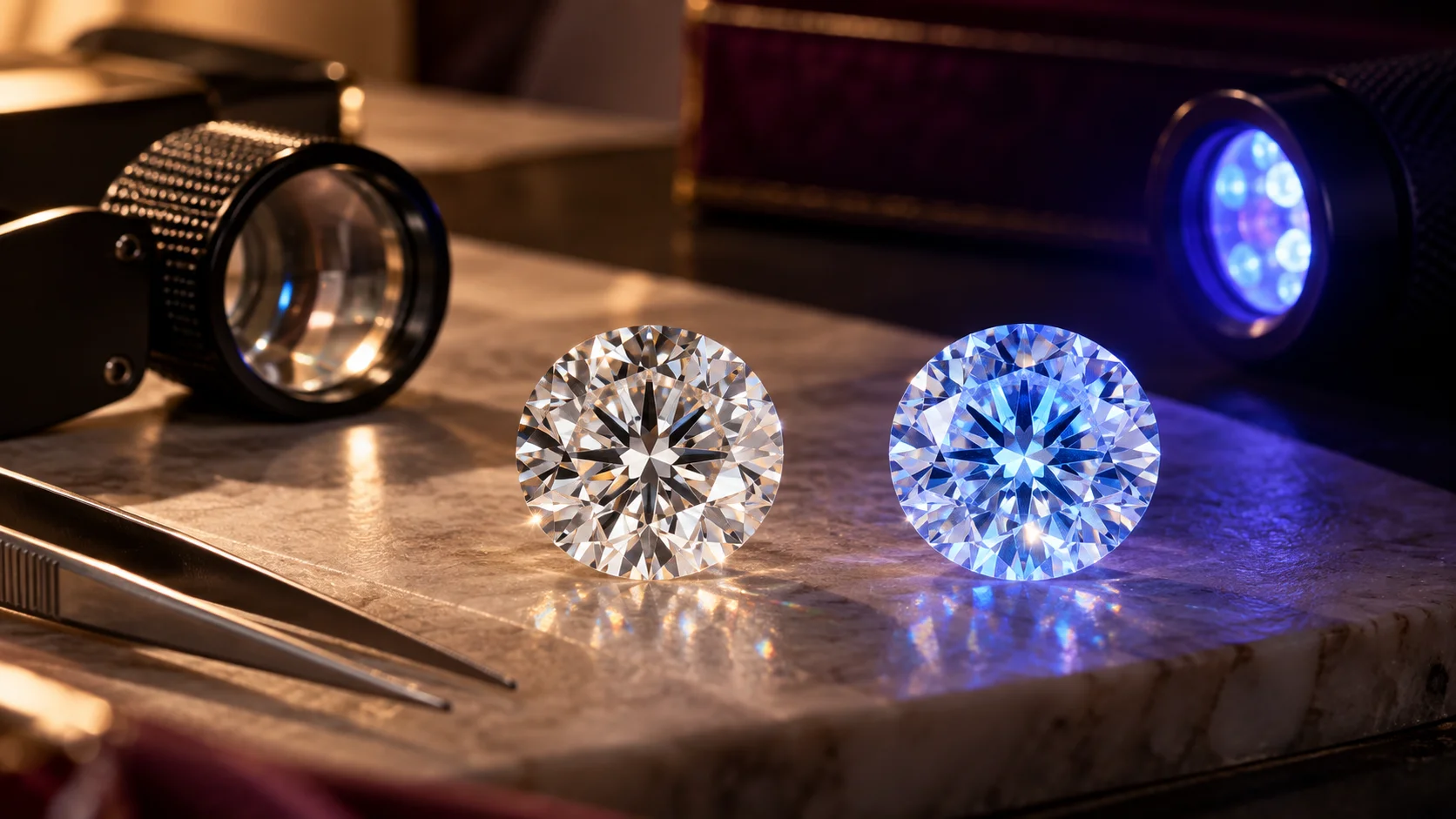
Is diamond fluorescence bad? Usually, no. Diamond fluorescence is a natural characteristic that causes some diamonds to emit a visible glow when exposed to ultraviolet (UV) light. For most diamonds, it has little to no noticeable effect on appearance in everyday lighting.
The confusion comes from the fact that fluorescence can sometimes affect how a diamond looks and how the market prices it. In particular, very strong fluorescence can occasionally contribute to a hazy or oily appearance in a small number of diamonds. But fluorescence itself does not make a diamond weak, damaged, or lower quality.
So, should you avoid a diamond because its grading report says it has fluorescence? Not necessarily. The right approach is to consider the fluorescence intensity, diamond color, transparency, and actual appearance together.
Is Diamond Fluorescence Bad or Good?
Diamond fluorescence is neither inherently good nor bad.
GIA research found that, for the overwhelming majority of diamonds, fluorescence does not produce a noticeable difference in appearance under normal viewing conditions. In some cases, observers even preferred the appearance of diamonds with medium to strong blue fluorescence.
The important distinction is between fluorescence itself and a rare appearance issue that may occur in certain stones.
A fluorescent diamond is not automatically:
- Cloudy
- Milky
- Less sparkly
- Weaker
- Lower quality
- Less durable
Those are common misconceptions.
What matters is how the individual diamond actually looks.
What Is Diamond Fluorescence?
Diamond fluorescence is the visible light a diamond emits when exposed to ultraviolet radiation.
Blue is the most common fluorescence color. More than 95% of fluorescent diamonds examined by GIA show blue fluorescence, although diamonds can fluoresce in other colors, including yellow, white, green, and orange.
Fluorescence is usually not visible under ordinary indoor lighting. It becomes more noticeable when a diamond is exposed to a UV source, such as certain types of lighting or sunlight.
GIA reports that approximately 25% to 35% of diamonds exhibit some degree of fluorescence.
If you want to understand the phenomenon in more detail, see our guide to what diamond fluorescence is.
When Can Diamond Fluorescence Be a Problem?
Fluorescence becomes worth paying closer attention to when the diamond has Strong or Very Strong fluorescence, particularly if the stone already has characteristics that affect transparency.
In rare cases, a diamond can have a hazy, oily, or milky-looking appearance. However, GIA specifically notes that fluorescence itself does not cause haziness. Instead, strong fluorescence can intensify pre-existing light-scattering defects in an affected diamond.
This distinction is important.
Fluorescence does not automatically mean cloudy
A diamond with Strong fluorescence is not automatically cloudy.
In fact, GIA’s research found that fewer than 0.2% of fluorescent diamonds submitted to GIA exhibited the hazy effect associated with light-scattering defects.
That makes the common advice to “never buy a fluorescent diamond” far too broad.
Instead, inspect the individual stone.
Can Fluorescence Make a Diamond Look Cloudy?
Rarely, but fluorescence itself is not the cause of the cloudiness.
Some diamonds contain microscopic characteristics that scatter light and can affect transparency. In an extremely small percentage of fluorescent diamonds, strong fluorescence can make this pre-existing issue more noticeable.
This is why you should not judge a diamond solely from the fluorescence field on its grading report.
If a diamond has Strong or Very Strong fluorescence, pay attention to whether the stone looks:
- Bright and transparent
- Crisp and lively
- Milky or hazy
- Dull compared with similar diamonds
If you are buying online, high-quality photographs and videos can help, but an independent grading report and the seller’s return policy are also important.
For a deeper explanation, see does fluorescence make a diamond look cloudy?.
Is Strong Diamond Fluorescence Bad?
Strong fluorescence is not automatically bad.
GIA’s research found that average observers generally could not consistently distinguish fluorescent diamonds from non-fluorescent diamonds under conditions similar to normal jewelry viewing. Some strongly blue-fluorescent diamonds were even perceived as having better color appearance when viewed face-up.
However, Strong fluorescence deserves more attention than Faint fluorescence because its effect is more likely to be noticeable under UV-rich lighting.
Very Strong fluorescence deserves the closest inspection because of the rare possibility of a hazy appearance when other transparency issues are present.
That does not mean you should automatically reject the stone. It means you should evaluate it carefully.
You can also compare Strong Blue Fluorescence with Medium Blue Fluorescence to understand how the intensities differ.
Does Fluorescence Matter More With Certain Diamond Colors?
Yes.
The diamond’s color grade is one of the most useful factors to consider when evaluating fluorescence.
D–F color diamonds
D, E, and F diamonds are in the colorless range. Strong blue fluorescence is sometimes viewed less favorably in these higher color grades, particularly by the diamond trade.
If you are paying a premium for a very high-color diamond, you may prefer a stone with None or Faint fluorescence simply because you are prioritizing a very controlled appearance.
That said, strong fluorescence does not automatically make a D–F diamond look bad.
G–J color diamonds
For G through J diamonds, fluorescence can be more of a personal preference.
Blue fluorescence may sometimes make a slightly warmer diamond appear whiter, although the actual color grade on the grading report does not change.
Lower-color diamonds
For diamonds with more noticeable yellow or warm body color, blue fluorescence can sometimes be beneficial because blue is complementary to yellow.
This can make a lower-color diamond appear more visually white in certain lighting conditions.
For more detail, see how fluorescence affects diamond color.
Does Diamond Fluorescence Affect Sparkle?
Fluorescence does not normally reduce a diamond’s sparkle.
A diamond’s sparkle is primarily influenced by its cut, proportions, facet arrangement, and how effectively it interacts with light. GIA’s research found little to no evidence that fluorescence inherently detracts from a diamond’s beauty or sparkle.
This means you should not choose a poorly cut diamond simply because it has no fluorescence.
When comparing two diamonds, cut quality should remain a major priority.
Does Fluorescence Make a Diamond Less Durable?
No.
Fluorescence does not make a diamond weaker or more likely to chip or break.
GIA states that diamonds with fluorescence have the same structural integrity as diamonds without fluorescence.
Fluorescence is therefore not a durability concern when choosing an engagement ring.
It is primarily an appearance and pricing consideration, not a structural one.
Does Diamond Fluorescence Affect Price?
It can.
Market pricing has historically treated fluorescence differently depending on the diamond’s color and fluorescence intensity. Strong fluorescence in higher-color diamonds may sometimes result in a lower price than a comparable stone without fluorescence.
That can create an opportunity for shoppers who care more about the diamond’s actual appearance than having a particular fluorescence grade.
The reverse can also happen with warmer-color diamonds, where blue fluorescence may be viewed as desirable because it can improve the apparent whiteness of the stone.
The important point is that fluorescence should not be evaluated independently of the rest of the diamond.
If you are comparing prices, see our guide to fluorescence and diamond price.
Should You Avoid a Diamond With Fluorescence?
No. You should not automatically avoid it.
Instead, use the fluorescence grade as one piece of information when comparing diamonds.
A fluorescent diamond can be an excellent choice when:
- You like the way the diamond looks.
- The fluorescence does not create visible haziness.
- The price is attractive compared with similar diamonds.
- You are comfortable with the fluorescence intensity.
- The diamond has good cut quality and transparency.
- You are shopping in a color range where blue fluorescence may complement the diamond’s body color.
You may want to be more cautious when:
- The diamond has Very Strong fluorescence.
- The stone appears hazy or milky.
- You are buying a very high-color diamond and want the most conservative choice.
- You cannot evaluate the diamond’s appearance and there is limited return protection.
How to Check a Diamond With Fluorescence Before Buying
If you are considering a fluorescent diamond, don’t make the decision from the certificate alone.
1. Check the fluorescence intensity
A grading report may describe fluorescence as None, Faint, Medium, Strong, or Very Strong, depending on the laboratory.
The intensity tells you how strongly the diamond reacts to UV light.
2. Look at the diamond under normal lighting
The most important question is simple:
Does the diamond look good?
Look for brightness, transparency, contrast, and overall visual appeal.
3. Check it in daylight
Daylight contains UV radiation, so fluorescence can sometimes become more apparent outdoors.
If you are buying in person, view the diamond in different lighting environments rather than relying on a single store’s lighting.
4. Compare it with a similar diamond
If possible, compare the fluorescent stone with a similar diamond of the same color and similar cut quality.
This gives you a much better idea of whether you personally notice a difference.
5. Check for haziness
This is particularly important with Strong or Very Strong fluorescence.
If the diamond looks milky, oily, or noticeably less transparent than comparable stones, consider another option.
6. Don’t sacrifice cut quality just to avoid fluorescence
A diamond with excellent visual performance and some fluorescence can be a better choice than a diamond with None fluorescence but mediocre cut quality.
The fluorescence field should be considered alongside the rest of the diamond’s characteristics, not treated as a pass-or-fail specification.
What Fluorescence Grade Is Best for an Engagement Ring?
There is no single fluorescence grade that is best for every engagement ring.
A practical approach is:
| Fluorescence | What to Consider |
|---|---|
| None | Safest choice if you simply prefer no fluorescence |
| Faint | Usually has little visible impact |
| Medium | Can be an attractive option, particularly in some warmer color grades |
| Strong | Inspect the individual diamond carefully |
| Very Strong | Pay close attention to transparency and overall appearance |
The right choice depends on your diamond’s color, transparency, cut, price, and your own visual preference.
Is Diamond Fluorescence a Dealbreaker?
Usually, no.
Fluorescence is one of those diamond characteristics that can sound more serious on a grading report than it actually is in real life.
For most fluorescent diamonds, there is no obvious negative effect on appearance. GIA research has also found that average observers generally cannot consistently distinguish fluorescent diamonds from non-fluorescent diamonds under normal viewing conditions.
The main situation to investigate is a diamond with Strong or Very Strong fluorescence that may have an existing transparency issue.
Otherwise, fluorescence can simply be another characteristic to consider – and in some cases, it may help you find a visually appealing diamond at a more attractive price.
Bottom Line: Is Diamond Fluorescence Bad?
Diamond fluorescence is not inherently bad.
It does not weaken a diamond, does not automatically make it cloudy, and does not normally reduce its sparkle. Most fluorescent diamonds show little to no noticeable difference in everyday viewing.
The best approach is to judge the individual diamond, especially if it has Strong or Very Strong fluorescence.
If the diamond looks bright, transparent, and beautiful to you – and the price makes sense – there is usually no reason to reject it simply because the grading report lists fluorescence.
In other words, don’t buy or reject a diamond based on fluorescence alone. Look at the whole stone.