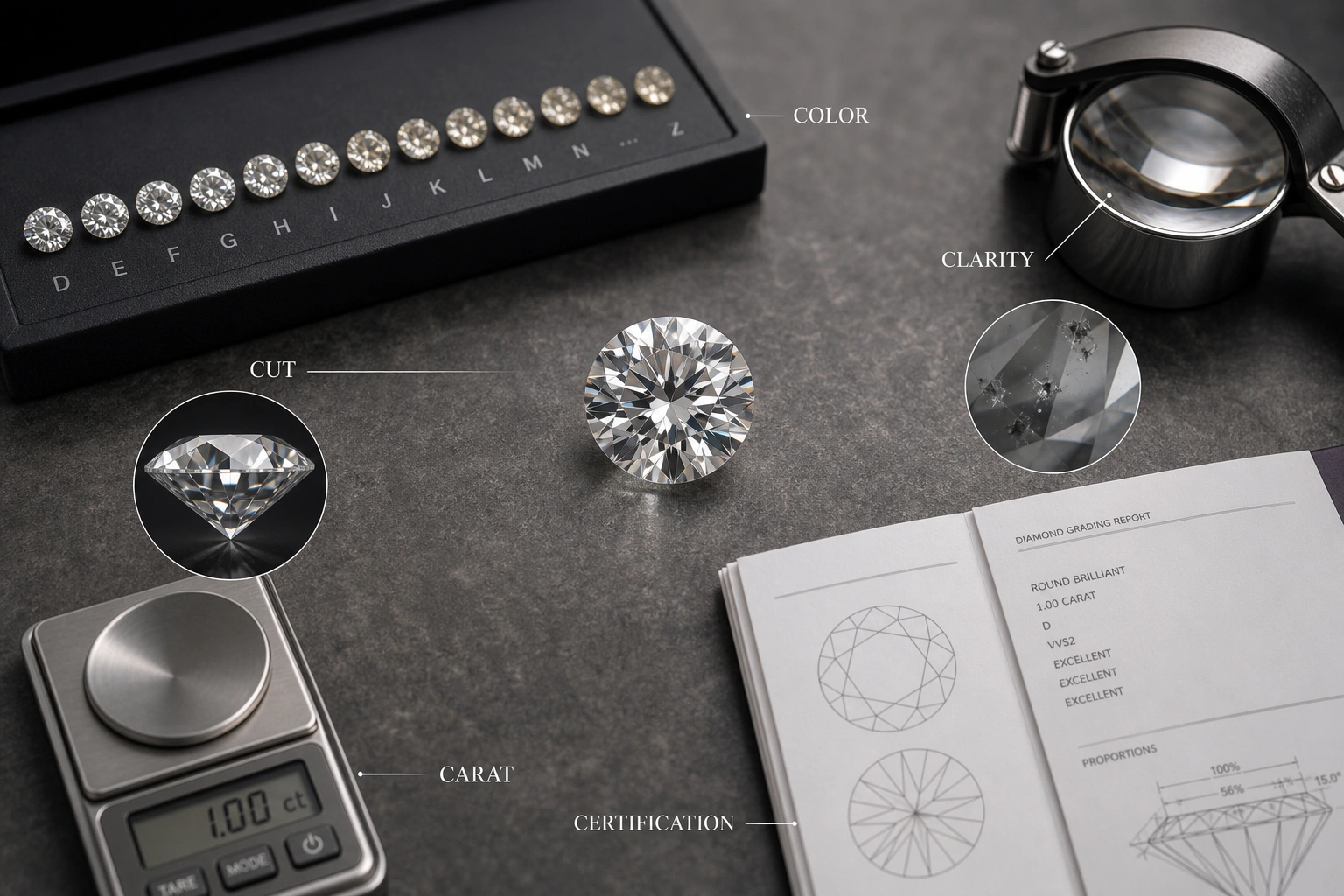
Buying a diamond can feel complicated when every stone seems to come with a long list of grades, measurements, and technical terms. The 5 Cs of diamonds give you a simpler way to understand what you are actually paying for.
The traditional 4Cs are cut, color, clarity, and carat weight. A fifth C, certification, is commonly included in modern diamond-buying guides because an independent grading report can help verify the diamond’s characteristics. GIA, however, officially uses the 4Cs as the standard framework for evaluating diamond quality.
Understanding these factors is important, but there is no single combination that makes one diamond perfect for everyone. The best choice depends on what matters most to you: sparkle, size, color, clarity, shape, budget, or confidence in the grading.
The goal is not to buy the highest grade in every category. It is to find the right balance.
What Are the 5 Cs of Diamonds?
The 5 Cs are:
- Cut – how well the diamond’s facets are proportioned and finished to interact with light
- Color – how much color is present in a diamond
- Clarity – the presence and visibility of inclusions and blemishes
- Carat – the diamond’s weight, not its physical size
- Certification – an independent grading report documenting the diamond’s characteristics
The first four are the established diamond quality factors. Certification is better understood as documentation that helps you verify those characteristics rather than as another physical quality grade.
1. Cut: The C That Controls Sparkle
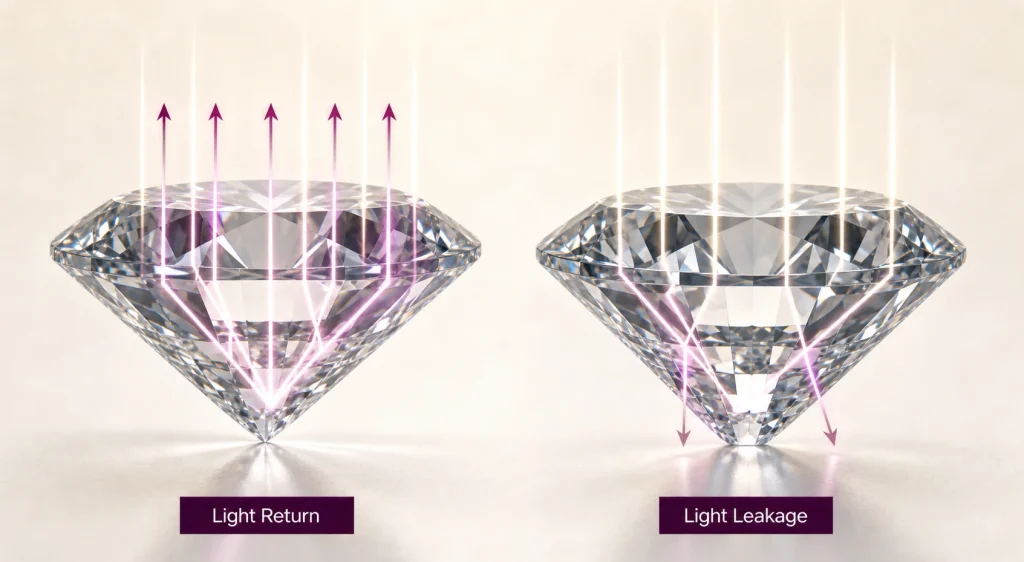
If sparkle is your priority, cut should usually be near the top of your list.
Diamond cut refers to the quality of a diamond’s proportions, facet arrangement, symmetry, and finish. It is different from the diamond’s shape. A round diamond, oval diamond, and emerald cut can all have very different shapes, but each can still have its own cut characteristics.
A well-cut diamond can return more light toward the viewer, creating brightness, fire, and scintillation. Poor proportions can cause light to escape through the sides or bottom, making the stone appear less lively. GIA describes cut as one of the most important factors in bringing a diamond’s beauty to life.
Diamond cut grades
For standard round brilliant diamonds graded by GIA, the cut scale ranges from:
- Excellent
- Very Good
- Good
- Fair
- Poor
For round brilliant diamonds, buyers who prioritize sparkle will often start by looking at higher cut grades and then compare individual stones.
However, don’t confuse cut with shape.
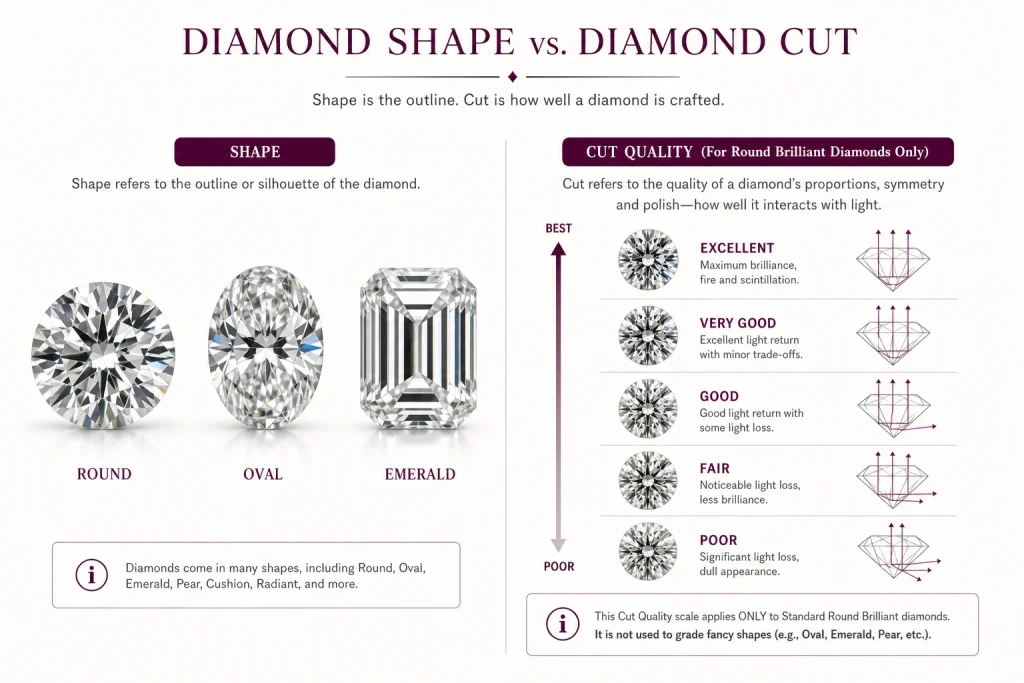
For example:
- Round is a diamond shape.
- Oval is a diamond shape.
- Emerald is a diamond shape.
- Excellent is a possible GIA cut grade for a round brilliant.
If you want to understand the subject in more detail, see this guide to diamond cut.
Why cut can be worth prioritizing
Imagine comparing two one-carat diamonds. One has excellent light performance while the other is poorly proportioned. The first may appear much more lively even though both have the same carat weight.
That is why chasing a larger carat at the expense of cut can be a poor trade.
Practical tip: If sparkle matters most, start with cut quality before trying to maximize carat weight.
2. Color: How White Does the Diamond Look?
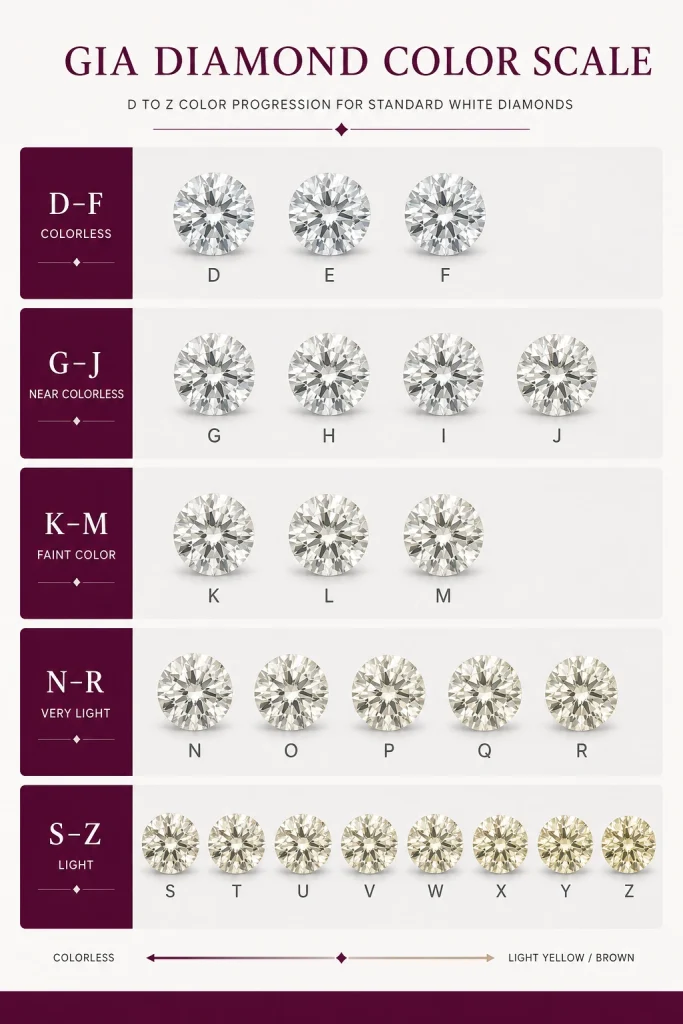
Diamond color measures the presence or absence of body color in a diamond.
For standard D-to-Z diamonds, the GIA color scale begins at D, which represents the highest colorless grade, and progresses toward Z as more yellow or brown coloration becomes apparent.
The broad categories are:
| Color range | General appearance |
|---|---|
| D–F | Colorless |
| G–J | Near colorless |
| K–M | Faint color |
| N–R | Very light |
| S–Z | Light |
Higher color grades are rarer, but that does not automatically mean they are the best choice for every buyer.
A well-cut diamond with a slightly lower color grade can still look bright and attractive, particularly when viewed face-up.
Does diamond color matter?
Yes, but its visibility depends on several factors.
The diamond’s:
- Shape
- Size
- Cut quality
- Setting
- Metal color
- Viewing conditions
can all influence how noticeable its body color is.
For example, a warmer diamond may look more harmonious in yellow gold than in a bright white metal. GIA also notes that the surrounding environment and metal can influence how diamond color is perceived.
How to save money on color
You do not necessarily need a D-color diamond to get a beautiful engagement ring.
If your priority is getting strong visual value rather than the highest possible color grade, compare several grades side by side. You may find that a near-colorless diamond gives you the appearance you want without paying for a top color grade.
You can also explore this diamond color guide for a deeper look at the grading scale.
3. Clarity: Does the Diamond Have Inclusions?
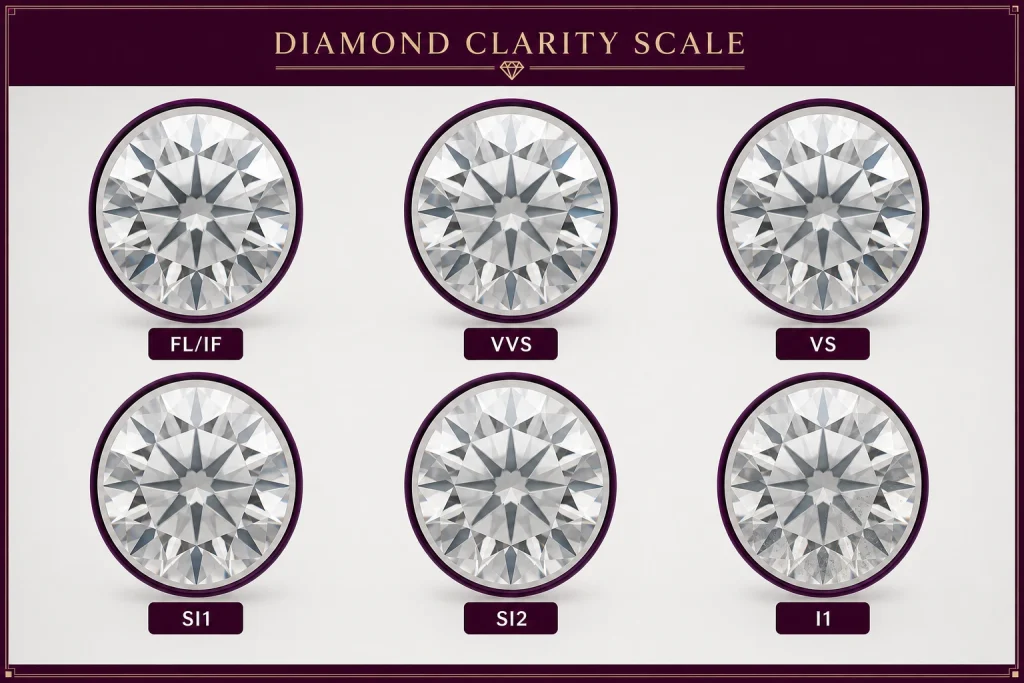
Clarity describes the presence, size, location, and visibility of inclusions and blemishes.
Natural diamonds form under extreme conditions, so many contain internal characteristics. Some are visible only under magnification, while others can be seen without it.
GIA’s clarity scale ranges from:
- FL – Flawless
- IF – Internally Flawless
- VVS1 – Very, Very Slightly Included
- VVS2 – Very, Very Slightly Included
- VS1 – Very Slightly Included
- VS2 – Very Slightly Included
- SI1 – Slightly Included
- SI2 – Slightly Included
- I1 – Included
- I2 – Included
- I3 – Included
The exact visibility of an inclusion depends on its size, type, position, relief, and other characteristics.
Do you need flawless clarity?
Usually, no.
A diamond does not have to be flawless to look clean to the naked eye.
This is one of the biggest opportunities for smart diamond shopping. Instead of automatically paying for FL or IF clarity, examine whether inclusions are actually visible when the diamond is viewed normally.
A well-chosen lower-clarity diamond can look remarkably clean without carrying the premium associated with the highest clarity grades.
You can compare the different grades in this diamond clarity guide.
What should you look for?
Pay particular attention to inclusions that:
- Are visible without magnification
- Sit near the center of the diamond
- Affect transparency
- Appear dark or prominent
- May affect durability
Clarity is especially important for shapes with large, open facets, such as emerald and Asscher cuts, because their facet structure can make inclusions easier to notice.
Practical tip: Think in terms of appearance, not simply the highest letter grade.
4. Carat: Weight, Not Size
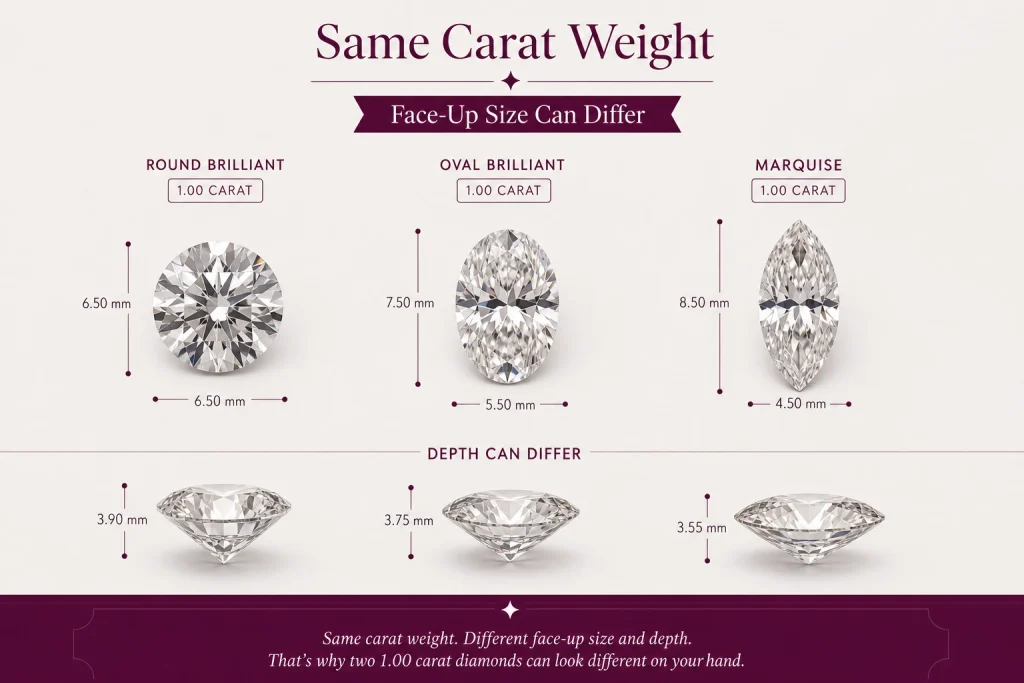
Carat is one of the most misunderstood diamond terms.
Carat weight measures how much a diamond weighs. It does not directly measure its physical dimensions or how large it looks.
One carat equals 0.2 grams.
Two diamonds with the same carat weight can have different measurements and may look noticeably different in size from the top.
This happens because factors such as:
- Shape
- Cut proportions
- Depth
- Table
- Length-to-width ratio
affect how much surface area is visible.
Is a bigger carat diamond better?
Not necessarily.
A larger diamond with weak proportions may look less impressive than a smaller diamond with excellent light performance.
GIA specifically notes that carat weight does not determine diamond quality by itself. The 4Cs need to be considered together.
How to get more visual size
If visible size is important, consider diamond shapes that tend to have a larger face-up appearance for their weight.
Elongated shapes such as:
- Oval
- Pear
- Marquise
can sometimes appear larger than a round diamond of similar weight because of their proportions.
Your setting can also influence perceived size. A halo, narrow band, or other design choices can make the center stone appear larger.
For more detail, explore the diamond carat guide.
5. Certification: The Paperwork Behind the Diamond
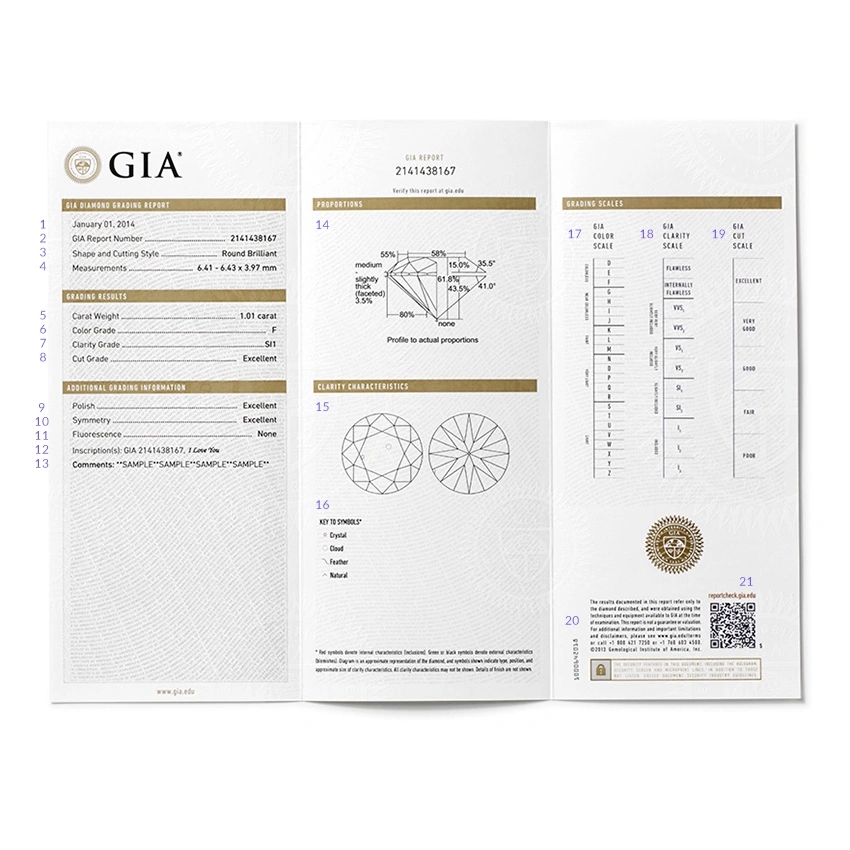
Certification is often called the fifth C, although it is important to understand what this means.
A diamond grading report is not a quality characteristic like cut or clarity. Instead, it is an independent document describing the diamond’s characteristics.
A reputable grading report can provide information about:
- Carat weight
- Color grade
- Clarity grade
- Cut grade when applicable
- Measurements
- Proportions
- Treatments
- Other identifying characteristics
For example, a GIA Diamond Grading Report assesses the 4Cs and includes additional information such as a plotted diagram of clarity characteristics and a graphic representation of the diamond’s proportions.
Why certification matters
A grading report gives you a standardized reference point when comparing diamonds.
Instead of relying entirely on a seller’s description, you can examine an independent report and compare the listed characteristics with other stones.
For a significant purchase, this additional documentation can make the buying process much easier to evaluate.
Check the report
If a diamond has a GIA report, the report number can be checked through GIA’s Report Check service.
The important lesson is simple:
Don’t treat a certificate as a guarantee that the diamond is beautiful. Use the report to understand what the diamond is, then evaluate whether those characteristics match your priorities.
Which of the 5 Cs Is Most Important?
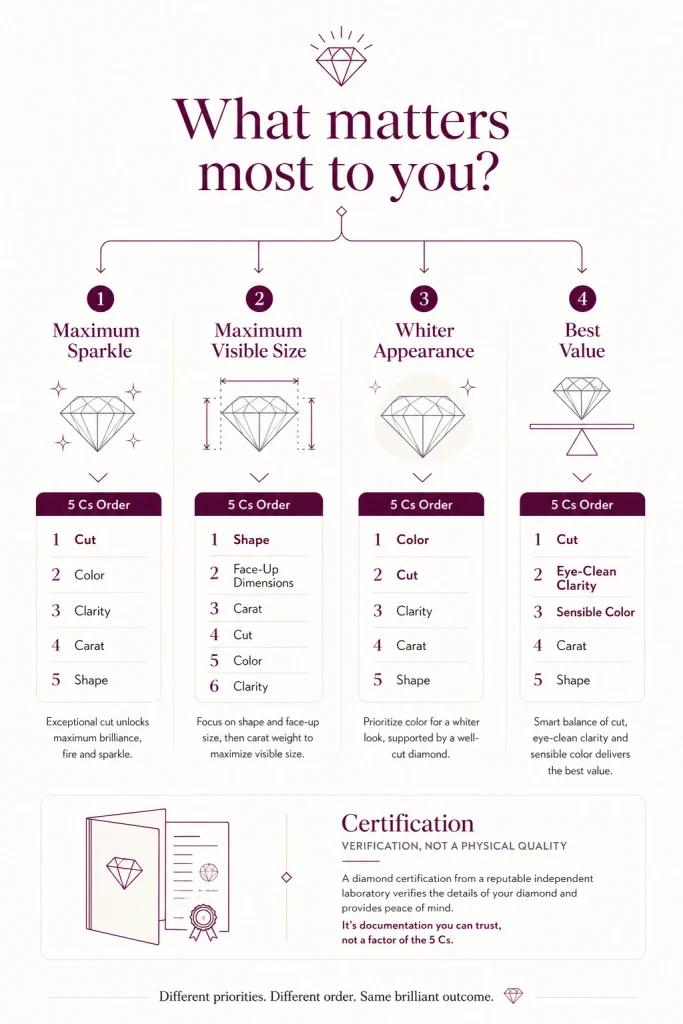
There is no universal ranking that works for every diamond.
However, for many engagement-ring buyers, a practical starting point is:
Cut → Color → Clarity → Carat
with certification used to verify the information.
Cut deserves special attention because it has a major influence on how a diamond interacts with light. GIA describes cut as a particularly important contributor to brilliance, fire, and scintillation.
But your priorities can change the order.
If you want maximum sparkle
Prioritize:
- Cut
- Clarity that is visually clean
- Color that looks right to you
- Carat within your budget
If size is your top priority
Consider:
- Face-up dimensions
- Carat weight
- Shape
- Cut quality
- Color and clarity based on what is visibly acceptable
If you want a very white-looking diamond
Prioritize:
- Color
- Cut
- Clarity
- Carat
If you want the best value
Prioritize:
- Cut quality
- Eye-clean clarity
- Appropriate color for the setting
- Face-up size
- Carat weight
There is no need to buy the highest grade in every category. The smartest purchase is usually about finding the right combination.
How to Balance the 5 Cs on a Budget
The biggest mistake is thinking you need to maximize every C.
You don’t.
Instead, decide what you care about most and compromise where the difference is difficult to see.
For example, you could choose:
- A slightly lower color grade instead of paying for D color
- A lower clarity grade that remains eye-clean
- A carat weight just below a major threshold
- A fancy shape that gives you more visible size
- A strong cut rather than a larger carat with weaker light performance
This approach lets you put more of your budget toward characteristics that actually affect the way the diamond looks to you.
A practical example
Suppose your budget allows either:
Option A
- Larger carat
- Lower cut quality
- Higher clarity
or
Option B
- Slightly smaller carat
- Better cut
- Eye-clean clarity
If sparkle matters more than maximum size, Option B may give you the more attractive diamond.
That is the central lesson of the 5 Cs: a diamond’s grades work together.
The Best 5 Cs Combination for Different Priorities
| Your priority | What to emphasize |
|---|---|
| Maximum sparkle | Cut |
| Maximum visible size | Shape + face-up dimensions + carat |
| Whiter appearance | Color + cut |
| Eye-clean appearance | Clarity + cut |
| Best overall value | Cut + eye-clean clarity + sensible color |
| Highest documented quality | Strong grades + reputable grading report |
| Lower budget | Cut first, then optimize color, clarity and carat |
| Statement center stone | Carat + face-up size + cut |
| Vintage appearance | Shape, proportions and setting style |
These are starting points rather than strict rules. The right combination depends on the actual diamond.
How the 5 Cs Change by Diamond Shape
The same grading strategy does not work equally well for every shape.
Round Brilliant
Round brilliant diamonds have a standardized GIA cut-grading system, making cut particularly straightforward to evaluate. Because sparkle is a major attraction of the shape, cut quality deserves significant attention.
Oval
With ovals, you should consider both the diamond’s overall proportions and its visual appearance. Bow-tie effects can also influence how the stone looks.
Emerald Cut
Emerald cuts use step-cut facets and tend to have larger, more open facet patterns. Because of this, clarity can become more noticeable.
Cushion Cut
Cushion diamonds can have different facet arrangements and appearances, so comparing individual stones is particularly important.
Pear and Marquise
These elongated shapes can provide a substantial face-up appearance for their carat weight. Symmetry and the appearance of the pointed ends also matter.
The key takeaway is that the 5 Cs should not be evaluated in isolation from diamond shape.
What to Check Before Buying a Diamond
Before purchasing, work through this checklist.
1. Confirm the shape
Make sure the diamond has the shape you actually want.
2. Evaluate cut
For round brilliant diamonds, examine the cut grade and overall proportions.
3. Compare color
Look at several diamonds rather than automatically choosing the highest color grade.
4. Inspect clarity
Determine whether inclusions are visible to the naked eye and where they are located.
5. Look beyond carat
Check the diamond’s actual measurements and face-up appearance.
6. Review the grading report
Confirm that the report corresponds to the diamond you are buying.
7. Check the report number
If applicable, verify the report through the grading laboratory’s database.
8. Compare the complete diamond
Do not make a decision from one grade alone.
A diamond with slightly lower grades can sometimes be a better-looking and better-value purchase than a diamond with impressive specifications on paper.
Common Mistakes When Using the 5 Cs
Mistake 1: Buying the biggest diamond possible
Carat weight does not tell you everything about visible size or beauty.
Mistake 2: Paying too much for clarity
The difference between high clarity grades may not be visible without magnification.
Mistake 3: Assuming D color is necessary
A diamond does not have to be D color to look white and beautiful.
Mistake 4: Ignoring cut
A high-carat diamond cannot compensate for poor light performance.
Mistake 5: Confusing cut and shape
Round, oval, pear, and emerald describe shapes. Cut refers to how the diamond’s facets and proportions affect its performance.
Mistake 6: Treating certification as proof of beauty
A grading report documents characteristics. It does not tell you whether you personally love the diamond’s appearance.
Mistake 7: Comparing grades without comparing the actual stones
Two diamonds with identical 4Cs grades can still look different.
5 Cs of Diamonds: Quick Buying Checklist
Before you buy, ask:
Cut
- Does the diamond have strong light performance?
- Is the cut appropriate for the shape?
Color
- Does the diamond look as white as you want?
- Does its color work with the ring metal?
Clarity
- Is it eye-clean?
- Are any inclusions distracting or potentially concerning?
Carat
- Do you like the actual face-up size?
- Are the measurements appropriate for the weight?
Certification
- Is there an independent grading report?
- Do the report details match the diamond?
- Can the report be verified?
If the answer to all five areas is satisfactory, you are much closer to finding a diamond that fits your priorities rather than simply buying the highest grades available.
Frequently Asked Questions
What are the 5 Cs of diamonds?
The 5 Cs of diamonds are cut, color, clarity, carat weight, and certification. The first four Cs are the traditional diamond quality factors used to evaluate a diamond’s appearance, characteristics, and value. Certification refers to an independent diamond grading report that helps verify those characteristics.
Which of the 5 Cs is most important when choosing a diamond?
For many diamond shoppers, cut is the most important factor because it has a major effect on how much brilliance, fire, and sparkle a diamond displays. A well-cut diamond can look more lively and attractive than a larger diamond with a weaker cut.
Is cut more important than carat in a diamond?
Often, yes. Carat measures weight, not visual beauty or apparent size by itself. A well-cut diamond can appear brighter and more visually appealing than a heavier diamond with poor proportions. When comparing diamonds, consider cut quality before simply choosing the highest carat weight.
What is the best diamond color grade?
There is no single best color grade for every diamond. For traditional white diamonds, higher grades such as D, E, and F are colorless, while grades closer to the middle of the D-to-Z scale can provide a balance between a white appearance and price. The ideal choice also depends on the diamond shape and metal color of the setting.
What is the best clarity grade for an engagement ring?
The best clarity grade depends on the diamond and your budget. A diamond does not necessarily need to be Flawless or Internally Flawless to look clean to the naked eye. The goal is to choose a diamond with a clarity level that provides the appearance you want without paying for microscopic characteristics you cannot see.
Is a higher carat diamond always better?
No. Carat is a measurement of diamond weight, not a direct measurement of quality. A larger diamond is not automatically more beautiful. Cut quality, proportions, shape, color, and clarity can all affect how a diamond looks.
What does diamond certification mean?
Diamond certification generally refers to an independent grading report that documents characteristics such as carat weight, color, clarity, and, where applicable, cut. A grading report gives shoppers an independent reference point when comparing diamonds from different sellers.
Why is diamond certification important?
Certification can help you verify that the diamond you are considering matches its stated characteristics. It gives buyers an independent grading reference instead of relying only on a seller’s description. When buying a diamond, it is important to review the grading report and verify that its details correspond with the diamond being sold.
What is the difference between the 4 Cs and the 5 Cs of diamonds?
The traditional 4 Cs are cut, color, clarity, and carat weight. Some diamond-buying guides add certification as a fifth C because an independent grading report helps verify the other four characteristics. GIA officially refers to the four quality factors as the 4Cs.
Which matters more: diamond clarity or color?
Neither is universally more important. The right balance depends on the diamond’s shape, setting, personal preference, and budget. In many cases, shoppers can save money by choosing a slightly lower clarity or color grade while still getting a diamond that looks beautiful to the naked eye.
How do the 5 Cs affect diamond price?
The 5 Cs influence diamond price in different ways. Carat weight and rarity can have a significant effect on price, while cut, color, and clarity can also create substantial differences between otherwise similar diamonds. Certification does not make a diamond more beautiful, but it can provide greater confidence in the stated quality.
Can two diamonds with the same 5 Cs look different?
Yes. Two diamonds can have similar grades but still look different because grading categories do not capture every visual characteristic. Proportions, symmetry, polish, fluorescence, shape, and the location of inclusions can affect a diamond’s appearance and light performance.
What should I prioritize when buying a diamond on a budget?
Start by deciding what matters most to you visually. For many shoppers, prioritizing strong cut quality and then balancing color, clarity, and carat weight can produce a better-looking diamond for the money than simply maximizing carat size.
Do the 5 Cs apply to lab-grown diamonds?
Yes. Lab-grown diamonds can also be evaluated using characteristics such as cut, color, clarity, and carat weight. A grading report can document these characteristics and help shoppers compare individual lab-grown diamonds.
Final Takeaway
The 5 Cs are not a formula for finding the most expensive diamond. They are a framework for understanding the trade-offs behind a diamond’s appearance, quality, and price.
Start with the characteristics that matter most to you. For many shoppers, that means paying close attention to cut, finding a color grade that looks right, choosing clarity based on what you can actually see, and selecting a carat weight that fits both the desired appearance and budget.
Then use a reputable grading report to verify the diamond’s characteristics.
The perfect diamond is not necessarily the one with the highest grades across the board. It is the one whose combination of cut, color, clarity, carat, and documentation gives you the appearance, size, confidence, and value you want.