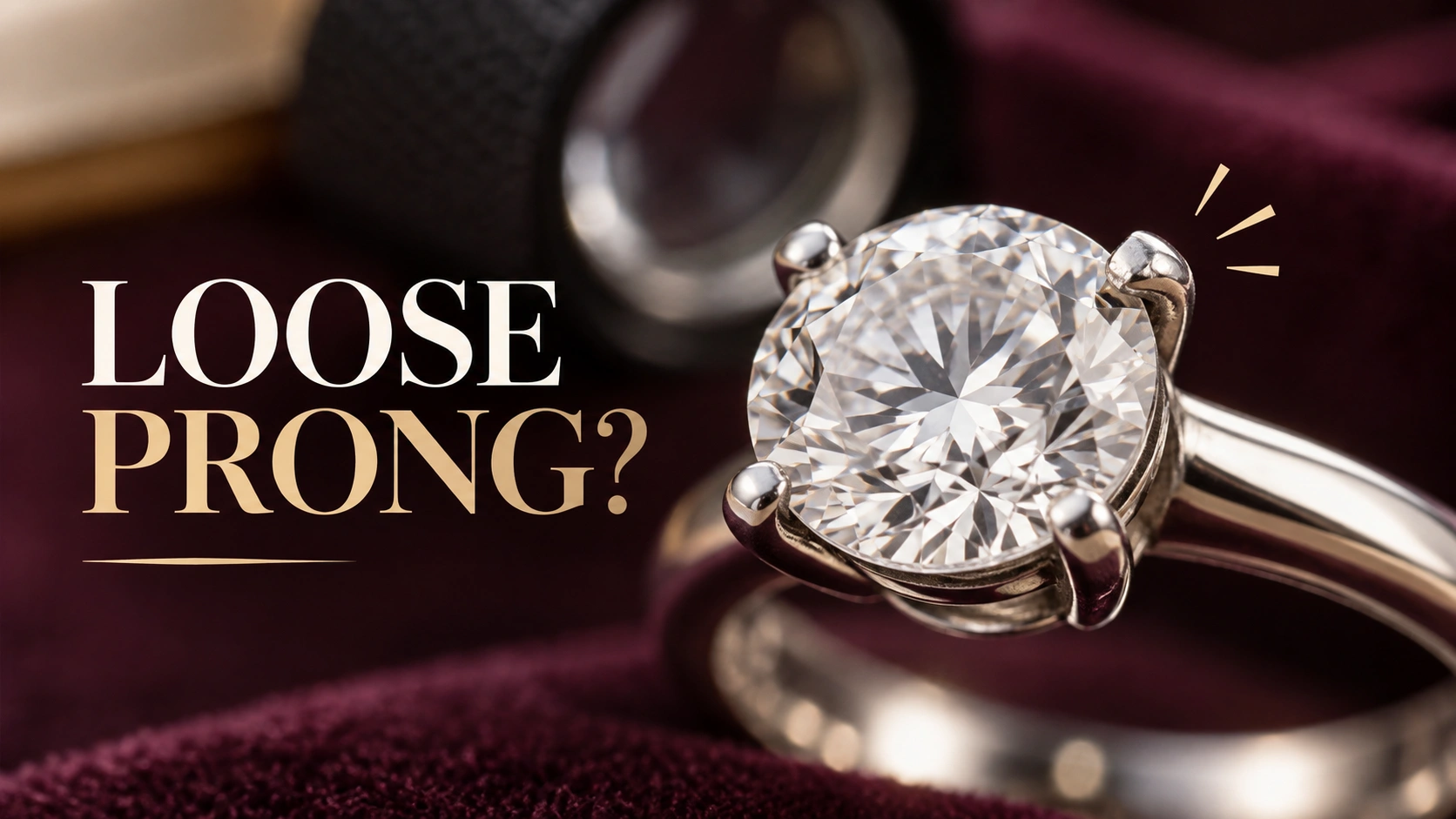
A loose prong can be difficult to spot at first. The metal may only be slightly bent or lifted, while the diamond still appears secure. But ignoring a damaged prong can put the stone at risk.
The good news is that you can look for several warning signs at home before a small problem becomes a lost diamond.
The most obvious sign is movement: if the diamond shifts when you gently touch it, the setting needs professional attention. Other clues include a prong that looks bent, a visible gap between the prong and diamond, a sharp edge, or a ring that suddenly starts catching on clothing.
How Can You Tell If a Prong Is Loose?
A prong may be loose if you notice one or more of these signs:
- The diamond moves when gently touched.
- You hear a faint clicking or rattling sound.
- One prong looks bent, lifted, or noticeably different from the others.
- There is a visible gap between the prong and the diamond.
- A prong feels unusually sharp.
- The ring catches on clothing, hair, or fabric.
- The diamond appears slightly rotated or out of position.
Not every sign means the diamond is about to fall out, but each deserves attention. A damaged prong is no longer holding the stone as securely as it should.
GIA notes that gently pushing the stone to check for movement and looking for gaps around the setting can help identify a loose stone or prong problem.
1. The Diamond Moves When You Touch It
One of the clearest warning signs is movement.
Hold the ring securely and very gently touch the diamond with a clean fingertip. You are not trying to push the stone out of the setting. You are simply checking whether it feels stable.
A properly secured stone should not noticeably shift in its setting.
If you can feel the diamond moving from side to side, stop wearing the ring and have a jeweler inspect it.
A loose stone can become increasingly vulnerable to damage as it moves inside the setting. GIA warns that a loose diamond has a greater risk of damage because it is no longer being held securely by the mounting.
2. You Hear a Faint Rattling or Clicking Sound
Another warning sign is a small clicking or rattling sound.
Hold the ring carefully and move it very gently near your ear. If you hear something moving inside the setting, the center stone or another gemstone may be loose.
A sound by itself does not tell you exactly which component is damaged, so don’t assume that the prong is the only problem. The safest approach is to have the setting examined by a professional.
3. One Prong Looks Bent or Lifted
Look closely at the prongs around the diamond.
They should generally appear consistent in position, shape, and size. If one prong looks noticeably higher, flatter, thinner, or farther away from the diamond than the others, it may have been bent or worn.
A hard impact can push a prong outward, while everyday wear can gradually wear down the metal.
GIA’s jewelry quality guidance emphasizes that prongs should have adequate contact with the stone and be consistent in size and shape.
If one prong suddenly looks different from the rest, it is worth having the ring checked.
4. You Can See a Gap Between the Prong and Diamond
A healthy setting should hold the diamond firmly against the areas designed to support it.
Look at the ring from different angles under good lighting. If you can see an unusual gap between a prong and the diamond, the prong may have moved away from the stone.
A jeweler’s loupe can make small gaps easier to spot, although you should not need magnification to notice a significant problem.
GIA specifically identifies gaps between the diamond and its setting as a warning sign worth checking.
5. The Prong Feels Sharp
Run a clean fingertip very gently around the setting.
If a prong suddenly feels sharp or rough when it previously felt smooth, the metal may have worn down, bent, or become damaged.
Be careful with this test. Don’t press hard against the prongs or try to move them with your fingernail.
A sharp prong does not automatically mean the diamond is loose, but it is a good reason to inspect the setting more closely.
6. Your Ring Starts Catching on Clothes
Does your engagement ring suddenly snag on sweaters, towels, blankets, or hair?
That can be a warning sign.
A prong that has bent outward or become worn may create a small raised edge that catches on fabric. Jewelers Mutual lists repeated catching on clothing, blankets, or hair as a possible indication of damaged prongs.
This is especially useful because you may notice snagging before you notice movement in the diamond.
If your ring has recently started catching on things, don’t simply file or bend the prong yourself. Have the setting inspected.
7. The Diamond Looks Slightly Out of Position
A diamond that appears to have rotated or shifted can also indicate a setting problem.
This can be easier to notice with shapes that have a clear orientation, such as emerald, oval, pear, or marquise diamonds.
For example, if your diamond normally sits perfectly straight but suddenly appears slightly crooked, check the setting rather than assuming the ring itself has changed.
A change in position can mean the stone has moved within the setting.
How to Check Your Ring Prongs at Home
You can perform a simple visual inspection without trying to repair the ring yourself.
Step 1: Clean your hands
Wash and dry your hands before handling the ring. This helps prevent dirt or oils from making inspection more difficult.
Step 2: Inspect the prongs under good lighting
Look at the ring from the top and sides.
Compare the prongs with one another. Look for:
- Bent prongs
- Missing prongs
- Thin or worn areas
- Uneven prong tips
- Gaps
- Sharp edges
- Prongs that no longer appear to contact the diamond
Step 3: Check whether the stone moves
Very gently touch the diamond.
Do not deliberately push it hard or try to test how much force it takes to move. You are only checking for obvious instability.
If the stone moves, treat that as a reason to stop wearing the ring until it has been inspected.
Step 4: Listen for movement
A faint rattle or click can indicate that the stone is not sitting securely.
Step 5: Compare the setting from different angles
A prong can look normal from above but appear lifted when viewed from the side.
If you are uncertain, professional inspection is safer than repeatedly testing the stone yourself.
For a broader guide to inspecting settings, see how to check diamond prongs at home.
What Should You Do If a Prong Is Loose?
If you suspect a loose prong, stop wearing the ring and have it inspected by a qualified jeweler.
Avoid:
- Pushing the prong back yourself
- Using pliers
- Bending the metal with your fingernail
- Continuing to wear the ring to “see what happens”
- Applying glue or another temporary adhesive
Prong repair is a precision job. The correct repair depends on whether the prong is simply out of position, worn too thin, broken, or part of a larger setting problem.
GIA describes professional prong tightening as a routine jewelry repair, but also explains that gemstones can remain loose if the underlying metal condition is not properly addressed.
Can You Keep Wearing a Ring With a Loose Prong?
It is better not to.
A loose prong means the diamond may not be held as securely as intended. Continuing to wear the ring exposes the setting to additional bumps and friction, potentially making the problem worse.
GIA notes that even one damaged prong can mean the diamond is no longer securely held in its mounting.
Place the ring somewhere safe and arrange an inspection instead.
If the diamond has already fallen out, don’t assume the ring can simply be worn without the stone. The setting should still be inspected before further use.
What Causes a Prong to Become Loose?
Prongs can become loose for several reasons, including:
Everyday wear
Repeated contact with surfaces can gradually wear the small amounts of metal that form the prongs.
Impact
Hitting the ring against a hard surface can bend or move a prong.
Snagging
Repeatedly catching a prong on clothing or other materials can pull it away from the stone.
Metal wear
Over time, prongs can become thinner and less capable of securely holding a gemstone.
Previous repairs
A ring that has already been repaired may have areas that require additional inspection or maintenance.
The exact cause matters because tightening a prong is not always the appropriate repair. A worn or broken prong may need to be rebuilt or replaced rather than simply pushed back into position. Jewelers Mutual notes that repair options can range from adding metal to a worn prong to rebuilding a severely damaged one.
How Often Should You Check Your Prongs?
A quick visual check at home is useful, especially if you wear your ring every day.
For professional inspections, GIA recommends having engagement-ring prongs checked regularly, with six months suggested as one option and an annual check as another practical reminder.
You should also have the ring inspected sooner if:
- You hit the ring against something hard.
- A prong suddenly looks different.
- The ring begins catching on fabric.
- The diamond starts moving.
- You hear a rattling sound.
- The setting looks damaged.
Regular inspections can identify problems before a stone is lost.
Loose Prong vs. Loose Ring: What’s the Difference?
A ring that feels loose on your finger does not necessarily have a loose prong.
These are two different problems.
A loose ring usually means the band is too large for your finger or your finger size has temporarily changed.
A loose prong is a setting problem involving the metal that holds the gemstone.
For example, your ring could fit perfectly around your finger while the diamond itself is loose in the setting.
If you’re concerned about the fit of the band rather than the diamond setting, see how tight should an engagement ring be.
Frequently Asked Questions
Can you tell if a prong is loose by touching it?
Sometimes. A loose prong may feel different from the others, but you should not try to move the prong deliberately. Instead, look for visible gaps, bent metal, sharp edges, or movement in the stone.
Should a diamond move at all in its setting?
No noticeable movement is a good rule of thumb. If the diamond shifts when you gently touch it, have the ring inspected.
Does a sharp prong mean it is loose?
Not necessarily. A sharp prong can be worn, bent, damaged, or lifted. However, it is a warning sign that deserves inspection.
Can a loose prong cause a diamond to fall out?
Yes. If the prong no longer secures the stone properly, the diamond can become loose and potentially fall out. The risk depends on the condition of the entire setting.
Can I tighten a loose prong myself?
It is best not to. Prong adjustment requires the right tools and technique, and forcing the metal can damage the setting or gemstone.
How quickly should a loose prong be repaired?
As soon as reasonably possible. If the stone is moving, a prong is broken, or there is a significant gap, stop wearing the ring until a jeweler has inspected it.
Final Words
The easiest way to know if a prong may be loose is to look for movement, gaps, bent or uneven prongs, sharp edges, snagging, and rattling sounds.
You don’t need to wait until the diamond visibly moves. A prong that suddenly looks different or starts catching on clothing can be an early warning that the setting needs attention.
If you find a problem, don’t try to bend the prong back yourself. Stop wearing the ring and have a qualified jeweler inspect the setting. Catching a loose prong early is much better than discovering the problem after the diamond is gone.