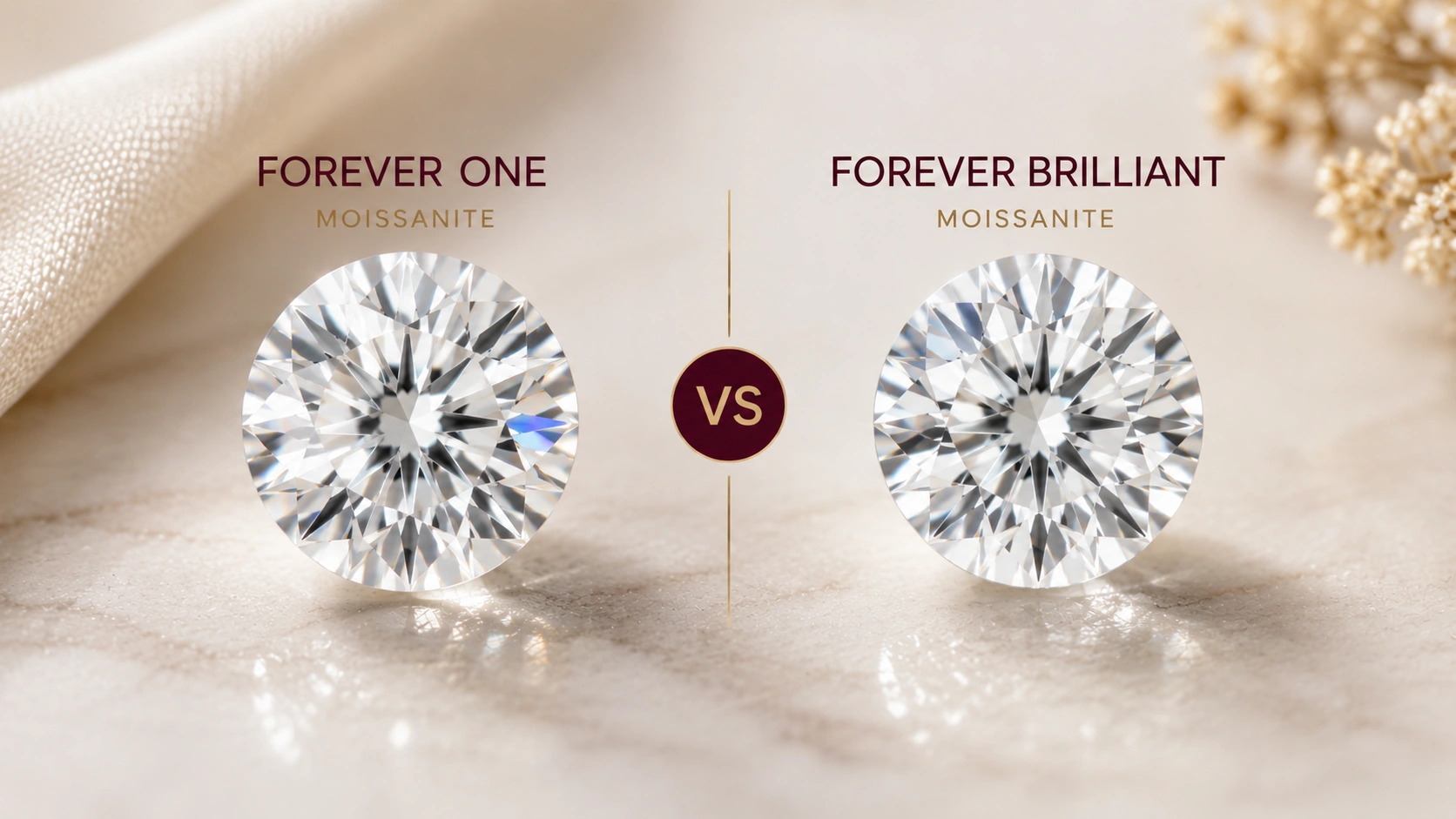
If you are comparing Forever One vs Forever Brilliant Moissanite, the decision can look more complicated than it really is. Both are Charles & Colvard moissanite lines, both offer the durability and distinctive sparkle associated with moissanite, and both can work beautifully in an engagement ring.
The biggest difference is color.
Forever One was introduced as Charles & Colvard’s first colorless moissanite, with a D-E-F color range. Forever Brilliant was positioned as a near-colorless option in the G-H-I range. Charles & Colvard used the GIA diamond color scale as a reference for describing these grades, although that scale was not created specifically to grade moissanite.
So, is Forever One better? Is Forever One worth the extra money? And can you actually see the difference?
Let’s break it down without making your jewelry decision sound like a chemistry exam.
Forever One vs Forever Brilliant: Quick Comparison
| Feature | Forever One | Forever Brilliant |
|---|---|---|
| Color classification | Colorless | Near-colorless |
| Common color range | D-E-F | G-H-I |
| Appearance | Whiter, cleaner appearance | Slightly warmer appearance |
| Brilliance | Excellent | Excellent |
| Fire | Strong moissanite fire | Strong moissanite fire |
| Hardness | 9.25 Mohs | 9.25 Mohs |
| Main difference | Color | Color |
| Best for | Buyers wanting the whitest appearance | Buyers who like subtle warmth or want a lower-cost option |
| Brand | Charles & Colvard | Charles & Colvard |
Charles & Colvard describes Forever One D-E-F as colorless and its G-H-I stones as near-colorless. Its earlier Forever Brilliant line occupied the near-colorless category.
The short answer
If you want the whitest possible appearance, Forever One D-E-F is the straightforward choice.
If you are comfortable with a slightly warmer appearance, Forever Brilliant can still be an attractive option.
The difference is primarily about color, not whether one stone suddenly forgot how to sparkle.
What Is Forever One Moissanite?
Forever One moissanite is a Charles & Colvard created moissanite introduced in 2015 as the company’s first colorless grade. The original Forever One was graded in the D-E-F range.
Charles & Colvard later expanded the Forever One family with a G-H-I near-colorless grade. The company says this newer near-colorless Forever One uses the same high-quality material as its D-E-F version.
For shoppers comparing the original Forever One with Forever Brilliant, however, the useful distinction is simple:
Forever One D-E-F = colorless appearance
Forever Brilliant G-H-I = near-colorless appearance
That difference can matter more when you choose a larger moissanite or a shape that shows body color more readily.
What Is Forever Brilliant Moissanite?
Forever Brilliant was one of Charles & Colvard’s earlier moissanite grades. Charles & Colvard described it as near-colorless, generally within the G-H-I range when compared with the GIA diamond color scale.
The company also published examples showing that Forever Brilliant could show a subtle warm tint under certain lighting conditions, particularly in larger stones.
This is important because “near-colorless” does not mean “colorless.”
A near-colorless moissanite can still look very white in everyday wear. But when you place it beside a D-E-F stone, especially under controlled lighting, the difference becomes easier to notice.
Also, Forever Brilliant should not automatically be treated as a current equivalent to every G-H-I moissanite sold today. Product lines and materials have changed over time, so buyers should verify the exact stone they are purchasing.
Forever One vs Forever Brilliant Color: Which Is Whiter?
This is where the Forever One vs Forever Brilliant color comparison becomes much easier.
Forever One D-E-F sits in the colorless range used by Charles & Colvard. Forever Brilliant was positioned in the near-colorless G-H-I range. On that scale, D-E-F represents less visible body color than G-H-I.
In practical terms:
- Forever One: cleaner, whiter and more icy-looking
- Forever Brilliant: slightly warmer, softer white appearance
Can everyone see the difference immediately?
No.
The difference depends on the stone’s size, shape, cut, lighting, setting and the viewer’s sensitivity to color.
A small stone may show very little noticeable difference. A larger center stone can make subtle color differences easier to spot.
That is why looking at the actual stone in different lighting is more useful than relying only on a color label.
Forever One vs Forever Brilliant Sparkle: Is One More Brilliant?
This is one area where comparisons can become misleading.
Moissanite naturally has strong brilliance and fire. GIA notes that synthetic moissanite has slightly more brilliance than diamond and more than twice the fire of diamond. It also has a Mohs hardness of 9.25, making it a highly durable gemstone for jewelry.
But that does not mean you can accurately say:
Forever One always sparkles more than Forever Brilliant.
That claim goes too far.
Both are moissanite, and the visual performance of a particular stone depends on factors such as:
- Cut quality
- Facet arrangement
- Shape
- Size
- Lighting
- Viewing angle
- Cleanliness
Color can change how you perceive the stone, but color grade alone does not determine all of a moissanite’s sparkle.
So when comparing Forever One brilliance vs Forever Brilliant, focus on the whole stone rather than assuming the higher color grade automatically creates dramatically more sparkle.
Forever One vs Forever Brilliant Price: Is Forever One Worth It?
Price is another major part of the Forever One vs Forever Brilliant price question.
Historically, Charles & Colvard positioned Forever One above Forever Brilliant in its pricing structure. When Forever One launched, the company explicitly described it as the highest-priced of its three moissanite grades at that time.
However, it would be misleading to give you one “current Forever One price” or “current Forever Brilliant price” without specifying the exact stone.
Moissanite pricing can vary based on:
- Stone size
- Shape
- Cut
- Jewelry setting
- Metal
- Retailer
- Availability
- Whether the stone is new or older inventory
There is another important point: Forever Brilliant is an older product line, so today’s prices for remaining or pre-owned stones do not provide a reliable apples-to-apples comparison with a current Forever One stone.
Is Forever One worth the extra money?
If your priority is maximum colorlessness, the upgrade can make sense.
If you are comfortable with a little warmth and would rather allocate more of your budget toward the ring setting, metal or overall design, Forever Brilliant may make more sense when you find a genuine, well-cut stone in good condition.
In other words, “worth it” depends on what your eyes value.
Forever One Moissanite vs Forever Brilliant: Quality Difference
The phrase quality difference can create confusion because color grade is only one part of a gemstone’s appearance.
Forever One was introduced specifically as a major improvement in color, while Forever Brilliant offered a near-colorless appearance. Charles & Colvard stated that all three of its original Forever grades had a Mohs hardness of 9.25 and exhibited strong brilliance and fire.
That means you should not think of Forever Brilliant as a “bad” moissanite.
It is better to think of the comparison this way:
Forever One: higher color grade and whiter appearance.
Forever Brilliant: lower color grade with more visible warmth.
That is a much more accurate comparison than simply calling one “high quality” and the other “low quality.”
Can You Tell the Difference Between Forever One and Forever Brilliant?
Yes, you can see a difference in some situations, but it will not always be obvious.
Place a Forever One D-E-F and Forever Brilliant G-H-I stone side by side under neutral lighting, and the Forever One should generally appear whiter.
The difference becomes more relevant as the stone gets larger because a larger surface gives the eye more opportunity to notice body color.
Your setting also matters.
A Forever Brilliant stone in yellow gold can look intentionally warm and harmonious. The same stone in a bright white-metal setting may make its warmth easier to notice.
This is why there is no universal answer to “which looks better?”
The better question is:
Which color appearance do you prefer?
Forever One or Forever Brilliant for an Engagement Ring?
Both can work for a moissanite engagement ring, provided the stone and setting meet your expectations.
Choose Forever One when:
- You want a very white, icy appearance.
- You prefer D-E-F color.
- You are sensitive to warm undertones.
- You plan to use a white-metal setting.
- You want the higher color grade to be part of your buying decision.
Consider Forever Brilliant when:
- You like a slightly warmer appearance.
- You are comfortable with near-colorless moissanite.
- You want to spend less when a genuine stone is available at a suitable price.
- You are pairing the stone with yellow or rose gold.
- A subtle warmth does not bother you.
And remember: an engagement ring is not graded by how many letters you can squeeze into its product description.
The stone has to look good to you.
Forever One vs Forever Brilliant: Which Should You Buy?
For most buyers who want the whitest appearance, I would choose Forever One D-E-F.
It offers the colorless appearance that made the Forever One line significant when Charles & Colvard introduced it.
But I would not tell every shopper that Forever One is automatically the better purchase.
If you prefer a little warmth, Forever Brilliant can still have a beautiful appearance. And if the price difference is substantial, you may decide that the additional money would bring more value elsewhere in your ring.
Frequently Asked Questions
Can you see the difference between Forever One and Forever Brilliant?
Very useful for users who are deciding whether the higher color grade will actually be noticeable.
Which is whiter, Forever One or Forever Brilliant?
This directly addresses the biggest product difference: color.
What color is Forever One moissanite?
Targets the specific color-grade search intent and gives you an opportunity to explain D-E-F accurately.
What color is Forever Brilliant moissanite?
Lets you explain the G-H-I / near-colorless positioning without repeating the same FAQ.
Does Forever One sparkle more than Forever Brilliant?
Important because users often confuse color grade with sparkle or brilliance.
Is Forever One worth the extra money?
This is one of the strongest commercial-intent questions in your keyword set and should definitely be included.
Is Forever Brilliant good for an engagement ring?
This captures the important transition from research → purchase decision.
How much more does Forever One cost than Forever Brilliant?
Good price-comparison intent, but I recommend answering this carefully because pricing varies by stone size, shape, cut, retailer and availability. Don’t publish a fixed price difference unless you have current product data to support it.
Forever One vs Forever Brilliant: Final Verdict
The easiest way to remember the comparison is:
Forever One = whiter
Forever Brilliant = warmer
Both are moissanite. Both can deliver the distinctive combination of brilliance and fire that makes moissanite popular. Both are durable enough for jewelry, with moissanite measuring 9.25 on the Mohs scale.
So, is Forever One better than Forever Brilliant?
If “better” means higher color grade and a whiter appearance, yes, Forever One wins.
If “better” means better for your budget and personal taste, there is no universal winner.
Choose Forever One if you want icy white. Choose Forever Brilliant if you appreciate a little warmth and find the right stone at the right price.
That is the real Forever Brilliant vs Forever One comparison: not good versus bad, but color preference versus budget.