If you want an engagement ring that feels different from a traditional round or oval diamond, both coffin cut and marquise diamonds are worth considering. But they create very different looks.
A coffin cut diamond has a strong geometric outline with angular edges and a distinctive gothic or architectural character. A marquise diamond has a long, curved silhouette with two pointed ends, giving it a more elegant and dramatic appearance.
So which is better?
For maximum uniqueness and a bold alternative style, a coffin cut diamond is the stronger choice. For elongating the finger, maximizing face-up presence and getting a more established diamond shape with abundant sparkle, marquise is usually the better choice.
The right option ultimately depends on the look you want from your engagement ring.
Coffin Cut vs Marquise: Quick Comparison
| Feature | Coffin Cut Diamond | Marquise Diamond |
|---|---|---|
| Overall shape | Angular and geometric | Long, curved and pointed |
| Style | Gothic, modern, alternative | Elegant, dramatic, vintage-inspired |
| Ends | Generally flatter or angled | Two sharp points |
| Faceting | Can vary; step, brilliant or mixed styles are possible | Commonly brilliant-style |
| Sparkle | Depends heavily on the individual stone and faceting | Usually strong brilliant-style sparkle |
| Visual size | Varies by proportions | Excellent face-up presence for its carat weight |
| Finger effect | Elongated but more architectural | Strongly lengthens the appearance of the finger |
| Uniqueness | Very high | Distinctive but more familiar |
| Tip vulnerability | Depends on the specific outline | Points require protection |
| Best for | Alternative and unconventional designs | Elegant, elongated statement rings |
What Is a Coffin Cut Diamond?
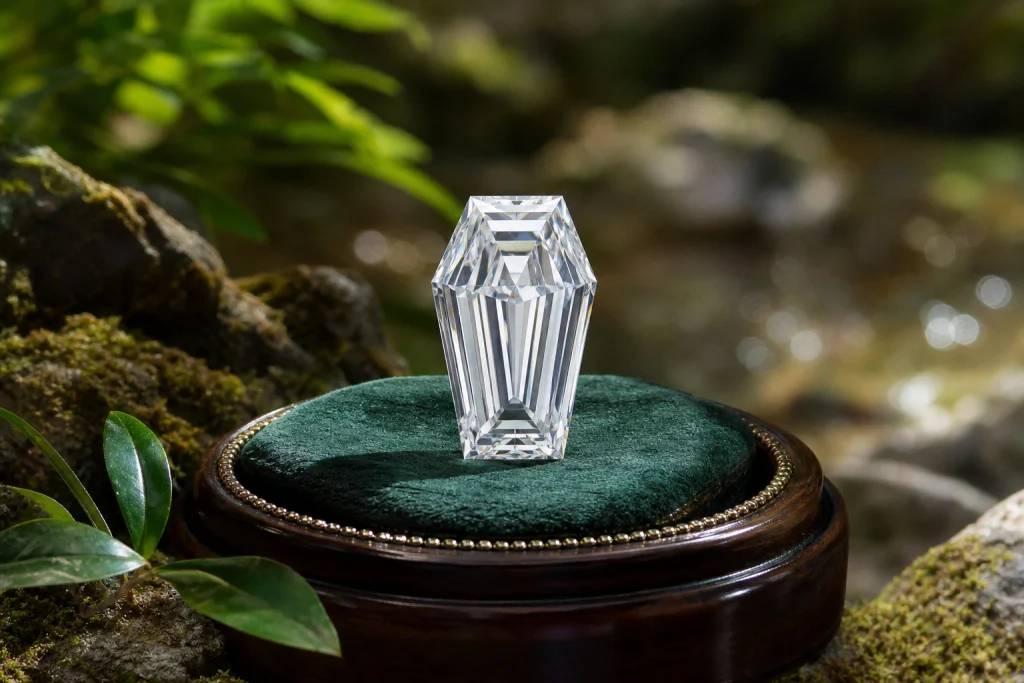
A coffin cut diamond is a specialty diamond shape with an elongated, angular outline that resembles the silhouette of a traditional coffin.
Unlike standardized shapes such as round or princess, coffin diamonds can vary considerably from one stone to another. The exact outline, proportions and faceting pattern can therefore have a major impact on how the finished diamond looks.
The shape commonly features:
- An elongated outline
- Angular or tapered sides
- Flattened or squared-off ends
- Strong geometric lines
- An architectural appearance
The name refers primarily to the shape, not necessarily to a particular faceting style. A coffin-shaped diamond can use different facet arrangements, which means two stones with similar outlines can have very different levels of sparkle and visual character.
For a more detailed explanation of the shape, see the complete coffin cut diamond guide from the site’s existing content.
What Is a Marquise Diamond?
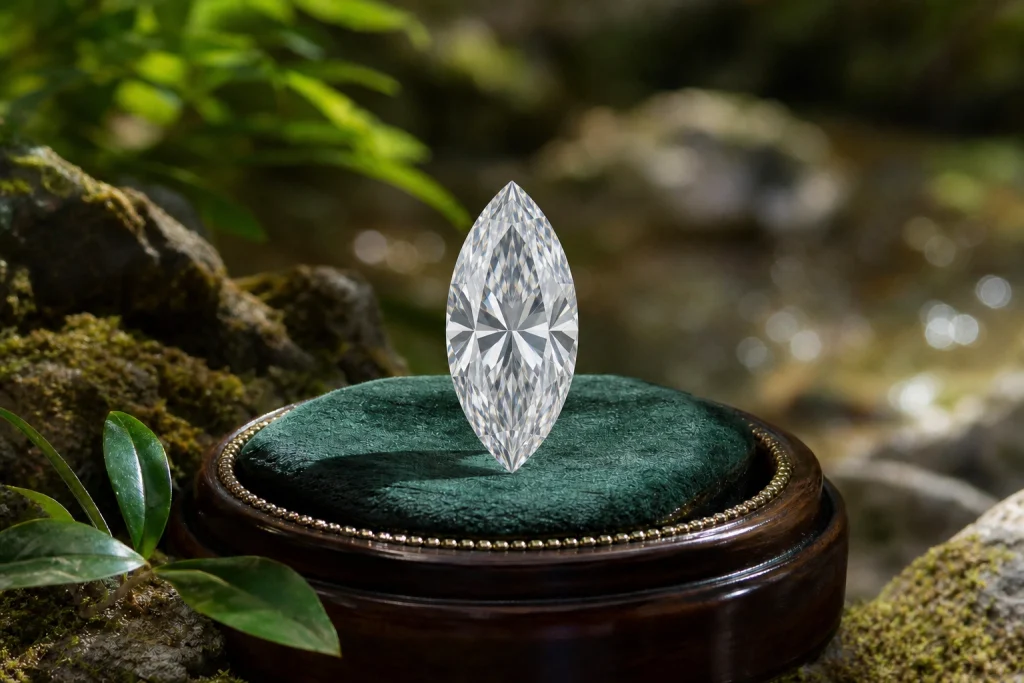
A marquise diamond is an elongated diamond shape with curved sides and two pointed ends.
Its long, narrow outline creates a substantial face-up appearance and can make the fingers look longer and slimmer. GIA notes that marquise diamonds commonly have length-to-width ratios ranging from about 1.6:1 to 2.2:1 among stones submitted to its laboratory, although individual preferences vary.
Marquise diamonds are generally associated with brilliant-style faceting, giving them considerably more sparkle than a typical step-cut stone.
Their pointed ends are also an important consideration. Because the tips are vulnerable areas, appropriate protection from the setting is important. GIA specifically notes that slightly greater girdle thickness at the points can be acceptable and that French tips may be used to improve protection.
Coffin Cut vs Marquise: What’s the Difference?
1. Shape and Appearance
The most obvious difference is the outline.
A coffin cut diamond is angular, while a marquise diamond is curved and pointed.
The coffin shape tends to create a stronger architectural impression. Straight edges and angled corners give it a deliberate, geometric appearance that works particularly well in unconventional engagement rings.
The marquise is softer visually. Its curved sides flow toward two pointed ends, creating the classic elongated “eye” or boat-like silhouette.
If you want a ring that immediately looks unusual, coffin has the advantage.
If you want something distinctive without moving too far away from familiar diamond aesthetics, marquise is easier to wear across different styles.
2. Sparkle
Sparkle depends on the individual diamond’s faceting, proportions, symmetry and light performance rather than simply its outline.
This distinction is especially important with coffin diamonds because the shape does not automatically dictate one specific facet arrangement.
A brilliant-faceted coffin diamond can have lively sparkle, while a step-cut coffin can produce broader, more understated flashes.
Marquise diamonds are commonly fashioned with brilliant-style faceting. This gives them a more traditional sparkling appearance.
GIA also points out that marquise diamonds can show a bow-tie effect, a darker area across the center of the stone. A slight bow-tie can be acceptable, but a strong, distracting bow-tie can reduce the stone’s visual appeal.
Winner for predictable sparkle: Marquise
Winner for flexibility: Coffin
3. Face-Up Size
Marquise is particularly strong when visual size matters.
Its elongated outline creates a large surface area across the finger relative to its carat weight. This can make a marquise diamond look substantial without requiring the same carat weight you might choose for a round diamond.
Coffin diamonds can also have impressive finger coverage, especially when they have an elongated outline, but their proportions vary much more from stone to stone.
That makes direct comparisons based solely on carat weight less useful.
When comparing two stones, look at their actual millimeter dimensions and face-up appearance rather than assuming that one shape will always look larger.
Winner for consistent visual coverage: Marquise
4. Finger-Lengthening Effect
Both shapes can visually lengthen the finger because they have elongated outlines.
However, marquise generally produces the more obvious effect.
Its long axis runs naturally along the finger, while the curved sides create a continuous visual flow toward the points.
A long, narrow coffin diamond can also create an elongated appearance, but its angular geometry gives the effect a more dramatic and architectural quality.
Choose marquise if you want an elegant, elongated look.
Choose coffin if you want elongation combined with strong geometric character.
5. Durability
Neither shape should be judged only by its name. The actual outline, girdle, proportions and setting all affect durability.
Marquise diamonds have two pointed tips. Those points are more vulnerable to damage than broader, rounded edges, so protective prongs or another suitable setting design are important.
Coffin diamonds have a different risk profile because their corners and angular edges vary according to the exact design. A stone with pronounced corners may need careful setting and protection as well.
This is one reason it is better to evaluate the individual stone rather than assume that every coffin or marquise diamond behaves identically.
Winner: Neither universally. The specific stone and setting matter more.
6. Uniqueness
This is where coffin cut has a major advantage.
Marquise is a recognizable and established diamond shape. It has a long history in jewelry and remains relatively distinctive compared with round or oval diamonds.
Coffin cut is considerably less conventional.
Its unusual silhouette immediately signals that the wearer has chosen something outside the traditional engagement-ring vocabulary.
For alternative brides, gothic jewelry lovers or anyone who wants a ring that feels highly personal, coffin is difficult to beat.
Winner for uniqueness: Coffin
7. Setting Options
Marquise diamonds work with many established engagement-ring designs.
Common approaches include:
- Solitaire settings
- Six-prong settings
- East-west settings
- Halo settings
- Bezel-inspired designs
- Vintage settings
- Three-stone designs
The two pointed ends need particular attention when selecting prongs.
Coffin diamonds are more dependent on the individual stone’s proportions and outline. Their geometric shape can work beautifully with minimalist, architectural and gothic settings.
For inspiration, the site’s guide to coffin diamond ring settings can help when moving from shape selection to the actual ring design.
Coffin Cut Diamond: Pros and Cons
Pros
- Extremely distinctive appearance
- Strong geometric character
- Excellent choice for alternative engagement rings
- Works particularly well with gothic aesthetics
- Can be paired with different faceting styles
- Offers more flexibility in visual character than a standardized shape
Cons
- Less common than established diamond shapes
- Individual stones can vary significantly
- Finding the right proportions may require more shopping
- Not every jeweler will have a wide selection
- Some buyers may find the coffin symbolism too unconventional
If you want a wider selection of coffin-style rings, the Coffin Diamond Rings collection is a natural place to explore.
Marquise Diamond: Pros and Cons
Pros
- Long, elegant silhouette
- Excellent face-up presence
- Strong finger-lengthening effect
- Usually offers lively brilliant-style sparkle
- Distinctive without being extremely unconventional
- Works with many engagement-ring styles
- Can suit vintage and modern designs
Cons
- Pointed ends require protection
- Bow-tie effect can be noticeable in some stones
- Symmetry is especially important
- Very long proportions can affect visual performance
- The shape may feel too traditional for someone seeking an extremely unconventional ring
GIA specifically recommends paying close attention to symmetry when choosing a marquise. The two halves should mirror each other, and the points should align correctly with the diamond’s central axis.
Which Is Better for a Gothic Engagement Ring?
If your priority is a gothic engagement ring, coffin is the obvious first choice.
Its angular silhouette naturally complements:
- Black diamonds
- Dark metal
- Claw or pointed prongs
- Gothic filigree
- Medieval-inspired details
- Alternative ring designs
Marquise can absolutely work in gothic jewelry too, particularly when combined with dark metal, black diamonds or dramatic settings.
The difference is that marquise tends to create a gothic-inspired look, while coffin can make the shape itself part of the gothic statement.
For more ideas, explore the site’s gothic engagement ring guide.
There is also dedicated content on gothic engagement rings with marquise diamonds, which is useful if you like the marquise shape but still want a darker aesthetic.
Which Is Better for an Alternative Engagement Ring?
For a highly unconventional ring, coffin wins.
The unusual outline gives you a design feature that does not depend entirely on the setting or metal.
That makes it especially suitable if your goal is:
- “I don’t want a traditional diamond shape.”
- “I want my engagement ring to look different.”
- “I like gothic or alternative jewelry.”
- “I want a strong geometric design.”
The broader alternative engagement rings collection can also be useful if you’re comparing coffin designs with other nontraditional styles.
Which Is Better for Maximum Sparkle?
If you want a familiar elongated shape with strong brilliant-style sparkle, marquise is the safer choice.
However, don’t assume that every marquise will outperform every coffin diamond.
A well-cut coffin with attractive brilliant faceting can look extremely lively, while a poorly proportioned marquise can suffer from an unattractive bow-tie or weak light performance.
The better approach is to compare the actual stones.
Look for:
- Brightness across the stone
- Minimal distracting dark areas
- Good symmetry
- Attractive facet patterns
- Appropriate girdle thickness
- No obvious chips or damage
- A shape you genuinely like from the top view
GIA emphasizes that cut quality and light performance are tied to how the diamond’s facets interact with light, not simply to its outline.
Which Is Better for a Vintage Look?
This depends on the kind of vintage style you want.
Marquise has a much longer established history in jewelry and can easily fit vintage, Edwardian-inspired and antique-inspired designs.
Coffin can also look vintage, particularly when paired with step-cut faceting, milgrain, filigree or ornate metalwork. But the overall effect is more unusual and often leans toward gothic or alternative vintage.
For a classic vintage-inspired engagement ring, marquise is generally easier to style.
For a darker, more unconventional vintage aesthetic, coffin may be more compelling.
How to Choose Between Coffin and Marquise
Ask yourself these five questions.
1. Do you want classic or unconventional?
Choose marquise for a distinctive but established diamond shape.
Choose coffin for something much more unconventional.
2. Is finger elongation important?
Choose marquise if creating a long, elegant visual line is a major priority.
Coffin can also elongate the finger, but its effect is more geometric.
3. Do you want maximum sparkle?
Start with marquise if you want the familiar brilliant-style appearance.
If choosing coffin, compare the actual faceting and light performance rather than assuming the shape determines sparkle.
4. Do you want a gothic or alternative aesthetic?
Choose coffin if you want the diamond itself to communicate that aesthetic.
Choose marquise if you prefer a more elegant shape that can be styled in a gothic direction.
5. Do you care more about the shape or the stone?
If the unusual outline is the main attraction, coffin may be the better choice.
If you want a broader selection of established proportions and a more predictable shopping experience, marquise may be easier.
Final Words
There is no universal winner because coffin and marquise diamonds are designed to create completely different impressions.
Choose a coffin cut diamond if you want:
- Maximum uniqueness
- Strong geometric lines
- Gothic or alternative character
- A nontraditional engagement ring
- A diamond that becomes the main design statement
Choose a marquise diamond if you want:
- An elegant elongated silhouette
- Strong finger-lengthening effect
- Excellent face-up presence
- Brilliant-style sparkle
- A distinctive shape with more established jewelry traditions
The simplest answer
Coffin is better for uniqueness and alternative style.
Marquise is better for elegance, finger elongation and a more familiar elongated diamond look.
If you’re torn between the two, don’t choose based only on carat weight or the name of the shape. Compare the actual stones side by side, paying attention to proportions, symmetry, light performance and how the outline looks on the hand.
The best diamond is ultimately the one whose shape fits both your style and the way you want the engagement ring to feel.
Frequently Asked Questions
Is a coffin cut diamond more unique than a marquise?
Yes. Coffin diamonds are much less conventional and have a distinctive geometric outline. Marquise diamonds are also distinctive, but they are a long-established diamond shape.
Does a coffin diamond sparkle as much as a marquise?
It depends on the coffin diamond’s faceting. A brilliant-faceted coffin can have substantial sparkle, while a step-cut coffin will generally have a more understated appearance. Marquise diamonds are commonly brilliant-faceted.
Which diamond looks bigger, coffin or marquise?
Marquise often has excellent face-up spread for its carat weight because of its elongated shape. Coffin size varies more significantly depending on its proportions, so the actual millimeter measurements should be compared.
Is marquise or coffin better for a gothic engagement ring?
Coffin is usually the stronger choice if you want the diamond itself to create a gothic statement. Marquise can also work very well in gothic designs when combined with an appropriate setting, metal and other design elements.
Is a marquise diamond more durable than a coffin diamond?
Neither shape automatically wins. Marquise points require protection, while the corners and edges of coffin diamonds depend on the specific outline. The individual stone and setting should both be evaluated before buying.
Which should you choose: coffin or marquise?
Choose coffin for a bold, unconventional and geometric look. Choose marquise for an elegant, elongated and sparkly appearance with strong finger-lengthening potential.