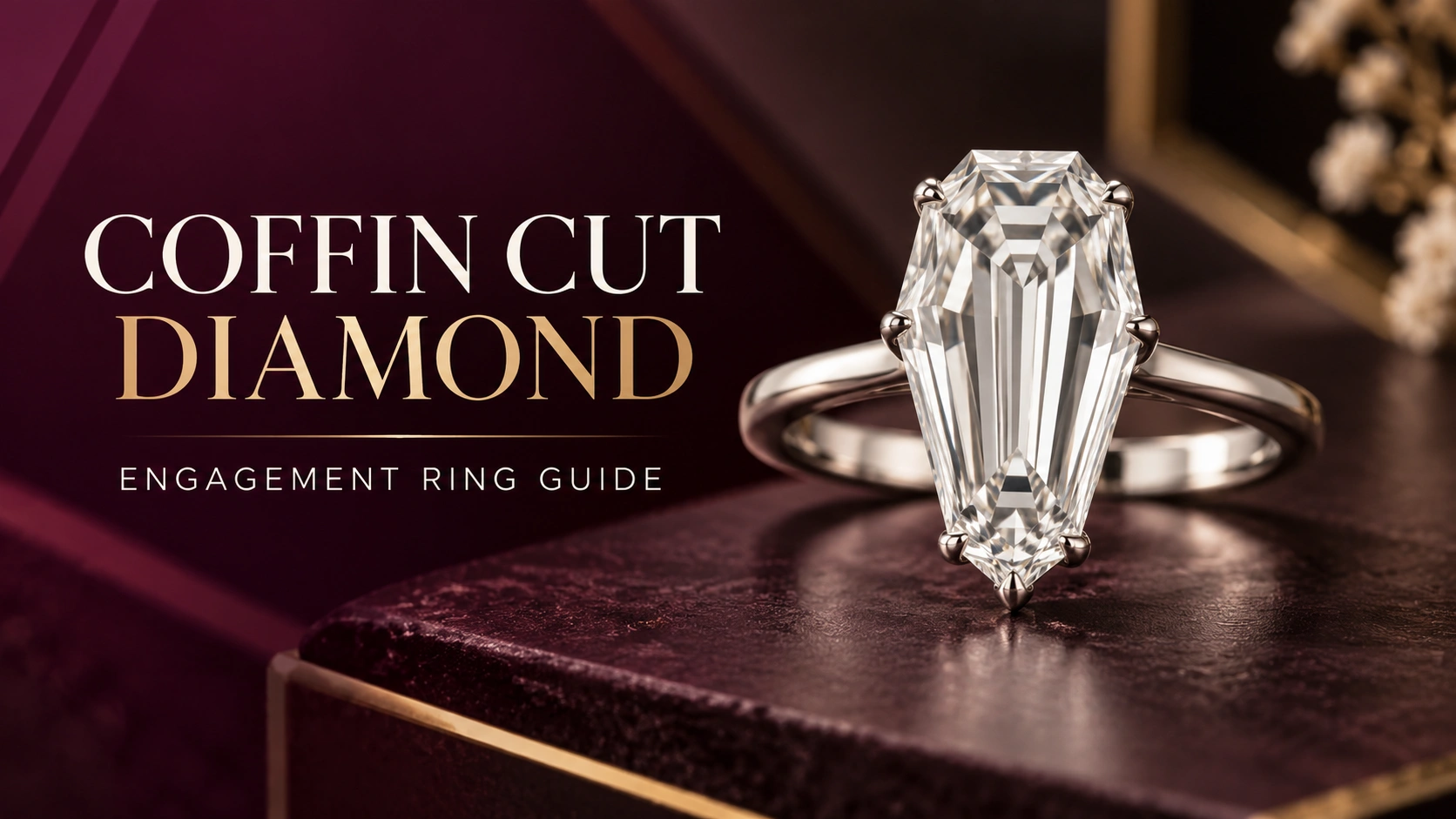
Choosing a coffin cut diamond is a little different from choosing a round, oval, or princess diamond. The shape itself is the main attraction, so small differences in proportions, symmetry, faceting, and dimensions can dramatically change how the finished ring looks.
There is also no single “perfect” coffin cut. Some stones look long and architectural, while others have a wider, bolder outline. Some use step-style faceting for broad flashes, while others are designed to produce more sparkle.
If you’re shopping for a coffin cut engagement ring, the best approach is to judge the individual diamond rather than buying based on carat weight or a shape name alone.
Here’s what to look for.
What Should You Look for in a Coffin Cut Diamond?
Before comparing individual stones, focus on these factors:
- A balanced, symmetrical outline
- Proportions that suit your preferred look
- Attractive faceting and light performance
- Eye-clean clarity
- A color grade that works with your setting
- Useful face-up dimensions
- Secure protection for the corners and ends
- A setting that complements the shape
- Clear photos or video of the actual stone
- A reasonable return and inspection policy
Because coffin cuts are specialty shapes, the visual appearance of the specific stone matters more than simply finding a particular grade or number.
1. Start With the Shape and Symmetry
The outline is the first thing to inspect.
A coffin cut gets much of its character from its angular silhouette, so uneven sides or poorly aligned corners can be especially noticeable.
Look for:
- Balanced left and right sides
- Consistent angles
- Even ends
- A centered outline
- Clean, deliberate-looking corners
- No obvious distortion
Imagine drawing a line through the center of the diamond from end to end. The two sides should look reasonably balanced around that line.
Perfect mathematical symmetry isn’t necessarily required for a beautiful specialty stone, but obvious asymmetry can make the ring look poorly proportioned once it is mounted.
This is one reason photographs of the actual diamond are more useful than a generic product image.
2. Compare the Length-to-Width Proportion
Coffin cut diamonds can vary considerably in how long or wide they appear.
A longer stone can create a sleek, elongated appearance, while a wider coffin shape may look more substantial and architectural.
Rather than searching for one universally “correct” ratio, compare several stones and decide which proportions appeal to you.
For example:
Longer and narrower
- More elongated appearance
- Can look elegant and dramatic
- Creates a stronger vertical presence on the finger
Wider and shorter
- More substantial face-up appearance
- Can feel bolder and more geometric
- May work particularly well with heavier settings
The ratio should support the look you’re trying to create.
Also remember that carat weight does not tell you everything. Two diamonds with the same carat weight can have different measurements and therefore look noticeably different on the hand.
3. Examine the Faceting and Light Performance
The shape tells you what the diamond looks like from above, but the faceting determines much of how it interacts with light.
Coffin-shaped diamonds can be produced with different faceting approaches. Step-style faceting tends to create broad, organized flashes and a more architectural appearance. Brilliant-style faceting can produce more frequent sparkle.
Neither is automatically better.
Choose based on the appearance you prefer.
Step-cut coffin diamonds
These can have:
- Broad flashes of light
- A cleaner, more geometric appearance
- A quieter type of sparkle
- More emphasis on the stone’s structure
Brilliant-style coffin diamonds
These can have:
- More visible sparkle
- More frequent light flashes
- A livelier appearance
- Less emphasis on long, mirror-like facets
When possible, watch a video of the actual diamond rotating under different lighting.
Look for:
- Attractive light return
- Limited persistent dark areas
- Facets that look intentional and defined
- A pleasing pattern when the stone moves
- No large areas that remain dull from normal viewing angles
Don’t judge the diamond only from one still photograph.
4. Don’t Automatically Buy the Highest Clarity
Clarity deserves extra attention because the faceting style can influence how easily inclusions are seen.
The goal is usually not to buy the highest clarity grade available. The goal is to find a diamond that looks clean to the naked eye at normal viewing distance.
Inspect the center of the stone carefully.
If an inclusion is obvious in a high-resolution image or video, it may remain noticeable after the diamond is set.
On the other hand, paying for a much higher clarity grade may not provide much visual benefit if lower-graded stones are already eye-clean.
For step-style faceting in particular, inspect the actual stone rather than assuming the clarity grade tells the whole story.
5. Choose Color Based on the Diamond and Metal
Color can also affect the appearance of a coffin cut.
A higher color grade can provide a crisp, bright appearance, while warmer grades can work beautifully with yellow or rose gold.
Think about the complete ring rather than the diamond in isolation.
For example:
White metals
A higher color grade may appeal if you want the stone to look particularly bright and neutral.
Yellow or rose gold
A slightly warmer diamond may blend naturally with the metal and can create a softer, vintage-inspired appearance.
There is no single color grade that is right for every coffin cut. Your setting, budget, and personal preference all matter.
6. Look at Millimeter Measurements, Not Just Carat Weight
Carat weight measures how much the diamond weighs. It does not tell you exactly how large it will look from above.
That’s particularly important with unusual shapes.
When comparing coffin diamonds, record:
- Length
- Width
- Depth
- Carat weight
- Length-to-width ratio
Then compare the actual face-up dimensions.
A diamond with a slightly lower carat weight may look larger across the finger if its proportions give it greater visible surface area.
This also helps when you’re designing a custom setting because the jeweler needs the exact dimensions of the center stone.
7. Decide Between Natural and Lab-Grown
Coffin cuts can be made from both natural and lab-grown diamonds.
The choice is primarily about your priorities rather than the shape itself.
A natural diamond may appeal if you specifically want a mined stone and its geological origin.
A lab-grown diamond may appeal if you want to allocate more of your budget toward size, design, or other ring features.
Whichever option you choose, evaluate the individual stone using the same basic principles:
- Shape
- Symmetry
- Proportions
- Faceting
- Clarity
- Color
- Dimensions
- Certification where applicable
Don’t assume that choosing natural or lab-grown automatically guarantees a better-looking coffin cut.
8. Choose the Ring Setting Before You Buy the Diamond
One of the easiest mistakes is purchasing the center stone first and thinking about the setting afterward.
With a coffin cut, the setting should be considered early because the unusual outline needs to be properly supported and displayed.
Possible options include:
Solitaire
A solitaire lets the coffin outline take center stage.
This is a strong choice if you want the shape itself to make the statement without surrounding diamonds competing for attention.
Bezel
A bezel surrounds the stone with metal and can provide additional protection.
It can be particularly useful when you want to minimize exposure around vulnerable edges, although the metal may visually soften some of the angular outline.
Prong setting
Prongs can keep more of the diamond visible while securing the stone.
The exact prong placement should be designed around the stone’s shape and vulnerable areas rather than copied from a standard round-diamond setting.
Halo
A halo can make the center stone appear more prominent and add additional detail around its unusual outline.
However, the halo should complement the coffin silhouette rather than hide it.
If you’re comparing setting styles, it can also help to review a broader guide on how to choose an engagement ring setting.
9. Consider North-South vs. East-West Orientation
Most elongated engagement-ring diamonds are positioned vertically along the finger.
But a coffin cut can also be set horizontally in an east-west orientation.
North-south
This orientation emphasizes the stone’s length and creates a more traditional elongated center-stone arrangement.
East-west
This orientation places the long dimension across the finger.
It can create a wider visual appearance and gives the ring an even more unconventional feel.
There isn’t a correct answer. Think about whether you want the diamond to emphasize length or width when worn.
10. Inspect the Diamond From More Than One Angle
Never make your final decision from a single face-up photograph if additional information is available.
Ask to see:
- Face-up images
- Side-profile images
- Rotating video
- Close-up images
- Images under different lighting
The side profile is particularly useful because it can reveal the diamond’s depth and give you a better understanding of how it will sit inside a ring.
Video is also valuable for assessing how the facets interact with moving light.
A diamond that looks impressive in one carefully lit photograph may look very different in ordinary conditions.
11. Check the Certification and Return Policy
When buying a significant diamond, review the documentation and seller policies before committing.
If the stone comes with a grading report, check that the report corresponds to the actual diamond you’re considering.
Also understand the return policy.
This matters even more for specialty shapes because personal preference plays such a large role. You may only realize after seeing the stone in person that you prefer a wider outline, different faceting, or another color grade.
A reasonable inspection and return period gives you more opportunity to evaluate the diamond before permanently setting it.
Common Mistakes When Buying a Coffin Cut Diamond
Choosing based only on carat weight
A larger carat number doesn’t automatically mean the diamond will look better.
Compare dimensions and proportions.
Assuming every coffin cut looks the same
Specialty stones can vary significantly.
Look at the actual outline rather than relying on the product name.
Ignoring symmetry
Small differences can become obvious because the shape is so geometric.
Buying from one photograph
Lighting and photography can dramatically affect how a diamond appears.
Focusing too heavily on the 4Cs
The traditional grading factors still matter, but shape, proportions, faceting, and visual appearance deserve special attention with a specialty cut.
Choosing the setting afterward
The setting should protect and showcase the exact stone you’ve selected.
Forgetting about the ring’s overall style
A coffin diamond can look gothic, modern, vintage, minimalist, or even surprisingly elegant depending on the setting and metal.
The stone shouldn’t be chosen separately from the overall design.
A Simple Coffin Cut Diamond Buying Checklist
Before purchasing, ask yourself:
- Does the outline look symmetrical?
- Do I prefer this length-to-width proportion?
- Are the dimensions appropriate for my desired ring size and design?
- Do I like the faceting pattern?
- Does the stone perform well in motion?
- Is it eye-clean enough for me?
- Does the color work with my chosen metal?
- Have I compared actual millimeter measurements?
- Do I prefer natural or lab-grown?
- Will the setting protect the stone?
- Do I want north-south or east-west orientation?
- Have I seen a video of the actual diamond?
- Does the diamond have appropriate documentation?
- Can I return or exchange it if the stone doesn’t look right in person?
If you can confidently answer these questions, you’re much less likely to choose a coffin cut simply because the shape looks unusual in a product photograph.
Frequently Asked Questions
What is the most important factor when choosing a coffin cut diamond?
There isn’t one single factor, but symmetry, proportions, faceting, and the actual visual appearance should be among your highest priorities. Specialty shapes can vary considerably, so evaluate the individual stone rather than relying on its name alone.
What length-to-width ratio is best for a coffin cut diamond?
There is no universal ideal ratio. A longer ratio creates a slimmer, more elongated appearance, while a wider ratio creates a bolder look. Compare several stones and choose the proportions that fit your preferred ring design.
Should a coffin cut diamond have high clarity?
Not necessarily. An eye-clean diamond is usually more important than simply choosing the highest clarity grade. Inspect the actual stone carefully, particularly around the center where inclusions may be easier to notice.
Does a coffin cut diamond sparkle?
Yes, but the amount and character of sparkle depend on the faceting style and cut quality. Brilliant-style versions can produce more obvious sparkle, while step-style versions tend to create broader flashes and a more architectural appearance.
Is a coffin cut diamond good for an engagement ring?
Yes. It can be an excellent choice if you want an unusual center stone that feels personal and nontraditional. Its specialty shape makes the individual stone and setting especially important.
Should I choose a coffin cut diamond before choosing the ring setting?
Ideally, consider both together. The exact dimensions and outline of the diamond affect how the setting should be designed and how much of the shape remains visible.
Can a coffin cut diamond be set east-west?
Yes. An east-west orientation places the elongated stone horizontally across the finger and can create a distinctive modern appearance.
Are coffin cut diamonds available as lab-grown diamonds?
Yes. Coffin shapes can be produced from lab-grown diamond material as well as natural diamond material.
Final Thoughts
The best coffin cut diamond isn’t necessarily the largest, highest-graded, or most expensive stone you can find.
It’s the one whose shape, proportions, faceting, clarity, color, dimensions, and overall appearance work together to create the look you want.
Start with the outline. Then compare proportions and millimeter measurements. Watch the diamond move under light, inspect its clarity and color, and think about the setting before you buy.
Most importantly, don’t treat “coffin cut” as a guarantee of quality. It describes a distinctive shape, but individual stones can look very different.
If you find a stone with balanced geometry, attractive light performance, and proportions that suit your hand and setting, a coffin cut can become an exceptionally distinctive engagement-ring center stone.