Half-moon diamonds are distinctive side stones with a straight inner edge and a curved outer edge. Their unusual shape allows them to sit closely against a center diamond, creating a smooth, balanced look that works especially well in three-stone engagement rings.
Unlike many popular diamond shapes that are commonly chosen as center stones, half-moon diamonds are primarily used to frame and enhance another diamond. They can add width, sparkle, symmetry, and a more custom appearance without taking attention away from the center stone.
This guide explains what half-moon diamonds are, how they are cut, which center stones pair well with them, and what to look for when choosing a matching pair.
What Is a Half-Moon Diamond?
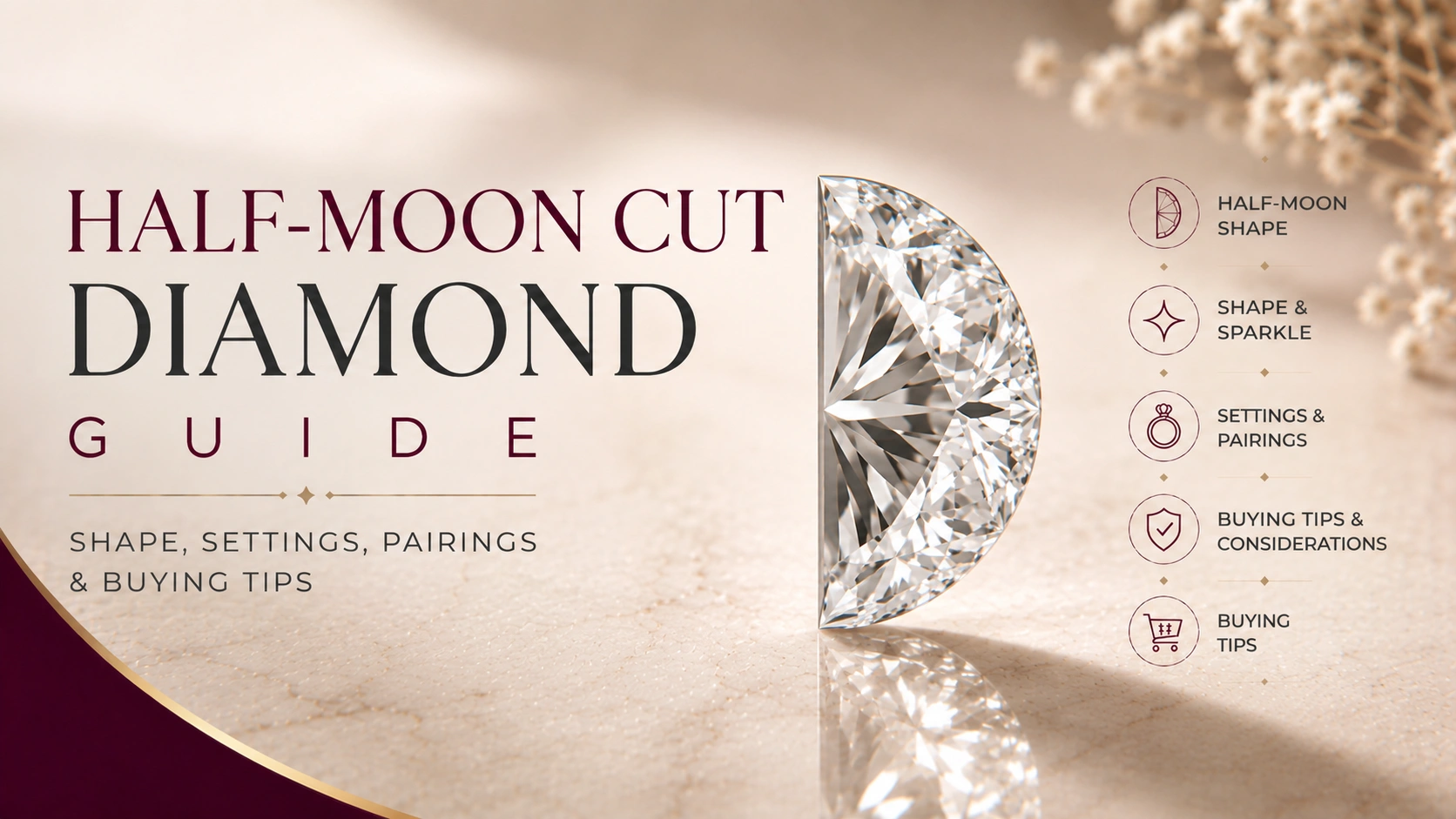
A half-moon diamond is a fancy-shaped diamond with one straight edge and one curved edge. The silhouette resembles half of a round or oval diamond, which gives the shape its name.
The straight edge is designed to sit toward the center stone, while the curved edge faces outward. This allows a pair of half-moon diamonds to follow the contours of a center stone while creating a wider, more substantial appearance.
Half-moon diamonds are also sometimes called demi-lune diamonds.
They are most commonly used as side stones rather than center stones, particularly in three-stone engagement rings.
Because half moons are often purchased as a pair, matching the two stones is an important part of the buying process. Their dimensions, curvature, color, clarity, and overall appearance should work together.
What Does a Half-Moon Diamond Look Like?
From above, a traditional half-moon diamond has a flat or nearly straight inner edge and a rounded outer edge.
The exact silhouette can vary. Some half moons are closer to a true semicircle, while others are narrower or more elongated.
This gives buyers some flexibility when pairing them with different center stones.
The shape combines two useful characteristics:
- A straight edge that can sit neatly beside the center diamond
- A curved edge that creates a softer transition toward the shoulders of the ring
That combination makes half moons particularly interesting for buyers who want something more distinctive than conventional straight-edged side stones.
Are Half-Moon Diamonds Used as Center Stones?
They can be, but that is not their most common role.
Half-moon diamonds are primarily cut and selected as side stones. Their straight edge makes them particularly suitable for sitting against a larger center stone, while their curved outer edge adds a softer visual transition.
Using a half moon as a center stone is possible in a custom design, especially for someone looking for an unconventional ring. However, most engagement-ring designs featuring half moons use two matching stones beside the center diamond.
This is one reason shopping for half moons is different from shopping for a traditional center diamond. The goal is not simply to find one attractive stone. It is usually to find two stones that look like a deliberate pair.
How Are Half-Moon Diamonds Cut?
Half-moon diamonds can be produced with different faceting styles. The two most important are brilliant cut and step cut.
Brilliant-Cut Half-Moon Diamonds
Brilliant-cut half moons use numerous facets designed to return light and create visible sparkle.
They tend to work particularly well when the center diamond also has a brilliant-style appearance.
A brilliant-cut half moon can add lively flashes of light to the sides of the ring and help create a more sparkling overall appearance.
Step-Cut Half-Moon Diamonds
Step-cut half moons use larger, more linear facets.
Instead of producing the intense scintillation associated with brilliant faceting, step cuts generally create broader flashes and a cleaner, more understated appearance.
They can be especially attractive beside step-cut center diamonds such as emerald and Asscher cuts because the faceting styles can visually complement one another.
If you want the side stones to blend naturally with the center stone, matching the faceting style is a useful starting point.
Why Are Half-Moon Diamonds Popular as Side Stones?
Half-moon diamonds offer a combination of structure and softness that is difficult to achieve with some other side-stone shapes.
Their straight edges allow them to sit close to a center diamond, while their curved outer edges keep the overall design from looking overly angular.
They can also make a center stone appear more substantial by extending the ring’s visual width.
Half moons are particularly appealing if you want a three-stone ring that feels:
- Elegant
- Symmetrical
- Architectural
- Distinctive
- Custom-designed
They are less conventional than round side stones and offer a different look from angular accents such as baguettes or trapezoids.
For readers comparing different diamond styles, a broader overview of types of diamond cuts can help put half moons into context.
Best Center Diamond Shapes for Half-Moon Side Stones
Half-moon diamonds are versatile, but some center shapes create especially harmonious combinations.
Emerald Cut
Emerald cuts are one of the strongest pairings for half-moon side stones.
An emerald cut has long, straight lines and step-cut faceting, so step-cut half moons can reinforce the same clean, architectural aesthetic.
The result can feel refined and geometric without becoming overly busy.
Radiant Cut
Radiant diamonds combine a rectangular or square outline with brilliant-style faceting.
Brilliant-cut half moons can complement the radiant’s sparkle while adding width around the center stone.
This combination works well if you want a three-stone ring with substantial brilliance.
Oval Cut
An oval center stone introduces softer curves that can echo the rounded edges of half moons.
The combination feels less geometric than an emerald-and-half-moon pairing and can create a graceful, flowing appearance.
Cushion Cut
Cushion diamonds have rounded corners and a softer outline, making them another natural partner for half-moon side stones.
Brilliant-cut half moons can add additional sparkle while helping the center stone feel more substantial.
You can also compare the characteristics of different cushion styles in this cushion cut diamond guide.
Asscher Cut
Asscher diamonds are strongly geometric and use step-cut faceting.
Step-cut half moons can complement this look by creating a consistent pattern of broad, clean flashes.
This pairing can work particularly well for vintage-inspired or Art Deco-influenced designs.
Princess Cut
A princess-cut center stone creates more contrast with a half moon.
The princess cut’s angular geometry sits against the half moon’s rounded outer edge, creating a combination that feels more modern and distinctive.
Half-Moon Diamonds in Three-Stone Engagement Rings
The three-stone setting is one of the most natural applications for half-moon diamonds.
Two matching half moons sit on opposite sides of the center diamond, creating symmetry across the ring.
The straight edges face inward toward the center stone, while the curved edges face outward.
This arrangement can:
- Add visual width to the ring
- Frame the center diamond
- Create a balanced silhouette
- Add additional sparkle
- Give the ring a more custom appearance
The proportions of the side stones matter considerably. A pair that is too small may disappear beside the center diamond, while oversized half moons can compete with it.
The best choice depends on the center stone’s shape, dimensions, setting, and overall design.
How to Choose Half-Moon Diamonds
Buying half-moon diamonds requires more than checking the carat weight.
Because these stones are frequently used as a matching pair, visual consistency is especially important.
1. Look for a Well-Matched Pair
The two half moons should be closely matched in:
- Length
- Width
- Curvature
- Color
- Clarity
- Faceting
- Overall brightness
Even if two stones have similar specifications on paper, they can look noticeably different when placed next to each other.
Whenever possible, view the stones side by side and evaluate them as a pair rather than individually.
2. Pay Attention to Symmetry
Symmetry is particularly important for half-moon side stones.
The curved edges should look balanced, and the two stones should mirror each other naturally.
An uneven or poorly proportioned pair can make an otherwise beautiful three-stone setting look unbalanced.
3. Evaluate Cut and Light Performance
Fancy-shaped diamonds such as half moons do not receive the same standardized cut-grading treatment as round brilliant diamonds.
That makes visual evaluation especially useful.
Look for stones that show reasonably even brightness and sparkle across the face. Avoid examples with large areas that appear noticeably dark or lifeless.
Some sources note that poorly cut half moons can show a bow-tie-like dark area, so viewing videos or photographs can be helpful when purchasing remotely.
4. Match the Color to the Center Diamond
Color consistency is important because the half moons sit directly beside the center stone.
A significant color difference can make the stones look disconnected.
You do not necessarily need the exact same grade for every stone, but the side stones should have a compatible visual color.
For more information about diamond color, see this diamond color guide.
5. Consider Clarity
Half-moon diamonds can be relatively small, which means some inclusions may be difficult to see without magnification.
However, clarity becomes more important when the stones are larger or when they use step-cut faceting.
Step cuts have larger, more open facets that can make inclusions easier to notice.
The goal is not automatically to choose the highest clarity grade. Instead, look for stones that appear clean to the eye and are well matched to each other.
You can learn more about the broader grading system in this diamond clarity guide.
6. Consider the Proportions
There is no single proportion that makes every half moon ideal.
A narrower half moon can work well beside elongated center stones, while a fuller shape may create a stronger visual presence beside a more compact center stone.
The most important consideration is how the side stones relate to the center diamond.
Look at the complete ring design rather than choosing a pair based on measurements alone.
Half-Moon Diamonds vs. Other Side Stones
Half moons occupy an interesting middle ground between curved and angular side stones.
Half Moon vs. Baguette
Baguettes are typically rectangular and step cut, giving them a clean, linear appearance.
Half moons add curvature and can create a softer transition around the center stone.
If you prefer geometric straight lines, baguettes may be more appealing. If you want structure with a softer outline, half moons may be the better fit.
Diamiv also has a dedicated baguette cut diamond guide for a closer look at that shape.
Half Moon vs. Trillion
Trillion diamonds have triangular outlines and create a much sharper visual effect.
Half moons are rounder and generally feel softer.
The choice comes down largely to whether you prefer curved or angular side-stone geometry.
Half Moon vs. Tapered Baguette
Tapered baguettes gradually narrow toward one end and can create a sleek transition from the center stone into the band.
Half moons provide a more rounded transition.
For another distinctive side-stone option, see the tapered baguette diamond guide.
Pros and Cons of Half-Moon Diamonds
Pros
- Distinctive and less conventional
- Excellent for three-stone engagement rings
- Can add visual width around a center diamond
- Straight edge sits neatly toward the center stone
- Curved edge creates a softer silhouette
- Works with many center diamond shapes
- Available in brilliant and step-cut styles
- Can create a custom or architectural appearance
Cons
- Matching a pair can be challenging
- Proportions need to suit the center stone
- Cut quality can vary considerably
- Step-cut versions can make inclusions easier to see
- They are less commonly used as center stones
- Poorly matched side stones can make the setting look uneven
Are Half-Moon Diamonds a Good Choice?
Half-moon diamonds can be an excellent choice if you want a three-stone engagement ring that feels distinctive without looking overly complicated.
Their biggest advantage is their ability to frame a center stone while maintaining a clean visual connection between the stones.
They are especially worth considering if you like emerald, radiant, oval, cushion, or Asscher center diamonds and want something more unusual than traditional round or baguette side stones.
The most important thing is to evaluate the complete combination. A beautiful half-moon diamond is not necessarily the right half moon for every center stone.
Focus on matching, proportions, symmetry, faceting, and overall visual balance.
If you’re still comparing diamond shapes, Diamiv’s diamond shape guide is a useful next step.
Frequently Asked Questions
What is a half-moon diamond?
A half-moon diamond is a fancy-shaped diamond with one straight edge and one curved edge. It is most commonly used as a side stone beside a larger center diamond.
Are half-moon diamonds usually sold in pairs?
Yes. Because they are commonly used on opposite sides of a center stone, half-moon diamonds are often selected and sold as matching pairs.
What diamond shapes pair best with half-moon side stones?
Popular pairings include emerald, radiant, oval, cushion, Asscher, and princess cuts. The best combination depends on the center stone’s proportions, faceting, and the desired ring style.
Are half-moon diamonds brilliant cut or step cut?
They can be either. Brilliant-cut half moons generally offer more sparkle, while step-cut versions create broader, cleaner flashes and can complement step-cut center stones.
Do half-moon diamonds have a bow-tie effect?
Some poorly cut half moons can show darker areas across the stone. Because fancy shapes are best evaluated visually, reviewing clear images or videos can help you assess light performance before buying.
Can a half-moon diamond be used as a center stone?
Yes, although this is uncommon. Half moons are primarily designed and used as side stones, but a custom ring can use the shape as an unconventional center stone.
Are half-moon diamonds good for engagement rings?
Yes. They can be particularly attractive in three-stone engagement rings where the goal is to frame the center diamond and create a distinctive, balanced design.
What should I look for when buying half-moon diamonds?
Prioritize a well-matched pair, good symmetry, attractive light performance, compatible color and clarity, and proportions that complement the center diamond. The two side stones should look cohesive when viewed together.