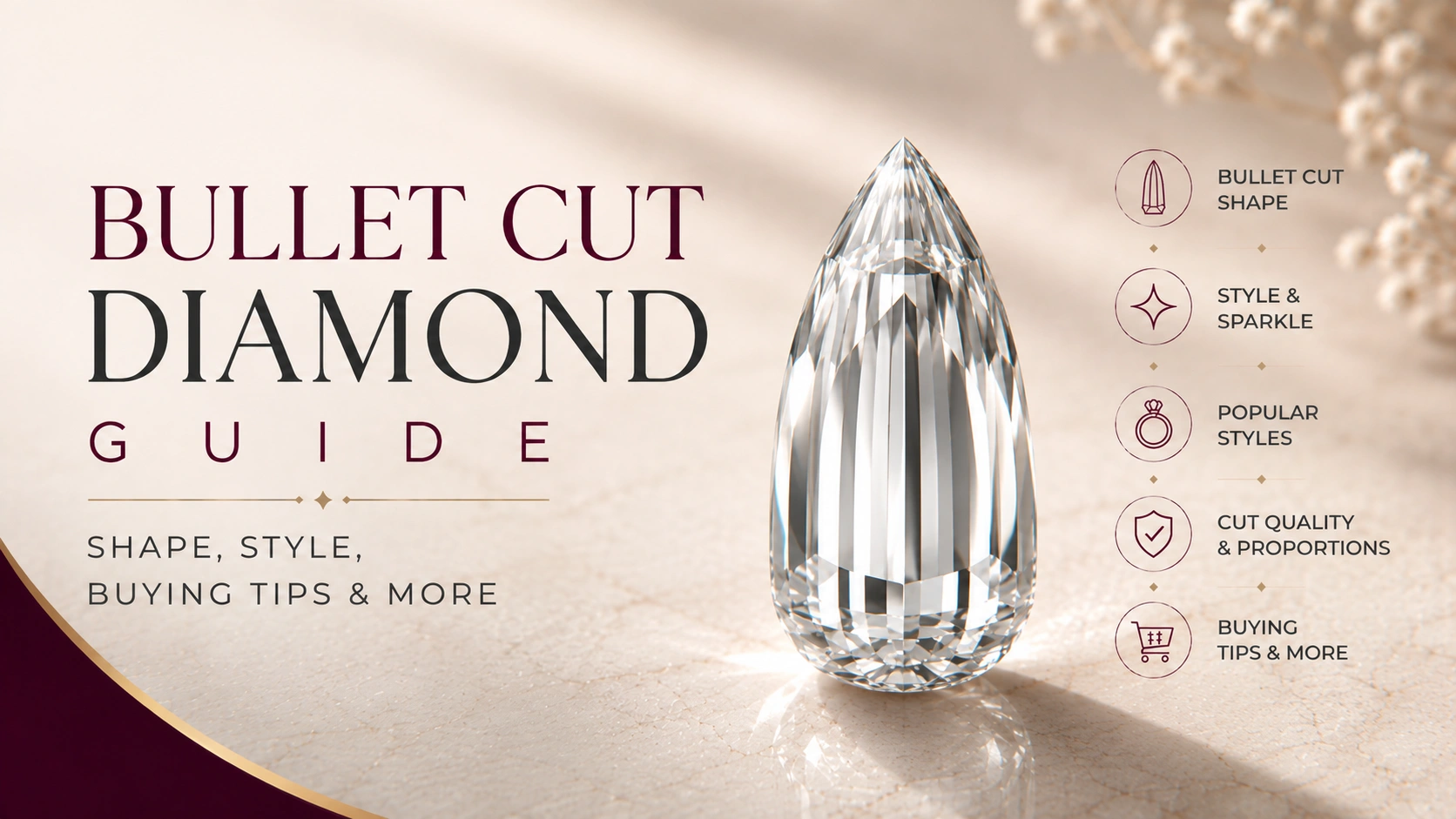
Bullet cut diamonds are one of the more unusual diamond shapes you’ll encounter when shopping for an engagement ring. With their elongated outline and distinctive pointed end, they bring a sharp, architectural look that is especially effective as a side stone.
Unlike round or oval diamonds, bullet cut diamonds are rarely the obvious centerpiece of a ring. Their real strength is in how they work with another diamond or gemstone. Used beside a center stone, they can add length, definition, symmetry, and a distinctive geometric character without overwhelming the main stone.
If you’re considering bullet diamonds for an engagement ring, here’s what you should know about their shape, faceting, appearance, pairings, settings, and what to look for before buying.
What Is a Bullet Cut Diamond?
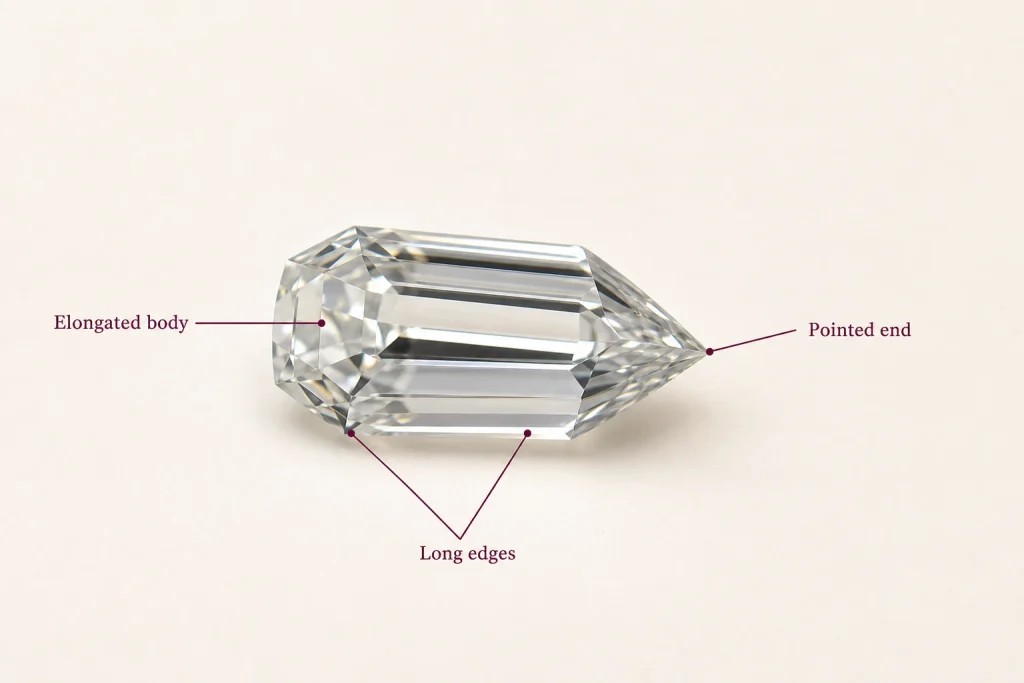
A bullet cut diamond is a fancy-shaped diamond with an elongated body and a distinctive pointed or angled end. The exact outline can vary, but the shape generally resembles a narrow baguette that transitions into a point at one end.
Bullet diamonds are most commonly used as side stones in three-stone engagement rings and other multi-stone designs. Their unusual outline makes them particularly useful when a ring needs a little more structure or visual direction than conventional baguettes provide.
Most bullet diamonds have a step-cut appearance, with long, relatively broad facets that create flashes of reflected light rather than the rapid sparkle associated with a round brilliant diamond. Some bullet diamonds can also be fashioned with brilliant-style faceting, so the shape and faceting style should not be treated as exactly the same thing.
For a broader explanation of how diamond shapes and cutting styles differ, see the guide to diamond cuts and shapes.
What Does a Bullet Cut Diamond Look Like?
The easiest way to picture a bullet diamond is as an elongated geometric stone with one end narrowing into a point.
Depending on the design, you may encounter:
- Straight-sided bullet shapes
- Tapered bullet shapes
- More pronounced V-shaped tips
- Softer or slightly rounded pointed ends
- Step-cut or brilliant-style versions
This variation is one reason it’s important to evaluate the actual stone rather than relying only on the name “bullet cut.”
When used as a pair, the stones are generally selected to have closely matching dimensions and appearance. Even small differences between the two side stones can become noticeable once they’re mounted next to each other.
How Are Bullet Cut Diamonds Faceted?
Many bullet cut diamonds use step-cut faceting. Instead of the radiating facet arrangement found in a round brilliant, step cuts use longer, linear facets arranged in parallel rows.
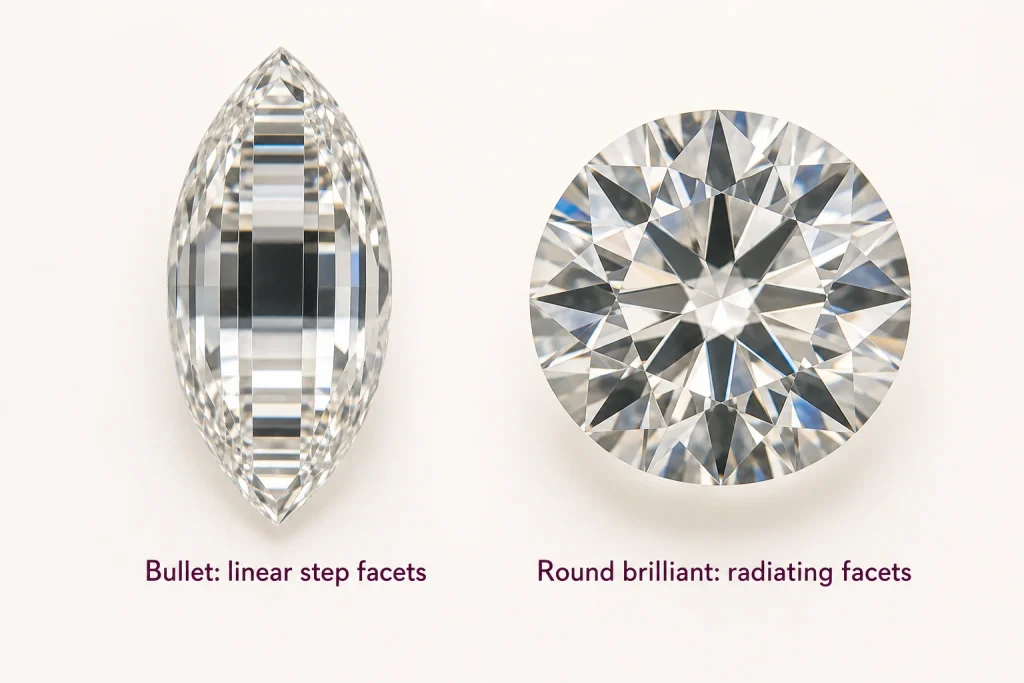
This gives the diamond a more structured appearance. Rather than producing constant pinfire sparkle, a well-cut step-style bullet diamond can show broader flashes and a hall-of-mirrors effect.
That visual character also means clarity can be particularly important. The larger, more open facets can make inclusions easier to notice than they would be in a heavily scintillating brilliant-style stone.
Because there isn’t a universally standardized cut-grade system for bullet diamonds comparable to the familiar round brilliant cut grade, buyers should pay close attention to the stone’s proportions, symmetry, facet consistency, and overall appearance.
Bullet Cut vs. Baguette Diamond
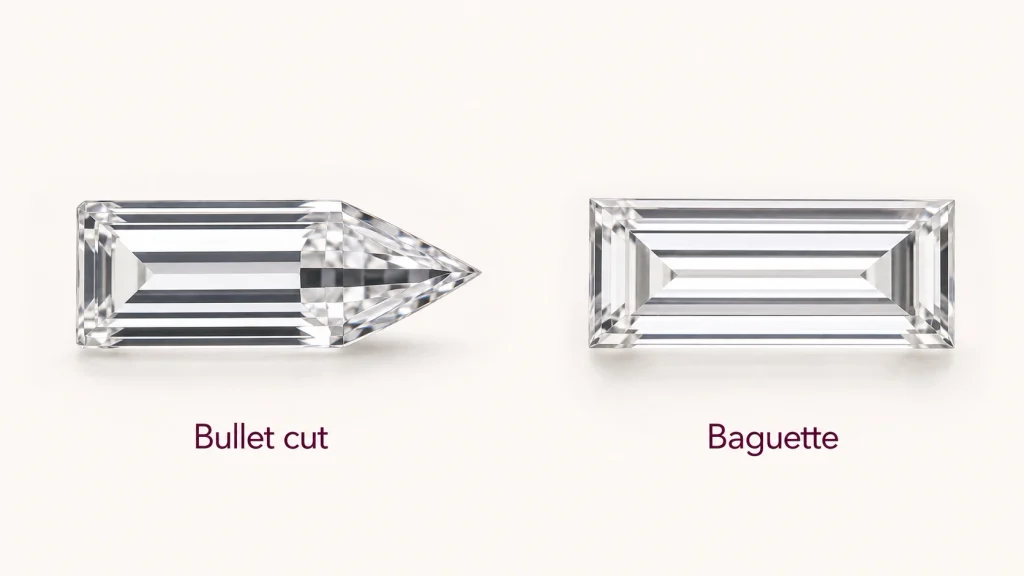
Bullet diamonds and baguette diamonds are natural comparisons because both can have long, geometric outlines and step-cut faceting.
The biggest difference is the end shape.
A traditional baguette generally has a rectangular or tapered outline with straight ends. A bullet diamond introduces a pointed or angled end, giving it a more directional appearance.
| Feature | Bullet Cut | Baguette |
|---|---|---|
| Overall shape | Elongated with a pointed/angled end | Long rectangular or tapered |
| Typical faceting | Often step cut | Usually step cut |
| Visual character | Sharp and directional | Clean and linear |
| Common use | Side stones and accents | Side stones and accents |
| Style | Geometric, distinctive | Classic, streamlined |
If you want a clean and familiar geometric side stone, baguettes are an easy choice. If you want something less conventional, bullet diamonds add more visual character.
You can also explore the baguette cut diamond guide to compare the two shapes in more detail.
Bullet Cut vs. Trapezoid Diamond
Trapezoid diamonds are another popular side-stone option, but their geometry is different.
A trapezoid generally has four sides and creates a broader transition between the center stone and the band. Bullet diamonds tend to look narrower and more directional because of their pointed end.
This makes the two shapes useful for different design goals:
Choose bullet diamonds when you want:
- A slimmer side-stone profile
- A pointed geometric detail
- A less common alternative to baguettes
- A strong Art Deco or architectural feel
Choose trapezoids when you want:
- More side coverage
- A wider visual transition from the center stone
- A substantial three-stone appearance
The right option ultimately depends on the proportions of the center diamond and the setting.
Are Bullet Cut Diamonds Good for Engagement Rings?
Yes, particularly if you want an engagement ring that feels distinctive rather than conventional.
Bullet diamonds work especially well when the ring design benefits from strong geometric lines. They’re frequently used in three-stone settings, vintage-inspired designs, and Art Deco-influenced jewelry. Historical Art Deco jewelry also includes bullet-shaped diamonds alongside baguettes and other geometric cuts.
They’re particularly effective as side stones because they can frame the center diamond without competing with it.
A pair of bullet diamonds can also create the impression of a more substantial ring face by extending the design outward from the center stone.
Best Center Stones for Bullet Cut Diamonds
Bullet diamonds are versatile side stones, but some center shapes create especially attractive combinations.
Emerald Cut
An emerald cut center is one of the most natural pairings for bullet diamonds.
Both shapes can feature step-style faceting and strong linear geometry, creating a cohesive look. The result is sophisticated, structured, and understated rather than intensely sparkly.
Oval Cut
An oval center creates an interesting contrast with pointed bullet side stones.
The center diamond has a softer, curved outline while the bullets introduce sharper lines around it. This can give the ring a custom appearance without making the overall design excessively angular.
For more information about the center shape itself, see the oval cut diamond guide.
Round Cut
A round diamond with bullet side stones creates a deliberate contrast.
The round center provides the traditional focal point, while the geometric side stones make the design feel more distinctive. This can be a good option if you like a classic center stone but want an unusual three-stone setting.
Cushion Cut
Cushion diamonds combine rounded corners with a generally square or rectangular outline. Bullet side stones can add sharper definition to that softer shape.
This combination works particularly well for someone who wants a cushion center without an overly traditional appearance.
See the cushion cut diamond guide for more on this center shape.
Marquise Cut
A marquise center already has pointed ends, so bullet side stones can reinforce the directional character of the design.
The result can have a particularly elongated appearance, making this an interesting choice for buyers who want strong finger-lengthening geometry.
How to Choose Bullet Cut Diamonds
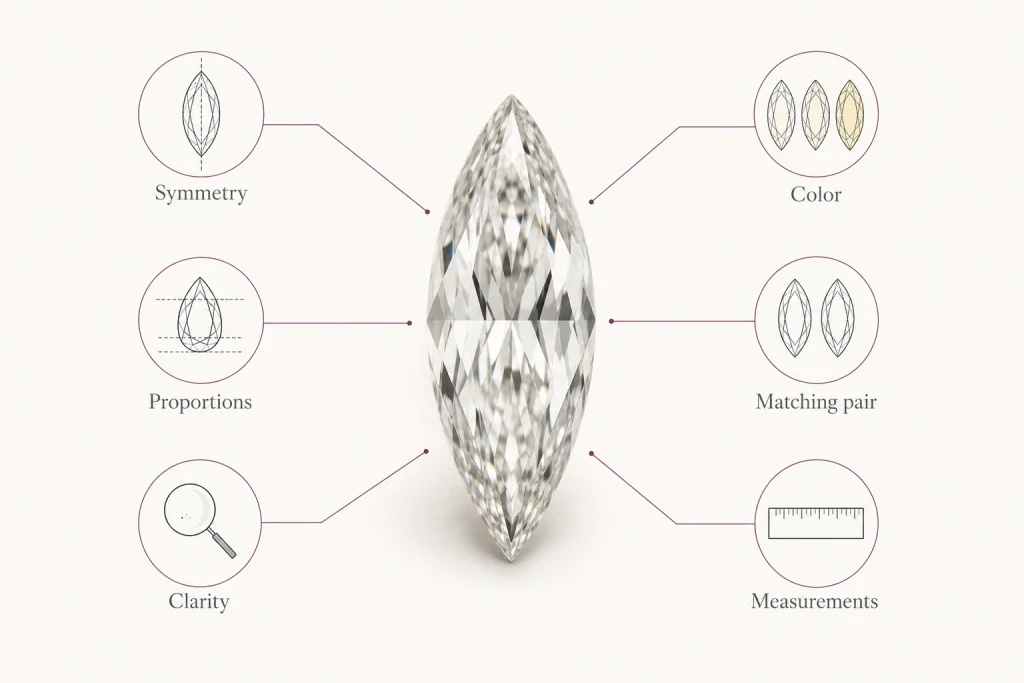
Buying bullet diamonds requires slightly different priorities from shopping for a conventional center stone.
1. Pay Close Attention to Symmetry
Symmetry is one of the most important considerations for a bullet side stone.
Look at:
- The alignment of the long edges
- The consistency of the taper
- The shape of the point
- The width and depth
- The overall outline
This becomes even more important when purchasing two stones as a matched pair.
A well-matched pair should look balanced when placed side by side. Differences in length, width, color, clarity, or outline can make the finished ring look uneven.
2. Look for Good Proportions
There isn’t one universally ideal proportion for every bullet diamond.
Instead, judge the stone according to the intended setting.
A very narrow bullet may disappear beside a substantial center stone, while a very wide bullet can overpower a smaller center.
The goal is visual balance between the center stone, side stones, and band.
3. Consider Clarity Carefully
Step-cut diamonds generally show inclusions more readily because of their larger, more open facets.
That doesn’t automatically mean you need the highest clarity grade available. Instead, focus on whether the stone appears clean to the eye at its intended viewing distance.
For a pair of side stones, consistency between the two stones is also important.
You can learn more about diamond clarity with this diamond clarity guide.
4. Think About Color
Color can be more apparent in elongated step-cut diamonds than in many brilliant-cut stones.
If the bullet diamonds will sit beside a very white center diamond, noticeable differences in color may be more obvious.
The best choice depends on your center stone’s color and the overall look you want. Matching the side stones reasonably closely with the center can help the finished ring look cohesive.
See the diamond color guide for a broader explanation of diamond color.
5. Don’t Focus Only on Carat Weight
Bullet diamonds are often relatively small because they’re primarily used as accent stones.
Their visual contribution comes from their outline and placement as much as from their carat weight.
When comparing bullet diamonds, look at the actual measurements and proportions rather than assuming that a higher carat weight automatically means a better-looking stone.
For general carat guidance, see the diamond carat guide.
6. Buy Matching Pairs When Possible
If your design uses two bullet diamonds, matching is critical.
Ideally, the pair should be closely matched for:
- Length
- Width
- Shape
- Color
- Clarity
- Faceting
- Overall visual appearance
Matched side stones help the ring look intentional and professionally designed.
Bullet Cut Diamond Settings
The setting you choose should complement the geometry of the bullet diamonds while protecting any vulnerable pointed areas.
Three-Stone Settings
Three-stone rings are perhaps the most natural home for bullet diamonds.
The center diamond remains the focal point while the bullets frame it from either side. This arrangement can create a balanced, elongated appearance.
Bezel Settings
A bezel setting can provide additional protection around the edges of a bullet diamond.
This can be useful when the pointed portion of the stone is exposed or positioned where it could experience more contact during everyday wear.
Channel Settings
Bullet diamonds can also work in channel-style arrangements, particularly when multiple geometric stones are incorporated into the design.
The setting should be chosen according to the exact shape and orientation of the stones rather than the name of the cut alone.
For more information about why engagement rings use different types of prongs and protective structures, see the guide to why engagement rings have prongs.
Are Bullet Cut Diamonds Rare?
Bullet diamonds are much less common than mainstream shapes such as round, oval, cushion, or princess cuts.
They’re also less commonly seen as large center stones. Their primary role is as a side or accent stone, which naturally limits the number of buyers searching for them.
That relative scarcity can be part of their appeal. Someone choosing bullet diamonds is less likely to end up with the same familiar silhouette seen in countless engagement rings.
However, rarity should not be confused with higher quality or automatically higher value. The quality of the individual diamond and the quality of the finished ring still matter most.
Pros and Cons of Bullet Cut Diamonds
Pros
- Distinctive and uncommon appearance
- Excellent for three-stone engagement rings
- Strong geometric character
- Works well with step-cut center stones
- Can create a visually elongated ring design
- Fits vintage and Art Deco-inspired styles
- Provides an alternative to conventional baguette side stones
Cons
- Less common and potentially harder to source
- Matching pairs can require more searching
- Step-cut versions may reveal inclusions more easily
- Pointed ends may need careful protection
- Less standardized than popular center-stone shapes
- Usually better suited to side-stone applications than traditional solitaire designs
Frequently Asked Questions
Can a bullet cut diamond be a center stone?
Yes, but it is uncommon. Bullet diamonds are primarily used as side stones because their asymmetric, pointed outline naturally works as a framing element. They can be used as a center stone in a custom design if the overall setting is built around their proportions.
Are bullet diamonds step cut?
Many bullet diamonds are step cut, but not every bullet diamond necessarily uses the same faceting style. The term “bullet” primarily describes the stone’s shape, while the faceting determines how light interacts with it.
Are bullet diamonds the same as baguettes?
No. They can look similar because both are often elongated and step cut, but bullet diamonds have a distinctive pointed or angled end, whereas baguettes typically have straighter rectangular or tapered outlines.
Do bullet diamonds sparkle?
They can, but their appearance depends heavily on their faceting style. Step-cut bullet diamonds tend to produce broader flashes and reflections rather than the intense scintillation associated with brilliant-cut diamonds.
Are bullet diamonds good side stones?
Yes. This is where the shape is most commonly used. Bullet diamonds can frame a center stone, add length to the ring design, and introduce a distinctive geometric detail.
What center diamond goes best with bullet side stones?
Emerald cuts are a particularly natural pairing because both shapes can share a clean, step-cut aesthetic. Oval, round, cushion, and marquise centers can also work well when their proportions complement the bullet side stones.
Final Thoughts
Bullet cut diamonds are an excellent option for anyone who wants an engagement ring with a less conventional look.
Their elongated, pointed shape makes them particularly useful as side stones, where they can frame a center diamond and create a strong sense of structure. They’re especially appealing in three-stone, vintage-inspired, and Art Deco-influenced designs.
When buying them, focus less on carat weight alone and more on shape, symmetry, proportions, clarity, color, and matching. If you’re purchasing a pair, make sure the stones look genuinely balanced together.
For shoppers who like the clean geometry of baguettes but want something more distinctive, bullet diamonds offer an interesting alternative that can make an engagement ring feel much more personal.