A hexagon cut diamond is a distinctive choice for anyone who wants an engagement ring that feels geometric, modern, and different from traditional round or oval diamonds. With six defined sides and a structured silhouette, hexagon diamonds have an architectural appearance that can range from sleek and minimalist to bold and vintage-inspired.
But there is more to choosing a hexagon diamond than counting its six sides. Hexagon diamonds can have different faceting styles, proportions, and lengths, and those differences affect their sparkle, clarity requirements, appearance, and price.
This guide explains what a hexagon cut diamond is, how it compares with other diamond shapes, what to look for when buying one, and which settings work best.
What Is a Hexagon Cut Diamond?
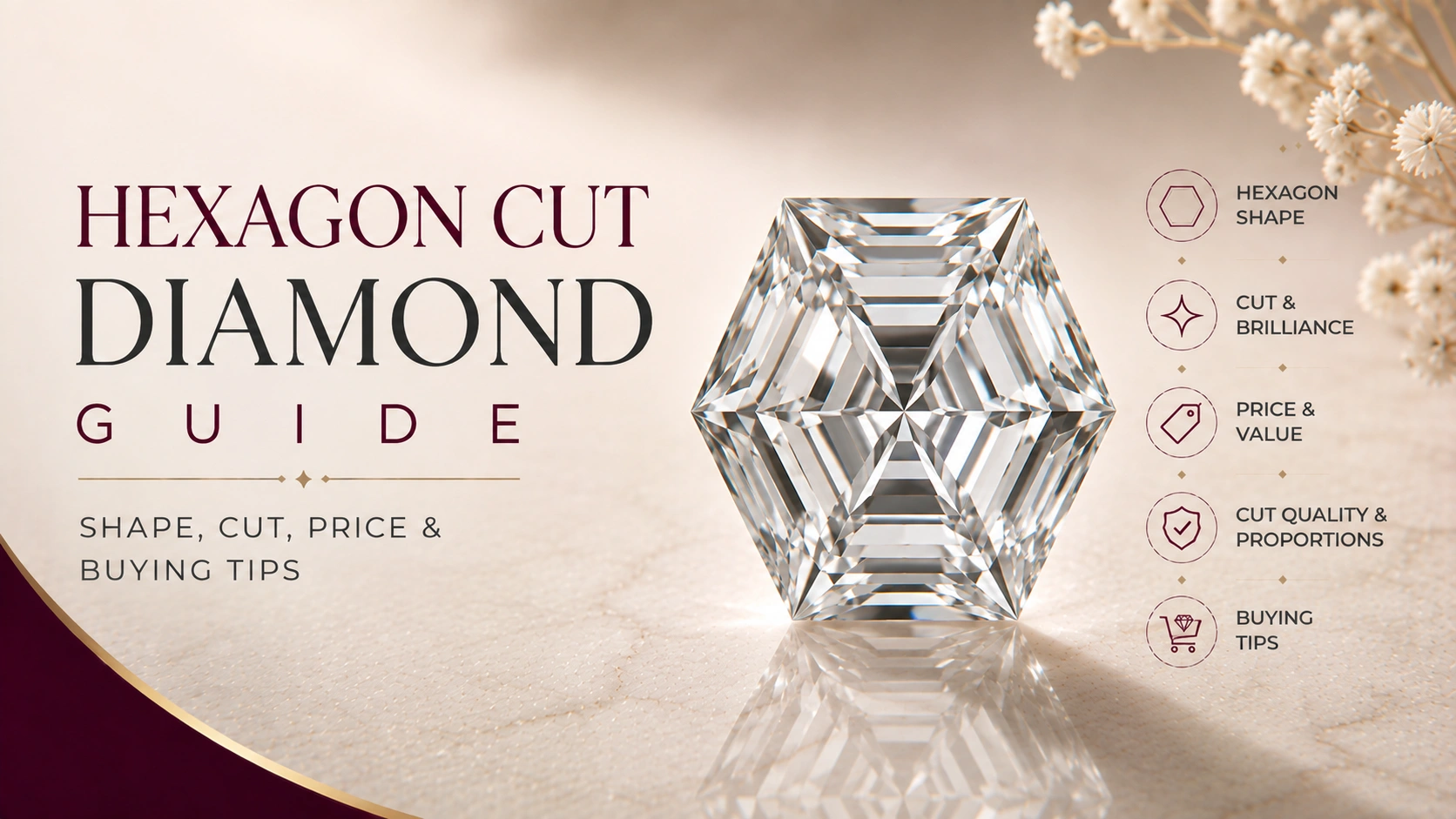
A hexagon cut diamond is a diamond with a six-sided outline. The sides create a strong geometric appearance, making the shape noticeably different from traditional round, oval, pear, or cushion diamonds.
Hexagon diamonds are generally considered fancy-shaped diamonds because they do not follow the standardized round brilliant cutting pattern. The hexagonal outline can be regular and symmetrical or elongated for a longer appearance on the finger.
One important point is that hexagon describes the shape of the diamond’s outline, not necessarily one specific facet pattern.
A hexagon diamond can be cut with step facets, brilliant-style facets, or other approaches. Step-cut hexagons are particularly recognizable for their long, linear facets and broad flashes of light, while brilliant-cut versions can provide more active sparkle.
This distinction matters when comparing stones because two diamonds with the same hexagonal outline can look very different.
What Does a Hexagon Diamond Look Like?
The defining characteristic of a hexagon diamond is its six-sided silhouette.
A traditional hexagon has relatively balanced proportions, with the sides creating a symmetrical geometric outline. An elongated hexagon stretches the shape vertically, giving it a longer appearance when worn on the finger.
The overall look can be:
- Geometric
- Architectural
- Modern
- Symmetrical
- Bold
- Minimalist
- Vintage-inspired, depending on the faceting and setting
Step-cut hexagons tend to have a cleaner, more structured appearance because their larger facets produce broad flashes rather than the rapid sparkle associated with brilliant cuts.
If you are comparing diamond shapes more broadly, you can also explore this guide to diamond shapes to see how hexagons fit into the larger range of options.
Hexagon Cut vs. Hexagonal Diamond
The terms hexagon cut diamond and hexagonal diamond are often used interchangeably.
In practice, both generally refer to a diamond with a six-sided outline. However, the word “cut” can sometimes make it sound as though every hexagon diamond follows one standardized cutting design.
That is not necessarily the case.
The outline can remain hexagonal while the internal faceting changes. A step-cut hexagon, for example, will have a very different visual personality from a brilliant-cut hexagon.
For this reason, when shopping, look beyond the shape name and examine the actual stone.
Types of Hexagon Diamond Cuts
Step-Cut Hexagon Diamonds
Step-cut hexagons have long, straight facets arranged in parallel rows. The visual effect is similar in concept to an emerald or Asscher cut.
Instead of producing constant pinfire-style sparkle, step facets create broad flashes and a reflective, hall-of-mirrors appearance.
This style can look especially elegant when the diamond has:
- Strong symmetry
- Clean facet alignment
- Good transparency
- Well-balanced proportions
- Minimal visible inclusions
The larger, open facets also make clarity more important because inclusions can be easier to see through the stone.
Brilliant-Cut Hexagon Diamonds
Brilliant-cut hexagons use a more complex arrangement of facets designed to create lively sparkle and light return.
Compared with a step cut, a brilliant-cut hexagon generally has a busier facet pattern. This can make the diamond appear more dynamic and can also help disguise small inclusions.
A brilliant-cut hexagon is a good option if you like the unusual six-sided outline but want a more traditional sparkling appearance.
Rose-Cut Hexagon Diamonds
Some hexagon diamonds are created with rose-cut faceting. Rose cuts typically have a flat base and a domed crown covered with triangular facets.
They produce a softer, more subtle glow rather than the intense brilliance of a modern brilliant cut.
Rose-cut hexagons can work particularly well for vintage-inspired, minimalist, and unconventional engagement rings.
Regular vs. Elongated Hexagon Diamonds
Not every hexagon diamond has the same proportions.
Regular Hexagon
A regular hexagon has a more balanced, symmetrical appearance. Its compact shape emphasizes the geometric character of the stone.
It can work particularly well in:
- Bezel settings
- Solitaire rings
- Geometric designs
- Cluster rings
- Modern engagement rings
Elongated Hexagon
An elongated hexagon has a longer outline, which creates more visual length on the finger.
This can be appealing if you like the geometry of a hexagon but want a shape with a more elongated appearance.
The length-to-width ratio becomes especially important here. A lower ratio produces a broader appearance, while a higher ratio makes the diamond look longer and slimmer.
There is no single ideal ratio for everyone. The right proportions depend on the look you prefer and how the diamond interacts with the ring setting.
Hexagon Diamond 4Cs
The traditional 4Cs—cut, color, clarity, and carat—still matter when buying a hexagon diamond, but the priorities can differ depending on the stone’s faceting.
For more background, see this overview of the 4Cs of diamond quality.
Cut
Cut quality is particularly important for a hexagon because the geometric outline makes symmetry and facet alignment easy to notice.
Look for:
- Balanced proportions
- Strong symmetry
- Well-aligned facets
- Good polish
- Attractive light performance
- A pleasing face-up appearance
Unlike a round brilliant, a fancy-shaped diamond such as a hexagon does not have the same standardized cut-grade framework. That means the actual appearance of the stone deserves close attention.
Do not choose a hexagon simply because its grading report or listing uses an attractive shape description. Examine the diamond itself.
Clarity
Clarity becomes especially important with step-cut hexagons.
Their broad, open facets can make inclusions easier to spot than they would be in a more heavily faceted brilliant-cut diamond.
A practical approach is to prioritize an eye-clean diamond rather than automatically paying for the highest clarity grade.
For brilliant-cut hexagons, the more complex facet pattern may make minor inclusions less noticeable.
For step-cut hexagons, you may want to consider higher clarity grades if an inclusion is visible through the large central facets.
The goal is not necessarily the highest clarity grade. The goal is a diamond that looks clean to the naked eye.
Color
Color preference is largely personal, but the faceting style can influence how color is perceived.
A step-cut diamond has large, open facets that can make body color more noticeable. If you prefer a crisp, icy appearance, you may want to consider a higher color grade.
A slightly warmer diamond can still look beautiful, particularly when paired with yellow or rose gold.
Instead of paying automatically for the highest color grade, compare diamonds in their intended setting.
You can learn more about choosing color in this diamond color guide.
Carat Weight
Carat tells you how much the diamond weighs, not exactly how large it looks from above.
Two hexagon diamonds with the same carat weight can have different face-up dimensions because of differences in depth, proportions, and cutting.
When shopping, pay attention to the diamond’s measurements in millimeters in addition to its carat weight.
If visual size is important to you, compare the actual length and width of the stones rather than relying on carat weight alone.
For more information about diamond weight and appearance, see the diamond carat guide.
How Much Does a Hexagon Diamond Cost?
There is no fixed price for a hexagon diamond.
The price depends on factors such as:
- Carat weight
- Color
- Clarity
- Faceting style
- Cut quality
- Symmetry
- Natural or lab-grown origin
- Availability
- Overall visual appeal
Hexagon diamonds can also be less readily available than mainstream shapes such as round, oval, and cushion diamonds. That can make comparing individual stones more important than relying on a simple price-per-carat expectation.
If you are working with a specific engagement-ring budget, compare the complete stone rather than assuming the unusual shape will automatically be cheaper or more expensive.
Are Hexagon Diamonds Good for Engagement Rings?
Yes. A well-cut and properly set hexagon diamond can make an excellent engagement ring.
The shape offers something different from the most common engagement-ring silhouettes while still providing a sophisticated and versatile appearance.
Hexagon diamonds can work particularly well for someone who wants:
- A distinctive center stone
- Strong geometric styling
- A modern engagement ring
- An unconventional alternative to an oval or round
- A vintage or Art Deco-inspired look
- A stone that stands out without relying on an elaborate setting
The main consideration is the setting.
Because the diamond has defined corners, the setting should hold the stone securely and provide appropriate protection. Current buying guides commonly recommend paying close attention to how the corners are secured.
Best Settings for Hexagon Diamonds
Bezel Setting
A bezel setting surrounds the diamond with metal and can emphasize the geometric outline.
It is also useful when you want additional protection around the edges and corners.
A bezel can give a hexagon engagement ring a sleek, contemporary appearance while keeping the design relatively minimal.
Solitaire Setting
A solitaire allows the six-sided shape to remain the focal point.
This is one of the simplest ways to showcase a hexagon diamond because there are fewer surrounding elements competing with its outline.
A solitaire can make a regular hexagon feel bold and architectural, while an elongated hexagon can create a graceful vertical appearance.
Halo Setting
A halo can make the center diamond appear larger and add additional sparkle around the geometric outline.
A traditional round halo creates contrast with the angular center stone, while a custom geometric halo can reinforce the hexagon shape.
Three-Stone Setting
A three-stone design can create a more substantial engagement ring while maintaining the hexagon as the central focal point.
Side stones can be selected to complement or contrast with the six-sided center diamond.
East-West Setting
An elongated hexagon does not have to be placed vertically.
Setting it east-west rotates the long axis across the finger, creating a wider and more unconventional look.
This can be an especially appealing option for someone who wants the unusual shape to be immediately noticeable.
Hexagon Diamond Durability
Diamond is extremely hard, but hardness and toughness are not the same thing.
A diamond’s hardness relates to its resistance to scratching, while toughness concerns how well it withstands impact.
The corners of a hexagon diamond can therefore deserve attention when selecting a setting. Some hexagons have more pronounced corners, while others have modified or slightly softened edges.
A well-designed setting can help protect vulnerable areas.
For additional context about why settings use protective prongs, see why engagement rings have prongs.
Hexagon Diamond Pros and Cons
Pros
- Distinctive six-sided shape
- Strong geometric appearance
- Uncommon alternative to traditional diamond shapes
- Available in different faceting styles
- Works well with modern and vintage-inspired designs
- Can look excellent in minimalist settings
- Elongated versions can create visual length on the finger
- Multiple hexagons can create striking geometric patterns
Hexagon diamonds can also work particularly well in clusters because their six-sided geometry can be arranged into repeating patterns.
Cons
- Less standardized than popular diamond shapes
- Individual stone quality can vary significantly
- Step-cut versions can show inclusions more readily
- Symmetry is especially important
- Finding the exact size, proportions, and faceting you want may take more searching
- Corners need appropriate consideration when choosing a setting
- Some buyers may prefer the stronger sparkle of a brilliant-cut shape
Hexagon vs. Other Diamond Shapes
Hexagon diamonds occupy a fairly unique position because their appeal comes strongly from their geometry.
Hexagon vs. Emerald Cut
Both can use step-style faceting and produce broad flashes rather than intense, scattered sparkle.
The main difference is the outline. Emerald cuts have a rectangular shape with clipped corners, while hexagons have six defined sides.
If you like the clean look of an emerald cut but want something more unconventional, a step-cut hexagon may be worth considering.
See the emerald cut diamond guide for more information about that shape.
Hexagon vs. Asscher Cut
Asscher cuts are square-shaped step cuts with cropped corners and a distinctive concentric appearance.
Hexagons take the same general geometric idea in a different direction with six sides.
Both can appeal to shoppers who prefer symmetry and architectural styling over traditional brilliant-cut sparkle.
You can compare the two approaches further with the Asscher cut diamond guide.
Hexagon vs. Round
Round diamonds are the classic choice for maximum familiarity and traditional brilliance.
A hexagon is almost the opposite stylistically. It puts the emphasis on geometry and individuality.
If sparkle and conventional proportions are your top priorities, a round may be more appealing. If uniqueness and shape are more important, a hexagon can be a compelling alternative.
See the round cut diamond guide for a closer look at the classic option.
How to Choose a Hexagon Diamond
When comparing hexagon diamonds, start with the shape and work inward.
1. Decide on the outline
Choose between a regular or elongated hexagon based on how you want the ring to look on the finger.
2. Choose the faceting style
Decide whether you prefer:
- Step-cut reflections
- Brilliant-cut sparkle
- Soft rose-cut glow
This decision can change the entire personality of the diamond.
3. Check symmetry
Look closely at the six sides.
Uneven proportions or poorly aligned facets can be particularly obvious because the shape is so geometric.
4. Examine clarity
For step cuts, inspect the diamond carefully for visible inclusions.
For brilliant cuts, focus on whether the stone is eye-clean rather than automatically choosing the highest clarity grade.
You can use this diamond clarity guide to understand the grading system.
5. Compare measurements
Look at length, width, and depth rather than carat weight alone.
The measurements tell you how much surface area the diamond presents when viewed from above.
6. Think about the setting
Consider how the corners will be secured and whether you want the geometric outline fully exposed.
A bezel, protective prongs, or another appropriately designed setting can influence both appearance and everyday wear.
7. View the actual diamond
This may be the most important step.
Because hexagon diamonds do not all follow one standardized cutting design, two stones with similar specifications can look noticeably different.
Look for the combination of symmetry, transparency, proportions, facet pattern, and overall visual appeal that suits you.
Is a Hexagon Diamond a Good Choice for You?
A hexagon diamond can be an excellent choice if you want an engagement ring that feels personal and unconventional without becoming overly complicated.
It is particularly appealing to shoppers who enjoy clean geometry, architectural design, and less common diamond shapes.
The best hexagon is not necessarily the largest, highest-clarity, or most expensive stone. It is the one with attractive proportions, strong symmetry, suitable clarity for its faceting style, and a setting that complements and protects the shape.
If you are still comparing unusual diamond shapes, explore the broader collection of diamond cut guides to see how hexagon compares with other less-common options.
Frequently Asked Questions
Are hexagon cut diamonds rare?
Hexagon diamonds are less commonly seen than mainstream shapes such as round, oval, cushion, and princess. Their relative scarcity can make them appealing to shoppers looking for a more distinctive engagement ring.
Do hexagon diamonds sparkle?
Yes, but the amount and character of sparkle depend heavily on the faceting style. Brilliant-cut hexagons can provide lively sparkle, while step-cut hexagons tend to produce broader flashes and a more reflective appearance.
Are hexagon diamonds expensive?
Not necessarily. Price depends on carat weight, color, clarity, cut quality, origin, availability, and the individual stone. There is no universal price premium simply because a diamond is hexagonal.
Is a hexagon diamond good for an engagement ring?
Yes. Hexagon diamonds can work very well as engagement-ring center stones when they are properly cut and securely set. Their geometric outline gives the ring a distinctive appearance.
What is the best setting for a hexagon diamond?
There is no single best setting. Bezel, solitaire, halo, three-stone, and east-west settings can all work well. The right choice depends on whether you want to emphasize the geometric outline, add protection, increase visual size, or create a particular style.
Are hexagon diamonds durable?
They can be suitable for everyday wear when properly set. The diamond itself is highly scratch-resistant, but the corners should still be considered when selecting a setting because impact can damage a diamond even though it is very hard.
What clarity should I choose for a hexagon diamond?
It depends on the faceting. Step-cut hexagons generally benefit from closer clarity inspection because their larger facets can make inclusions easier to see. Brilliant-cut hexagons can be more forgiving. In either case, prioritize an eye-clean appearance over simply choosing the highest grade.
What is an elongated hexagon diamond?
An elongated hexagon is a six-sided diamond with a longer length-to-width ratio. Its stretched outline gives the diamond a slimmer appearance and can create additional visual length on the finger.
Can hexagon diamonds be set east-west?
Yes. An elongated hexagon can be rotated horizontally across the finger for a more distinctive east-west engagement-ring design.
Final Takeaway
A hexagon cut diamond is all about geometry and individuality.
Its six-sided outline creates a look that is immediately different from traditional diamond shapes, while the choice of step, brilliant, or rose faceting determines how that outline interacts with light.
When shopping, focus on symmetry, proportions, faceting style, clarity, measurements, and setting security rather than relying on the shape name alone.
For the right buyer, a well-chosen hexagon diamond can be a striking center stone that feels both contemporary and timeless.