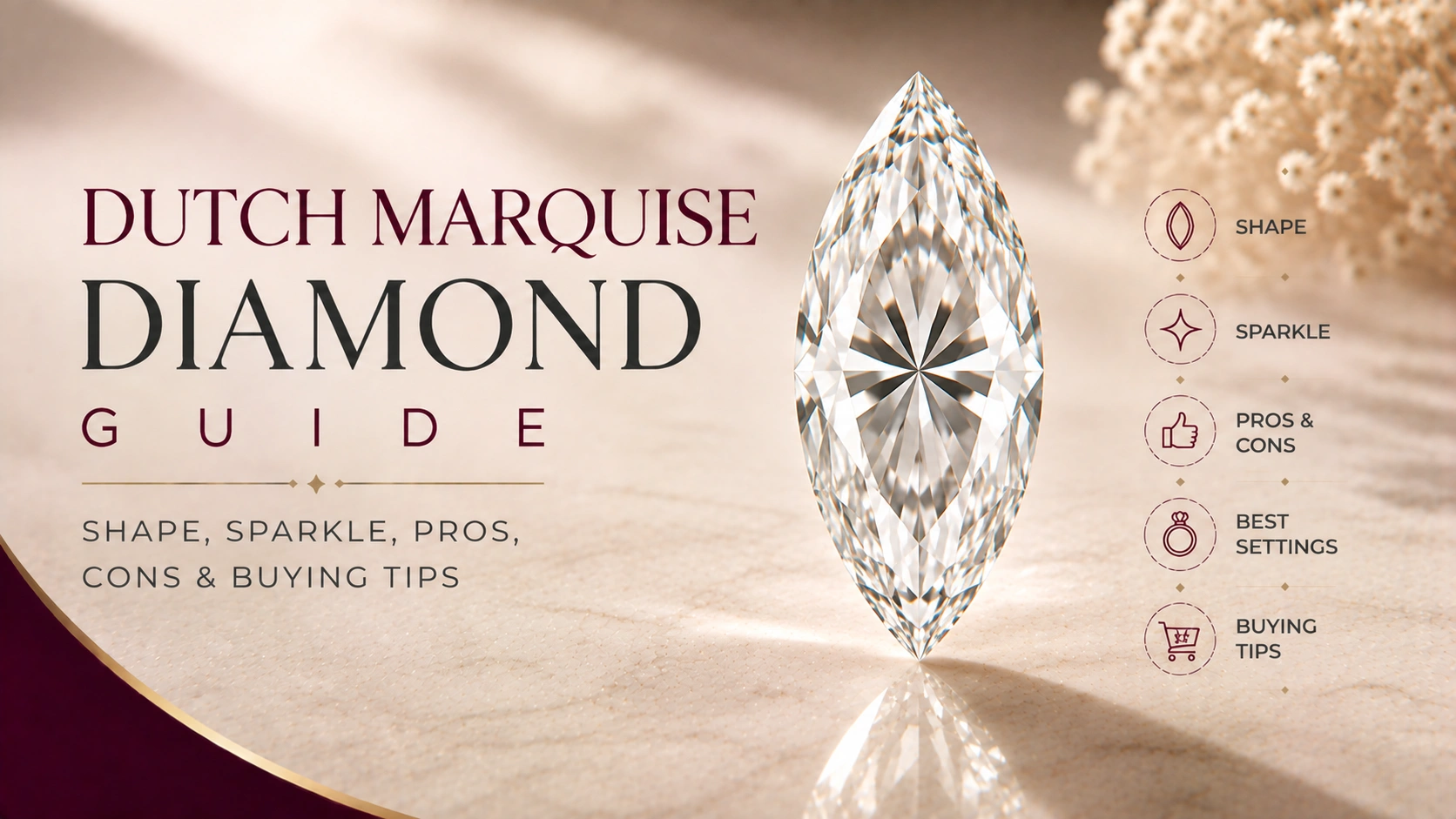
A Dutch Marquise diamond is a distinctive elongated diamond shape that combines the length of a marquise with a more geometric appearance. Instead of the smoothly curved sides associated with a traditional marquise, Dutch Marquise designs are generally characterized by straighter, more angular lines and a fuller, structured silhouette.
It is an uncommon choice for an engagement ring, which makes it appealing to shoppers who want something more distinctive than a round, oval, or traditional marquise diamond.
One important detail is that “Dutch Marquise” is not a universally standardized gemological shape name. Different jewelers and cutters may use the term somewhat differently. That means shoppers should pay attention to the diamond’s actual outline, proportions, faceting, grading report, and appearance rather than relying on the name alone.
What Is a Dutch Marquise Diamond?
A Dutch Marquise diamond is a specialty elongated diamond shape inspired by the traditional marquise silhouette.
The defining visual idea is a long, narrow outline with pointed ends and more angular sides. Depending on the cutter and design, the stone may appear closer to an elongated hexagon or a geometric interpretation of a marquise.
This gives the Dutch Marquise a different personality from a conventional marquise diamond.
A traditional marquise tends to have flowing, curved sides that create a soft boat-like outline. A Dutch Marquise generally has a more architectural appearance, with straighter lines and stronger geometric definition.
Because the terminology is not standardized, two stones marketed as Dutch Marquise diamonds may not look exactly alike. For that reason, photographs, measurements, proportions, and the actual stone matter more than the label.
What Does a Dutch Marquise Diamond Look Like?
The easiest way to recognize a Dutch Marquise is to look at its overall outline.
Typical characteristics can include:
- An elongated silhouette
- Pointed ends
- Straighter or more angular sides
- A fuller central body
- Strong geometric symmetry
- A distinctive appearance compared with traditional marquise diamonds
The shape is particularly interesting because it sits between familiar and unusual.
It retains the elongated presence that makes marquise diamonds attractive, but its geometry gives it a sharper and more contemporary character.
On the finger, an elongated diamond can also create a lengthening effect. Because more of the stone’s surface is distributed across its length, it may provide substantial visual coverage relative to its carat weight.
For shoppers interested in how different shapes affect finger appearance, a guide to the [best diamond shapes for long fingers] can provide useful context.
Dutch Marquise vs. Traditional Marquise
The biggest difference is the outline.
A traditional marquise diamond has two pointed ends connected by smoothly curved sides. A Dutch Marquise generally has a more angular, geometric outline.
| Feature | Dutch Marquise | Traditional Marquise |
|---|---|---|
| Overall look | Geometric and architectural | Curved and elegant |
| Ends | Pointed | Pointed |
| Side profile | Generally straighter and angular | Smoothly curved |
| Appearance | Distinctive and uncommon | Classic and recognizable |
| Finger coverage | High | High |
| Style | Modern, vintage-inspired, or unconventional | Romantic and traditional |
Neither shape is inherently better.
The better choice depends on the look you want. If you like the classic romance of a marquise but want something less familiar, a Dutch Marquise can be an interesting alternative.
If you prefer a well-established shape with a softer outline and a larger selection of stones, the traditional marquise may be easier to shop for.
You can also compare the Dutch Marquise with other elongated silhouettes in our guide to [marquise vs. oval vs. pear diamonds].
Is Dutch Marquise an Official Diamond Shape?
Not in the same way as widely recognized shape categories such as round, oval, pear, or marquise.
“Dutch Marquise” is best treated as a specialty or trade term. Current jewelers and diamond sellers do not use one universally agreed definition for the term, and grading laboratories generally classify diamonds according to their measurable shape and cutting characteristics rather than every specialty marketing name.
That distinction matters when buying one.
A seller may call a stone a Dutch Marquise, but the grading report may use a different description. Therefore, buyers should not assume that the name alone guarantees a particular facet pattern or exact outline.
When evaluating a stone, look at:
- The grading report
- Measurements
- Length-to-width ratio
- Symmetry
- Actual photographs or video
- Faceting pattern
- Girdle and tip condition
- How the stone performs under different lighting
In other words, treat “Dutch Marquise” as a description of a particular design style rather than a substitute for examining the diamond itself.
How Does a Dutch Marquise Diamond Sparkle?
Sparkle depends heavily on the specific cut.
There is no single universal facet arrangement for every diamond marketed as a Dutch Marquise. Some contemporary versions are designed with brilliant-style faceting, while other uses of the name are associated with antique-inspired cutting traditions.
That means you should not assume that every Dutch Marquise diamond will have the same type or amount of brilliance.
A well-cut stone can show attractive brightness, contrast, and scintillation, but proportions and facet arrangement matter.
When comparing stones, look for a diamond that appears lively rather than one that has large areas of persistent darkness or dullness.
This is also why it can be useful to understand the broader difference between [step-cut and brilliant-cut diamonds].
Dutch Marquise Diamond Pros
1. It is distinctive
The biggest advantage is individuality.
Dutch Marquise diamonds are far less common in engagement rings than round, oval, cushion, or even traditional marquise diamonds. If you want a center stone that immediately looks different, this shape is worth considering.
2. It provides strong finger coverage
The elongated outline spreads the diamond’s visual presence across the finger.
As with other elongated shapes, this can make the stone appear substantial relative to its carat weight.
3. It combines length with geometric character
A traditional marquise can feel soft and romantic. A Dutch Marquise can introduce sharper lines and a more structured appearance.
That makes it particularly interesting for modern, Art Deco-inspired, or vintage-influenced jewelry designs.
4. It works with several ring styles
The unusual shape does not mean you are limited to one setting.
A Dutch Marquise can work well in a solitaire, halo, hidden halo, three-stone, or side-stone design depending on the proportions of the center stone and the overall ring.
5. It can appeal to vintage and modern tastes
Because the terminology is used for more than one style of cut, Dutch Marquise diamonds can appear in both contemporary and antique-inspired designs.
The specific stone and faceting style determine the final personality of the ring.
Dutch Marquise Diamond Cons
1. Selection can be limited
Because this is a specialty shape, shoppers may have fewer stones to compare than they would with a round or oval diamond.
That can make it harder to find the exact combination of carat weight, color, clarity, proportions, and price you want.
2. The name can be inconsistent
This is one of the biggest things buyers should understand.
There is not one universally enforced definition of Dutch Marquise. Different sellers may use the name for somewhat different outlines or faceting styles.
Always inspect the actual diamond.
3. Pointed ends need attention
Pointed diamond tips are naturally more exposed than the rounded edges of a round or oval stone.
If the Dutch Marquise you choose has pronounced points, the setting should provide appropriate protection.
Prongs positioned around vulnerable areas can help secure the stone and reduce the risk of accidental impact. For more background, see our guide explaining why engagement rings have prongs.
4. Symmetry is especially important
An elongated geometric shape makes asymmetry easier to notice.
Look closely at both sides of the diamond. The two ends should feel balanced, and the outline should look intentional rather than lopsided.
How to Choose a Dutch Marquise Diamond
Because there is no single standardized Dutch Marquise formula, evaluating the actual stone is particularly important.
Check the length-to-width ratio
The ratio determines how elongated the diamond appears.
There is no single perfect ratio for every buyer. Some people prefer a slimmer, more dramatic shape, while others prefer a shorter and fuller appearance.
Rather than chasing a specific number, compare stones visually and decide which proportions fit your taste.
Examine symmetry
Symmetry should be high on your checklist.
Look at the stone from directly above and compare both sides. Uneven shoulders, mismatched ends, or an irregular outline can make a specialty cut look less refined.
Evaluate the faceting
Look at the stone under different lighting conditions.
A good diamond should show attractive brightness and lively contrast rather than appearing consistently flat or dark.
If possible, view both still photographs and video before purchasing.
Pay attention to color
Elongated diamonds can sometimes make body color more noticeable, particularly toward their ends or depending on their proportions and faceting.
Your choice of color grade should also take the ring metal into account.
For a broader explanation of diamond color, see our guide to [diamond color].
Do not overpay for clarity
Clarity should be judged by what you can actually see.
A higher clarity grade is not automatically a better purchase if lower-graded stones are eye-clean and offer better value.
The right balance depends on the diamond’s size, faceting, inclusions, and viewing distance.
Our guide to [diamond clarity] can help explain how clarity grades work.
Verify the grading report
For a significant diamond purchase, an independent grading report provides useful information about the stone’s characteristics.
Because “Dutch Marquise” is a specialty term, the report is especially useful for separating the seller’s marketing terminology from the measurable characteristics of the diamond.
Best Settings for a Dutch Marquise Engagement Ring
The right setting can either emphasize the unusual shape or make it part of a more traditional design.
Solitaire
A solitaire is one of the simplest choices.
With no competing center stones, the Dutch Marquise becomes the main visual feature. A clean band can make the geometric outline especially noticeable.
Halo
A halo adds more visual presence around the center stone.
This can create a glamorous look while emphasizing the elongated outline.
Hidden halo
A hidden halo can add sparkle around the underside of the center stone without changing the clean appearance from the top.
It is a good option if you want extra detail without overwhelming the unusual shape.
Three-stone setting
Side stones can frame the Dutch Marquise and create a more substantial engagement ring.
The side stones should be chosen carefully so they complement rather than compete with the distinctive center.
Cathedral setting
A cathedral-style design can give the center diamond additional height and create a more dramatic presentation.
If you are deciding between elevated and lower-profile designs, compare a [cathedral vs. low-profile engagement ring] before choosing your setting.
Is a Dutch Marquise Diamond Rare?
The answer depends on what is meant by “Dutch Marquise.”
As a specialty shape, it is certainly much less common than mainstream diamond shapes such as round, oval, and cushion. But the market includes different interpretations of the term, including modern stones and antique-inspired versions.
Genuine historical examples of unusual antique cuts can be particularly difficult to find, while modern stones inspired by those shapes can be produced today.
Therefore, rarity should not be assumed simply because a seller uses the term “Dutch Marquise.”
If rarity and historical provenance are important to you, ask whether the specific diamond is an antique original or a modern reproduction.
Is a Dutch Marquise Good for an Engagement Ring?
Yes, it can be an excellent choice if you value individuality and an elongated silhouette.
It is particularly well suited to someone who wants:
- A distinctive center stone
- An elongated appearance
- Strong finger coverage
- A geometric design
- Something less common than an oval or round
- A ring with vintage or architectural character
However, it may not be ideal if you want the easiest possible shopping experience.
Mainstream diamond shapes offer far more inventory, standardized expectations, and comparison options. With a Dutch Marquise, you need to spend more time evaluating the individual stone.
Dutch Marquise vs. Other Diamond Shapes
The Dutch Marquise sits in an interesting position among elongated diamond shapes.
A traditional marquise provides a softer, curved silhouette.
An oval gives you an elongated shape without pointed ends and tends to have a softer overall appearance.
A pear combines a rounded end with a single point, creating a teardrop-like profile.
An emerald cut provides a more rectangular outline and step-cut faceting, producing broader flashes rather than the same visual effect associated with brilliant-style faceting.
A Dutch Marquise is more geometric and unusual, making it a strong option for someone who wants an elongated center stone but does not want a conventional outline.
For more comparisons, see the existing guides on Dutch Marquise vs. pear, Dutch Marquise vs. old mine, Dutch Marquise vs. oval, and Dutch Marquise vs. emerald.
Frequently Asked Questions
Is a Dutch Marquise the same as a marquise diamond?
No. They share an elongated concept and pointed ends, but a Dutch Marquise generally has a more geometric and angular outline. The exact appearance can vary because the term is not universally standardized.
Does a Dutch Marquise sparkle?
It can. Sparkle depends on the individual diamond’s faceting, proportions, symmetry, and cut quality. Different Dutch Marquise stones can perform differently.
Does a Dutch Marquise look bigger than its carat weight?
Its elongated outline can provide strong face-up coverage relative to its weight, similar to other elongated diamond shapes. However, the actual visual size depends on the stone’s measurements and proportions.
Is Dutch Marquise a modern or antique cut?
The term is used in different ways. Some current sellers use it for modern specialty cuts, while others associate it with antique-inspired or historical cutting styles. Always ask about the specific stone rather than assuming its age from the name.
Is Dutch Marquise a good choice for a unique engagement ring?
Yes. Its relative rarity and geometric appearance make it a strong option for someone who wants an engagement ring that looks different from more common diamond shapes.
What setting is best for a Dutch Marquise?
There is no single best setting. Solitaire, halo, hidden halo, three-stone, and cathedral settings can all work. The best choice depends on the stone’s proportions and the style you want.
Should the tips be protected?
Yes. If the diamond has pronounced pointed ends, a setting that provides appropriate protection around those areas is worth considering.
Final Takeaway
A Dutch Marquise diamond offers an unusual combination of elongation, pointed ends, and geometric character. It can give an engagement ring a distinctive appearance while maintaining the finger-lengthening effect associated with elongated diamond shapes.
The most important thing to remember is that “Dutch Marquise” is not a universally standardized diamond-shape designation. The term can be used differently by different sellers and cutters.
So instead of buying based on the name alone, examine the stone’s actual outline, proportions, symmetry, faceting, grading information, and performance.
For shoppers who want something less conventional than a round, oval, or traditional marquise, that extra research can be well worth it.
5. Internal Linking Plan
I found these highly relevant URLs in the Diamiv internal-link database, including the exact guide URL and several Dutch Marquise comparison pages.
- Dutch Marquise vs. Oval →
https://www.diamiv.com/dutch-marquise-vs-oval-engagement-ring/ - Dutch Marquise vs. Pear →
https://www.diamiv.com/dutch-marquise-vs-pear-engagement-ring/ - Dutch Marquise vs. Old Mine →
https://www.diamiv.com/dutch-marquise-vs-old-mine-engagement-ring/ - Dutch Marquise vs. Emerald →
https://www.diamiv.com/dutch-marquise-vs-emerald-engagement-ring/ - Marquise Cut Diamond Guide →
https://www.diamiv.com/marquise-cut-diamond-guide/ - Best Diamond Shape for Long Fingers →
https://www.diamiv.com/best-diamond-shape-for-long-fingers/ - Types of Diamond Cuts →
https://www.diamiv.com/types-of-diamond-cuts/ - Step Cut vs. Brilliant Cut Diamonds →
https://www.diamiv.com/step-cut-vs-brilliant-cut-diamonds/ - Diamond Color →
https://www.diamiv.com/diamond-color/ - Diamond Clarity →
https://www.diamiv.com/diamond-clarity/ - Why Do Engagement Rings Have Prongs? →
https://www.diamiv.com/why-do-engagement-rings-have-prongs/ - Cathedral vs. Low-Profile Engagement Ring →
https://www.diamiv.com/cathedral-vs-low-profile-engagement-ring/