If you want an engagement ring that feels different from the usual round, oval, or cushion diamond, both Dutch Marquise and Old Mine cuts are worth a closer look.
At first, they seem to belong to the same world. Both have an old-world feel, both can look distinctive in an engagement ring, and neither is as predictable as a modern round brilliant. But they create very different impressions on the finger.
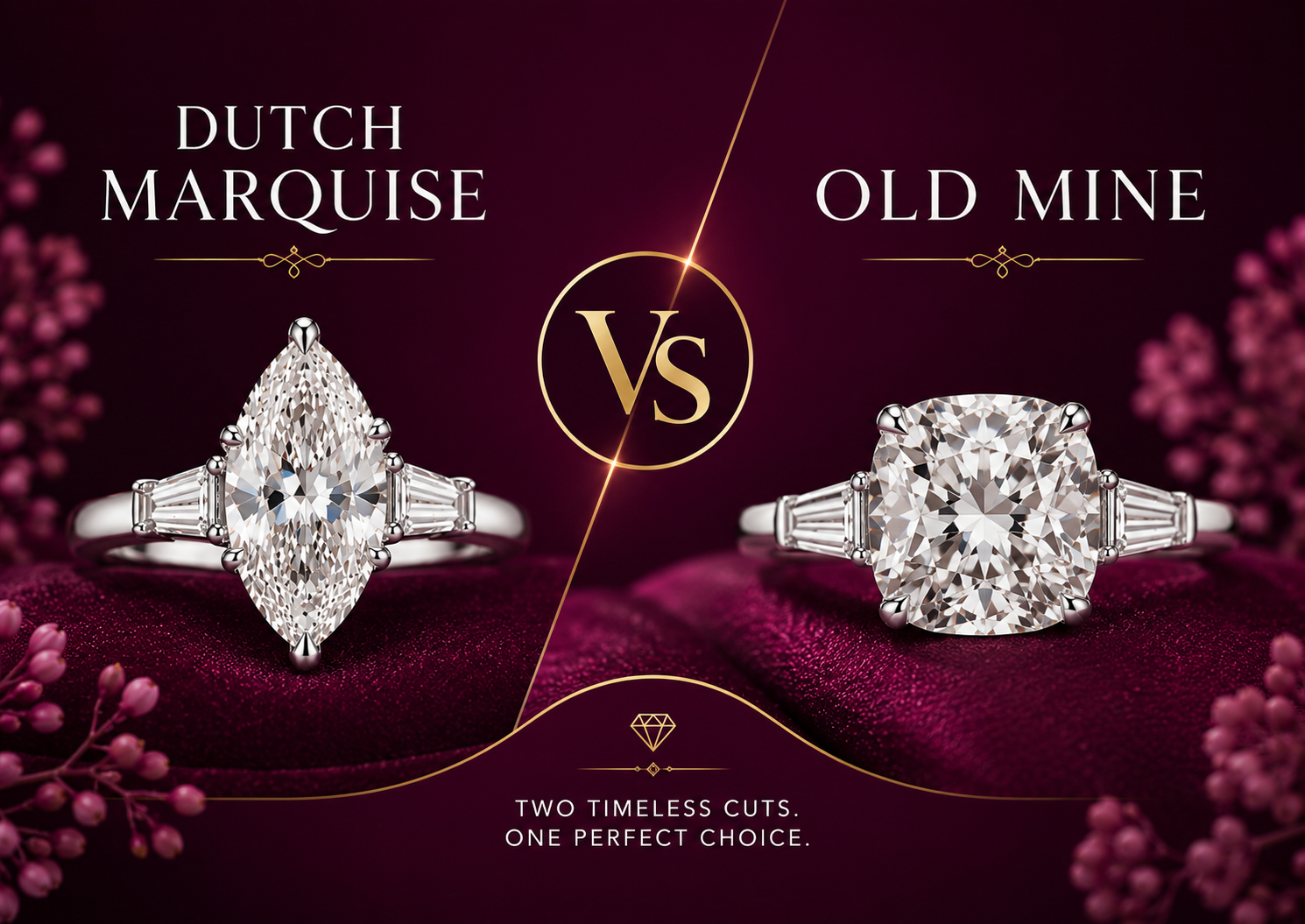
A Dutch Marquise has a long, geometric silhouette with pointed ends and straight, angled sides. An Old Mine cut has a softer, squarer or cushion-like outline, usually with rounded corners, a high crown, small table, large facets, and a visible culet.
The biggest difference comes down to personality: Dutch Marquise feels architectural and elongated, while Old Mine feels soft, romantic, and unmistakably antique.
Dutch Marquise vs Old Mine at a Glance
| Feature | Dutch Marquise | Old Mine Cut |
|---|---|---|
| Overall shape | Elongated, angular, hexagonal | Squarish or cushion-like |
| Ends | Two pointed tips | Rounded corners |
| Faceting | Often brilliant-style or antique-inspired | Broad, chunky antique facets |
| Sparkle | Lively, crisp flashes depending on the stone | Broader, softer flashes and fire |
| Overall look | Geometric, unusual, elegant | Romantic, warm, vintage |
| Symmetry | Typically more structured | Can show natural hand-cut irregularity |
| Best for | Someone who wants a rare elongated shape | Someone who wants authentic antique character |
| Style direction | Vintage-inspired with a modern edge | Strongly antique and heirloom-inspired |
What Is a Dutch Marquise Diamond?
A Dutch Marquise is an elongated diamond shape with two pointed ends and straight, angled sides. Rather than having the continuously curved sides of a traditional marquise, its outline reads more like an elongated hexagon.
One important detail is that Dutch Marquise is generally used as a trade name rather than an official laboratory shape designation. A grading report may describe the stone using geometric terminology instead of the words “Dutch Marquise.”
That makes the actual stone especially important when shopping. Look beyond the name and examine its proportions, symmetry, facet pattern, and overall light performance.
The shape is appealing if you like the finger-lengthening effect of a marquise but want something more angular and unusual.
It also works well for shoppers who want a vintage-inspired diamond without choosing a conventional antique shape.
What Is an Old Mine Cut Diamond?
The Old Mine cut is a historic diamond cut that was widely used during the 18th and 19th centuries. Unlike modern diamonds, these stones were shaped by hand, so proportions and outlines can vary considerably from one stone to another.
Typical characteristics include:
- A high crown
- A relatively small table
- Broad facets
- A deep pavilion
- A large or visible culet
- A cushion-like or softly squared outline
- Individual variations caused by hand cutting
GIA notes that Old Mine cuts typically have 58 facets, but their facet arrangement and proportions differ significantly from modern brilliant cuts. Their broad facets can create larger flashes of light and noticeable fire.
That is why an Old Mine diamond does not necessarily look “less sparkly.” It simply produces a different kind of sparkle.
Instead of the rapid, precise scintillation associated with a modern brilliant, you can see broader and slower flashes of light.
Dutch Marquise vs Old Mine: The Biggest Differences
1. Shape
Shape is probably the easiest difference to spot.
The Dutch Marquise has a long, narrow, angular outline. Its straight sides and pointed ends give it a more architectural appearance.
The Old Mine cut is much softer. Its outline is generally square or cushion-like with rounded corners.
If you want a diamond that visually stretches along the finger, Dutch Marquise has the advantage.
If you prefer a stone that looks substantial, soft, and slightly irregular, Old Mine is more likely to appeal.
2. Sparkle
The two cuts also approach light performance differently.
Dutch Marquise stones can produce lively flashes across their elongated surface, particularly when cut with effective proportions and brilliant-style faceting. However, because Dutch Marquise is a trade name rather than a single standardized cut specification, individual stones can vary.
Old Mine cuts are known for broader flashes created by their larger facets, high crowns, and antique proportions. GIA describes them as having relatively less brilliance but more fire than modern brilliant cuts.
So, if your definition of sparkle is:
Fast, energetic flashes: Dutch Marquise may be the better fit.
Large, warm, romantic flashes: Old Mine is the stronger choice.
Neither is automatically “better.” They simply create different visual effects.
3. Overall Personality
A Dutch Marquise tends to feel unusual, structured, and artistic.
Its elongated geometry gives the ring a strong visual identity without relying on a traditional round or oval silhouette.
Old Mine feels more romantic, historical, and heirloom-like.
The irregularity of antique stones can actually be part of their charm. Instead of looking machine-perfect, they can have subtle variations that make the individual diamond feel one of a kind.
If you want your ring to look like a piece of jewelry with a story, Old Mine has an obvious advantage.
If you want something that looks rare without necessarily looking like an antique ring, Dutch Marquise is compelling.
Which Has More Sparkle: Dutch Marquise or Old Mine?
There is no universal winner because sparkle depends heavily on the individual diamond.
Cut quality, proportions, symmetry, facet arrangement, lighting, and viewing angle all influence what you see.
Still, the type of sparkle is different.
Dutch Marquise generally gives you a more directional and energetic appearance. The elongated outline creates a distinctive light pattern across the stone.
Old Mine gives you larger, softer flashes. Its high crown and broad facets contribute to the warm, chunky light play associated with antique diamonds.
If you want maximum visual movement, pay close attention to the actual Dutch Marquise stone rather than choosing it solely because of the name.
If you love colorful fire and broad flashes, Old Mine may be more naturally aligned with your preferences.
Which Looks Bigger on the Finger?
Dutch Marquise can have an advantage in visual length because of its elongated outline.
Its shape draws the eye along the finger, which can make the hand appear longer and more slender.
Old Mine is different. Its broader, squarer outline tends to create more visual weight in the center of the ring.
That means the choice depends on what you want the diamond to emphasize.
Choose Dutch Marquise if you want:
- More finger coverage from end to end
- An elongated appearance
- A distinctive silhouette
- A more architectural look
Choose Old Mine if you want:
- A broader-looking center stone
- Soft corners
- A substantial antique appearance
- A more traditional vintage silhouette
Carat weight alone does not determine how large a diamond looks. Measurements and proportions matter too.
Dutch Marquise vs Old Mine for Vintage Engagement Rings
Both can work beautifully in vintage-inspired engagement rings, but they create different versions of vintage style.
Dutch Marquise: Vintage With a Modern Edge
Dutch Marquise is ideal if you want vintage influence without making the entire ring look like an antique reproduction.
Try pairing it with:
- Yellow gold
- Simple solitaire settings
- Bezel settings
- Geometric side stones
- Milgrain details
- Art Deco-inspired designs
Its angular outline works particularly well when the setting repeats geometric lines.
Old Mine: Authentic Antique Romance
Old Mine naturally lends itself to antique-inspired designs.
Consider:
- Yellow gold
- Rose gold
- Milgrain
- Filigree
- Beaded details
- Three-stone settings
- Halo designs
- Chunkier vintage bands
The stone itself already carries a historical visual language, so the setting does not need to work as hard to create a vintage effect.
Which Is More Durable for Everyday Wear?
The diamond material itself is extremely hard, but the shape and setting still matter.
Dutch Marquise has pointed ends. Those tips deserve particular attention when selecting a setting because exposed points can be more vulnerable to impact than rounded corners.
A protective bezel or secure prong arrangement can help protect the tips.
Old Mine cuts have rounded corners, which eliminates the sharp points found on a marquise-style stone. However, antique Old Mine diamonds can have very thin girdles or other irregularities because of their age and hand-cut construction. GIA specifically recommends considering protective settings for antique Old Mine stones where vulnerable areas need additional protection.
For either cut, inspect the actual stone and setting rather than assuming one shape is automatically safer.
Best Settings for a Dutch Marquise Engagement Ring
The right setting should emphasize the unusual geometry without overwhelming it.
Solitaire
A solitaire is one of the cleanest choices. It allows the unusual outline to become the main feature.
Bezel
A bezel can emphasize the geometric shape while also offering protection around the diamond’s edges and points.
Three-Stone
Side stones can create an interesting frame around a Dutch Marquise center stone. Slim baguettes, tapered shapes, or other angular side stones can reinforce its architectural character.
Vintage-Inspired Setting
Milgrain and engraved details can soften the geometric outline and create a more romantic appearance.
If you want more ideas about choosing a setting for a marquise-style center stone, see the guide to the best setting for a marquise diamond.
Best Settings for an Old Mine Engagement Ring
Old Mine diamonds are especially flexible in vintage-inspired designs.
Solitaire
A simple solitaire lets the antique cut remain the focus.
Three-Stone
A three-stone design can enhance the old-world character of the center diamond while giving the ring more visual presence.
Halo
A halo can make an Old Mine center look larger while reinforcing its romantic appearance.
Antique-Inspired Setting
Filigree, milgrain, engraved shoulders, and warm-toned metals pair naturally with an Old Mine cut.
The setting should also account for the individual stone’s proportions and any vulnerable areas.
Which One Is More Unique?
If uniqueness is the main priority, both are strong choices, but in different ways.
Dutch Marquise is unusual because of its silhouette.
Many shoppers have seen round, oval, pear, emerald, and traditional marquise diamonds. An elongated hexagonal Dutch Marquise is far less familiar.
Old Mine is unusual because of its character and history.
The outline may resemble a cushion, but the stone’s high crown, broad facets, visible culet, and hand-cut irregularities make it noticeably different from a modern cushion.
So ask yourself:
Do I want people to notice the shape first, or the antique character first?
For shape, choose Dutch Marquise.
For character, choose Old Mine.
Dutch Marquise vs Old Mine: Pros and Cons
Dutch Marquise Pros
- Distinctive elongated silhouette
- Visually lengthens the finger
- Uncommon alternative to traditional marquise
- Strong geometric character
- Works well with modern and vintage-inspired settings
- Excellent choice for someone who wants a conversation-starting ring
Dutch Marquise Cons
- Less familiar to many shoppers
- Individual stones can vary considerably
- Pointed ends require thoughtful protection
- The trade name does not guarantee a particular facet pattern or light performance
Old Mine Pros
- Strong antique character
- Broad, attractive flashes of light
- Naturally romantic appearance
- Hand-cut stones can have unique personalities
- Excellent for vintage and heirloom-inspired rings
- Rounded outline works beautifully with antique settings
Old Mine Cons
- Antique stones can have irregular proportions
- Some may have thin or vulnerable girdles
- Usually less crisp-looking than modern brilliant cuts
- Authentic antique stones can be harder to source
- Buyers need to evaluate the individual stone rather than relying only on grading numbers
Should You Choose a Dutch Marquise or Old Mine Engagement Ring?
Choose a Dutch Marquise if you want an engagement ring that is:
- Rare-looking
- Elongated
- Geometric
- Elegant but unconventional
- Vintage-inspired without looking strictly antique
- Focused on an unusual silhouette
Choose an Old Mine cut if you want a ring that is:
- Romantic
- Warm
- Antique-inspired
- Rich in fire
- Full of individual character
- Suitable for an heirloom-style design
There is also a third possibility: you may like the idea of Old Mine character but want a more contemporary diamond. In that case, compare Old Mine with antique-inspired cushion styles as well.
For another useful comparison, see Antique Cushion vs Old Mine Cut.
Where to Explore These Styles
For shoppers considering lab-grown options, you can also browse Dutch Marquise lab-grown diamond engagement rings and Old Mine Cut lab-grown diamond engagement rings.
If you want a broader vintage direction, antique cut lab-grown diamond engagement rings and vintage cut lab-grown diamond engagement rings can help you compare the overall aesthetic.
Frequently Asked Questions
Is a Dutch Marquise the same as a regular marquise?
No. A traditional marquise generally has curved sides and a boat-like outline. A Dutch Marquise is typically more angular, with straight sides and a more elongated-hexagonal appearance.
Is an Old Mine cut more sparkly than a Dutch Marquise?
Not necessarily. They produce different types of sparkle. Old Mine diamonds are known for broad flashes and fire, while Dutch Marquise stones can produce lively flashes depending on their individual faceting and proportions.
Is Old Mine the same as a cushion cut?
No. The shapes can look similar, but Old Mine is a historic cutting style with distinctive proportions, including a high crown, smaller table, broad facets, and often a visible culet. Modern cushion cuts are generally more standardized and precisely cut.
Is a Dutch Marquise a rare diamond cut?
It is relatively uncommon compared with mainstream shapes such as round, oval, and cushion. However, because “Dutch Marquise” is a trade name rather than a standardized laboratory category, availability and the exact design can vary between sellers.
Which is better for a vintage engagement ring?
Both work well. Old Mine is the more naturally antique-looking option because the cut itself comes from historic hand-cutting traditions. Dutch Marquise is better if you want vintage influence combined with a more geometric and unusual silhouette.
Which one should I choose for an everyday engagement ring?
Either can work for everyday wear when properly selected and securely set. For Dutch Marquise, pay particular attention to protecting the pointed ends. For an antique Old Mine diamond, inspect the girdle and overall condition carefully, especially if the stone is genuinely old.
Can you get both Dutch Marquise and Old Mine in lab-grown diamonds?
Yes. Modern cutters can recreate historical or vintage-inspired appearances in lab-grown diamonds, making these styles accessible beyond the limited supply of genuine antique stones.
Final Words
There is no single winner between Dutch Marquise and Old Mine.
They solve different style preferences.
Dutch Marquise wins for distinctive geometry, elongated finger coverage, and an unusual vintage-meets-modern appearance.
Old Mine wins for antique character, broad flashes of light, and romantic heirloom appeal.
If you want your engagement ring to stand out because of its shape, start with Dutch Marquise.
If you want it to stand out because of its history and personality, Old Mine is hard to beat.
And whichever one you choose, judge the actual diamond rather than relying only on the cut name. Proportions, symmetry, facet pattern, setting, and lighting can make two diamonds with the same general cut look surprisingly different.