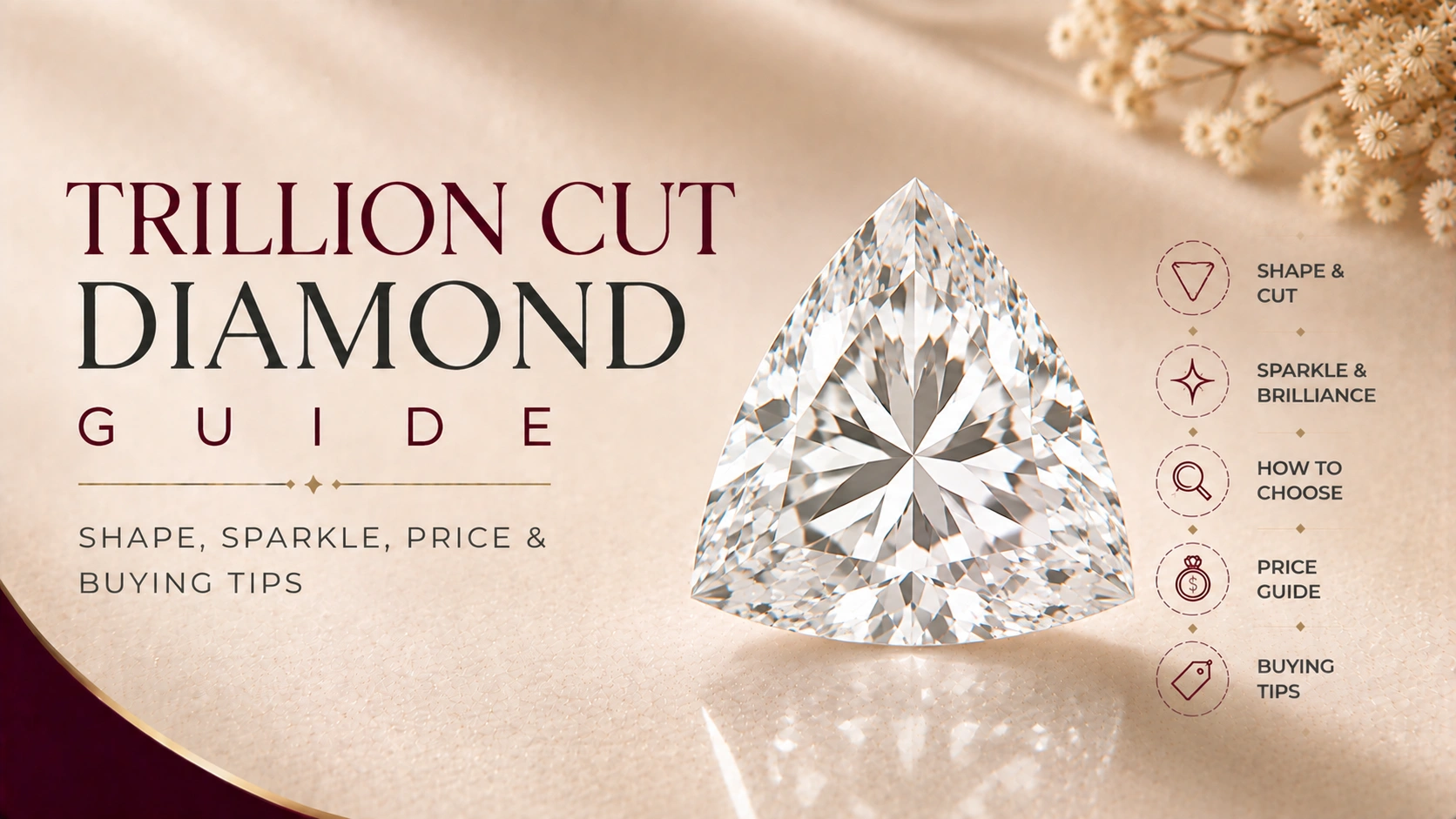
A trillion cut diamond stands out immediately. With its distinctive triangular outline and brilliant-style faceting, it offers a look that feels modern, architectural, and noticeably different from more familiar shapes such as round, oval, or princess.
Trillion diamonds are especially popular as side stones in three-stone engagement rings, but they can also make striking center stones when the proportions and setting are right.
If you’re considering one, the shape itself is only the beginning. You also need to look at symmetry, proportions, clarity, color, point protection, and how the diamond performs in the setting.
This guide explains what to know before buying a trillion cut diamond, including its advantages, drawbacks, pricing, and how to choose one that looks beautiful in person.
What Is a Trillion Cut Diamond?
A trillion cut diamond is a triangular-shaped diamond with brilliant-style faceting. Its three sides can be straight or slightly curved, depending on the style and intended use.
The shape is generally designed around a triangular outline, with the best examples showing strong symmetry and a balanced appearance. The broad face-up shape also gives trillion diamonds considerable visual spread for their carat weight.
Trillion diamonds are often used as accent stones on either side of a larger center diamond. However, curved-sided versions can also work well as center stones for someone who wants a less conventional engagement ring.
If you’re still learning how diamond proportions and faceting affect appearance, it’s useful to understand the broader concept of diamond cut before comparing individual shapes.
Trillion vs. Trilliant: What’s the Difference?
In everyday diamond terminology, trillion and trilliant are generally used interchangeably.
Both describe a triangular brilliant-style diamond. The spelling you encounter can vary between jewelers, diamond dealers, and educational resources.
What’s more important than the name is the actual design of the stone.
Two trillion diamonds can look quite different depending on whether they have straight or curved sides, their facet arrangement, proportions, symmetry, and whether they’re intended to function as an accent or center stone.
What Does a Trillion Cut Diamond Look Like?
The most recognizable feature is its triangular outline.
A traditional trillion has three sides that are approximately equal, creating a balanced triangular appearance. The corners may be sharp-looking or slightly softened, while the sides can be straight or gently curved.
Its brilliant-style faceting is designed to produce sparkle, fire, and lively light return rather than the broad, mirror-like flashes associated with step-cut diamonds.
The combination of a wide outline and shallow profile can make a trillion appear surprisingly large for its carat weight.
This makes the shape particularly appealing if you want a diamond with substantial visual presence without automatically moving to a larger carat weight.
Types of Trillion Cut Diamonds
There isn’t just one visual interpretation of the trillion cut.
Straight-Sided Trillion
Straight-sided trillions have a sharper, more geometric appearance.
They’re frequently used as side stones because their clean triangular shape works particularly well when paired with another center diamond.
The straight edges create a crisp, contemporary look and can provide strong contrast against round, oval, emerald, or other center shapes.
Curved-Sided Trillion
Curved-sided trillions have gently convex edges that soften the triangular outline.
This style tends to have a more fluid appearance and is commonly favored when the trillion is being used as a center stone.
If you’re shopping for a trillion center diamond, comparing several stones side by side is especially important because subtle differences in the outline can dramatically change the overall look.
How Are Trillion Diamonds Cut?
Trillion diamonds use brilliant-style faceting rather than the step-cut faceting found in shapes such as emerald cuts.
The exact facet arrangement can vary. Sources commonly describe trillion diamonds as having different facet configurations depending on the style and intended use.
Rather than focusing only on a particular facet count, buyers should pay attention to what the finished stone actually looks like.
Look for:
- Strong overall symmetry
- A balanced triangular outline
- Even facet patterns
- Good light return
- No obvious dark areas
- Clean-looking corners
- Consistent proportions
A certificate can provide useful information, but visual inspection remains particularly important for fancy-shaped diamonds.
Are Trillion Cut Diamonds Good for Engagement Rings?
Yes, but they’re best suited to buyers who want something less conventional.
A trillion can make an excellent engagement-ring diamond if you like:
- Unique geometric shapes
- Strong visual spread
- Brilliant-style sparkle
- Modern or architectural designs
- Three-stone engagement rings
- Nontraditional center stones
However, the pointed corners require more consideration than shapes with rounded edges.
For an engagement ring, the setting should provide appropriate protection around the vulnerable points. Bezel and protective prong designs can help reduce the risk of accidental damage.
If you’re deciding between different shapes for an engagement ring, you can also compare different types of diamond cuts before settling on a trillion.
Trillion Cut Diamond Pros and Cons
Pros
Distinctive appearance:
The triangular silhouette immediately separates a trillion from more traditional diamond shapes.
Excellent face-up spread:
Trillions can look larger than their carat weight suggests because of their broad, shallow outline.
Good sparkle:
The brilliant-style faceting can produce strong brilliance and fire when the diamond is well cut.
Great for three-stone rings:
Two matching trillions can create a dramatic frame around a center diamond.
Nontraditional center-stone option:
A curved-sided trillion can create a bold alternative to a round, oval, or cushion center.
Potential value:
Trillion diamonds are less mainstream than popular shapes, and their market demand can be lower. That can sometimes create attractive pricing, although individual prices vary considerably.
Cons
Pointed corners need protection:
The corners are more vulnerable to chipping than rounded shapes.
Quality can be difficult to judge:
There is no universal laboratory cut grade for trillion diamonds comparable to the standardized cut grade available for round brilliants.
Limited availability:
High-quality trillion diamonds can be harder to find, particularly at larger carat weights.
Symmetry matters greatly:
A slightly uneven triangular outline can be obvious once the stone is set.
Different styles share the same name:
A straight-sided accent trillion and a curved-sided center-stone trillion can look quite different despite both being called trillion cuts.
How to Choose a Trillion Cut Diamond
Choosing a trillion isn’t simply about finding the highest grades on a certificate.
Start with the shape and appearance, then evaluate the diamond’s other characteristics.
1. Check Symmetry
Symmetry is one of the most important considerations.
The three sides should look balanced, and the three corners should appear appropriately aligned. If the triangle looks noticeably lopsided, the problem can remain visible even after the diamond is mounted.
For a pair of trillion side stones, matching becomes even more important.
The two stones should be similar in:
- Size
- Shape
- Outline
- Color
- Faceting
- Symmetry
2. Evaluate the Outline
Don’t assume that every triangular diamond will have the same appearance.
Some look sharply geometric. Others have softer, curved sides.
Decide which style you prefer before comparing prices.
3. Look at Light Performance
The diamond should show lively brightness rather than large areas that appear consistently dark or dull.
Because trillion diamonds don’t have the same standardized cut grading system as round brilliants, examining videos and multiple viewing angles can be especially useful.
4. Inspect the Corners
Pay particular attention to inclusions or structural weaknesses near the corners.
Those areas are already vulnerable because of the triangular shape, so you don’t want an obvious inclusion positioned directly where the diamond is most exposed.
5. Compare the Actual Diamonds
For fancy shapes, two diamonds with similar specifications can look very different.
Whenever possible, compare several stones rather than choosing based solely on carat, color, clarity, or price.
For a broader explanation of how these characteristics work together, see this guide to the 4Cs of diamond quality.
Trillion Diamond Color
Color selection depends partly on your setting and personal preference.
Because trillion diamonds use brilliant-style faceting, sparkle can help disguise some body color. Still, color can become more noticeable in certain stones and settings.
For a white-metal setting such as platinum or white gold, buyers who want a crisp, near-colorless appearance may prefer a higher color range.
With yellow or rose gold, warmer diamond colors can sometimes blend more naturally with the metal.
There’s no single color grade that’s right for every trillion diamond. The better approach is to compare the stone’s actual appearance and decide how much color you’re comfortable seeing.
You can learn more about the broader topic in this diamond color guide.
Trillion Diamond Clarity
Clarity deserves careful attention because trillion diamonds have broad facets that can make some inclusions easier to notice.
However, buying the highest clarity grade isn’t automatically the best use of your budget.
Instead, look for an eye-clean diamond with no distracting inclusions visible without magnification.
Pay special attention to inclusions near the pointed corners. A visible inclusion in this area can be more concerning than one located in a less vulnerable part of the stone.
For more context on choosing an appropriate clarity grade, see the guide to diamond clarity.
Trillion Diamond Carat and Size
One of the biggest attractions of the trillion shape is its face-up spread.
Because the stone can be relatively shallow and broad, it may cover more visible area than another diamond of the same carat weight.
That doesn’t mean every trillion will look larger. Proportions and cutting quality still matter.
When comparing stones, look at the actual millimeter measurements rather than relying on carat weight alone.
For engagement-ring shopping, you can also explore this diamond carat guide to understand how carat weight relates to apparent size.
What Proportions Are Best for a Trillion Diamond?
There isn’t one universally accepted set of proportions that guarantees a beautiful trillion.
Some commonly cited guidance places trillion depth around 32% to 48%, with table percentages often falling around 50% to 70% and a length-to-width ratio close to 1.00 to 1.10. These figures should be treated as starting points rather than rigid pass/fail rules.
The visual result matters.
A well-proportioned trillion should have:
- A balanced triangular outline
- Strong symmetry
- Good brightness
- Attractive facet distribution
- No obvious dead areas
- Appropriate depth for its design
Avoid applying round-brilliant proportions to a trillion. Fancy shapes have different cutting requirements.
Do Trillion Diamonds Have a Cut Grade?
Generally, no standardized laboratory cut grade is provided for trillion diamonds in the same way that GIA grades the cut of round brilliant diamonds.
That means terms such as “Excellent” or “Ideal” used by a seller should not automatically be interpreted as an independent laboratory cut grade.
Instead, consider the stone’s symmetry, polish, proportions, optical performance, and overall appearance.
This is one reason buying a trillion diamond requires more visual evaluation than simply sorting certificates by cut grade.
Best Settings for Trillion Cut Diamonds
The right setting should balance appearance with protection.
Three-Stone Setting
This is one of the most natural applications for trillion diamonds.
Two triangular side stones can frame a larger center diamond, creating a distinctive three-stone design.
Round, oval, cushion, and other center shapes can all potentially work with trillion side stones.
Solitaire Setting
A trillion can work as a solitaire center stone for someone who wants a bold and unconventional engagement ring.
This approach puts the triangular outline completely in the spotlight.
Bezel Setting
A bezel can provide substantial protection around the diamond’s edges.
It can also create a sleek, contemporary appearance.
Prong Setting
Prongs can preserve more of the diamond’s outline and allow plenty of light into the stone, but the design needs to provide adequate protection for the vulnerable points.
The exact prong arrangement should be chosen by an experienced jeweler based on the stone’s shape and proportions.
Trillion Cut Diamond Price
There isn’t a single price range for trillion diamonds.
The cost depends on:
- Carat weight
- Color
- Clarity
- Cut quality
- Symmetry
- Polish
- Natural or lab-grown origin
- Availability
- Shape appeal
- Certification
- Setting
Trillion diamonds can sometimes be less expensive per carat than highly sought-after shapes, partly because demand is lower. But rarity at certain sizes and the availability of well-cut stones can also affect pricing.
Don’t assume that a lower price automatically represents better value.
A poorly proportioned trillion can look significantly worse than a well-cut stone with slightly lower color or clarity grades.
Trillion Diamond vs. Other Shapes
Trillion vs. Round
Round diamonds are the traditional choice for maximum brilliance and a classic appearance.
A trillion is more unusual and has a much more geometric outline.
Choose a trillion if individuality and shape are more important to you than traditional styling.
Trillion vs. Princess
Both have strong geometric appeal, but a princess is generally square or rectangular while a trillion is triangular.
A trillion also creates a softer visual relationship when used as a side stone around a round or other center diamond.
Trillion vs. Pear
Both have pointed elements, but their silhouettes are very different.
A pear is elongated and asymmetrical, while a trillion is generally triangular and balanced around three sides.
Trillion vs. Emerald
An emerald cut is known for step-cut facets and hall-of-mirrors flashes.
A trillion uses brilliant-style faceting and tends to produce a livelier, more sparkling appearance.
If you’re considering multiple fancy shapes, the site’s diamond shape guide is a useful starting point.
Trillion as a Center Stone vs. Side Stone
Historically and commercially, trillion diamonds have been especially associated with accent stones.
Their triangular outline naturally directs attention toward the center of a three-stone ring, making them effective companions for a larger center diamond.
As center stones, however, they can create a much more unusual engagement ring.
The key is choosing the right variation.
A straight-sided trillion can look particularly crisp as an accent, while curved-sided versions can have a softer outline that works well as a center.
Natural vs. Lab-Grown Trillion Diamonds
The same shape considerations apply whether you’re choosing a natural or lab-grown trillion diamond.
In both cases, evaluate:
- Symmetry
- Proportions
- Light performance
- Color
- Clarity
- Corner protection
- Certification
- Price
The main difference is the diamond’s origin and the pricing structure associated with it.
If you’re deciding between origins before choosing the shape, you can compare lab-grown and natural diamonds.
Are Trillion Diamonds Durable Enough for Everyday Wear?
They can be, but the corners deserve extra attention.
The pointed portions of a trillion are more exposed than the rounded edges of shapes such as oval or round diamonds. An accidental impact can therefore create a greater risk of damage.
A properly designed setting can reduce that risk.
If you choose a trillion for an engagement ring that you’ll wear every day, don’t select the setting based solely on appearance. Make sure the diamond’s vulnerable points are appropriately protected.
Is a Trillion Diamond a Good Choice for You?
A trillion cut diamond may be a great choice if you want an engagement ring that feels distinctive without sacrificing sparkle.
It’s particularly appealing for someone who likes:
- Geometric designs
- Modern jewelry
- Unusual diamond shapes
- Large-looking stones
- Three-stone engagement rings
- Brilliant-style sparkle
- Nontraditional center diamonds
It may not be the best choice if you want the easiest possible diamond to evaluate, the widest selection of available stones, or a shape with a highly standardized cut-grading system.
Frequently Asked Questions
Is a trillion diamond the same as a trilliant diamond?
Yes. The terms trillion and trilliant are generally used interchangeably for this triangular brilliant-style diamond shape.
Do trillion diamonds sparkle?
Yes. Trillion diamonds use brilliant-style faceting and can show strong brilliance and fire when well cut.
Do trillion diamonds look bigger than other diamonds?
They can. Their broad, shallow shape gives them strong face-up spread, which can make them appear larger than diamonds of similar carat weight.
Are trillion diamonds expensive?
Not necessarily. Their price depends on the 4Cs, symmetry, proportions, origin, certification, availability, and other factors. Their lower mainstream demand can sometimes make them comparatively affordable.
Are trillion diamonds good for engagement rings?
Yes. They can work especially well in three-stone settings or as distinctive center stones. The main consideration is protecting their pointed corners.
What is the best setting for a trillion diamond?
There isn’t one universal best setting. Bezel and protective prong designs can provide stronger point protection, while other prong arrangements may emphasize the diamond’s shape and allow more light exposure.
Are trillion diamonds rare?
They’re considerably less common in the engagement-ring market than round, oval, princess, or cushion diamonds. High-quality stones, particularly larger center stones, can therefore be harder to find.
Should I prioritize clarity or color in a trillion diamond?
Neither should automatically take priority. Start with the diamond’s overall appearance, then choose the lowest color and clarity grades that still give you the look you want while staying within your budget.
Do trillion diamonds have a GIA cut grade?
GIA does not provide the same standardized cut grade for trillion diamonds that it provides for round brilliant diamonds. Buyers should instead evaluate factors such as symmetry, polish, proportions, and visual performance.
Final Thoughts
A trillion cut diamond is one of the more distinctive choices available for an engagement ring.
Its triangular outline, brilliant-style faceting, and impressive face-up spread give it a combination of sparkle and personality that is difficult to replicate with more traditional shapes.
The biggest things to remember are simple: look closely at symmetry, evaluate the diamond visually, don’t rely on a round-diamond cut grade, and protect the points with an appropriate setting.
For a side stone, a well-matched pair of trillions can transform a traditional three-stone ring. For a center stone, a curved-sided trillion can create an especially bold and unconventional design.
If the shape speaks to you, don’t dismiss it simply because it’s less common. A well-chosen trillion can be both visually striking and a smart alternative to the usual diamond shapes.