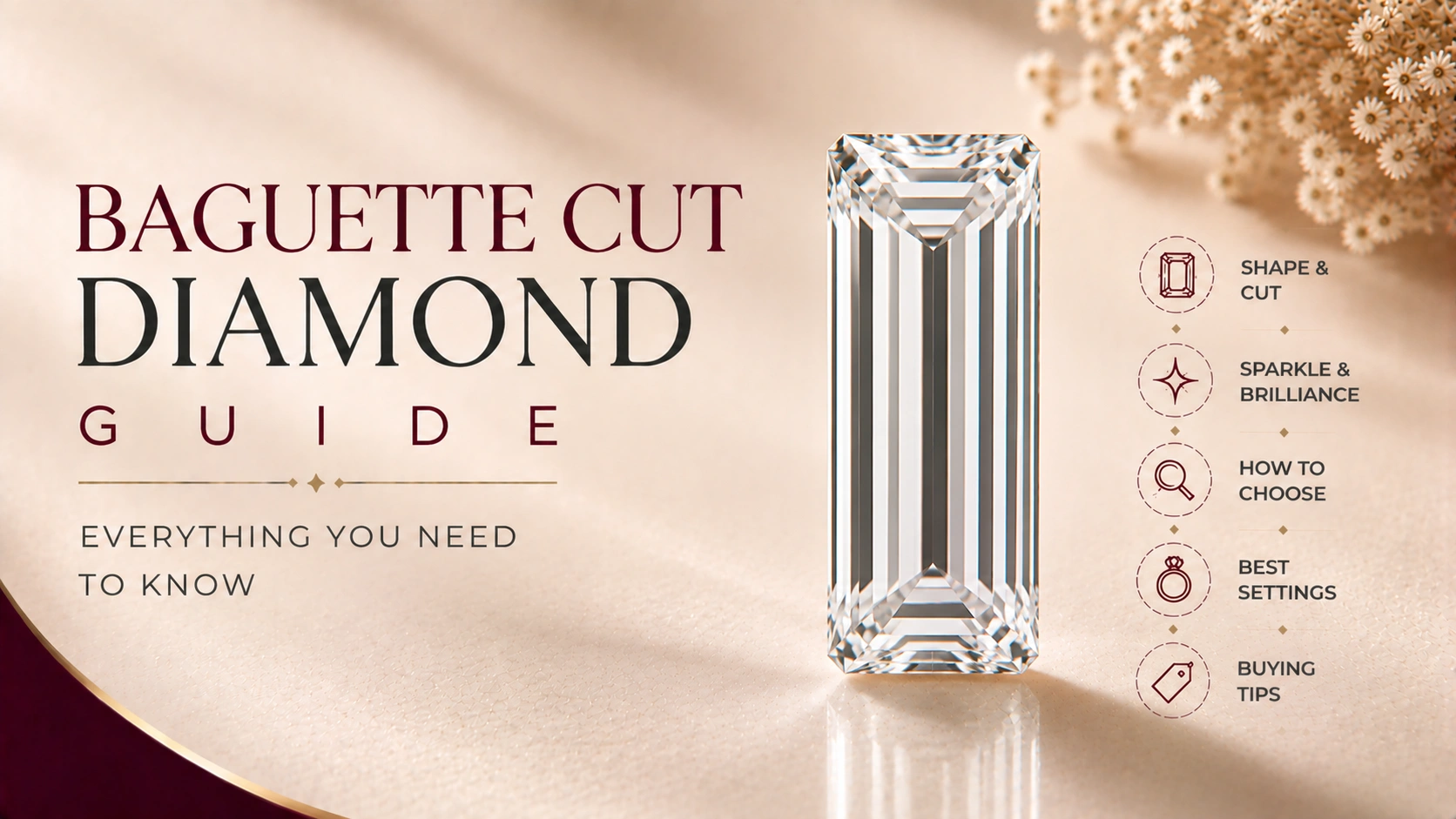
A baguette cut diamond is a slim, elongated rectangular diamond with straight, step-cut facets and typically sharp, square corners. Unlike brilliant-cut diamonds, which are designed to maximize sparkle, baguettes have a more understated appearance with long, clean flashes of reflected light.
They are most commonly used as accent or side stones rather than as the main center diamond in an engagement ring. Their geometric shape makes them especially popular in three-stone rings, Art Deco-inspired designs, channel-set bands, and other rings where clean lines are part of the design.
If you’re considering a baguette diamond, the most important things to understand are its shape, faceting, clarity, proportions, color, and how it works with the center stone.
What Is a Baguette Cut Diamond?
A baguette cut diamond is a rectangular step-cut diamond characterized by an elongated profile, parallel sides, and straight linear facets.
The step-cut design means the facets are arranged in long, parallel rows rather than the triangular, radiating pattern found in brilliant cuts. A traditional baguette generally has 14 facets, giving it a sleek and glassy appearance rather than intense scintillation.
The shape is closely associated with the geometric jewelry designs that became popular during the Art Deco period. Today, baguettes remain particularly useful as accent stones because their long, narrow profile can frame a larger center diamond without overwhelming it.
If you’re still comparing diamond terminology, it can help to first understand the difference between diamond shape and diamond cut before choosing a particular style.
Explore the different diamond shapes
What Does a Baguette Diamond Look Like?
The easiest way to recognize a baguette diamond is its long, narrow rectangular outline.
A traditional straight baguette has:
- Straight, parallel sides
- Sharp, square corners
- An elongated rectangular shape
- Step-cut facets
- A large, open-looking table
- Subtle rather than brilliant sparkle
The result is a diamond that looks clean, architectural, and sophisticated.
Baguettes are often deliberately used in pairs or groups. For example, two baguettes can sit on either side of a larger center diamond in a three-stone engagement ring. Their straight edges create a visual transition between the center stone and the band.
This is one reason baguettes can work particularly well with geometric engagement ring designs.
How Are Baguette Diamonds Cut?
Baguettes belong to the step-cut family of diamonds. Instead of using many small facets to break up and redirect light, step cuts use broad, parallel facets that resemble a series of steps.
This creates long reflections that can move across the diamond as it changes position.
The effect is much more restrained than the sparkle of a round brilliant diamond. That isn’t necessarily a disadvantage. A baguette is generally chosen for its clean geometry and sophisticated appearance rather than maximum brilliance.
Because the facet pattern is relatively simple, the diamond also has less ability to disguise imperfections. Clarity and proportions therefore deserve particular attention when choosing one.
Straight vs. Tapered Baguette Diamonds
There are two main baguette styles you’ll encounter: straight baguettes and tapered baguettes.
Straight Baguette Diamonds
A straight baguette has parallel sides from one end to the other.
Its silhouette is essentially a narrow rectangle, making it a natural choice for:
- Channel-set bands
- Eternity and anniversary bands
- Geometric ring designs
- Side stones
- Matching accent-stone arrangements
The symmetrical shape gives the ring a structured, orderly appearance.
Tapered Baguette Diamonds
A tapered baguette becomes narrower toward one end. Instead of forming a perfect rectangle, its sides angle inward slightly.
This makes tapered baguettes particularly useful as side stones because the narrower end can visually transition toward the center diamond or the ring shank.
GIA specifically distinguishes the two styles by noting that straight baguettes have parallel edges, while tapered baguettes have long sides that angle inward.
If you want to explore the tapered version in more detail, see the dedicated guide:
Learn more about tapered baguette diamonds
Baguette vs. Emerald Cut Diamond
Baguette and emerald cut diamonds can look very similar because both use step-cut faceting and rectangular outlines. However, they are not the same cut.
The biggest visual difference is the corners.
A baguette typically has sharp, square corners, while an emerald cut has diagonally beveled corners. Emerald cuts also generally have substantially more facets and are commonly used as center stones.
| Feature | Baguette Cut | Emerald Cut |
|---|---|---|
| Shape | Slim rectangle | Wider rectangle |
| Corners | Square and sharp | Beveled |
| Faceting | Step cut | Step cut |
| Typical facet count | About 14 | Typically around 50–58 |
| Sparkle | Subtle | More pronounced flashes |
| Common use | Side or accent stone | Center stone or accent |
| Overall look | Sleek and linear | Elegant and open |
The distinction matters when you’re designing an engagement ring. If you want the main diamond to have a strong presence, an emerald cut is usually the more natural choice. If you want slim geometric accents around a center stone, baguettes are particularly effective.
How Much Does a Baguette Diamond Sparkle?
Baguette diamonds do not sparkle like round brilliant diamonds.
Their step-cut faceting produces broader reflections instead of the rapid scintillation and fire associated with brilliant cuts. The result is often described as clean, glassy, understated, or mirror-like.
This makes baguettes a good choice for someone who prefers elegance over maximum sparkle.
If intense brilliance is your priority, a brilliant-cut shape may be a better fit. If you prefer crisp lines and subtle flashes of light, the baguette’s appearance can be much more appealing.
For a broader comparison of faceting styles, you can also explore:
Step-cut vs. brilliant-cut diamonds
Baguette Diamond Clarity: What Should You Look For?
Clarity is especially important with baguette diamonds.
Because baguettes have relatively few, broad facets, inclusions can be easier to see than they are in many brilliant-cut diamonds. The simple step-cut pattern doesn’t scatter light enough to disguise imperfections as effectively.
That means you shouldn’t choose a baguette based on clarity grade alone. Look at the actual stone and consider whether inclusions are visible from the top.
For a small accent baguette, you may not need the same clarity level you would choose for a large center stone. However, visible inclusions can become distracting when several baguettes are placed together.
A practical approach is to prioritize a baguette that looks clean to the eye rather than automatically paying for the highest possible clarity grade.
For more information about diamond clarity:
Baguette Diamond Color: Does It Matter?
Color can also be noticeable in step-cut diamonds.
The broad, open facets of a baguette can make body color easier to see than it would be in some brilliant-cut diamonds. This is particularly relevant if the baguette is being paired with a center diamond that has a noticeably different color grade.
Matching the side stones to the center diamond can help the finished ring look more cohesive.
That doesn’t mean every baguette needs to be extremely high on the color scale. The right choice depends on the center diamond, metal color, setting design, and your personal tolerance for warmth.
For a deeper look at diamond color:
Baguette Diamond Proportions and Length-to-Width Ratio
Because baguettes are highly elongated, proportions have a major effect on their appearance.
Length-to-width ratio is calculated by dividing the diamond’s length by its width.
For example, a diamond measuring 4 mm long and 1 mm wide has a 4:1 length-to-width ratio.
There isn’t one universally correct ratio for every baguette. The ideal proportion depends on how the stone will be used.
A shorter baguette can look more substantial, while a very elongated baguette creates a slimmer, more linear appearance.
For side stones, the proportions should also work with the center diamond. Two baguettes that are individually attractive can still look unbalanced if their length or width doesn’t complement the center stone.
When buying a pair, matching measurements and appearance is particularly important.
Are Baguette Diamonds Durable?
Baguettes require some care because their sharp corners can be more exposed to impact.
The square corners that give a baguette its distinctive appearance can also be vulnerable to chipping if the stone receives a hard blow. The risk depends on the individual stone, setting, and how the ring is worn.
A secure setting can provide important protection.
This is one reason baguettes are frequently placed into settings that hold their edges securely, such as channel settings or carefully designed side-stone arrangements.
If you’re choosing a ring rather than loose stones, the setting should be evaluated alongside the diamond.
Best Engagement Ring Settings for Baguette Diamonds
Baguettes are versatile accent stones and can be used in several engagement ring styles.
Three-Stone Rings
One of the most recognizable designs pairs a larger center diamond with baguettes on either side.
Straight or tapered baguettes can create a clean frame around the center stone while adding additional diamond detail without overwhelming it.
Channel Settings
Baguettes can be arranged closely together inside a channel, creating a continuous geometric line.
This works especially well for wedding bands and eternity-style designs.
Ballerina Settings
A ballerina setting uses multiple baguettes around a center stone to create a fan-like outline.
Tapered baguettes are particularly useful for this design because their shape can follow the contours of the center stone and create the characteristic outward sweep.
Art Deco-Inspired Rings
The straight lines and geometric symmetry of baguettes naturally complement Art Deco-inspired jewelry.
They can be paired with emerald, Asscher, round, or other center diamond shapes depending on the design.
For additional inspiration, you can compare baguettes with other diamond shapes in the site’s collection of diamond-cut guides.
Baguette Diamond Pros and Cons
Pros
- Clean, geometric appearance
- Elegant and understated
- Works exceptionally well as an accent stone
- Complements many center diamond shapes
- Strong Art Deco and vintage appeal
- Often creates a larger visual impact when used in groups
- Works well in three-stone and channel-set designs
Cons
- Produces less sparkle than brilliant cuts
- Inclusions can be easier to see
- Body color may be more noticeable
- Sharp corners can require careful protection
- Large baguettes are less common as center stones
- Matching baguettes can require more attention to consistency
Are Baguette Diamonds Good for Engagement Rings?
Yes, especially if you like a structured, sophisticated design.
A baguette may be a particularly good choice if you want:
- Side stones rather than a traditional halo
- A geometric or Art Deco-inspired ring
- Subtle diamond sparkle
- A clean, minimalist appearance
- A three-stone design
- A distinctive alternative to round or brilliant-cut accents
However, baguettes aren’t the obvious choice for someone whose main priority is maximum brilliance.
For a traditional center stone, you may want to compare baguettes with other popular diamond shapes before deciding.
Compare popular diamond shapes
How to Choose a Baguette Diamond
When you’re shopping for a baguette diamond, consider these factors together rather than focusing on a single specification.
1. Decide Between Straight and Tapered
Choose a straight baguette if you want a clean rectangular appearance.
Choose a tapered baguette if you want the stone to transition more naturally around a center diamond.
2. Examine Clarity
Look closely for visible inclusions, especially when the baguette will be large enough to attract attention.
3. Compare Color
Consider how the baguette’s color will look beside the center diamond and against the ring’s metal.
4. Check the Proportions
Make sure the length and width suit the design. Extremely long baguettes can create a very different appearance from shorter, wider examples.
5. Look at the Setting
The setting should protect the stone while complementing its linear shape.
6. Compare Matching Stones
If you’re buying a pair, don’t assume that two baguettes with identical listed measurements will look identical. Compare their visual appearance, color, clarity, and proportions.
7. Consider the Overall Ring
The baguette is often part of a larger composition. The center diamond, side stones, band width, and metal color all affect how the finished ring looks.
Understanding the broader 4Cs can also help put individual diamond specifications into context.
Review the 4Cs of diamond quality
Frequently Asked Questions
Is a baguette diamond a real diamond?
Yes. A baguette is a diamond cut, not a separate type of gemstone. A natural or lab-grown diamond can be fashioned into a baguette shape.
Are baguette diamonds expensive?
The price depends on factors such as whether the diamond is natural or lab-grown, carat weight, color, clarity, cut quality, and the specific stone. Baguettes are frequently used in smaller sizes as accent stones, so the total diamond cost can be lower than that of a large center diamond, but individual prices vary.
Do baguette diamonds have good sparkle?
They have a different type of light performance from brilliant cuts. Their step-cut facets create broad, clean reflections rather than intense scintillation.
Are baguette diamonds good side stones?
Yes. This is one of their most common uses. Their narrow rectangular profile works particularly well beside a larger center diamond.
What is the difference between a baguette and a tapered baguette?
A straight baguette has parallel sides. A tapered baguette narrows toward one end. Tapered baguettes are especially useful when they need to transition between a center stone and the band.
Is a baguette cut the same as an emerald cut?
No. Both are step cuts, but baguettes are generally narrower and have square corners, while emerald cuts have beveled corners and are typically more substantial center stones.
Are baguette diamonds good for everyday wear?
They can be, but the setting matters. Their sharp corners can be more vulnerable to impact, so secure protection is important for rings worn regularly.
Final Takeaway
Baguette cut diamonds stand out for their clean lines, elongated rectangular shape, and understated step-cut appearance.
They’re not designed to compete with a round brilliant diamond for sparkle. Instead, their appeal comes from geometric precision, broad reflections, and the way they frame a larger center stone.
For engagement rings, baguettes are particularly compelling as side stones in three-stone designs, channel settings, and Art Deco-inspired rings. Straight baguettes provide a crisp rectangular look, while tapered baguettes offer a more gradual transition around a center stone.
When choosing one, pay close attention to clarity, color, proportions, matching, and setting protection. Because baguettes have relatively simple faceting, visible imperfections and mismatched stones can stand out.
If that clean, architectural look is what you’re after, a well-selected baguette can add a distinctive touch to an engagement ring without overpowering the center diamond.