Choosing the best carat size for an engagement ring isn’t simply about buying the biggest diamond you can afford. The right carat depends on your budget, finger size, diamond shape, ring style, and how large you want the diamond to look.
For many shoppers, 1 to 1.5 carats is a good starting range because it offers noticeable presence without feeling excessively large. But there is no universal “best” carat size.
The most important thing to understand is that carat measures diamond weight, not exactly how large the diamond looks.
What Is the Best Carat Size for an Engagement Ring?
There isn’t one carat size that’s right for everyone.
| Carat Size | General Appearance | Best For |
|---|---|---|
| 0.50–0.74 ct | Delicate | Minimalist and budget-conscious rings |
| 0.75–0.99 ct | Noticeable | Classic, understated styles |
| 1.00–1.49 ct | Balanced | A substantial but versatile look |
| 1.50–1.99 ct | Larger | More finger coverage |
| 2.00+ ct | Bold | Statement engagement rings |
For most shoppers, 1–1.5 carats is an excellent range to start comparing.
But don’t choose based on carat alone. Understanding diamond carat will help you compare weight with actual visual size.
Does Carat Mean Diamond Size?
No.
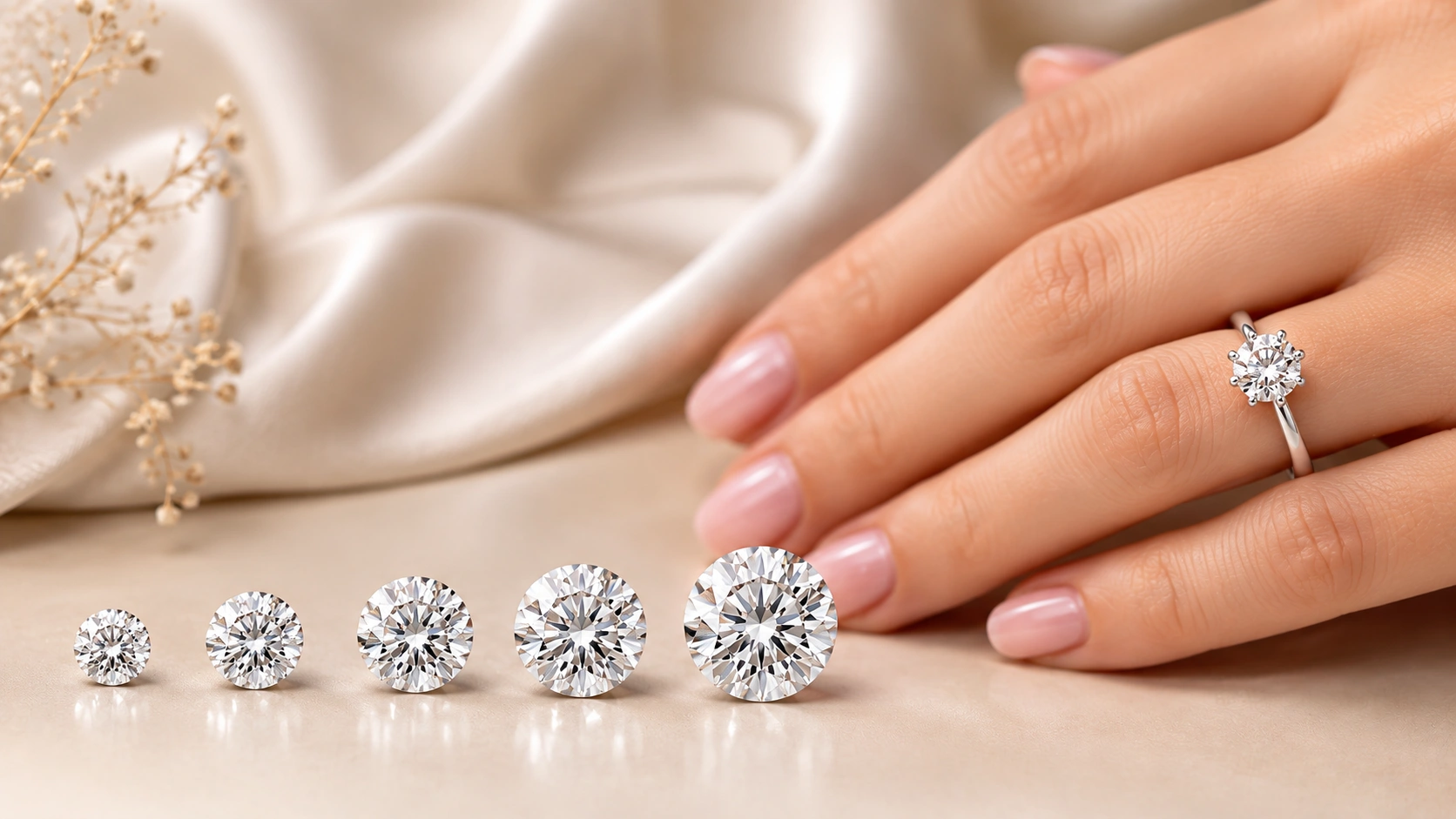
Carat is a measurement of weight. It doesn’t directly tell you how large a diamond will look from the top.
Two diamonds with the same carat weight can have different:
- Length and width
- Depth
- Face-up size
- Proportions
- Overall appearance
For example, a 1-carat oval may look larger from the top than a 1-carat round diamond because of its elongated shape.
So when choosing an engagement ring, look at carat weight and millimeter measurements together.
Is 1 Carat a Good Size for an Engagement Ring?
Yes. 1 carat is a classic engagement-ring size and offers a good balance of presence and practicality.
It’s particularly suitable for:
- Solitaire rings
- Halo rings
- Pavé settings
- Three-stone rings
A 1-carat diamond can look substantial without dominating the hand.
If your budget is limited, choosing a well-cut 1-carat diamond can also be more sensible than stretching for a larger stone and compromising on other important qualities.
Is 1.5 Carats a Good Size for an Engagement Ring?
Yes. 1.5 carats is an excellent choice if you want more visual presence than a 1-carat diamond.
It offers:
- More finger coverage
- A noticeable center stone
- A luxurious appearance
- Plenty of setting options
If your budget comfortably allows it, 1.5 carats can be a very good middle ground between a classic 1-carat ring and a more dramatic 2-carat ring.
Is 2 Carats Too Big for an Engagement Ring?
No. A 2-carat engagement ring can be elegant and appropriate for everyday wear.
Whether it looks too flashy depends on your:
- Personal style
- Finger size
- Diamond shape
- Setting
- Lifestyle
If you’re specifically considering this size, read our guide on whether a 2-carat ring is too flashy.
What Carat Size Looks Best on Your Finger?
The same diamond can look very different depending on finger size.
A 1-carat diamond may look substantial on a smaller finger but more understated on a larger finger.
Instead of trying to match an “average” carat size, think about how much finger coverage you want.
If you’re unsure about your ring size, use this finger size guide.
Does Diamond Shape Affect How Big It Looks?
Yes, significantly.
Some diamond shapes provide more visible surface area for their carat weight.
Oval
Oval diamonds can offer excellent face-up coverage and often appear larger than round diamonds of the same weight.
Marquise
The long, narrow shape can create substantial visual coverage.
Pear
Pear-shaped diamonds combine length with a distinctive silhouette.
Radiant
Radiant cuts can offer a large-looking rectangular appearance while maintaining brilliant-style sparkle.
Emerald
Emerald cuts have broad, open facets that can make the diamond look elegant and substantial.
Round
Round diamonds are highly popular because of their classic appearance and strong brilliance, but they may not look as large face-up as some elongated shapes of the same weight.
You can compare different options in our diamond shape guide.
What Carat Size Looks Biggest?
If your priority is maximum visual size, don’t automatically increase the carat.
Consider elongated shapes such as:
- Oval
- Marquise
- Pear
- Elongated radiant
These shapes can provide excellent face-up coverage.
A well-proportioned 1.5-carat oval, for example, may appear larger from the top than a 1.5-carat round.
Should You Buy a 1-Carat or 1.5-Carat Diamond?
Choose 1 carat if you want:
- A classic appearance
- A more understated center stone
- More room in your budget for other qualities
- A versatile everyday ring
Choose 1.5 carats if you want:
- More visual presence
- Greater finger coverage
- A larger center stone
If both fit your budget, compare the actual diamonds rather than choosing solely by carat.
Should You Buy a 1.5-Carat or 2-Carat Diamond?
A 2-carat diamond will generally provide more visual presence, but the price can increase significantly.
If moving from 1.5 to 2 carats means compromising heavily on cut, color, or clarity, the 1.5-carat option may be the better choice.
A bigger diamond isn’t automatically a better diamond.
The 4Cs of diamond quality explain why carat should be considered alongside cut, color, and clarity.
How to Make an Engagement Ring Look Bigger
If you want more visual impact without significantly increasing carat weight, consider:
Choose an elongated shape
Oval, marquise, pear, and elongated radiant diamonds can provide strong face-up coverage.
Choose a halo setting
A halo surrounds the center stone with smaller diamonds, increasing the overall visual footprint.
Choose a slimmer band
A thinner band can create more contrast and make the center diamond appear larger.
Compare measurements
Look at the diamond’s length and width instead of focusing only on its carat weight.
Is Buying Just Under 1 Carat a Good Idea?
It can be.
A 0.90–0.95 carat diamond can offer much of the visual presence of a 1-carat diamond while potentially costing less.
The same strategy can work around other popular carat thresholds.
However, don’t sacrifice cut quality simply to stay below a particular carat number.
A well-cut 0.90-carat diamond can easily be a better choice than a poorly cut 1-carat diamond.
What Is the Best Carat Size for a Budget?
Start with your total engagement-ring budget rather than a fixed carat target.
Then prioritize:
- Diamond shape
- Cut quality
- Suitable color
- Eye-clean clarity
- Carat weight
This approach allows you to maximize the diamond’s overall appearance instead of simply maximizing its weight.
If you’re comparing diamond types as part of your budget decision, see lab-grown vs natural diamonds.
Best Carat Size by Ring Style
Solitaire
A 1–1.5 carat center diamond is a versatile starting point for a classic solitaire.
Halo
A halo can make a smaller center diamond appear larger, so you may not need as much carat weight.
Three-Stone
Side diamonds add extra visual presence, meaning a moderate center stone can still create a substantial look.
Hidden Halo
A hidden halo adds sparkle underneath the center diamond without significantly increasing its face-up outline. See this hidden halo ring guide.
Best Carat Size for Everyday Wear
There’s no universal carat size for everyday wear.
If you prefer a subtle ring or frequently work with your hands, 0.75–1.25 carats can be a practical starting range.
If you want a more noticeable ring, 1.5–2+ carats can also work well with a suitable setting.
The setting, height, and security of the ring matter just as much as carat weight for everyday comfort.
Common Mistakes When Choosing Carat Size
Avoid choosing a diamond based only on:
- The highest carat weight your budget allows
- A popular “standard” carat
- Certificate numbers without checking measurements
- Carat weight without considering cut
- Finger size
- The overall ring proportions
The goal should be the best-looking diamond within your budget, not simply the largest one.
Final Words
For most engagement-ring shoppers, 1 to 1.5 carats is an excellent starting range.
A simple way to decide:
- 0.50-0.75 ct: Best for a delicate, understated look
- 0.75-1 ct: Classic and noticeable
- 1-1.5 ct: Balanced and substantial
- 1.5-2 ct: More prominent and luxurious
- 2+ ct: Bold and statement-making
But the “best” carat size ultimately depends on your preferences.
Choose the carat that gives you the visual presence you want without compromising the diamond’s overall quality or exceeding your budget.
And remember: carat is weight, not beauty or visible size. A well-cut 0.90-carat diamond can look better than a poorly cut 1.2-carat diamond, while an elongated 1.5-carat diamond may look larger than a round diamond with the same weight.
So don’t ask only, “How many carats should my engagement ring be?”
Ask:
“What carat size gives me the look I want at a quality and price I’m comfortable with?”
Frequently Asked Questions
Is 1 carat enough for an engagement ring?
Yes. A well-cut 1-carat diamond can look elegant and substantial, especially in a solitaire setting.
Is 1.5 carats a good size for an engagement ring?
Yes. 1.5 carats offers more visual presence than 1 carat while still working well for everyday engagement rings.
Is 2 carats too big for an engagement ring?
No. A 2-carat diamond can be an excellent choice if you prefer a larger, more prominent center stone.
Does carat mean diamond size?
No. Carat measures diamond weight, while visible size depends on the diamond’s shape, proportions, and measurements.
What diamond shape looks biggest for its carat weight?
Oval, marquise, pear, and elongated radiant diamonds can often provide more face-up coverage than round diamonds of the same carat weight.
Should I buy 1 carat or 1.5 carats?
Choose 1 carat for a classic and understated look. Choose 1.5 carats if you want greater visual presence and finger coverage.
Is a bigger diamond always better?
No. Cut quality, proportions, color, clarity, and shape all affect how attractive a diamond looks. A smaller, well-cut diamond can look better than a larger poorly cut one.
How can I make an engagement ring look bigger?
Choose an elongated diamond shape, a suitable setting such as a halo, a slimmer band, and a diamond with strong face-up measurements.