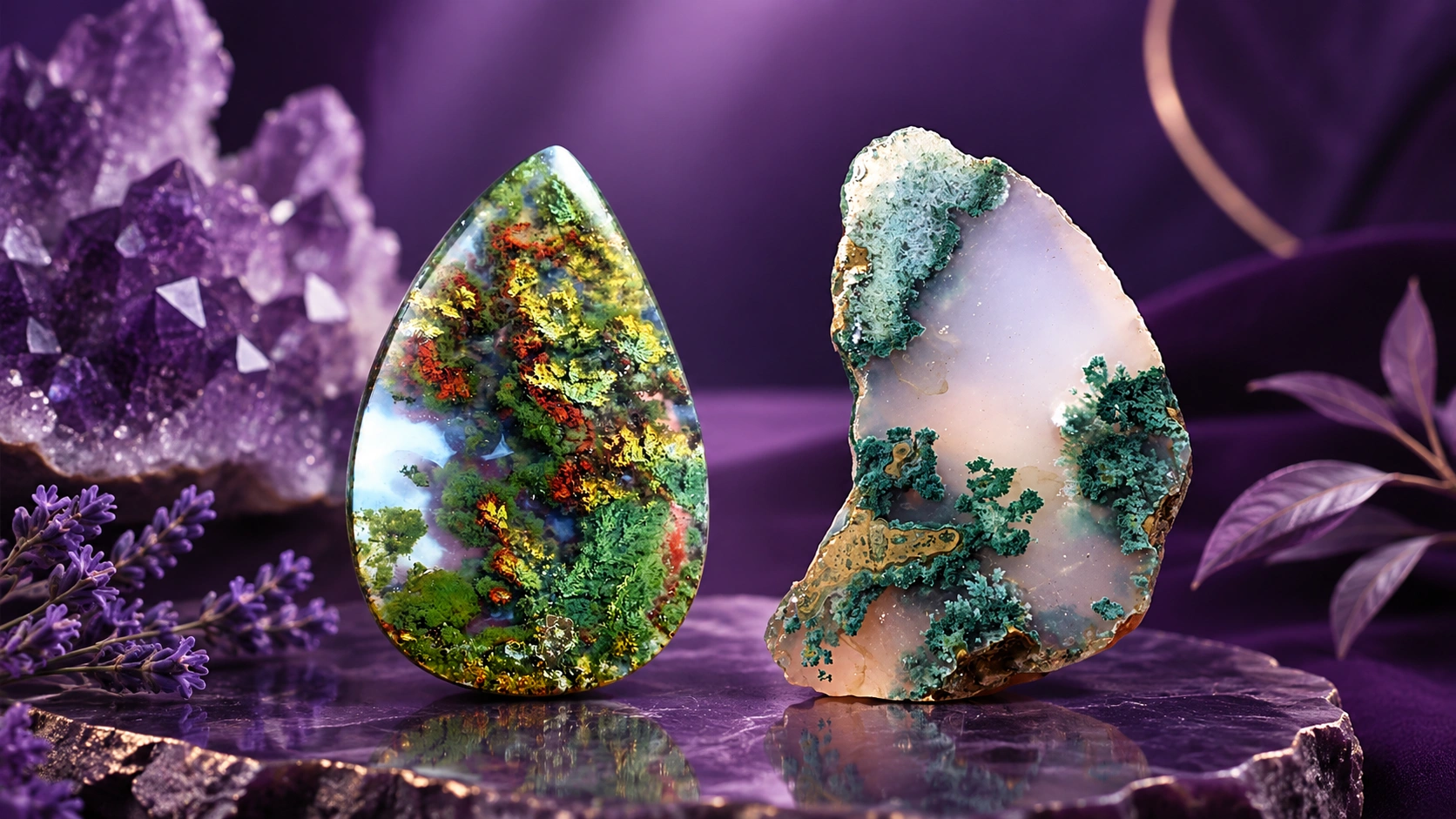
Moss agate is a gemstone that looks less like a traditional jewel and more like a tiny piece of nature preserved inside stone. Its translucent body can contain green, brown, black, or reddish mineral patterns that resemble moss, branches, leaves, and miniature landscapes.
That organic appearance is what makes moss agate so different from conventional engagement-ring stones. While diamonds are admired primarily for brilliance and sparkle, moss agate is appreciated for its natural patterns and individuality.
It has also become increasingly popular in alternative and nature-inspired engagement rings, particularly among people who want a center stone that feels personal rather than traditional. Recent jewelry-industry coverage has highlighted moss agate’s growing appeal because of its distinctive, one-of-a-kind appearance.
But what exactly is moss agate? Is it a real agate? How durable is it? Is it valuable? And is it suitable for everyday wear?
Here’s everything you need to know.
What Is Moss Agate?
Moss agate is a variety of chalcedony, a microcrystalline form of quartz. Its defining characteristic is the presence of mineral inclusions that create branching, moss-like patterns inside the stone.
These inclusions can contain minerals such as chlorite and other iron- or manganese-bearing minerals. The Geological Survey of India specifically describes moss agate as chalcedony containing chlorite inclusions that create greenish dendritic patterns.
Interestingly, despite its name, moss agate isn’t necessarily an “agate” in the strict geological sense. Traditional agate is typically characterized by bands or layers, while moss agate is better known for its dendritic, vegetation-like inclusions.
The trade name, however, is well established, so “moss agate” remains the term most shoppers will encounter.
And no, the green material inside moss agate isn’t actual moss. The patterns are mineral inclusions that formed naturally within the chalcedony.
What Does Moss Agate Look Like?
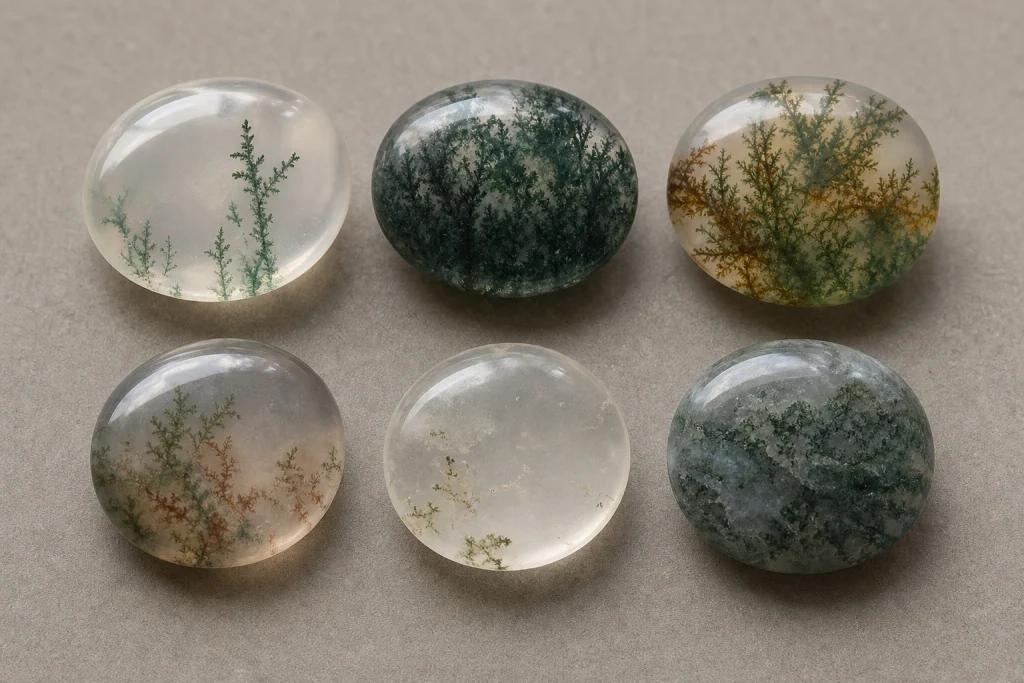
Moss agate can look dramatically different from one stone to another.
The base may be translucent, colorless, milky white, gray, or lightly tinted, while the internal inclusions can appear green, brown, black, or reddish.
Common visual patterns include:
- Branches
- Ferns
- Leaves
- Roots
- Forest-like shapes
- Wispy clouds
- Abstract landscapes
Some stones have very delicate green inclusions, while others have dense patterns covering much of the stone.
This variation is one of the biggest reasons people choose moss agate.
Two stones of the same size can look completely different because their internal patterns formed differently. In other words, you’re not simply choosing a color. You’re choosing a natural pattern.
That makes moss agate particularly appealing to shoppers who value individuality.
How Is Moss Agate Formed?
Moss agate develops when silica-rich material forms chalcedony while mineral-rich fluids introduce inclusions into the growing material.
Over geological time, those minerals become incorporated into the chalcedony, creating the branching patterns visible inside the finished gemstone.
The exact appearance depends on the minerals involved and the geological conditions during formation.
Some inclusions produce green patterns, while others can create brown, black, or reddish details.
The result is a gemstone where the internal inclusions are actually part of the attraction rather than something considered an imperfection.
This is an important difference from diamonds. When learning about diamond clarity, you’ll find that inclusions and blemishes can affect a diamond’s clarity grade. With moss agate, distinctive inclusions are often precisely what gives the stone its identity.
Moss Agate Colors
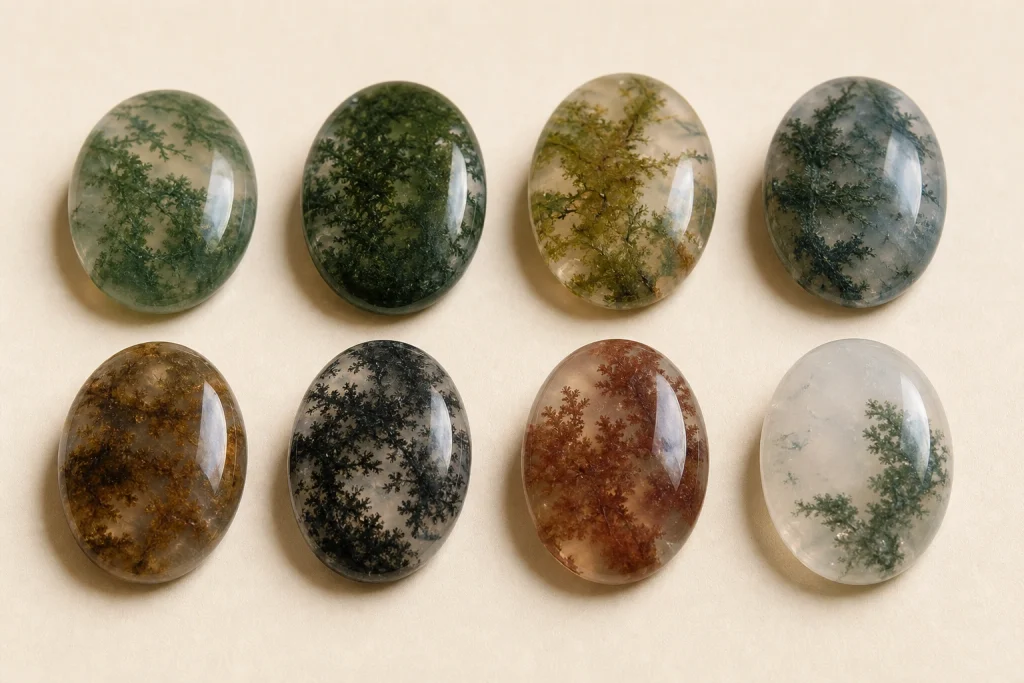
Green is the color most strongly associated with moss agate, but the gemstone can display much more variation.
You may encounter:
- Sage green
- Forest green
- Olive green
- Gray-green
- Brown
- Black
- Red
- White
- Colorless or translucent areas
Some stones combine several of these colors.
The pattern can also range from faint and delicate to bold and highly contrasted.
When choosing a moss agate, don’t automatically assume that the greenest stone is the best one.
Instead, consider the relationship between the body color, transparency, and inclusions.
A stone with subtle green dendrites and excellent depth can be more visually appealing than one with extremely dark inclusions that obscure the rest of the gemstone.
Moss Agate Meaning and Symbolism
Moss agate is commonly associated with nature, growth, renewal, abundance, balance, and new beginnings.
These associations come largely from traditional and modern crystal symbolism rather than established scientific evidence, so they should be understood as cultural or personal beliefs rather than proven properties.
Still, the symbolism can make moss agate especially meaningful in jewelry.
Its organic patterns naturally evoke ideas of growth and connection with nature. For an engagement ring, those themes can feel particularly appropriate because marriage itself represents the beginning of a new chapter.
People often associate moss agate with:
- Growth
- New beginnings
- Renewal
- Connection with nature
- Balance
- Abundance
- Individuality
If symbolism is an important part of your ring decision, you may also want to explore our guide explaining what an engagement ring symbolizes.
Moss Agate Properties
Moss agate belongs to the chalcedony family, which is part of the quartz group.
Here are some commonly cited gemological characteristics:
| Property | Moss Agate |
|---|---|
| Gemstone type | Chalcedony |
| Mineral group | Quartz |
| Chemical composition | SiO₂ |
| Mohs hardness | Approximately 6.5–7 |
| Transparency | Translucent to semi-translucent |
| Luster | Waxy to vitreous |
| Cleavage | None |
| Typical appearance | Translucent body with moss-like mineral inclusions |
Its hardness of approximately 6.5–7 means moss agate is reasonably durable for jewelry.
However, hardness only tells part of the story.
A gemstone can resist scratching while still being vulnerable to impact. That’s why choosing the right setting and taking sensible precautions are particularly important when moss agate is used in an engagement ring.
For readers comparing gemstone quality with traditional diamond grading, Our 4Cs of diamond quality guide explains how cut, color, clarity, and carat are used to evaluate diamonds.
Is Moss Agate Durable Enough for Everyday Wear?
Yes, moss agate can be worn regularly, but it isn’t as scratch-resistant as diamond or sapphire.
Moss agate generally ranks around 6.5–7 on the Mohs hardness scale. That is considerably lower than sapphire at 9 and diamond at 10.
For an engagement ring, that difference matters because the ring may be exposed to everyday bumps, friction, dirt, and other sources of wear for many years.
If you choose moss agate for daily wear:
- Remove the ring during heavy manual work.
- Avoid hitting the gemstone against hard surfaces.
- Keep it away from abrasive materials.
- Store it separately from harder gemstones.
- Check the setting periodically.
- Clean it gently.
The good news is that moss agate doesn’t have cleavage, which can be advantageous for jewelry durability.
Still, “durable enough for jewelry” doesn’t mean “indestructible.”
If maximum scratch resistance is your priority, diamond or sapphire will give you a stronger margin for everyday wear.
Is Moss Agate Good for an Engagement Ring?
Moss agate can be an excellent engagement-ring stone for someone who wants something distinctive and nature-inspired.
It can be especially appealing if you want:
- A one-of-a-kind center stone
- A nature-inspired ring
- An alternative to a traditional diamond
- An organic appearance
- A meaningful gemstone
- A potentially more accessible center-stone option
The biggest consideration is durability.
If your lifestyle involves frequent heavy manual work, sports, construction, or activities where your hands regularly encounter hard surfaces, you may prefer a harder center stone or a protective setting.
For someone with a typical lifestyle who is willing to treat the ring thoughtfully, moss agate can work beautifully.
The setting also matters.
A bezel setting can provide more protection around the gemstone, while a prong design can expose more of the stone and create a lighter, more traditional appearance.
If you’re comparing engagement-ring designs, Our guide to hidden halo vs. solitaire rings is useful for understanding how different settings change the overall look.
You can also explore the differences between flush-fit and non-flush-fit engagement rings if you plan to wear your engagement ring alongside a wedding band.
Best Moss Agate Shapes and Cuts
The ideal moss agate shape depends heavily on the pattern inside the individual stone.
Unlike a diamond, which is commonly cut to maximize brilliance, moss agate is often cut to showcase its inclusions and internal landscape.
If you’re unfamiliar with how gemstone shapes differ from diamond cuts, Our guide to different types of diamond cuts provides useful background on diamond terminology.
Oval Moss Agate
Oval shapes provide a generous surface area for displaying internal patterns while maintaining a familiar engagement-ring silhouette.
Pear Moss Agate
The pointed end of a pear-shaped stone can work beautifully when the inclusions naturally flow toward it.
Hexagon Moss Agate
Hexagonal stones combine a geometric outline with organic internal patterns, creating a distinctive modern look.
Kite-Shaped Moss Agate
Kite shapes are particularly popular in alternative and nature-inspired jewelry because they emphasize the unusual character of the stone.
Cabochon Moss Agate
Cabochons have a smooth, curved surface rather than traditional faceting.
This can be particularly attractive for moss agate because the viewer’s attention remains focused on the internal patterns instead of sparkle.
Moss Agate vs. Diamond
Moss agate and diamond are fundamentally different in what they offer visually.
Diamond is known for brilliance, fire, and scintillation.
Moss agate is known for its internal pattern and organic character.
| Feature | Moss Agate | Diamond |
|---|---|---|
| Main visual appeal | Natural internal patterns | Brilliance and sparkle |
| Typical appearance | Organic and earthy | Bright and reflective |
| Mohs hardness | 6.5–7 | 10 |
| Individuality | Extremely high | More standardized |
| Style | Nature-inspired | Classic to contemporary |
| Everyday durability | Good with care | Excellent |
| Visual character | Organic | Brilliant |
Neither is universally better.
If you want maximum sparkle and scratch resistance, diamond has a clear advantage.
If you want an engagement ring that looks like a tiny landscape and doesn’t resemble conventional diamond jewelry, moss agate may be more appealing.
If you’re considering diamonds but aren’t sure whether mined or lab-grown is right for you, Our lab-grown vs. natural diamond comparison is a useful next step.
Moss Agate vs. Other Gemstones
Moss agate is just one of many alternatives to a traditional diamond.
Compared with sapphire, for example, moss agate is softer but offers a much more distinctive internal pattern.
Compared with moissanite, moss agate offers dramatically less sparkle but a much more organic appearance.
And compared with other quartz varieties, moss agate’s defining feature is the visual complexity created by its mineral inclusions.
The right choice ultimately depends on what you want your engagement ring to communicate.
For anyone still deciding between traditional diamond shapes, Our diamond shape guide provides an overview of the most popular options.
How Much Is Moss Agate Worth?
Moss agate is generally much less expensive than fine-quality diamond, but there isn’t one universal price for the gemstone.
Value can depend on:
- Pattern quality
- Transparency
- Color
- Size
- Cutting quality
- Overall visual appeal
- Treatment
- Origin or provenance
- Jewelry craftsmanship
- Metal used in the finished piece
One important difference from diamonds is that moss agate doesn’t have an equivalent universal grading system based on the diamond 4Cs.
That means visual appeal plays a particularly important role.
A larger moss agate isn’t automatically better.
A smaller stone with excellent translucency and an attractive, well-balanced pattern can be more desirable than a much larger stone with a dull or poorly positioned pattern.
It’s also important not to confuse price with resale value. A gemstone being inexpensive to purchase doesn’t necessarily mean it will hold its value particularly well.
For comparison, Our article on which diamond shape holds value explores how market demand and desirability can influence diamond value.
How to Choose a Moss Agate
Choosing moss agate is different from choosing a traditional diamond.
Instead of focusing on a standardized grading report alone, spend time looking at the actual stone.
1. Examine the pattern
Look closely at the inclusions.
Do they resemble branches, leaves, forests, clouds, or something completely abstract?
There is no universally “correct” pattern. Choose the one you personally find attractive.
2. Look at transparency
Translucency allows light to interact with the internal inclusions and can give the stone greater visual depth.
3. Consider pattern distribution
A balanced pattern often creates a stronger overall appearance than inclusions concentrated entirely in one small area.
4. Check the edges
Look carefully for chips, cracks, or damage, particularly around pointed shapes and thin edges.
5. Ask about treatments
If treatment status matters to you, ask the seller whether the stone has been dyed, stabilized, coated, or otherwise treated.
6. Think about the setting
A protective setting may be preferable for a gemstone that will be worn every day.
7. Choose the stone before the setting when possible
Because every moss agate has a different pattern, it can make sense to select the actual gemstone first and then design the ring around it.
That approach allows the setting to complement the stone instead of forcing a beautiful pattern into a predetermined design.
Moss Agate and Vintage-Style Engagement Rings
Moss agate’s earthy appearance naturally pairs well with vintage-inspired jewelry.
Its organic inclusions can complement:
- Yellow gold
- Rose gold
- Floral motifs
- Milgrain details
- Art Nouveau-inspired designs
- Nature-inspired settings
- Antique-style halos
If you love this aesthetic, it is worth understanding the distinction between vintage and antique engagement rings.
The terms are often used interchangeably, but they don’t mean exactly the same thing.
Moss agate can also work beautifully in a contemporary setting, especially when paired with a minimalist band that allows the gemstone to remain the focal point.
Moss Agate and Ring Stacking
If you plan to wear your engagement ring with a wedding band or other rings, think about the overall stack before choosing the setting.
A high-profile center stone may leave more room for a wedding band, while a lower profile can create a sleeker look.
You can explore different approaches in Diamiv’s ring stacking guide.
This is especially useful if you’re choosing an unusual moss agate shape. A traditional straight wedding band may not sit flush against every unusual center-stone design.
How to Clean and Care for Moss Agate
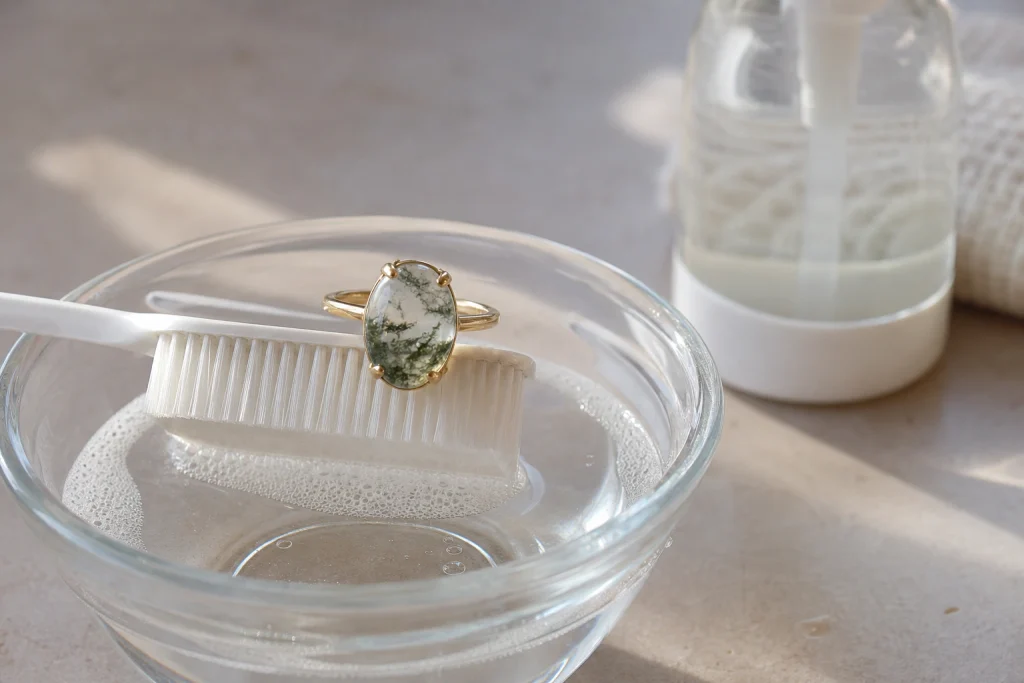
Moss agate doesn’t require complicated maintenance.
For routine cleaning, use:
- Lukewarm water
- Mild soap
- A soft cloth
- A very soft brush when necessary
Gently clean the stone and setting, rinse thoroughly, and dry it with a soft cloth.
Avoid abrasive cleaners and harsh chemicals.
Because moss agate is softer than diamond, storing it directly beside harder gemstones can also lead to scratches over time.
For an engagement ring worn frequently, it’s a good idea to have the setting inspected periodically.
You should also be mindful of everyday exposure to water, soap, and household products. Diamiv’s guide on whether you can wear an engagement ring in the shower covers some of the practical issues surrounding regular ring wear.
Moss Agate Pros and Cons
Pros
- Every stone has a distinctive natural pattern
- Strong nature-inspired appearance
- Attractive translucent body
- Suitable for many jewelry designs
- Can be more accessible than traditional diamond center stones
- Excellent choice for alternative engagement rings
- Works particularly well with organic and vintage-inspired designs
Cons
- Softer than diamond and sapphire
- Can develop scratches with rough everyday wear
- Can be damaged by hard impacts
- Quality can be subjective
- No universal grading system comparable to the diamond 4Cs
- Resale value shouldn’t be assumed
Is Moss Agate Rare?
Moss agate can be unusual and visually distinctive without necessarily being extremely rare.
Its value generally comes from a combination of beauty, pattern, transparency, size, cutting quality, and demand rather than simply from the fact that it is called “rare.”
This distinction matters when shopping.
A seller describing a particular moss agate as rare doesn’t automatically mean it is exceptionally valuable.
Instead, evaluate the actual gemstone and ask questions about its treatment, quality, origin when relevant, and overall craftsmanship.
Is Moss Agate Worth Choosing?
Moss agate is worth considering if you want a gemstone with personality rather than conventional sparkle.
Its greatest strength isn’t brilliance. It’s character.
The branching inclusions can create images that resemble forests, leaves, roots, and landscapes, making every stone visually different.
That individuality is particularly attractive for engagement rings because the center stone can feel genuinely personal.
The trade-off is durability.
At around 6.5–7 on the Mohs scale, moss agate is suitable for jewelry but doesn’t provide the same scratch resistance as diamond or sapphire.
So the decision comes down to priorities.
Choose diamond if maximum hardness, brilliance, and traditional engagement-ring appeal are your priorities.
Choose moss agate if individuality, natural patterns, and an earthy aesthetic matter more to you.
There isn’t one universally correct choice.
The best engagement ring is the one that fits the wearer’s lifestyle, personal style, and priorities.
Frequently Asked Questions
Is moss agate a real gemstone?
Yes. Moss agate is a recognized gemstone material associated with chalcedony and quartz. Its characteristic appearance comes from mineral inclusions inside the translucent stone.
Is moss agate actually green?
It can be. Green is the most recognizable color, but moss agate can also contain brown, black, reddish, gray, and white areas.
Does moss agate contain real moss?
No. The moss-like patterns are mineral inclusions, not organic moss.
Is moss agate expensive?
Moss agate is generally more affordable than fine diamond, but prices vary according to size, pattern, transparency, cutting quality, treatment, and the finished jewelry.
Can moss agate be worn every day?
Yes, with reasonable care. Its hardness is approximately 6.5–7, so it is suitable for jewelry but is more susceptible to scratching than diamond or sapphire.
Is moss agate good for an engagement ring?
It can be a very good choice for someone who wants a unique, nature-inspired engagement ring. Because it is softer than diamond, protective settings and sensible care are recommended.
What does moss agate symbolize?
Moss agate is traditionally associated with growth, renewal, abundance, balance, and connection with nature. These are symbolic or spiritual associations rather than scientifically proven properties.
Why does every moss agate look different?
The mineral inclusions develop in different patterns during the stone’s formation. This creates the highly individual appearance that makes moss agate so distinctive.
Is moss agate better than diamond?
Neither is universally better. Diamond is significantly harder and offers much more brilliance, while moss agate offers unique internal patterns and a more organic appearance.
What setting is best for moss agate?
Protective settings such as bezels can help shield the gemstone, while prongs can provide a more traditional appearance. The best choice depends on the stone’s shape, lifestyle, and desired design.
Final Takeaway
Moss agate isn’t trying to compete with diamond on sparkle.
Its appeal comes from something completely different: the feeling that you’re looking at a tiny natural landscape captured inside a gemstone.
For people who want a distinctive engagement ring, that can be more meaningful than traditional brilliance.
Just remember the trade-off. Moss agate is reasonably durable, but it isn’t as hard as diamond or sapphire, so everyday care matters.
Choose the stone for its actual pattern, select a setting that suits your lifestyle, and don’t assume that a larger or supposedly rarer stone is automatically better.
When you find a moss agate whose pattern immediately catches your eye, that’s often the strongest reason to choose it.