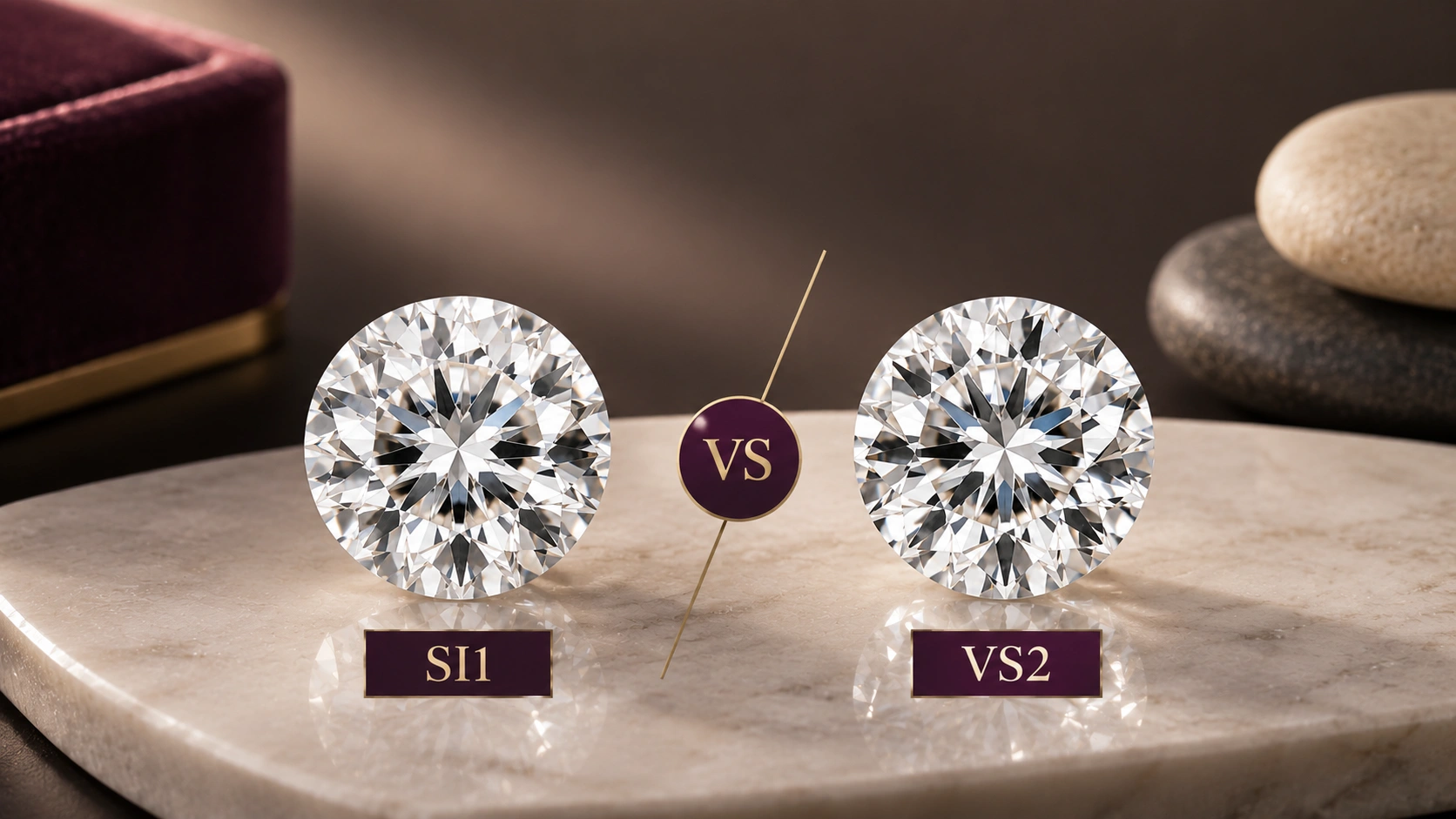
If you’re comparing SI1 vs VS2 diamonds, you’re looking at two clarity grades that can be surprisingly close in appearance while being meaningfully different on the grading scale.
VS2 stands for Very Slightly Included 2, while SI1 stands for Slightly Included 1. VS2 sits above SI1 on the clarity scale, meaning its inclusions are generally more difficult for a skilled grader to see under 10× magnification.
But here’s the part that matters when you’re actually buying an engagement ring:
A well-selected SI1 can look just as clean to the naked eye as a VS2.
That’s why the decision isn’t simply about choosing the higher grade.
A VS2 will usually cost more than a comparable SI1, but an eye-clean SI1 can potentially give you more carat weight or allow you to spend more on cut, color, or the setting.
The key is to evaluate the individual diamond, not just the clarity label.
SI1 vs VS2 at a Glance
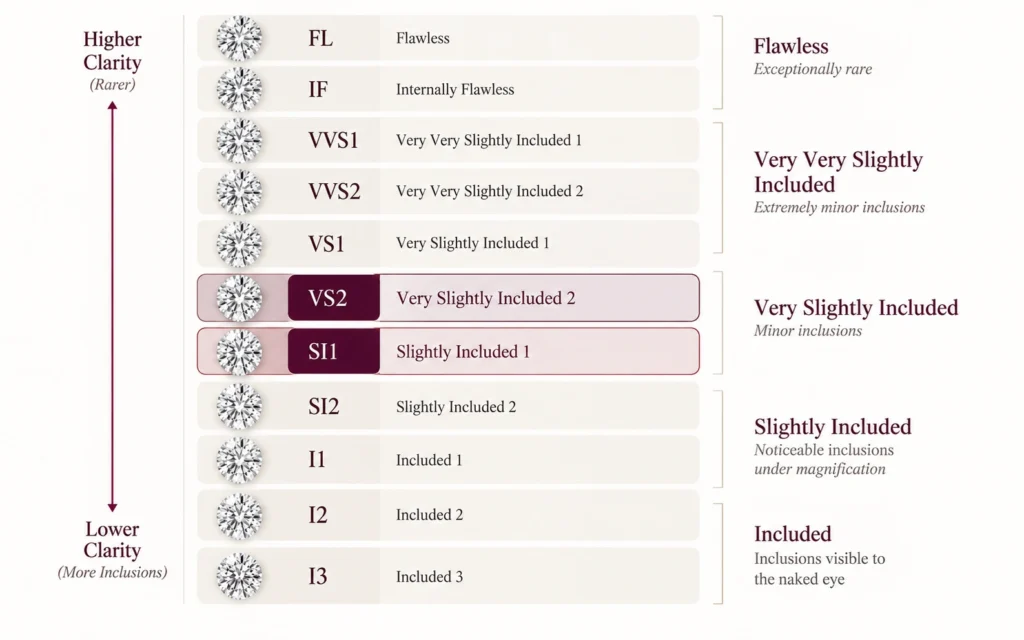
| Feature | VS2 | SI1 |
|---|---|---|
| Full name | Very Slightly Included 2 | Slightly Included 1 |
| Clarity category | VS | SI |
| Position on clarity scale | Higher | Lower |
| Inclusions under 10× | Somewhat difficult to see | More noticeable to a skilled grader |
| Usually eye-clean? | Often | Sometimes |
| Price | Usually higher | Usually lower |
| Best for | Buyers wanting more clarity confidence | Buyers prioritizing value |
| Individual inspection important? | Yes | Very important |
| Automatically the better choice? | No | No |
The biggest takeaway is simple:
VS2 is the safer clarity choice, but SI1 can be the better value if you find an eye-clean stone.
What Does VS2 Diamond Clarity Mean?
VS2 stands for Very Slightly Included 2.
It is the lower of the two VS grades, sitting immediately below VS1.
VS2 diamonds contain minor inclusions that can be somewhat difficult for a skilled grader to see under 10× magnification. The exact characteristics can vary significantly from one diamond to another.
Possible inclusions can include:
- Clouds
- Pinpoints
- Feathers
- Needles
- Crystals
- Internal graining
The presence of an inclusion doesn’t automatically mean you’ll see it while wearing the diamond.
In fact, many VS2 diamonds can be eye-clean.
That’s why VS2 is popular among shoppers who want a relatively high clarity grade without moving into VVS territory.
Is VS2 a Good Clarity Grade?
Yes.
VS2 is generally a very practical clarity grade for an engagement ring.
It can offer a strong balance between:
- Clean appearance
- Reasonable price
- Good selection
- Budget flexibility
However, don’t assume every VS2 diamond will look identical.
A VS2 with a tiny inclusion near the edge can look cleaner than another VS2 with a more noticeable characteristic near the center.
The grade gives you a category.
The individual diamond tells you what you’re actually getting.
What Does SI1 Diamond Clarity Mean?
SI1 stands for Slightly Included 1.
It sits immediately below VS2 on the clarity scale.
The inclusions in SI1 diamonds are generally easier for a skilled grader to see under 10× magnification than those in VS-grade diamonds.
But “slightly included” doesn’t mean “visibly flawed.”
This is an important distinction.
Some SI1 diamonds can look completely clean to the naked eye.
Others may have inclusions that are noticeable without magnification.
That’s why SI1 is one of the clarity grades where individual diamond selection becomes particularly important.
You shouldn’t buy an SI1 simply because it has the right carat, color, and price.
You should inspect the actual stone.
Is SI1 a Good Clarity Grade?
It can be an excellent choice.
SI1 is especially attractive for buyers who want to maximize value.
If you find an SI1 diamond that is:
- Eye-clean
- Well-cut
- Attractive in color
- Properly proportioned
- Well-priced
there may be little reason to pay substantially more for VS2.
But there’s an important condition:
The SI1 needs to look clean to you.
What Is the Difference Between SI1 and VS2?
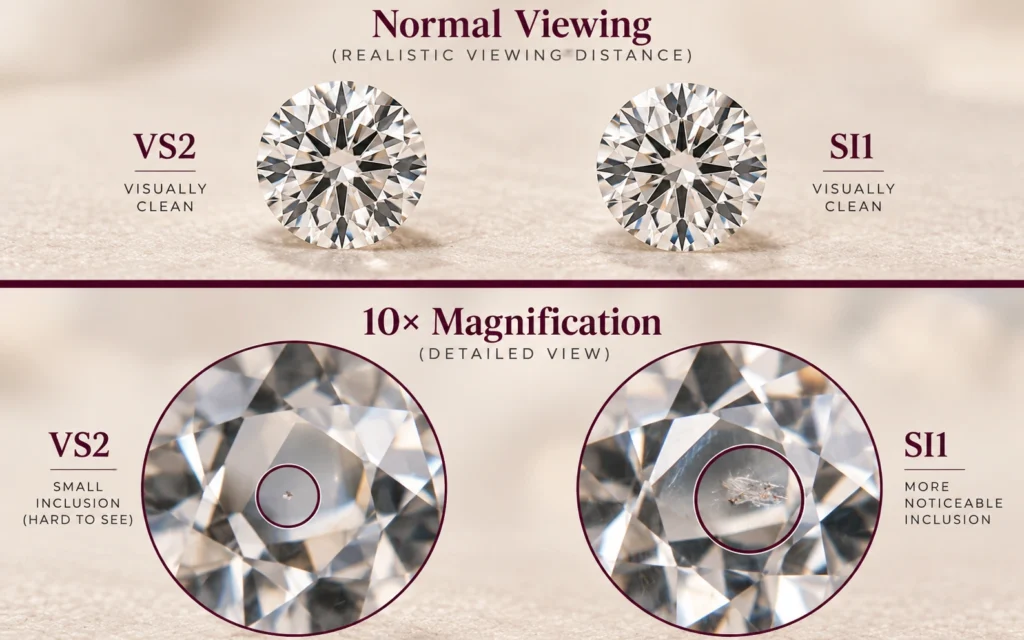
The technical difference is the visibility of inclusions under magnification.
VS2 is higher on the clarity scale.
SI1 is one grade below it.
In simple terms:
- VS2: inclusions are somewhat difficult to see under 10× magnification.
- SI1: inclusions are easier for a skilled grader to see under 10× magnification.
But the grading boundary doesn’t create a guaranteed visual difference.
A particular SI1 may look cleaner than a particular VS2 depending on:
- Inclusion type
- Inclusion size
- Inclusion location
- Inclusion color
- Contrast
- Diamond shape
- Cut quality
- Lighting conditions
This is why comparing the actual stones is so important.
Can You See the Difference Between SI1 and VS2 With the Naked Eye?
Sometimes.
This is where SI1 differs from VVS1, VVS2, and many VS2 diamonds.
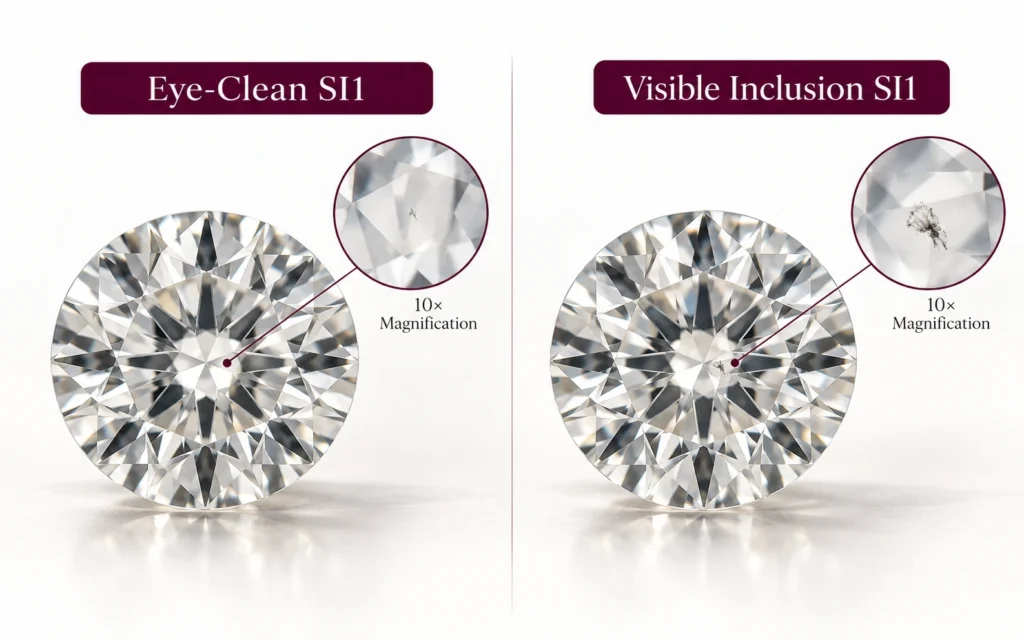
A well-selected SI1 can be eye-clean.
But SI1 has a wider range of potential appearances.
One SI1 may look completely clean from normal viewing distance.
Another may have a visible inclusion near the center of the diamond.
This means you shouldn’t assume:
SI1 = eye-clean
or:
VS2 = automatically eye-clean.
Both grades need individual evaluation.
However, VS2 generally gives you a greater margin of confidence that inclusions will not be obvious.
Does VS2 Sparkle More Than SI1?
Not simply because VS2 has higher clarity.
Clarity and sparkle are different characteristics.
A diamond’s visual performance depends heavily on its cut quality, proportions, faceting, symmetry, polish, and ability to return light.
A beautifully cut SI1 diamond can look more lively and brilliant than a poorly cut VS2.
That’s why sacrificing cut quality simply to move from SI1 to VS2 may not be the best decision.
If you’re comparing diamonds, start by understanding the importance of diamond cut before assuming a higher clarity grade automatically means a more beautiful stone.
You can also see how clarity works alongside the other major quality factors in this guide to the 4Cs of diamond quality.
SI1 vs VS2 Price: Is VS2 Worth Paying More For?
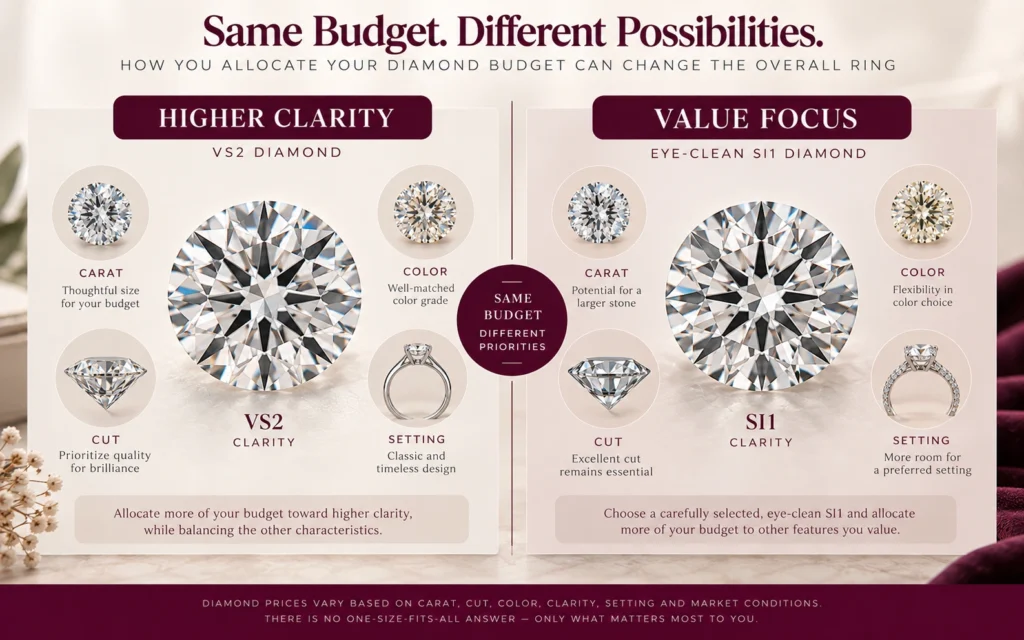
VS2 will generally cost more than SI1 when the other major characteristics are comparable.
But the price difference varies depending on:
- Carat weight
- Color
- Cut
- Shape
- Certification
- Natural or lab-grown origin
- Fluorescence
- Market conditions
There isn’t a universal percentage you should expect to pay for upgrading from SI1 to VS2.
The better question is:
What does the additional money actually buy you?
If the VS2 and SI1 look equally clean, the SI1 may provide better value.
For example, instead of spending more on clarity, you might use the savings for:
- A larger carat weight
- Better cut quality
- Higher color
- A more desirable shape
- A better setting
This is one of the biggest advantages of shopping for an eye-clean SI1.
You’re paying for appearance, not simply a higher number on a grading report.
Which Is Better: SI1 or VS2?
Neither is universally better.
Choose VS2 if:
- You want more clarity confidence.
- You prefer having fewer or harder-to-see inclusions.
- You’re buying a diamond online and want a little more clarity margin.
- You’re choosing a shape where inclusions may be easier to notice.
- The VS2 price fits comfortably within your budget.
- You don’t want to spend as much time comparing individual SI1 stones.
Choose SI1 if:
- You want maximum value.
- You’ve found an eye-clean stone.
- You would rather spend more on carat, cut, or color.
- The inclusion is small and unobtrusive.
- You can inspect the actual diamond before purchasing.
- The price difference between SI1 and VS2 is significant.
For many budget-conscious shoppers, eye-clean SI1 can be one of the smartest value options.
But if you don’t want to spend time evaluating individual stones, VS2 may be the easier choice.
When Is VS2 Worth the Extra Money?
There are several situations where VS2 can make sense.
1. You’re Buying a Larger Diamond
As diamond size increases, inclusions can become easier to inspect.
A characteristic that is almost impossible to notice in a smaller diamond may deserve more attention in a larger stone.
This doesn’t mean a large SI1 is automatically a bad choice.
It means you should examine the actual stone carefully.
If the SI1 inclusion is visible and the VS2 isn’t, paying the premium could be worthwhile.
2. You’re Choosing a Clarity-Sensitive Shape
Some diamond shapes can make inclusions easier to notice.
Step-cut shapes such as emerald and Asscher can be particularly revealing because their broad facets provide larger windows into the stone.
If you’re comparing faceting styles, this guide to step-cut and brilliant-cut diamonds can help.
3. You Want Less Risk
If you’re shopping online and can’t inspect diamonds in person, VS2 may provide additional peace of mind.
It’s not a guarantee that the stone will be eye-clean, but the higher clarity category gives you a little more margin.
4. The Price Difference Is Small
Sometimes the upgrade from SI1 to VS2 is relatively modest.
If the diamonds are otherwise nearly identical, choosing VS2 may make sense simply because you’re getting the higher clarity grade without sacrificing much elsewhere.
When Is SI1 the Better Choice?
SI1 becomes especially attractive when you find a stone that is genuinely eye-clean.
Imagine you’re comparing:
Diamond A
- VS2
- 1.00 carat
- G color
- Excellent cut
- Higher price
Diamond B
- SI1
- 1.15 carats
- G color
- Excellent cut
- Eye-clean
- Lower price
If you can’t see the SI1 inclusion, Diamond B may offer significantly better value.
You’re getting something you can actually see:
more diamond.
This is why many experienced diamond shoppers don’t automatically filter out SI1.
They look for the right SI1.
Does Diamond Shape Affect the Choice?
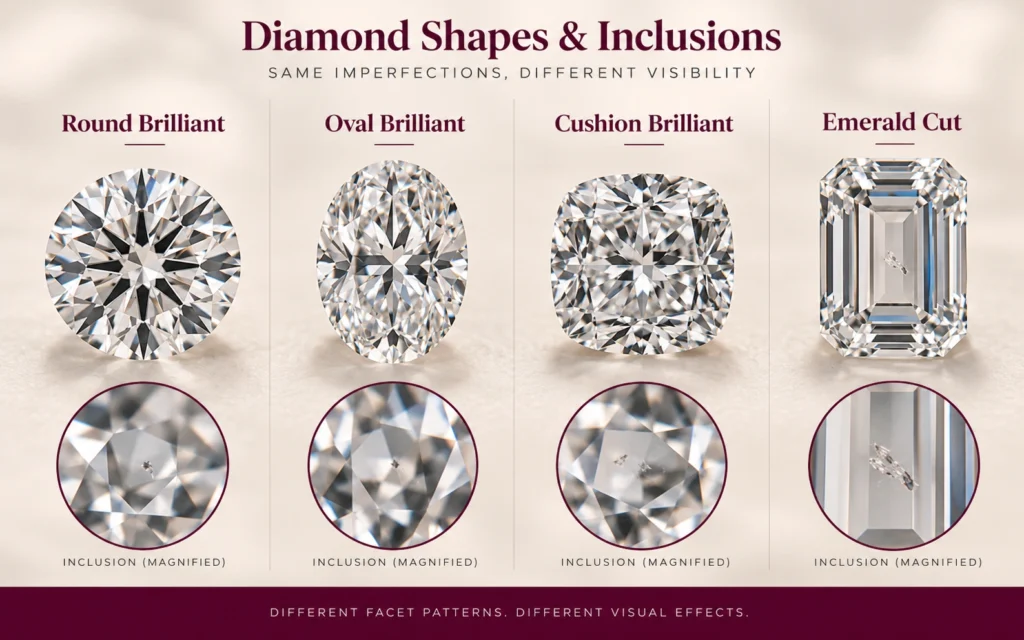
Absolutely.
Shape should be considered whenever you’re deciding between SI1 and VS2.
Round Brilliant
Round brilliant diamonds tend to be relatively forgiving because their faceting can create strong visual activity.
A well-selected SI1 can be a very attractive option.
Oval
Oval diamonds can hide certain inclusions effectively, depending on their location and contrast.
However, you should still inspect the actual stone.
This diamond shape guide explains how different shapes affect the overall appearance of a diamond.
Cushion
Cushion diamonds vary in facet pattern, so inclusion visibility can differ considerably from stone to stone.
A clean SI1 cushion can be excellent value.
Emerald
Emerald cuts deserve more caution.
Their large step facets can make inclusions easier to spot.
For an emerald-cut diamond, moving from SI1 to VS2 may be more worthwhile than it would be for certain brilliant-cut shapes.
Princess
Princess cuts can be good candidates for SI1 if the inclusions are well-positioned, but you should still evaluate the individual diamond carefully.
If you’re comparing princess and round shapes, see this comparison of princess-cut and round diamonds.
SI1 vs VS2 for Lab-Grown Diamonds
The same basic clarity principles apply to lab-grown diamonds.
A lab-grown diamond can receive a VS2 or SI1 clarity grade, and the grading distinction remains important.
But just like natural diamonds, you shouldn’t assume the grade alone determines appearance.
If you’re considering a lab-grown diamond, the potentially lower price may allow you to allocate more of your budget toward:
- Carat weight
- Cut
- Color
- Ring setting
The key question remains:
Does the actual SI1 look clean?
If yes, there may be little visual reason to pay significantly more for VS2.
If you’re comparing different diamond materials, this guide to lab-grown, natural diamonds, and moissanite can help you understand the bigger decision.
SI1 vs VS2 for Natural Diamonds
For natural diamonds, the same approach applies.
Don’t treat clarity as an isolated specification.
Consider:
- Cut
- Color
- Carat
- Shape
- Clarity
- Certification
- Inclusion characteristics
- Price
A VS2 is technically higher clarity.
But an eye-clean SI1 can still be an excellent natural diamond.
If you’re comparing two stones, focus on what you can actually see.
Does Carat Weight Change the Decision?
Yes.
Carat weight can influence how carefully you should evaluate clarity.
Larger stones provide more surface area and can make certain inclusions easier to observe.
For example, an SI1 inclusion that is almost impossible to notice in a smaller stone may be more apparent in a larger diamond.
However, size isn’t everything.
The inclusion’s:
- Type
- Location
- Color
- Contrast
- Size
can be just as important.
For more information about how carat weight fits into diamond selection, explore this diamond carat guide.
What Should You Look for in an SI1 Diamond?
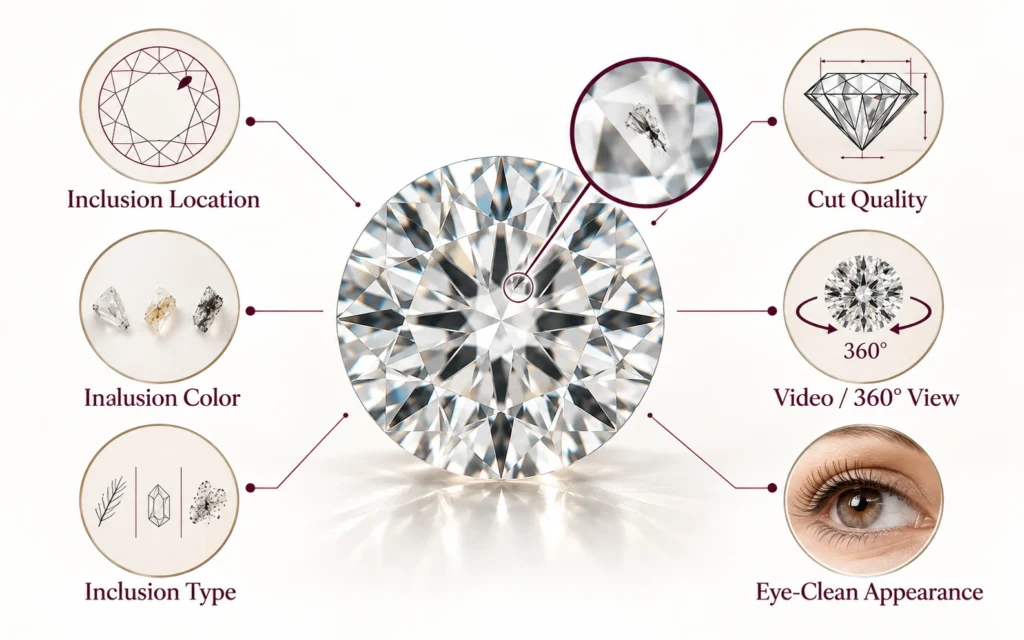
If you’re considering SI1, this section is especially important.
Don’t just select “SI1” from a search filter and buy the cheapest option.
Instead, inspect the individual diamond.
1. Inclusion Location
Where the inclusion sits can make a huge difference.
An inclusion near the edge may be much less noticeable than one directly under the table.
2. Inclusion Color
Dark inclusions can attract more attention than transparent or low-contrast characteristics.
3. Inclusion Type
Different inclusions have different visual effects.
Study the grading report and available imagery.
4. Cut Quality
Strong light performance can help reduce the visual impact of minor inclusions.
5. Video and 360-Degree Images
If you’re shopping online, inspect the diamond from different angles.
Don’t rely only on a static photograph.
6. Eye-Clean Appearance
This should be your main goal.
Ask:
Can I see the inclusion without magnification?
If the answer is no, you’ve potentially found an excellent value.
Should You Choose SI1 or VS2 for an Engagement Ring?
For many engagement rings, both can work extremely well.
The better choice depends on your priorities.
If you want a safer clarity choice and don’t mind paying more, VS2 is excellent.
If you want maximum value and are willing to inspect individual stones, SI1 can be even more compelling.
A good way to think about it is:
VS2 = more clarity confidence.
SI1 = more potential value.
Neither statement means every VS2 is eye-clean or every SI1 is visibly included.
The individual diamond still matters.
SI1 vs VS2 vs VS1
Understanding the surrounding grades helps put the comparison into perspective.
From higher to lower clarity:
FL → IF → VVS1 → VVS2 → VS1 → VS2 → SI1 → SI2 → I1 → I2 → I3
VS2 sits immediately above SI1.
That means the two grades are adjacent on the clarity scale.
This is one reason the comparison can be more complicated than something like VVS1 vs SI1.
The difference is meaningful from a grading perspective, but it doesn’t always translate into an obvious visual difference.
If you’re interested in how the two VS grades compare with each other, you can read this guide to VS1 and VS2 clarity.
SI1 vs VS2 vs VVS2
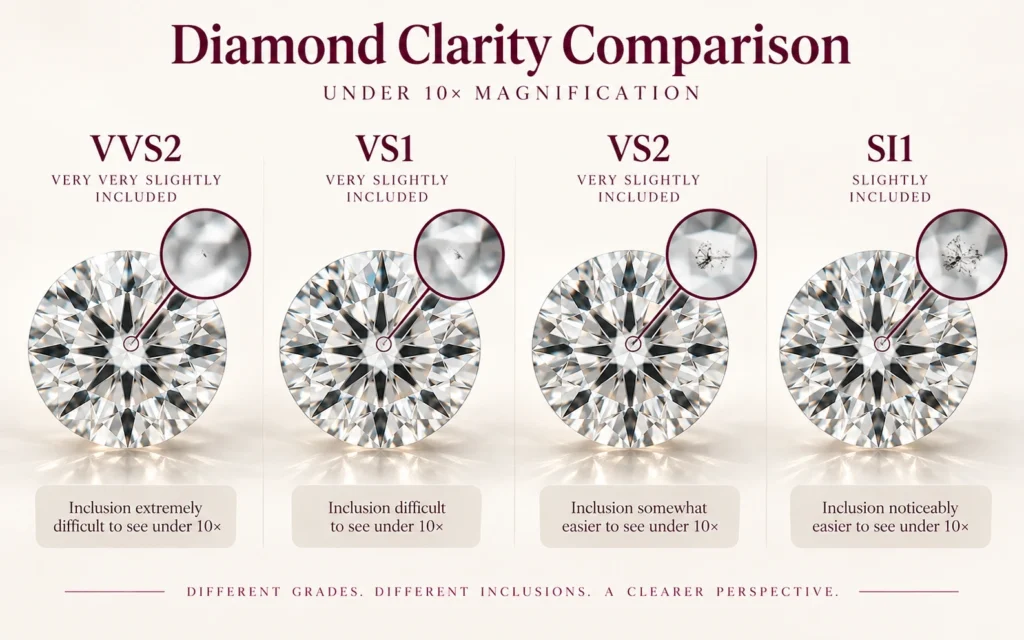
VVS2 sits significantly higher on the clarity scale than both VS2 and SI1.
But that doesn’t mean it will necessarily look dramatically better.
A VVS2 diamond can have exceptionally difficult-to-see inclusions, while a carefully selected SI1 can look clean to the naked eye.
This is why diamond shopping shouldn’t become a race toward the highest clarity grade.
Instead, think about visible performance and value.
If you’re considering VVS grades, this guide on VVS1 and VVS2 clarity explains that comparison in more detail.
Common Mistakes When Comparing SI1 and VS2
Mistake 1: Assuming SI1 Is Automatically Included to the Naked Eye
It isn’t.
Some SI1 diamonds can be completely eye-clean.
Mistake 2: Assuming Every VS2 Is Eye-Clean
VS2 provides more clarity confidence, but individual stones still vary.
Mistake 3: Buying the Lowest-Priced SI1
The cheapest SI1 isn’t necessarily the best SI1.
You need to evaluate the actual stone.
Mistake 4: Sacrificing Cut for Clarity
A higher clarity grade won’t compensate for poor cut quality.
Mistake 5: Ignoring Diamond Shape
An SI1 that works beautifully in one shape may not be the best choice in another.
Mistake 6: Looking Only at the Certificate
A grading report tells you the grade.
It doesn’t replace viewing the diamond.
How to Decide Between SI1 and VS2
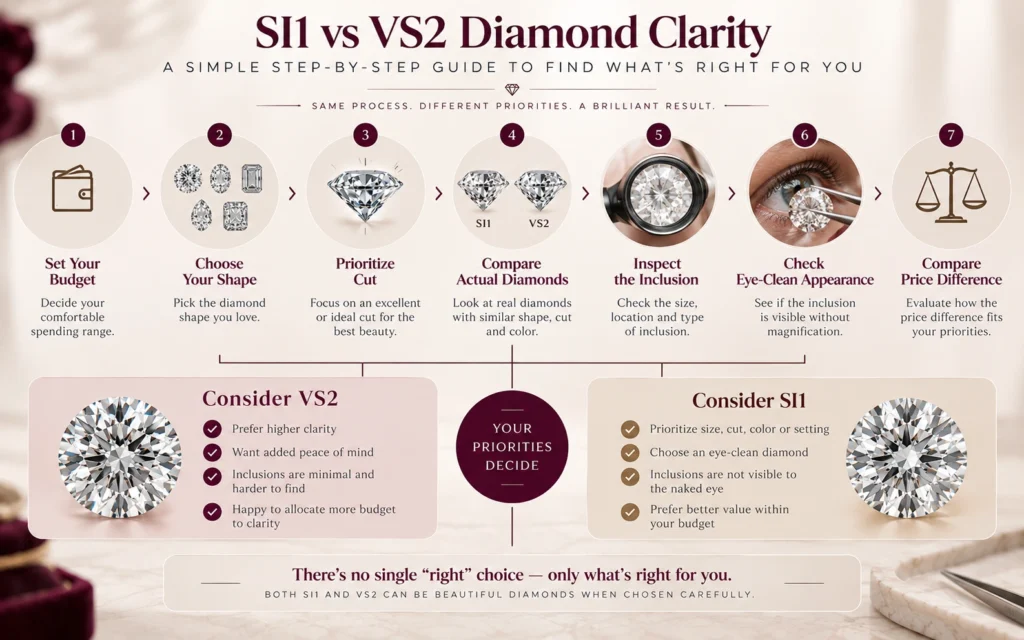
Use this simple process.
Step 1: Set Your Budget
Know how much you’re comfortable spending.
Step 2: Choose Your Diamond Shape
Your shape can affect clarity visibility.
Step 3: Prioritize Cut
Don’t sacrifice excellent visual performance just to move up in clarity.
Step 4: Compare VS2 and SI1 Stones
Look at the actual diamonds side by side.
Step 5: Check the Inclusion
Look at its:
- Location
- Size
- Type
- Color
- Contrast
Step 6: Check Whether the SI1 Is Eye-Clean
If you can’t see the inclusion without magnification, that’s a major advantage.
Step 7: Compare the Price Difference
Ask what you could buy with the money saved by choosing SI1.
Step 8: Make the Overall Decision
Choose VS2 if the clarity premium provides value to you.
Choose SI1 if the stone looks equally good and offers meaningful savings.
Final Words: SI1 or VS2?
For most engagement-ring shoppers, a well-selected eye-clean SI1 can offer outstanding value.
VS2 is the better choice if you want greater clarity confidence, are buying a clarity-sensitive shape, purchasing a larger diamond, or simply prefer the higher grade.
But don’t assume the higher grade automatically means a better-looking diamond.
A beautiful, eye-clean SI1 can look just as impressive as a VS2 when viewed normally.
The smartest approach is:
Buy the lowest clarity grade that gives you the appearance and confidence you want.
If that’s VS2, choose VS2.
If you find an eye-clean SI1 that looks beautiful and costs meaningfully less, SI1 may be the smarter purchase.
Ultimately, your goal isn’t to buy the highest clarity number.
It’s to find the best combination of:
cut + color + carat + clarity + shape + price.
For a deeper look at how clarity works across the entire grading scale, explore this guide to diamond clarity.
Frequently Asked Questions
Is VS2 better than SI1?
VS2 is technically the higher clarity grade, with inclusions that are generally more difficult for a skilled grader to see under 10× magnification. However, a well-selected SI1 can look just as clean to the naked eye.
Is SI1 good enough for an engagement ring?
Yes. An eye-clean SI1 can be an excellent engagement-ring choice, especially for buyers who want to maximize value.
Can you see SI1 inclusions with the naked eye?
Sometimes. Some SI1 diamonds have visible inclusions, while others can appear completely clean. Individual inspection is especially important when buying SI1.
Can you see the difference between SI1 and VS2?
Sometimes, but not always. The difference is more likely to be noticeable when the SI1 has a prominent or high-contrast inclusion. A well-selected SI1 and VS2 can look very similar in normal viewing.
Does VS2 sparkle more than SI1?
No. Clarity alone doesn’t determine sparkle. Cut quality and light performance are much more important factors.
Is SI1 better value than VS2?
It can be. If you find an eye-clean SI1, the lower price can allow you to spend more on carat weight, cut, color, or another feature you value.
Is VS2 worth the extra money?
It can be, particularly if the SI1 alternative has visible inclusions or if the price difference is small. But if an SI1 looks equally clean, VS2 may not provide enough visible benefit to justify a large premium.
Is SI1 good for a 1-carat diamond?
Yes. A 1-carat SI1 can be an excellent choice if it is eye-clean and well-cut. The inclusion’s location and appearance matter more than the SI1 label alone.
Is VS2 better for a large diamond?
VS2 can provide additional clarity confidence for larger stones, but the individual diamond still needs to be evaluated. A clean SI1 can also work beautifully at larger sizes.
Which is better for an emerald-cut diamond, SI1 or VS2?
VS2 is generally the safer choice because emerald cuts can make inclusions easier to notice due to their broad step facets. However, a carefully selected SI1 may still work if it is genuinely eye-clean.
Should I buy SI1 or VS2 for a lab-grown diamond?
Both can be good options. If you find an eye-clean SI1, it may provide excellent value. VS2 may be preferable if you want additional clarity confidence.
Should I prioritize VS2 clarity over cut quality?
Generally, no. A well-cut SI1 can be more attractive than a poorly cut VS2. Cut should remain a major consideration when evaluating a diamond’s visual performance.