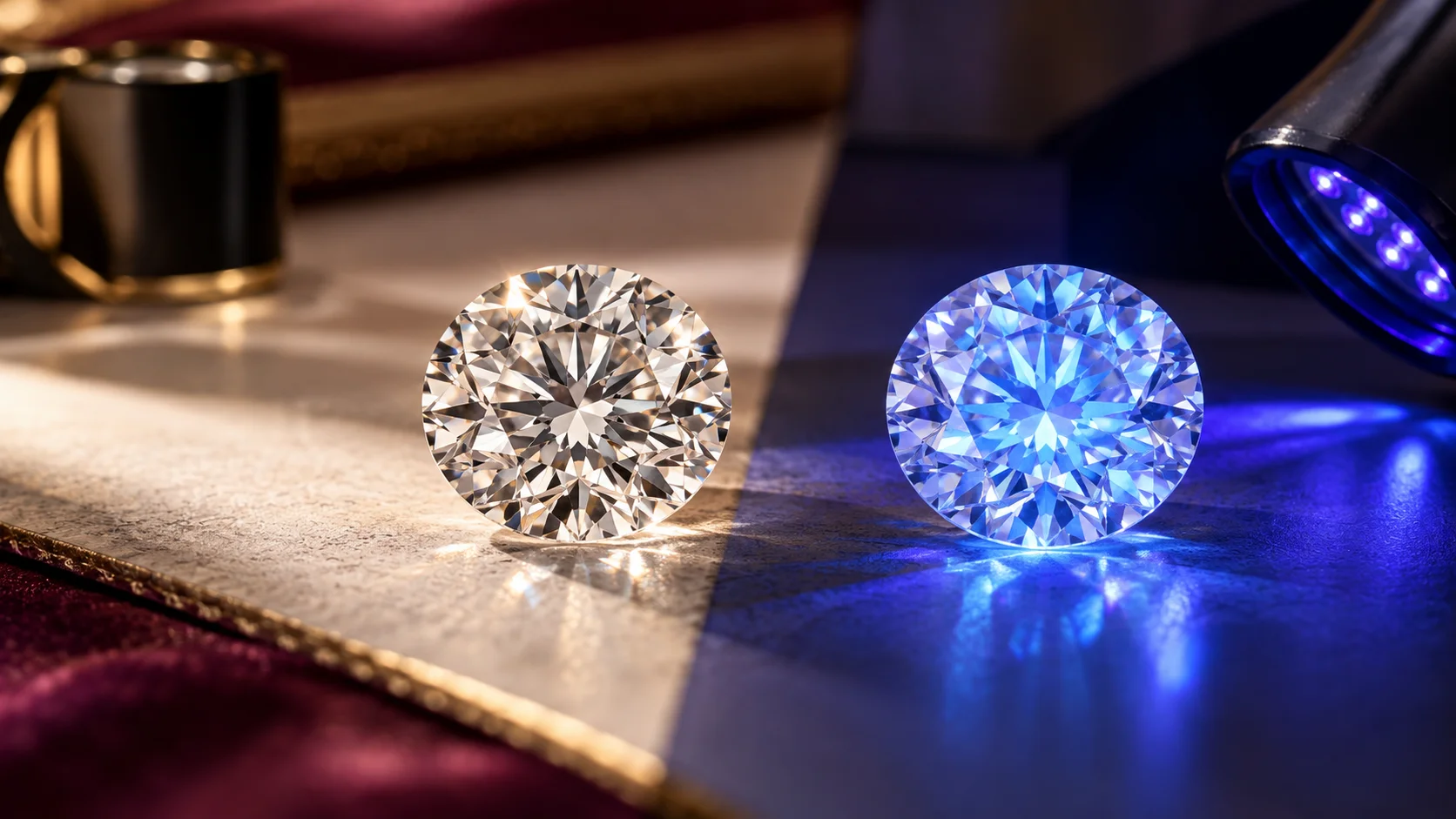
Yes, diamond fluorescence can be good – but it isn’t automatically an advantage or a disadvantage. For many diamonds, fluorescence has little noticeable effect on appearance. In some lower-color diamonds, blue fluorescence may make the stone appear slightly whiter, while strong fluorescence in certain high-color diamonds can sometimes be associated with a hazy or oily appearance.
The best approach is not to automatically avoid fluorescence. Instead, consider the diamond’s color grade, fluorescence intensity, overall appearance, and price together.
Is Diamond Fluorescence Good or Bad?
Diamond fluorescence is neither inherently good nor bad.
Fluorescence is a natural characteristic that causes some diamonds to emit a visible glow when exposed to ultraviolet (UV) light. Blue is by far the most common fluorescence color.
It is also not one of the 4Cs. Instead, fluorescence is reported separately as an identifying characteristic on a diamond grading report.
GIA describes fluorescence intensity using grades such as None, Faint, Medium, Strong, and Very Strong.
If you want to understand the phenomenon itself before looking at whether it is beneficial, see what diamond fluorescence is.
When Can Diamond Fluorescence Be Good?
Fluorescence can be beneficial in certain situations, particularly when you’re considering a diamond with a warmer color grade.
1. Blue fluorescence can complement warmer diamonds
Diamonds in lower color grades can show more visible yellow or warm tones. In some cases, blue fluorescence can make the diamond appear somewhat whiter when viewed in lighting containing UV.
This does not change the diamond’s official color grade. Instead, it can influence how the stone looks to your eyes.
GIA notes that blue fluorescence can sometimes enhance the apparent color of diamonds in the I-to-M range.
That means a buyer who is comfortable with a warmer color grade may find a fluorescent diamond particularly interesting.
2. Fluorescence can sometimes offer value
Fluorescent diamonds can sometimes sell for less than comparable diamonds without fluorescence, especially in higher color grades where fluorescence has historically been viewed less favorably.
That creates an opportunity for buyers who care more about how the diamond actually looks than about having a “None” fluorescence designation on the report.
A diamond with Medium or Strong fluorescence is not automatically a worse diamond. If it looks beautiful in normal viewing conditions and is priced attractively, the fluorescence may actually work in your favor.
For more detail on the financial side, see how diamond fluorescence affects price.
3. Fluorescence does not weaken the diamond
Fluorescence does not make a diamond structurally weaker.
A fluorescent diamond is not more fragile simply because it reacts to UV light. The presence or absence of fluorescence is related to characteristics within the diamond and does not inherently compromise its durability.
When Might Diamond Fluorescence Not Be Good?
There are situations where you may want to be more cautious.
1. Strong fluorescence in a high-color diamond
If you’re buying a D, E, F, G, or H color diamond, you may not gain much from blue fluorescence because the diamond already has a relatively high color grade.
In rare cases, strong or very strong fluorescence can make a diamond with certain pre-existing light-scattering characteristics appear hazy or oily.
Importantly, fluorescence itself does not create the haziness. GIA explains that fluorescence can intensify an existing issue in an extremely small number of diamonds. Fewer than 0.2% of fluorescent diamonds submitted to GIA exhibited this type of effect.
So the sensible rule is not “strong fluorescence is always bad.”
It is:
Strong fluorescence deserves closer inspection, particularly in a high-color diamond.
2. You prefer a completely neutral appearance
Some buyers simply prefer diamonds with no fluorescence.
That’s a valid preference. If two otherwise comparable diamonds look equally good and one has None fluorescence while the other has Strong fluorescence, you may prefer the simpler choice.
But there is no need to pay a large premium simply to eliminate fluorescence if the fluorescent diamond looks equally attractive.
Does Fluorescence Make a Diamond Look Whiter?
Sometimes, but not universally.
Blue fluorescence can interact with the warm tones visible in lower-color diamonds. This can make some diamonds appear somewhat whiter under certain lighting conditions.
The effect is most relevant when you’re considering diamonds toward the warmer end of the color scale.
However, fluorescence does not upgrade the diamond’s official color grade. A diamond graded J remains a J even if its fluorescence makes it appear slightly whiter to your eyes.
For a deeper look at this relationship, see diamond fluorescence and color.
Does Fluorescence Make a Diamond Look Cloudy?
Usually, no.
This is one of the biggest misconceptions about diamond fluorescence.
Fluorescence does not automatically make a diamond cloudy or milky. GIA’s research found that fluorescence has little to no effect on transparency in the overwhelming majority of diamonds.
The concern mainly applies to rare diamonds that already contain light-scattering defects. Strong fluorescence can make an existing hazy appearance more noticeable.
This is why you should evaluate the actual diamond, rather than rejecting every stone simply because its report says Strong or Very Strong fluorescence.
If cloudiness is your concern, you may also want to read does diamond fluorescence make it look cloudy?.
Is Strong Fluorescence Bad?
Not necessarily.
Strong fluorescence is a characteristic, not a quality grade.
A Strong fluorescent diamond can look completely attractive and perform well. Another Strong fluorescent diamond may show an appearance you don’t like.
The difference is the individual stone.
GIA’s research found that average observers generally could not consistently distinguish fluorescent diamonds from non-fluorescent diamonds under typical viewing conditions. In some cases, observers actually preferred the appearance of strongly blue fluorescent diamonds.
So rather than using this rule:
Strong fluorescence = bad
use:
Strong fluorescence = inspect the diamond more carefully.
Does Diamond Fluorescence Affect Price?
Yes, it can.
Fluorescence may influence a diamond’s market price because buyers and the trade have historically viewed certain fluorescence combinations differently.
In particular, diamonds with higher color grades and stronger fluorescence can sometimes be priced below comparable diamonds without fluorescence.
That doesn’t necessarily mean you’re getting an inferior diamond.
If the diamond looks excellent and the fluorescence contributes to a lower price, it can potentially provide better value.
On the other hand, you should not assume that fluorescence automatically makes a diamond cheaper. Pricing depends on the entire combination of characteristics, including color, clarity, cut, carat weight, fluorescence, proportions, and overall market demand.
Which Diamonds Can Benefit Most From Fluorescence?
There isn’t one fluorescence level that is best for every diamond.
However, blue fluorescence can be particularly interesting when you’re considering a warmer color grade.
For example, a buyer comparing two visually similar diamonds might find that a fluorescent I- or J-color diamond looks appealing while costing less than a higher-color diamond.
That can make fluorescence part of a value-oriented buying strategy.
By contrast, someone shopping for a D-color diamond may have little reason to seek fluorescence specifically.
The important point is that fluorescence should be evaluated in context with color.
Does Fluorescence Affect Diamond Sparkle?
Fluorescence is not what determines whether a diamond has strong sparkle.
The diamond’s cut, proportions, facet arrangement, and light performance are much more important to its brilliance and sparkle.
GIA states that fluorescence has little to no effect on diamond sparkle and that cut is a primary factor in how well a diamond interacts with light.
So if you’re choosing between two diamonds, don’t sacrifice a better-cut diamond simply because another stone has a preferred fluorescence grade.
Should You Buy a Diamond With Fluorescence?
Yes, you can absolutely buy a diamond with fluorescence.
In fact, fluorescence should not automatically be treated as a reason to reject a diamond.
A fluorescent diamond can be a good choice when:
- You like how the diamond looks in normal lighting.
- The fluorescence complements the diamond’s color.
- The stone has good overall transparency and appearance.
- The price represents good value.
- You have compared it with similar diamonds without fluorescence.
You may want to be more cautious when:
- The diamond has Strong or Very Strong fluorescence.
- It is a high-color diamond.
- You notice haziness, milkiness, or reduced visual contrast.
- The diamond is being purchased sight unseen without adequate imagery or inspection.
- You are paying a premium without seeing a corresponding visual benefit.
How to Choose a Diamond With Fluorescence
If you’re considering a fluorescent diamond, use this simple process.
1. Check the fluorescence intensity
Look at the grading report and determine whether the diamond has None, Faint, Medium, Strong, or Very Strong fluorescence.
Don’t treat the intensity as a standalone quality score.
2. Consider the color grade
Ask whether fluorescence complements the diamond’s color.
Blue fluorescence can be more interesting in warmer diamonds, while there may be less practical benefit in an already colorless diamond.
3. Examine the actual diamond
This is especially important with Strong or Very Strong fluorescence.
Look for:
- Brightness
- Transparency
- Contrast
- Sparkle
- Any hazy or milky appearance
- Overall color
4. Compare it with similar diamonds
Don’t compare fluorescence in isolation.
Compare diamonds with similar:
- Carat weight
- Cut quality
- Color
- Clarity
- Shape
- Proportions
- Price
Then decide which stone actually looks better.
5. Consider the price
If two diamonds look similarly attractive but one costs less because of fluorescence, that can be an advantage.
The goal isn’t to find a diamond with the “perfect” fluorescence grade.
The goal is to find the best-looking diamond for your budget.
Is Diamond Fluorescence Good? The Bottom Line
Diamond fluorescence can be good, but it depends on the individual diamond.
For many stones, it has little noticeable effect on appearance. In some warmer-color diamonds, blue fluorescence may improve the perceived whiteness. In other cases – particularly rare stones with certain pre-existing characteristics – strong fluorescence can contribute to a hazy appearance.
The most important takeaway is:
Don’t automatically avoid fluorescence, and don’t automatically seek it out. Evaluate the diamond as a whole.
If a fluorescent diamond looks beautiful, has strong overall cut and light performance, and offers a compelling price, fluorescence can be an advantage rather than a problem.
For a broader overview, continue with the Diamond Fluorescence Guide or learn more about whether diamond fluorescence is bad.
