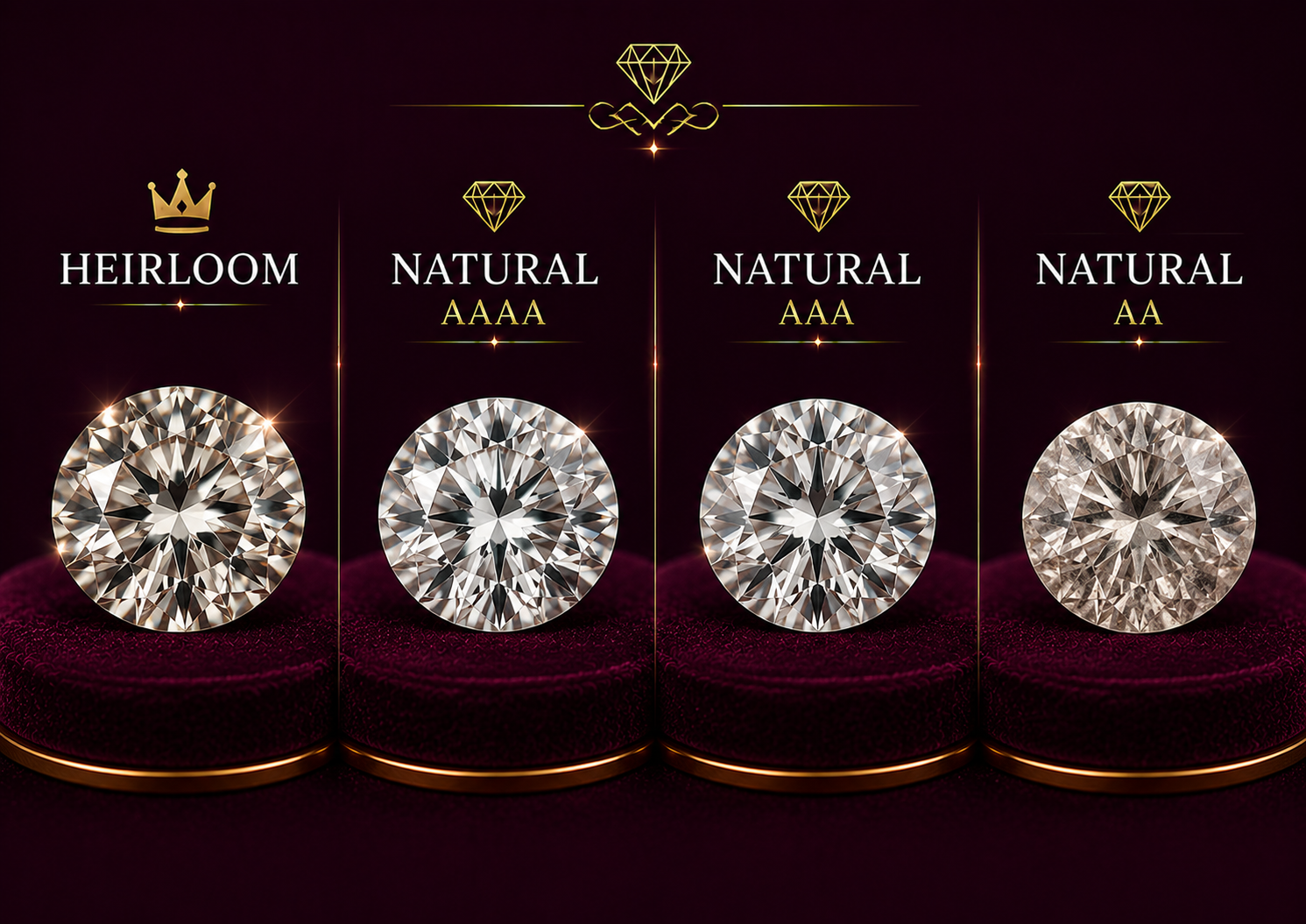
When shopping for gemstones, you’ll often encounter descriptions such as natural, heirloom, AAAA, AAA, and AA. But what do these terms actually mean, and does a higher grade always indicate a better gemstone?
The important distinction is that natural describes a gemstone’s origin, while AAAA, AAA, and AA are commercial quality labels. Heirloom can describe a piece of jewelry passed through generations or be used by some sellers as a premium gemstone-quality designation.
Understanding these differences makes it easier to compare gemstones, recognize marketing terminology, and choose a stone that matches your expectations and budget.
What Does Heirloom vs Natural AAAA vs AAA vs AA Mean?
These terms describe different aspects of gemstones rather than one universal grading system.
- Natural: A gemstone formed through natural geological processes rather than manufactured in a laboratory.
- Heirloom: Traditionally, jewelry passed down through generations. Some gemstone sellers also use this term to describe exceptionally fine-quality stones.
- AAAA: A premium commercial quality label used by some sellers for their finest gemstone selections.
- AAA: A high-quality commercial designation generally associated with attractive color, clarity, and cutting.
- AA: A commercial quality designation generally describing good-quality gemstones with more noticeable variations than higher tiers.
However, there is an important limitation: colored gemstones do not share one universally accepted AAAA-to-AA grading system. Different sellers can use these labels according to their own selection criteria.
Therefore, you should never assume that an AAAA gemstone from one retailer will automatically outperform an AAA gemstone from another.
Heirloom vs Natural Gemstones: What’s the Difference?
Heirloom and natural are not competing gemstone categories. A gemstone can be both natural and heirloom quality.
The difference becomes easier to understand when you consider what each term describes.
What Is a Natural Gemstone?
A natural gemstone forms through geological processes in the Earth. Natural gemstones can develop over millions of years under specific conditions involving temperature, pressure, and mineral composition.
Examples include:
- Natural sapphire
- Natural ruby
- Natural emerald
- Natural garnet
- Natural amethyst
- Natural aquamarine
Natural gemstones can contain internal inclusions, color variations, and other characteristics created during their formation.
These features are not automatically defects. Inclusions can sometimes help gemologists understand a gemstone’s identity and formation history.
However, natural does not automatically mean high quality. A natural gemstone can have weak color, poor transparency, an uneven cut, or noticeable damage.
What Is an Heirloom-Quality Gemstone?
The traditional meaning of heirloom refers to a piece of jewelry intended to be preserved and passed down through generations.
When gemstone retailers use the expression heirloom quality, they may be describing stones selected for exceptional appearance, rarity, craftsmanship, or long-term appeal.
However, there is no universal gemological definition that establishes an official heirloom gemstone grade.
A gemstone marketed as heirloom quality should therefore be evaluated through its actual characteristics rather than the label alone.
Consider the following:
- Attractive and consistent color
- Suitable clarity for the gemstone variety
- Good cutting and proportions
- Appropriate durability for its intended jewelry setting
- Verified natural or laboratory-grown origin
- Disclosed treatments
- Reliable identification documentation
Important: Natural origin and heirloom quality are separate considerations. A natural gemstone is not automatically heirloom quality, and the word heirloom does not independently prove a stone’s rarity, origin, or investment potential.
Understanding AAAA vs AAA vs AA Gemstone Quality
Commercial gemstone grading systems often use letter-based descriptions to help buyers distinguish different quality levels.
Although the exact definitions vary, the following table explains how these labels are commonly intended to work.
| Grade | General quality description | Typical characteristics |
|---|---|---|
| AAAA | Exceptional or premium | Attractive color, strong overall appearance, and carefully selected clarity and cutting |
| AAA | High quality | Good color, attractive transparency, and generally well-finished cutting |
| AA | Good quality | More noticeable color variation or inclusions, depending on the gemstone |
| A | Commercial quality | Greater variation in color, clarity, and overall appearance |
These descriptions are general commercial conventions, not official grading requirements.
1. AAAA Gemstones
AAAA is sometimes used to describe the highest commercial selection available from a particular gemstone seller.
Stones carrying this label may have:
- Strong or vivid color
- Attractive color consistency
- High transparency where appropriate
- Few distracting visible inclusions
- Good cutting and polishing
- Strong overall visual appeal
Some retailers reserve AAAA for particularly fine examples of a gemstone.
However, an AAAA label does not guarantee that a stone is flawless, untreated, rare, or independently certified.
Always ask the seller what specific characteristics qualify a gemstone for this grade.
2. AAA Gemstones
AAA gemstones are generally positioned below AAAA in commercial grading systems.
They can still offer excellent visual appeal and may be suitable for fine jewelry and engagement rings.
Common characteristics include:
- Attractive and reasonably consistent color
- Good transparency for the gemstone variety
- Limited distracting inclusions
- Good polishing and cutting
- A pleasing overall appearance
For many buyers, AAA gemstones can provide a practical balance between appearance and cost.
The important point is to compare the actual gemstone rather than assuming that every AAA stone has identical characteristics.
3. AA Gemstones
AA is commonly used to describe good commercial-quality gemstones.
Compared with higher commercial tiers, an AA gemstone may have:
- Less saturated or less consistent color
- More visible natural inclusions
- Slight variations in transparency
- Less precise cutting or polishing
- More noticeable differences between individual stones
However, these characteristics depend heavily on the gemstone variety and the seller’s grading criteria.
An AA gemstone is not necessarily unattractive or unsuitable for jewelry.
For buyers who prioritize affordability, distinctive natural patterns, or a particular color, an AA stone may still be a satisfying choice.
4. A-Grade Gemstones
Although the main comparison focuses on AAAA, AAA, and AA, some sellers also use A as an additional commercial tier.
A-grade stones may display more noticeable variations in color, clarity, cutting, or surface quality.
They can work well in certain decorative jewelry designs where perfect color consistency or high transparency is not essential.
The suitability of an A-grade gemstone depends on the individual stone and its intended use.
AAAA vs AAA vs AA: Complete Gemstone Comparison
Here is a simplified comparison of the commonly intended differences.
| Characteristic | AAAA | AAA | AA |
|---|---|---|---|
| Commercial positioning | Exceptional | High quality | Good quality |
| Color | Often strong and attractive | Generally attractive | May be less saturated or consistent |
| Clarity | Usually carefully selected | Generally good | More inclusions may be visible |
| Transparency | Often high where applicable | Generally good | Can vary more |
| Cutting | Usually carefully finished | Good overall finishing | More variation possible |
| Visual consistency | Generally higher | Good | More variation |
| Price | Often higher | Mid-to-premium | Often more affordable |
Remember: This table describes common seller terminology, not a standardized gemstone grading specification. The same gemstone can receive different commercial grades from different sellers.
What Determines the Quality of a Gemstone?
A gemstone’s quality cannot be established by one letter grade alone.
Several characteristics work together to determine its appearance, durability, rarity, and desirability.
1. Color
Color is one of the most important considerations when evaluating many colored gemstones.
Gemologists consider three major components:
- Hue: The basic color, such as blue, green, red, or purple.
- Tone: How light or dark the gemstone appears.
- Saturation: How strong or vivid the color looks.
For example, a sapphire with attractive, well-balanced blue color may be more desirable than a stone with a dull or overly dark appearance.
However, preferred color characteristics vary between gemstone varieties.
2. Clarity and Inclusions
Clarity describes the internal characteristics and surface features of a gemstone.
Natural gemstones frequently contain inclusions formed during their geological development.
Their visibility and importance vary considerably between gemstone varieties.
For example, emeralds commonly contain inclusions, and their appearance should be evaluated with the characteristics of emeralds in mind.
A gemstone does not necessarily need to be completely inclusion-free to be attractive or valuable.
3. Cut and Proportions
Cutting influences how a gemstone looks when light interacts with its surfaces.
A well-cut gemstone can display attractive brilliance, color distribution, and overall visual balance.
Poor cutting may create:
- Uneven proportions
- Excessive light leakage
- A dark or lifeless appearance
- Uneven color distribution
- An unattractive outline
A higher commercial grade should not distract buyers from evaluating the actual cutting quality.
4. Carat Weight
Carat measures a gemstone’s weight, not its overall quality.
Two gemstones with identical carat weights may have different dimensions, proportions, colors, and clarity characteristics.
Larger gemstones can also be rarer in certain varieties, particularly when they combine attractive color and clarity.
However, a larger gemstone is not automatically better than a smaller, more attractive example.
5. Treatments and Enhancements
Gemstone treatments can change or improve a stone’s appearance.
Common examples include:
- Heat treatment
- Fracture filling
- Diffusion treatment
- Dyeing
- Surface coating
- Irradiation
Some treatments are widely accepted in the gemstone industry.
However, treatment information matters because it can influence a gemstone’s appearance, care requirements, rarity, and market value.
Always ask whether the gemstone has been treated and whether the treatment is stable or requires special care.
Does AAAA Always Mean Better Than AAA or AA?
Not necessarily.
Within one retailer’s clearly defined grading system, AAAA may represent a higher selection tier than AAA or AA.
However, there is no universal grading authority enforcing these labels across the colored gemstone market.
For example, one seller may reserve AAAA for stones with particularly strong color and very few visible inclusions, while another may use the same label more loosely.
This creates a problem when shoppers compare products from different retailers.
A gemstone labeled AAAA is not automatically superior to another seller’s AAA gemstone.
Instead, compare:
- Actual gemstone color and saturation.
- Visible inclusions and transparency.
- Cutting quality and proportions.
- Natural, laboratory-grown, or imitation status.
- Treatment information.
- Available identification reports.
- Price relative to the stone’s actual characteristics.
This approach provides a much more meaningful comparison than relying on commercial grading labels alone.
How to Identify a Quality Gemstone Before Buying
Before purchasing a gemstone, look beyond the product title and advertised quality grade.
Here are some practical steps that can help.
Ask for Actual Gemstone Photographs
Request clear photographs and videos of the specific gemstone you are purchasing.
Stock images may not accurately represent the color, inclusions, or appearance of an individual stone.
If possible, review the gemstone under different lighting conditions.
Check the Gemstone’s Origin
Ask whether the gemstone is natural, laboratory-grown, or an imitation.
These categories describe different material origins and should not be confused with commercial quality grades.
A laboratory-grown gemstone can have attractive visual characteristics, while a natural gemstone can have lower visual quality.
Understand the Treatment Status
Ask the seller whether the stone has undergone heat treatment, dyeing, fracture filling, or another enhancement.
Treatment disclosure is particularly important for buyers who prioritize untreated gemstones.
Request an Independent Gemstone Report
For significant purchases, consider obtaining an identification report from a reputable gemological laboratory.
Depending on the laboratory and report type, documentation may identify the gemstone species, indicate whether it is natural or laboratory-grown, and disclose detectable treatments.
Remember that gemstone identification is not the same as receiving a universal AAAA or AAA commercial grade.
Compare the Actual Price and Appearance
A high commercial grade does not automatically justify a premium price.
Compare gemstones of the same variety, similar size, comparable treatment status, and similar visible quality.
This helps you understand whether the price difference reflects meaningful characteristics or simply different seller terminology.
Which Gemstone Grade Should You Choose?
The right gemstone depends on your priorities rather than automatically choosing the highest available label.
Choose AAAA if:
- You want to explore the seller’s premium gemstone selection.
- You prioritize particularly attractive color and overall appearance.
- You have a higher budget and the seller provides clear grading criteria.
Choose AAA if:
- You want an attractive gemstone without necessarily paying for the highest commercial tier.
- You value a balance between appearance and cost.
- You can find a stone with appealing color, clarity, and cutting.
Choose AA if:
- You have a more limited budget.
- You appreciate natural variations.
- The individual gemstone still looks attractive and suits your intended jewelry design.
Choose an heirloom-quality gemstone carefully if:
- You want a piece with lasting sentimental significance.
- You value gemstone characteristics and craftsmanship.
- You want jewelry that can be maintained and potentially passed down through generations.
Ultimately, the individual gemstone matters more than the advertised grade.
A beautifully colored, well-cut AAA gemstone may be a better purchase for your needs than a poorly selected stone carrying an AAAA label.
Exploring Different Gemstone Jewelry Options
Once you understand gemstone quality, you can start exploring different gemstone varieties and jewelry styles.
For example, a garnet engagement ring can offer a distinctive red appearance, while gemstone engagement rings can provide more unusual and expressive designs.
You can also explore January birthstone rings if you appreciate garnet jewelry and meaningful birthstone designs.
If you are still deciding which gemstone suits your preferences, these educational comparisons can help:
Understanding the characteristics of different gemstones makes it easier to choose jewelry based on appearance, durability, and personal preference.
Frequently Asked Questions
Is AAAA better than AAA in gemstones?
AAAA is generally intended to represent a higher commercial quality tier than AAA. However, these labels are not standardized, and their meanings vary between sellers. Always compare the gemstone’s actual characteristics.
Is AAA better than AA?
Within many commercial gemstone grading systems, AAA is positioned above AA. AAA stones generally have more desirable color, clarity, and cutting characteristics, but the exact differences depend on the seller and gemstone variety.
What does heirloom quality mean in gemstones?
Heirloom quality is sometimes used by retailers to describe exceptionally fine gemstones or jewelry intended to last for generations. However, it is not a universally recognized gemological grade.
Are natural gemstones always better than treated gemstones?
No. Natural describes how a gemstone originated, while treated describes whether it has undergone an enhancement process. Some natural gemstones are treated using widely accepted industry practices. The important consideration is understanding the treatment and its implications.
Can a natural gemstone be AAAA quality?
Yes. A natural gemstone can be assigned an AAAA commercial grade by a seller using that grading system. However, the designation is not a universal certification of quality.
Are AAAA gemstones rare?
Not automatically. AAAA is a commercial quality label rather than a formal measure of geological rarity. Actual rarity depends on the gemstone variety, color, size, clarity, origin, and availability.
Does a higher gemstone grade mean a higher price?
Generally, sellers may charge more for stones they classify in higher quality tiers. However, price also depends on gemstone variety, size, rarity, treatments, origin, cutting, and market demand.
Is AAAA the highest gemstone grade?
Not universally. Some sellers use AAAA as their highest tier, while others use AAA, GEM, or additional designations. There is no single internationally accepted AAAA-to-AA grading hierarchy.
How can I verify whether a gemstone is natural?
A qualified gemologist or reputable gemological laboratory can examine the gemstone and provide an identification report. Depending on the stone and available testing, the report may help establish whether it is natural or laboratory-grown and identify detectable treatments.
Final Thoughts
Understanding heirloom vs natural AAAA vs AAA vs AA becomes much easier when you separate gemstone origin from commercial quality labels.
Natural describes how a gemstone formed, heirloom describes traditional ownership or a retailer’s premium-quality positioning, and AAAA, AAA, and AA are informal grading designations whose definitions vary between sellers.
Rather than choosing a gemstone based solely on its advertised grade, examine its color, clarity, cut, transparency, treatment status, and available documentation.
The best gemstone isn’t necessarily the one with the most A’s in its description. It’s the one whose actual quality, appearance, and price make sense for you.