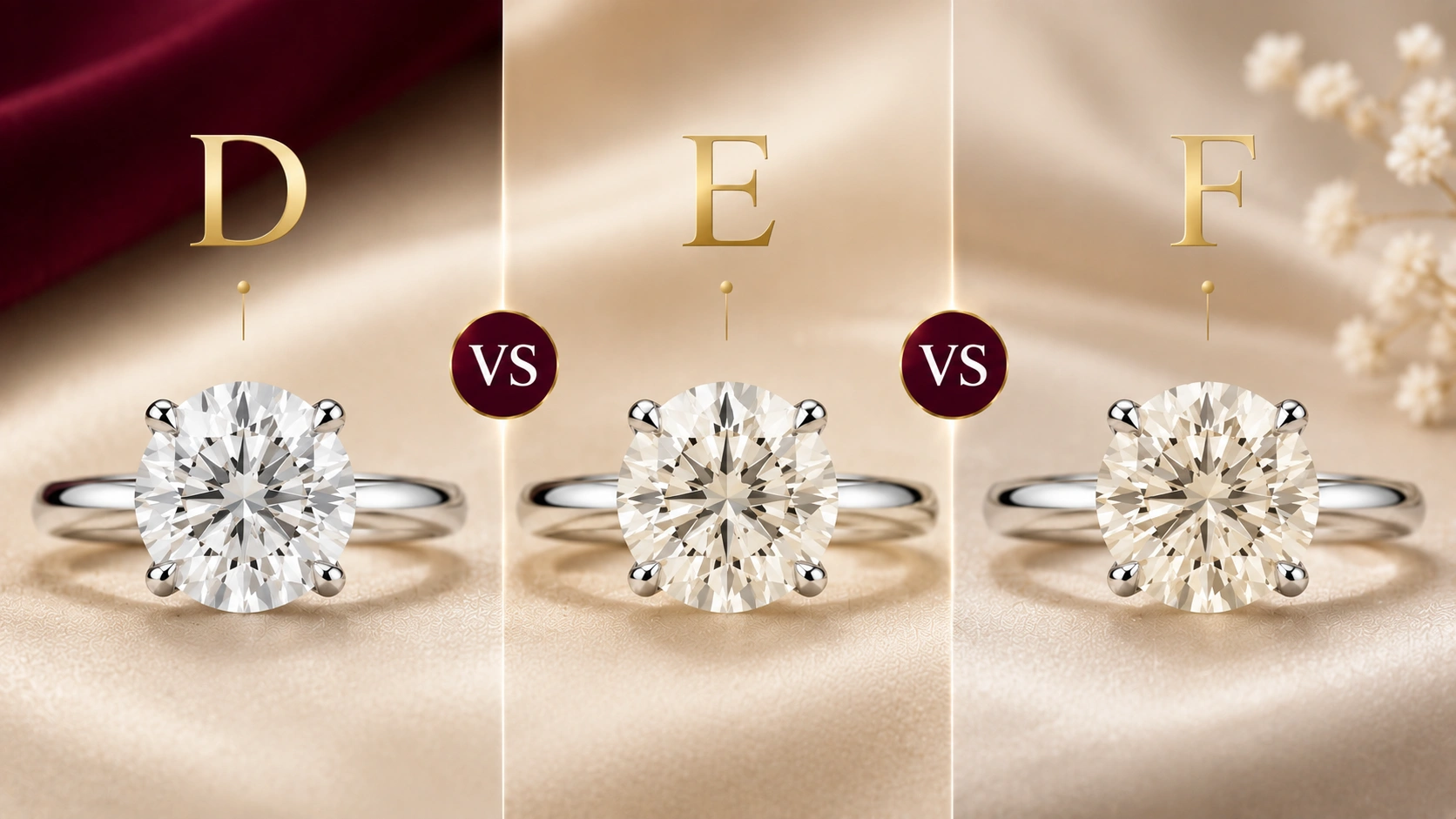
If you’re comparing D vs E vs F diamonds, you’re already looking at the very top of the standard diamond color scale.
D, E, and F are all classified as Colorless by GIA. D is the highest color grade, followed by E and then F. The differences between these grades are extremely subtle and are determined under controlled grading conditions rather than by simply looking at a diamond in everyday lighting.
So, does that mean D is automatically the best choice?
Technically, D is the highest color grade.
But from a practical buying perspective, the answer is more complicated.
A well-selected F-color diamond can look just as colorless to many people as an E or D when the stones are viewed normally. Since moving higher on the color scale can increase the price, many shoppers may find E or F a better balance between color quality and overall value.
The right choice depends on your diamond’s shape, carat weight, setting, cut quality, budget, and how sensitive you are to subtle differences in color.
D vs E vs F Diamond Color at a Glance
| Feature | D Color | E Color | F Color |
|---|---|---|---|
| Color category | Colorless | Colorless | Colorless |
| Position on scale | Highest | Second-highest | Third-highest |
| Visible color | Essentially none | Extremely difficult to detect | Extremely difficult to detect |
| Rarity | Highest of the three | Very high | Very high |
| Price | Usually highest | Usually high | Usually lower |
| Everyday appearance | Colorless | Colorless | Colorless |
| Best for | Maximum color purity | Luxury + balance | Value within colorless range |
| Worth paying more automatically? | No | No | No |
The most important takeaway is:
D, E, and F are all colorless grades, so the visual difference between them can be much smaller than the price difference.
What Does D Color Mean?
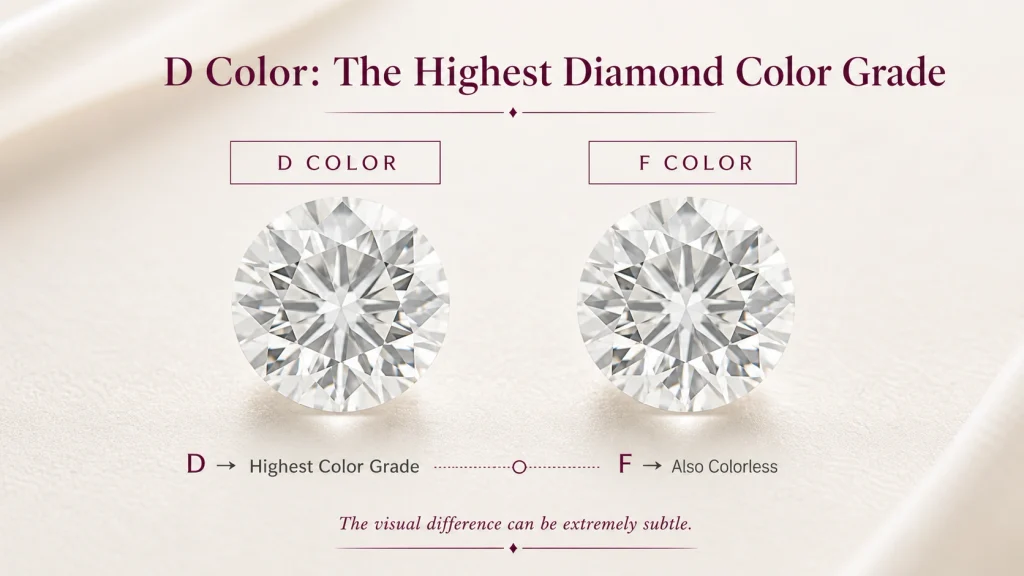
D is the highest color grade on the GIA D-to-Z diamond color scale.
A D-color diamond is classified as Colorless and represents the top end of the standard color grading range. GIA grades diamonds by comparing them with master stones under controlled lighting conditions, allowing trained graders to identify extremely subtle differences in color.
D color is often associated with:
- Maximum colorlessness
- High rarity
- Strong demand
- A crisp, icy appearance
- Premium pricing
Because D is the highest grade, it is often attractive to buyers who want the best possible color specification.
But there is an important distinction:
Highest grade doesn’t necessarily mean visibly better.
If you place a D and F diamond into two similar engagement rings, most people won’t be able to identify which one is D simply by looking at them under normal conditions.
Is D Color Worth It?
It can be.
If you have a large budget and color is one of your highest priorities, D can be an excellent choice.
But if choosing D means sacrificing:
- Carat weight
- Cut quality
- Clarity
- Setting quality
then the premium may not be worth it.
For many shoppers, the difference between D and F is much harder to see than the difference in price.
What Does E Color Mean?
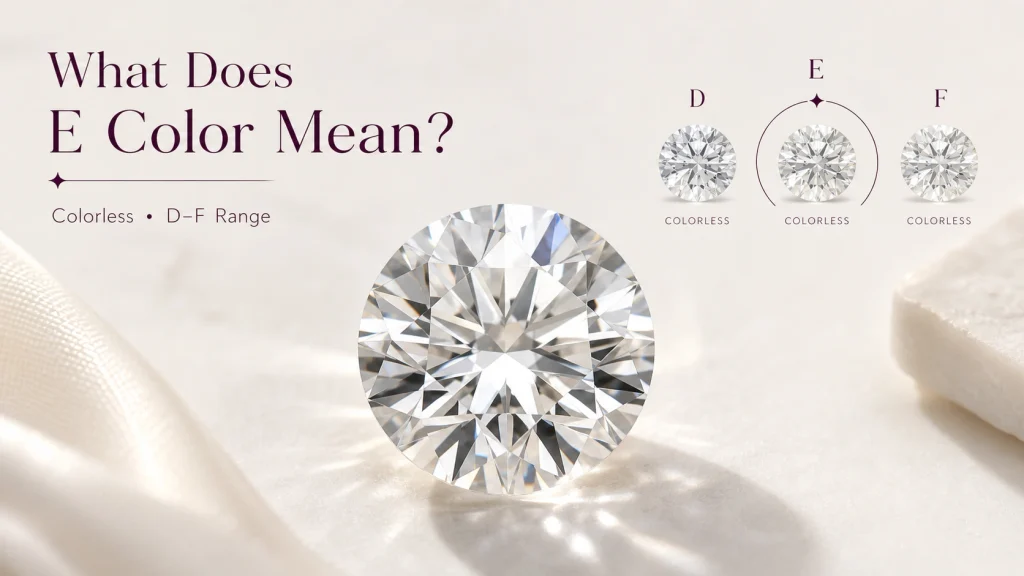
E is the grade immediately below D.
It still falls within GIA’s Colorless category, which includes D, E, and F.
An E-color diamond contains an extremely subtle amount of body color that is difficult for even trained observers to distinguish from D without controlled comparison.
In everyday viewing, an E diamond will generally appear completely colorless.
That’s why E can be an interesting middle ground.
You get:
- A top-tier color grade
- Colorless classification
- Very high rarity
- Slightly lower pricing than D in many cases
Is E Color Better Value Than D?
For many buyers, yes.
If you’re comparing otherwise similar D and E diamonds, the E may provide almost the same visual experience without the full premium associated with the highest color grade.
However, pricing is individual. Two diamonds with the same color grade can still have very different prices because of cut, carat weight, clarity, shape, certification, and other characteristics.
So don’t assume every E diamond is automatically a bargain.
What Does F Color Mean?
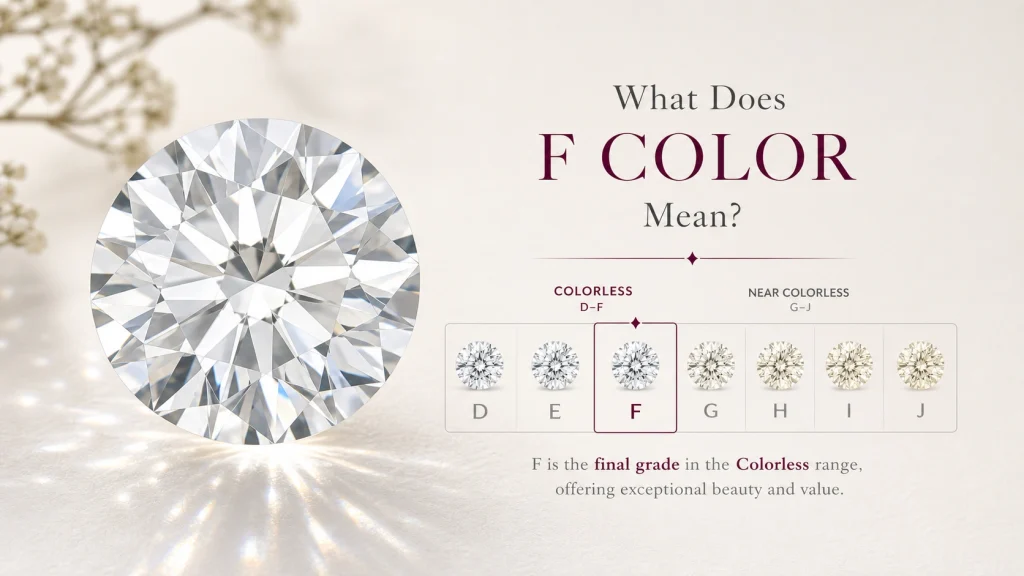
F is the third grade in the Colorless category.
It sits directly below E and above G.
According to GIA, D through F are classified as Colorless, while G through J fall into the Near Colorless category.
F-color diamonds contain a very subtle amount of body color, but they remain within the highest color category of the standard D-to-Z scale.
For many engagement-ring shoppers, F can be an excellent choice because it offers:
- Colorless grading
- High visual whiteness
- Excellent appearance
- Potentially better value than D or E
This makes F particularly interesting for buyers who don’t want to compromise on color quality but also don’t want to pay a significant premium for the very top grades.
What Is the Difference Between D, E, and F Diamonds?
The difference is primarily the degree of colorlessness.
Think of the scale as a very fine gradient rather than three dramatically different colors.
D → E → F → G → H → I → J
As you move down the alphabet, the amount of detectable body color gradually increases.
D is the most colorless.
E has slightly more color than D.
F has slightly more color than E.
But D, E, and F all remain within the Colorless category.
The differences are subtle enough that professional grading requires controlled conditions and comparison stones.
That’s why a shopper shouldn’t expect a dramatic visual difference between D and F.
Can You See the Difference Between D, E, and F?
Usually not easily under normal viewing conditions.
This is one of the most important things to understand before paying a premium for D color.
When diamonds are graded professionally, they are compared under controlled lighting and specific viewing conditions. This allows graders to identify color differences that are extremely difficult to see casually.
In everyday life, you’re likely to see the diamond:
- On your finger
- In indoor lighting
- Outdoors
- Under jewelry-store lighting
- Against different clothing colors
- In photographs
- From several feet away
Under those conditions, D, E, and F can all appear beautifully white.
A side-by-side comparison of loose stones under controlled conditions is much more revealing than looking at one mounted diamond by itself.
Does D Color Sparkle More Than E or F?
No.
Color and sparkle are different characteristics.
A diamond’s sparkle is strongly influenced by its:
- Cut quality
- Proportions
- Faceting
- Symmetry
- Polish
- Light return
A D-color diamond doesn’t automatically sparkle more than an F-color diamond.
In fact, a beautifully cut F-color diamond can look more lively and brilliant than a poorly cut D-color diamond.
This is why you shouldn’t sacrifice cut quality simply to reach D color.
If you’re still deciding how much importance to give cut, start with this diamond cut guide.
You can also understand how color works alongside carat, clarity, and cut in this guide to the 4Cs of diamond quality.
D vs E vs F Diamond Price: Is D Worth Paying More For?
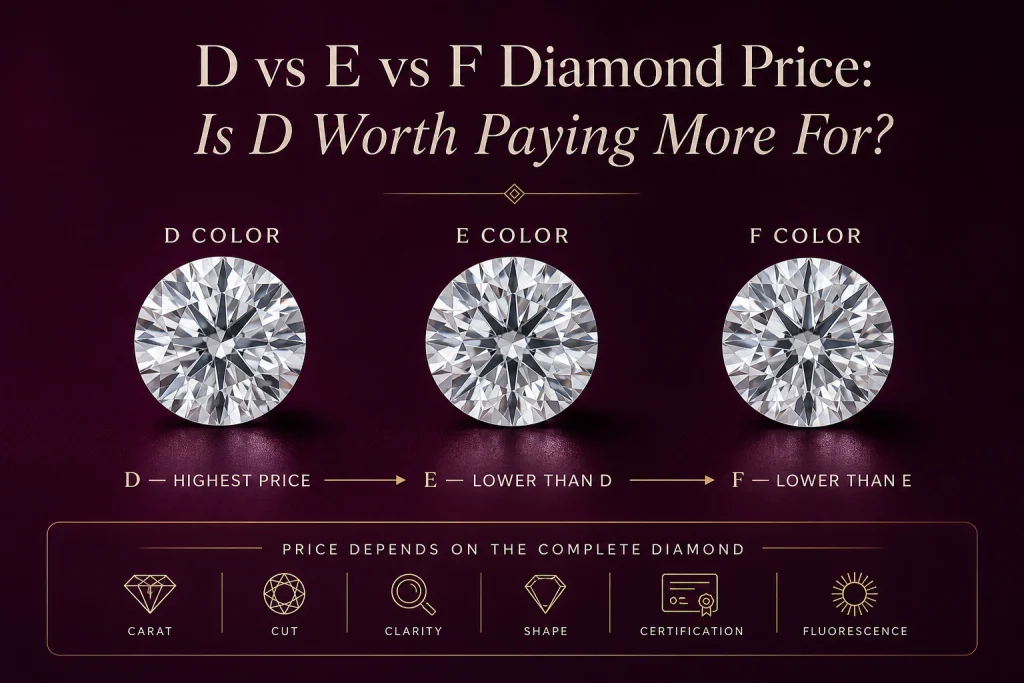
This is where the comparison becomes especially important.
All else being equal, higher color grades tend to command higher prices because colorless diamonds are rarer. GIA specifically notes that even subtle differences in color can affect diamond value.
So, generally:
D → highest price
E → lower than D
F → lower than E
But the actual price difference depends on the complete diamond.
Factors include:
- Carat weight
- Cut
- Clarity
- Shape
- Certification
- Fluorescence
- Natural or lab-grown origin
- Current market pricing
There isn’t a universal percentage you should expect to pay for moving from F to E or E to D.
The better question is:
Can you see enough difference to justify the extra money?
If you can’t, that additional budget may be better used elsewhere.
Which Is Better: D, E, or F?
There isn’t one universal winner.
Choose D if:
- You want the highest possible color grade.
- Color is one of your biggest priorities.
- You prefer an exceptionally icy appearance.
- Your budget comfortably allows the premium.
- You are buying a diamond where colorlessness is particularly important to you.
- You simply want the highest standard color grade available.
Choose E if:
- You want an extremely high color grade.
- You want to stay within the Colorless category.
- You prefer a middle ground between D and F.
- You don’t want to pay the full premium for D.
- The E diamond offers a better overall combination of quality and price.
Choose F if:
- You want a Colorless diamond without necessarily paying for the top grade.
- You prioritize value.
- You’d rather spend more on carat weight or cut.
- You can’t see a meaningful difference between D, E, and F.
- The F diamond has better overall characteristics at the same budget.
For many shoppers, F can be the value sweet spot within the Colorless range.
When Is D Color Worth the Extra Money?
There are situations where D can make sense.
1. You’re Buying a Large Diamond
As diamond size increases, subtle color differences can sometimes become easier to evaluate.
This doesn’t mean an F-color diamond will suddenly look yellow.
It means that larger stones can give you more visual information to examine.
If you’re spending a significant amount on a large diamond and want maximum colorlessness, D may provide additional confidence.
2. You’re Using a White-Metal Setting
Platinum and white gold can create a very bright, neutral background around the diamond.
Some buyers prefer the highest color grades in these settings because they want the entire ring to maintain a crisp, icy appearance.
That said, D isn’t mandatory for a white-metal setting.
E and F can also look exceptionally white.
3. You Prioritize Color Above Everything Else
Sometimes the decision is simply personal.
If you care deeply about having the highest color grade, D can be worth paying for.
Not every purchase has to be optimized solely around maximum visual value.
4. You Want the Highest Grade
D represents the top of the standard D-to-Z color scale.
For some buyers, that fact itself has value.
If owning the highest color grade is important to you, paying the premium can be completely reasonable.
When Is E Color the Better Choice?
E can be an excellent compromise.
You’re still within the Colorless category, but you’re not paying specifically for the very top D grade.
Imagine you’re comparing:
Diamond A
- D color
- 1.00 carat
- VS2
- Excellent cut
- Higher price
Diamond B
- E color
- 1.00 carat
- VS2
- Excellent cut
- Lower price
If you can’t see a meaningful color difference, E could be the more sensible choice.
You may also find that an E diamond gives you room to improve another characteristic without compromising the color category.
When Is F Color the Better Choice?
F can be particularly attractive for shoppers who want a genuinely high color grade but care about getting the most from their budget.
Imagine:
Diamond A
- D color
- 1.00 carat
- Excellent cut
- Higher price
Diamond B
- F color
- 1.10 carats
- Excellent cut
- Lower price
If both appear colorless to you, Diamond B may offer more visual impact because of the additional size.
The same principle applies to cut.
If the choice is between:
D color + weaker cut
and
F color + excellent cut
the F diamond may be the more attractive stone.
Does Diamond Shape Affect D vs E vs F?
Absolutely.
Diamond shape can influence how color is perceived.
This is one of the reasons you shouldn’t choose a color grade without considering the shape you’re buying.
Round Brilliant
Round brilliant diamonds are generally efficient at returning light.
D, E, and F can all look exceptionally white in a well-cut round.
For many buyers, F can provide excellent value.
Oval
Ovals can show subtle body color differently depending on their proportions and faceting.
Because of their elongated shape, color evaluation should be done on the actual stone rather than relying solely on a grade.
Cushion
Cushion diamonds can vary significantly in faceting style.
Some cushions show more body color than others, so comparing actual stones is important.
Emerald
Emerald cuts are especially interesting.
Their broad, open step facets can make the diamond’s body color easier to observe than in some brilliant-cut designs.
If you’re considering an emerald cut, moving toward D or E can sometimes make more sense if colorlessness is a high priority.
GIA also notes that step-cut faceting can make characteristics more apparent in clarity-sensitive comparisons, reinforcing the importance of evaluating the actual stone rather than relying on specifications alone.
Princess
Princess cuts can look beautifully white in D, E, and F.
Because they use brilliant-style faceting, many buyers can consider F without feeling like they’re sacrificing a visibly colorless appearance.
D vs E vs F for White Gold and Platinum
White-metal settings are often paired with Colorless diamonds because both create a crisp, bright appearance.
If you’re using:
- Platinum
- White gold
- Palladium
D, E, and F can all work beautifully.
But don’t assume you need D.
An F-color diamond can still look extremely white when well cut.
If the D premium is substantial, you may prefer spending the difference on cut quality or carat weight.
D vs E vs F for Yellow Gold and Rose Gold
Warm-toned settings change the equation.
Yellow and rose gold introduce a warmer color around the diamond.
In these settings, the small color distinction between D, E, and F may be even less important to many shoppers.
In fact, you may find that paying a large premium for D provides little practical benefit when the setting itself has a strong warm tone.
This doesn’t mean D is a bad choice.
It simply means you should consider the entire ring rather than looking at the diamond in isolation.
Does Carat Weight Change the Decision?
Yes.
Carat weight can influence how you perceive color.
As the diamond gets larger, the stone can give you more surface area through which to observe its body color.
This doesn’t create a hard rule like:
“Anything over 2 carats must be D.”
There is no universal cutoff.
Instead, larger diamonds should be evaluated individually.
A beautifully cut F-color diamond may still appear very white at a substantial size, while another stone with different proportions may show more warmth.
For a deeper look at how carat affects your diamond choice, see this diamond carat guide.
What About Diamond Cut?
Cut is one of the most important factors to consider when comparing D, E, and F.
A well-cut diamond can return a tremendous amount of light, influencing how the stone looks to the eye.
This can make subtle color differences less prominent in normal viewing.
That’s why you shouldn’t automatically choose:
D color + average cut
over:
F color + excellent cut
If your budget is limited, the second diamond may be much more attractive.
This is particularly important because the 4Cs don’t work independently.
The final appearance comes from the combination of characteristics.
D vs E vs F for Lab-Grown Diamonds
The same color principles apply to lab-grown diamonds.
Lab-grown diamonds can also receive color grades such as D, E, and F.
The question is therefore not whether the diamond is lab-grown or natural when evaluating the basic color grade.
The bigger question is:
How much should you spend on color?
If you’re buying a lab-grown diamond and have a fixed budget, you may have more flexibility to allocate your money toward:
- Carat
- Cut
- Clarity
- Setting
For a broader comparison of diamond options, including lab-grown and natural diamonds, see this guide to lab-grown, natural diamonds, and moissanite.
D vs E vs F for Natural Diamonds
For natural diamonds, D, E, and F are all part of the Colorless range.
The same buyer-focused principles apply.
Don’t simply choose D because it’s the highest grade.
Instead, compare:
- Color
- Cut
- Clarity
- Carat
- Shape
- Certification
- Fluorescence
- Price
A natural F-color diamond with excellent cut quality can be an outstanding choice.
Likewise, an E may offer a compelling balance between color and price.
And D can make sense when maximum colorlessness is the priority.
Does Fluorescence Matter When Comparing D, E, and F?
It can.
Fluorescence is a separate characteristic from the diamond’s color grade.
GIA notes that some diamonds emit visible light when exposed to ultraviolet radiation, with blue being the most common type of fluorescence. In certain circumstances, blue fluorescence can make a diamond with more body color appear somewhat whiter.
However, fluorescence shouldn’t be treated as a simple “good” or “bad” feature.
Its effect depends on the individual diamond.
If you’re comparing D, E, and F diamonds, check the grading report and evaluate the actual stone.
Should You Choose D, E, or F for an Engagement Ring?
For most engagement rings, all three can be excellent choices.
The best grade depends on your priorities.
If you want maximum colorlessness and don’t mind paying the premium:
D.
If you want an extremely high color grade with potentially better value:
E.
If you want to stay within the Colorless category while maximizing budget flexibility:
F.
There is no wrong answer.
The mistake is assuming that D must automatically be the best purchase.
D vs E vs F vs G: Is F Really Colorless?
This is an important distinction.
The GIA color categories are:
D–F = Colorless
G–J = Near Colorless
So F is the final grade in the Colorless category, while G starts the Near Colorless category.
That doesn’t mean G suddenly looks yellow.
A well-cut G-color diamond can still appear beautifully white.
But if staying within the strict Colorless category is important to you, F is the lowest grade that gives you that classification.
This is one reason F can be an attractive stopping point for shoppers who want a high color grade without paying the premium for D.
D vs E vs F vs G: Should You Consider G?
Absolutely.
If your goal is maximum value, don’t automatically stop at F.
G is the first grade in the Near Colorless category, and GIA notes that color in the G-J range is often difficult for an untrained observer to notice.
Depending on the diamond’s shape, size, cut, and setting, a G can look beautifully white.
So if you’re deciding between:
F + smaller size
and
G + larger size
the G may be worth considering.
Your personal sensitivity to color matters.
Common Mistakes When Comparing D, E, and F
Mistake 1: Assuming D Is Visibly Whiter
D is technically higher, but the visual difference between D and F is extremely subtle.
Mistake 2: Sacrificing Cut for Color
A poorly cut D isn’t necessarily more beautiful than a well-cut F.
Mistake 3: Assuming F Has Visible Yellow
F is still classified as Colorless.
Mistake 4: Comparing Only the Letters
Look at the actual diamonds.
Mistake 5: Ignoring the Setting
White, yellow, and rose gold can change how color is perceived.
Mistake 6: Ignoring Carat Weight
Larger diamonds can make subtle body-color differences easier to evaluate.
Mistake 7: Paying the D Premium Automatically
The highest grade isn’t always the best value.
How to Decide Between D, E, and F
Use this simple process.
Step 1: Set Your Budget
Know your maximum spending limit before choosing a color grade.
Step 2: Choose Your Shape
Color sensitivity can vary by shape.
Step 3: Prioritize Cut
Don’t sacrifice strong light performance for a tiny color upgrade.
Step 4: Compare D, E, and F Side by Side
If possible, compare actual stones under similar lighting.
Step 5: Consider the Setting
Think about whether you’re choosing platinum, white gold, yellow gold, or rose gold.
Step 6: Compare the Price Difference
Ask how much extra you’re paying to move:
F → E
or
E → D
Step 7: Ask What the Difference Could Buy
Could the same money give you:
- More carat weight?
- Better cut?
- Higher clarity?
- A better setting?
Step 8: Choose Based on What You Can Actually See
If D and F look equally white to you, you may not need to pay for D.
Final Verdict: D vs E vs F Diamond
D, E, and F are all Colorless grades, and all three can produce an exceptionally white-looking engagement diamond. (GIA 4Cs)
D is the highest color grade.
E offers an extremely high level of colorlessness with potentially better value.
F is the lowest grade in the Colorless category and can be an excellent choice for shoppers focused on value.
For many buyers, F can be the sweet spot if the goal is to get a colorless diamond without spending heavily for the highest possible grade.
E can be an excellent middle ground.
D is ideal when maximum colorlessness and rarity are priorities and the premium doesn’t compromise other aspects of the ring.
The smartest approach isn’t:
“Always buy D.”
It’s:
“Buy the highest color grade that makes sense for your eyes and your budget.”
If an F-color diamond looks completely colorless to you, there’s little reason to pay a large premium simply because the certificate says D.
And if you can clearly appreciate the difference and love the icy appearance of D, then D may be worth it.
Ultimately, look at the complete diamond:
cut + color + clarity + carat + shape + price.
For a broader explanation of how color works across the entire grading scale, explore this diamond color guide.
Frequently Asked Questions
Is D better than E and F?
Yes. D is the highest color grade on the GIA D-to-Z scale. E comes immediately after D, followed by F. However, the visual difference between the three is extremely subtle.
Is F diamond color good?
Yes. F is still within the Colorless category and is the lowest grade in the D-F Colorless range.
Can you see the difference between D and F color?
Usually not easily under normal viewing conditions. The distinction is subtle enough that professional grading uses controlled lighting and comparison stones.
Does D color sparkle more than F?
No. Color grade does not directly determine sparkle. Cut quality and light performance have a much greater influence on how lively a diamond appears.
Is E color better value than D?
It can be. E remains in the Colorless category while sitting below D on the grading scale. If the visual difference is difficult for you to see, E may provide a more attractive balance between color and price.
Is D color worth the extra money?
It can be if maximum colorlessness is important to you and the premium fits comfortably within your budget. But many buyers may prefer putting the additional money toward carat weight or cut quality.
Is F color better value than E?
Often, it can be. F is still Colorless, so buyers who don’t see a meaningful difference between E and F may prefer F and use the savings elsewhere.
Is F color considered colorless?
Yes. D, E, and F are all classified as Colorless on the GIA D-to-Z color scale.
Which is better for an engagement ring: D, E, or F?
All three can be excellent. D is best for buyers prioritizing maximum colorlessness, E can offer a strong balance, and F can provide excellent value while remaining within the Colorless category.
Does diamond size affect color visibility?
It can. Larger diamonds can make subtle body-color differences easier to evaluate, so the actual stone becomes increasingly important as size increases.