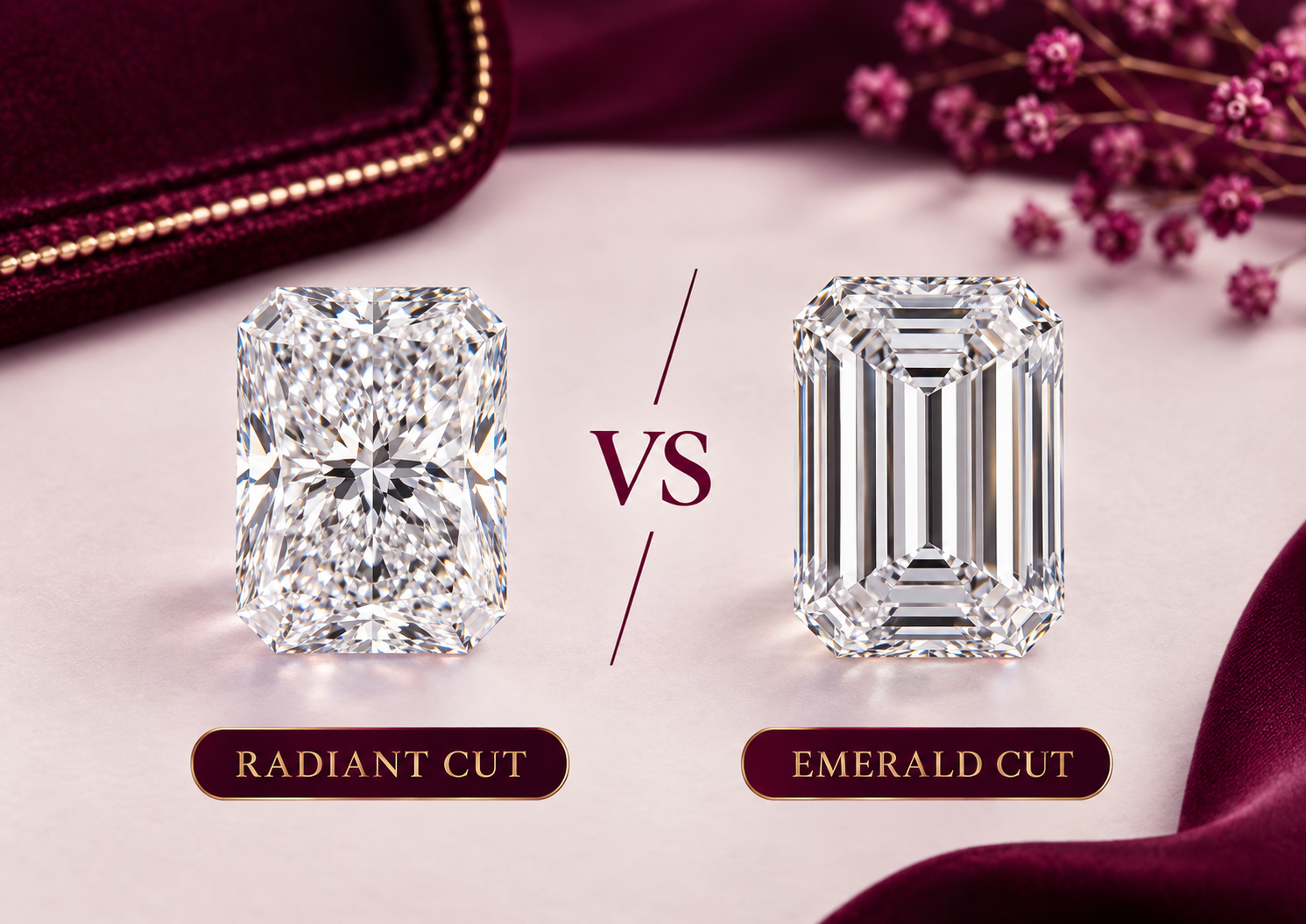
Radiant and emerald cut diamonds may look similar at first glance. Both can have rectangular outlines, cropped corners and an elongated appearance. But their faceting creates two very different visual experiences.
An emerald cut uses long, open step-cut facets that create broad, mirror-like flashes of light. A radiant cut combines a rectangular or square outline with brilliant-style faceting for a brighter, more energetic appearance.
If you are choosing between the two, the better question is not simply “Which is better?” It is:
Do you want maximum sparkle, or do you prefer clean lines and broad flashes of light?
This guide compares radiant vs emerald cut diamonds across sparkle, clarity, color, size, proportions, price, durability, settings and overall style so you can choose with confidence.
Radiant vs Emerald Cut: Quick Comparison
| Feature | Radiant Cut | Emerald Cut |
|---|---|---|
| Faceting | Brilliant-style / mixed faceting | Step cut |
| Light appearance | Bright, lively sparkle | Broad, mirror-like flashes |
| Scintillation | Higher | More subtle |
| Clarity visibility | More forgiving | More revealing |
| Color visibility | Generally more forgiving | Generally more noticeable |
| Shape | Square or rectangular | Primarily rectangular |
| Corners | Cropped | Cropped |
| Style | Modern, glamorous, lively | Elegant, architectural, understated |
| Best for | Buyers who prioritize sparkle | Buyers who prefer sophisticated reflections |
GIA describes the radiant as a square or rectangular mixed cut with cropped corners and notes that its faceting can be more forgiving of inclusions than an emerald cut. Emerald cuts use open step facets that emphasize clarity, symmetry and luster rather than intense brilliance.
What Is a Radiant Cut Diamond?
A radiant cut is a square or rectangular diamond with cropped corners and a faceting pattern designed to create strong brilliance and scintillation.
Unlike an emerald cut, which relies on long step-cut facets, the radiant uses a more complex faceting arrangement that breaks up reflected light into numerous bright flashes.
This makes the radiant a popular choice for buyers who want the elongated outline of a rectangular diamond without giving up the sparkle associated with brilliant-style cuts.
What Makes Radiant Cuts Different?
- Square or rectangular outline
- Cropped corners
- Brilliant-style faceting
- Strong brightness and scintillation
- Available in elongated and squarer proportions
- Generally more forgiving of visible inclusions than emerald cuts
GIA notes that radiant cuts can combine step-cut facets on the crown with brilliant-cut facets on the pavilion, creating a distinctive combination of shape and light performance.
What Is an Emerald Cut Diamond?
An emerald cut is a rectangular step-cut diamond recognized for its long, parallel facets and broad flashes of reflected light.
Rather than producing the busy sparkle associated with brilliant cuts, an emerald cut creates what is commonly called a “hall of mirrors” effect.
The result is clean, geometric and highly transparent-looking.
Because the facets are larger and more open, they can also make inclusions and body color easier to notice. GIA specifically highlights clarity and color as important considerations when selecting an emerald cut.
Radiant vs Emerald Cut: What’s the Biggest Difference?
The biggest difference is faceting.
The two shapes can share a similar outline, but their internal facet arrangements make them behave very differently in light.
Radiant: Brilliant-Style Sparkle
Radiant cuts are designed to produce lively brightness and scintillation.
The many smaller facets create numerous reflections, giving the stone a more energetic appearance.
Emerald: Step-Cut Reflections
Emerald cuts use long, parallel step facets.
Instead of producing constant small flashes, these facets create larger areas of light and dark that move across the stone as it changes position.
GIA explains that scintillation is only one part of diamond appearance, alongside brightness and fire, and that faceting style strongly influences how a diamond interacts with light.
Which Sparkles More: Radiant or Emerald Cut?
Radiant generally appears more sparkly than emerald cut.
Its brilliant-style faceting creates more frequent flashes of light and stronger scintillation.
Emerald cuts produce a different effect. Their long step facets create broad flashes and reflections rather than the dense sparkle associated with brilliant-style faceting.
That does not make emerald cuts inferior. It simply means they are designed to emphasize a different visual quality.
Choose radiant if you want: more sparkle and lively light performance.
Choose emerald if you want: broad reflections, contrast and a cleaner visual pattern.
Radiant vs Emerald Cut Clarity
Clarity is one of the most important differences between these shapes.
Emerald cuts have large, open facets that allow you to look deeper into the stone. Because of this transparency, inclusions can be easier to notice.
Radiant cuts have more complex faceting that can break up the view of inclusions.
GIA specifically notes that radiant cuts can be more forgiving of inclusions, while emerald cuts generally benefit from exceptional clarity.
Should You Buy a Higher Clarity Emerald Cut?
Usually, clarity deserves extra attention when shopping for an emerald cut.
However, do not choose a clarity grade blindly.
Two diamonds with the same clarity grade can look different because inclusions vary in:
- size
- location
- color
- type
- visibility
The goal should be an emerald cut that looks clean to the eye at a normal viewing distance, not simply the highest grade on the certificate.
Is Radiant More Forgiving?
Generally, yes.
The radiant’s more complex faceting can make some inclusions less noticeable than they would be in an emerald cut.
That can give buyers more flexibility when balancing clarity against size or price.
Radiant vs Emerald Cut Color
Color is another area where the two shapes behave differently.
Emerald cuts can reveal body color more readily because of their large open facets.
Radiant cuts can be more forgiving because their faceting can break up and mask some color.
However, the right color grade depends on:
- diamond size
- actual stone appearance
- metal color
- setting
- personal preference
- whether the diamond is natural or lab grown
Instead of treating a particular color grade as a universal rule, compare the actual diamond in the setting you plan to wear.
Which Looks Bigger: Radiant or Emerald Cut?
There is no universal winner.
Visual size depends on the diamond’s actual millimeter dimensions, depth, proportions and length-to-width ratio, not just its carat weight.
Two 2-carat diamonds can have noticeably different face-up dimensions.
This is why buyers comparing radiant and emerald diamonds should look at:
Length × Width × Depth
rather than comparing carat weight alone.
Why Elongated Shapes Can Look Large
An elongated radiant or emerald can occupy a larger visible area across the finger than a round diamond of the same carat weight.
The exact effect depends on the individual stone.
For that reason, Diamiv should compare actual millimeter measurements whenever possible.
Radiant vs Emerald Cut Length-to-Width Ratio
Length-to-width ratio determines how long or square a rectangular diamond looks.
For example:
- Around 1.20–1.30: broader appearance
- Around 1.30–1.40: moderately elongated
- Around 1.40–1.50: noticeably elongated
- 1.50+: strongly elongated
These are visual guidelines rather than strict quality standards.
A buyer who wants a long, elegant silhouette may prefer a higher ratio, while someone looking for a wider and more substantial appearance may prefer a lower ratio.
Radiant cuts offer particularly broad flexibility because they can range from nearly square to strongly rectangular.
Radiant vs Emerald Cut Price
Price should not be determined by shape alone.
The price of a diamond depends on multiple variables:
- carat weight
- color
- clarity
- proportions
- light performance
- certification
- natural vs lab grown
- retailer
- market demand
Instead of asking:
“Which shape is cheaper?”
ask:
“Which diamond gives me the appearance I want for my budget?”
A lower-priced diamond that looks dull or poorly proportioned may offer less value than a slightly more expensive diamond with better visual performance.
Radiant vs Emerald Cut Durability
Both shapes have cropped corners, which remove the sharp points found on some other diamond shapes.
That can make them practical choices for engagement rings.
However, durability depends on more than shape.
The setting, prong placement, diamond proportions and daily wear habits all matter.
For active lifestyles, protective settings such as bezels can provide additional protection.
Best Engagement Ring Settings for Radiant Cut Diamonds
Radiant cuts work well with many settings.
Solitaire
A solitaire keeps attention on the radiant’s sparkle and rectangular silhouette.
Halo
A halo can increase the visual presence of the center stone and create an even more glamorous look.
Hidden Halo
A hidden halo adds detail without changing the clean appearance from above.
Three-Stone
Side stones can emphasize the radiant’s elongated proportions.
East-West
An east-west radiant creates a more unconventional modern appearance.
Best Engagement Ring Settings for Emerald Cut Diamonds
Emerald cuts are especially effective in clean and geometric settings.
Solitaire
A solitaire allows the emerald’s proportions and step-cut pattern to remain the focus.
Three-Stone
Baguette or tapered side stones can reinforce the emerald’s architectural appearance.
Bezel
A bezel offers a sleek appearance while surrounding the diamond with metal.
Art Deco
Geometric side stones and symmetrical settings pair naturally with the emerald’s linear faceting.
Radiant vs Emerald Cut: Which Looks More Modern?
Both can look modern, but they communicate different styles.
Radiant
A radiant tends to feel:
- glamorous
- energetic
- contemporary
- bold
- brilliant
Emerald
An emerald tends to feel:
- architectural
- refined
- minimalist
- sophisticated
- Art Deco-inspired
The setting and metal can dramatically change the final appearance.
Radiant vs Emerald Cut for Different Finger Styles
Both shapes can create an elongated visual effect when their proportions are sufficiently rectangular.
However, there is no universal “best” diamond shape for every hand.
Pay attention to:
- length-to-width ratio
- ring setting
- band width
- side stones
- diamond dimensions
A longer radiant or emerald can emphasize length, while a wider proportion creates a broader visual presence.
If finger appearance is important to you, compare the actual ring on the hand rather than relying only on photographs.
Radiant vs Emerald Cut Lab Grown Diamonds
Both shapes are available as lab grown diamonds.
The same basic visual principles apply.
A lab grown emerald cut still uses step-cut faceting, while a lab grown radiant still uses brilliant-style/mixed faceting.
When shopping for lab grown diamonds, compare:
- certification
- dimensions
- color
- clarity
- proportions
- video/images
- actual price
- setting compatibility
For emerald cuts in particular, inspect the stone carefully for visible inclusions and unwanted color.
For radiant cuts, pay close attention to brightness, scintillation and overall visual balance.
Radiant vs Emerald Cut: Which Is Better for You?
Choose a Radiant Cut If:
- You want strong sparkle
- You like brilliant-style light performance
- You want a rectangular or square shape
- You prefer a modern appearance
- You want more flexibility when selecting clarity
- You want an elongated shape with high visual energy
Choose an Emerald Cut If:
- You prefer understated elegance
- You love clean geometric lines
- You want broad flashes of light
- You appreciate Art Deco or vintage styling
- You enjoy seeing the diamond’s internal structure
- You are comfortable paying closer attention to clarity and color
5 Mistakes to Avoid When Buying a Radiant or Emerald Cut
1. Choosing Only by Carat Weight
Carat weight does not tell you how large a diamond looks from above.
Always compare dimensions.
2. Ignoring Length-to-Width Ratio
Two rectangular diamonds can look dramatically different even at the same carat weight.
3. Buying an Emerald Without Checking Clarity
The open facets can make inclusions easier to see.
4. Assuming the Certificate Tells the Whole Story
A grading report is important, but it does not replace visual inspection.
Look at photographs, videos and the actual stone when possible.
5. Choosing a Diamond Without Comparing Proportions
Shape names alone do not tell you whether a particular diamond will have the appearance you want.
Compare actual dimensions and proportions.
Radiant vs Emerald Cut: Which One Should You Choose?
There is no universal winner.
Choose radiant if sparkle is your priority.
Its brilliant-style faceting creates a lively appearance and can offer more flexibility when balancing clarity and color.
Choose emerald if sophistication and clean reflections are your priority.
Its step-cut faceting creates broad flashes of light and a distinctive architectural appearance.
The best choice is the diamond that matches the visual effect, proportions and budget you care about most.
Frequently Asked Questions
Which sparkles more, radiant or emerald cut?
Radiant cuts generally produce more noticeable sparkle and scintillation because of their brilliant-style faceting. Emerald cuts create broader, more mirror-like flashes from their long step-cut facets. The two shapes therefore produce very different light patterns rather than simply one being “better.”
Is radiant cut better than emerald cut?
Not universally. Radiant is usually the better choice for buyers who prioritize sparkle and a lively appearance. Emerald is better suited to buyers who prefer clean geometry, broad reflections and understated elegance.
Which looks bigger, radiant or emerald cut?
Neither automatically looks bigger. Face-up dimensions depend on carat weight, depth and length-to-width ratio. Compare millimeter measurements rather than carat weight alone when judging apparent size.
Is emerald cut more expensive than radiant cut?
There is no universal price difference that applies to every diamond. Price depends on carat weight, color, clarity, proportions, certification, origin and retailer. Compare diamonds with similar specifications rather than comparing shape alone.
Which is better for an engagement ring?
Both are excellent choices. Radiant cuts suit buyers who want sparkle and a modern look, while emerald cuts suit buyers who prefer elegant lines and broad step-cut reflections.
Which cut is more durable?
Both have cropped corners, which can help reduce exposure at the corners. However, the durability of an engagement ring also depends on the setting, prongs, diamond proportions and how the ring is worn.
What clarity is best for an emerald cut?
Emerald cuts generally benefit from higher clarity because their large open facets make inclusions easier to see. However, clarity should be judged by the actual stone rather than choosing a grade automatically.
What clarity is best for a radiant cut?
Radiant cuts are generally more forgiving of inclusions because their faceting can break up their visibility. The best choice is an eye-clean diamond that balances appearance and price.
Which shows more color, radiant or emerald?
Emerald cuts generally reveal body color more readily because of their open step-cut facets. Radiant cuts can be more forgiving of slight color because their more complex faceting can mask some color.
Final Verdict
Radiant and emerald cuts may share a rectangular silhouette, but their faceting creates two completely different personalities.
Radiant = sparkle, brilliance and energy.
Emerald = clean lines, broad reflections and sophistication.
If you want your diamond to catch the light with frequent flashes, start with radiant cuts.
If you prefer a quieter diamond with dramatic mirror-like reflections, explore emerald cuts.
The smartest final step is to compare actual diamonds side by side rather than choosing based on the shape name alone.