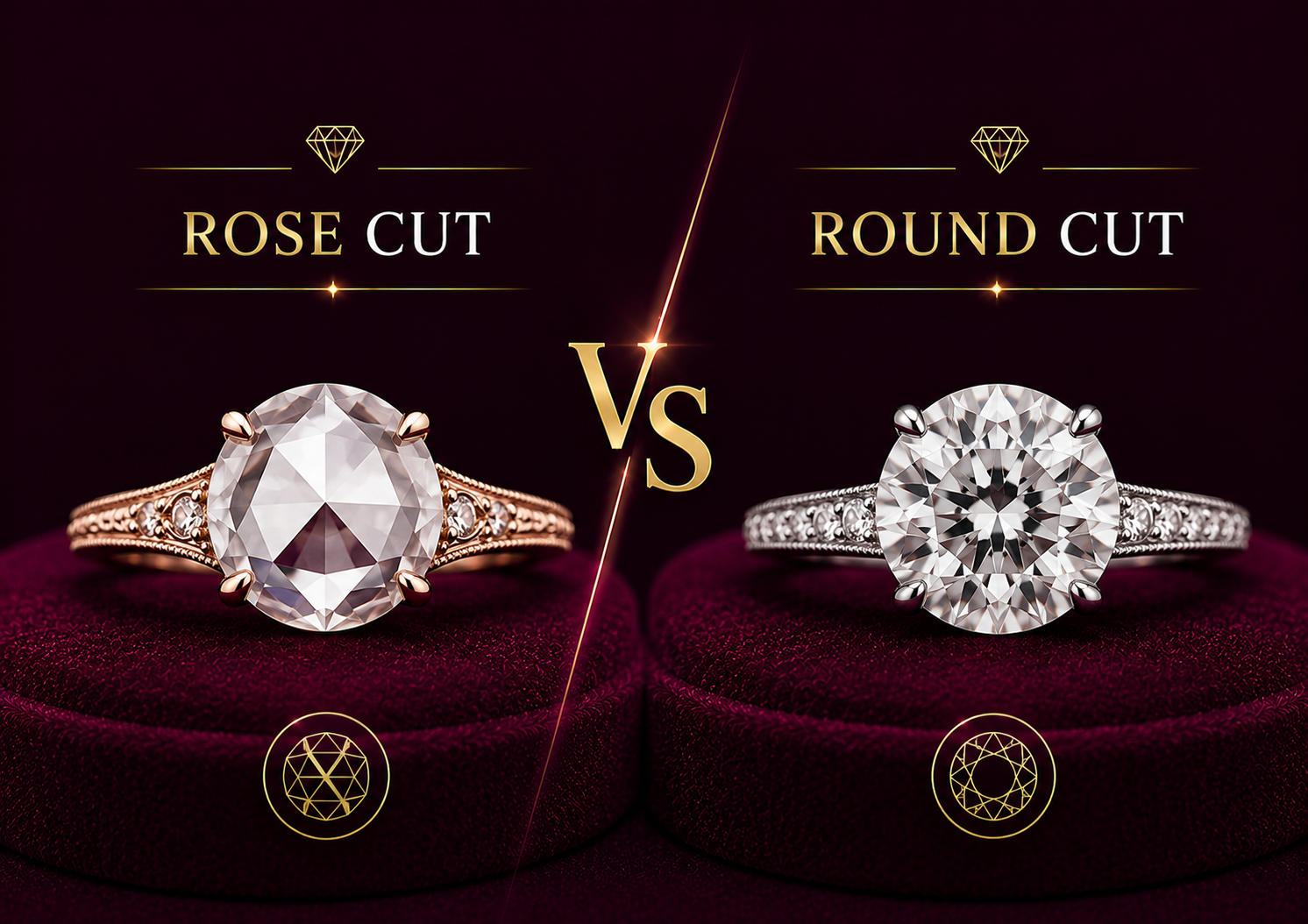
Choosing between a rose cut and a round cut diamond comes down to more than sparkle. These two cutting styles create very different looks, profiles, and overall experiences.
A rose cut diamond has an antique feel, a flat base, a domed faceted top, and a softer type of sparkle. A modern round brilliant is built around light performance, with a carefully arranged facet pattern designed to produce strong brilliance, fire, and scintillation.
So which one is right for you?
If you want a distinctive, vintage-inspired diamond with understated beauty, a rose cut may be the better choice. If you want maximum sparkle, classic styling, and an easier-to-compare modern diamond, a round brilliant is likely to be the stronger option.
Here is how the two compare.
Rose Cut vs Round Cut: Quick Comparison
| Feature | Rose Cut | Round Brilliant |
|---|---|---|
| Overall style | Vintage, romantic, unconventional | Classic, timeless, versatile |
| Faceting | Fewer triangular facets | 57 or 58 facets |
| Bottom | Flat | Deep pavilion |
| Profile | Low and shallow | Deeper |
| Sparkle | Soft, broad flashes | Bright, lively scintillation |
| Fire | Subtle | More pronounced |
| Face-up appearance | Can look large for its weight | More depth relative to its diameter |
| Cut grading | No standard GIA overall cut grade | GIA cut grading available |
| Best for | Vintage and understated styles | Classic sparkle and versatility |
One terminology point is worth clarifying. Technically, round describes the diamond’s shape, while brilliant describes its faceting style. When shoppers say “round cut” in the context of engagement rings, they usually mean a modern round brilliant.
What Is a Rose Cut Diamond?
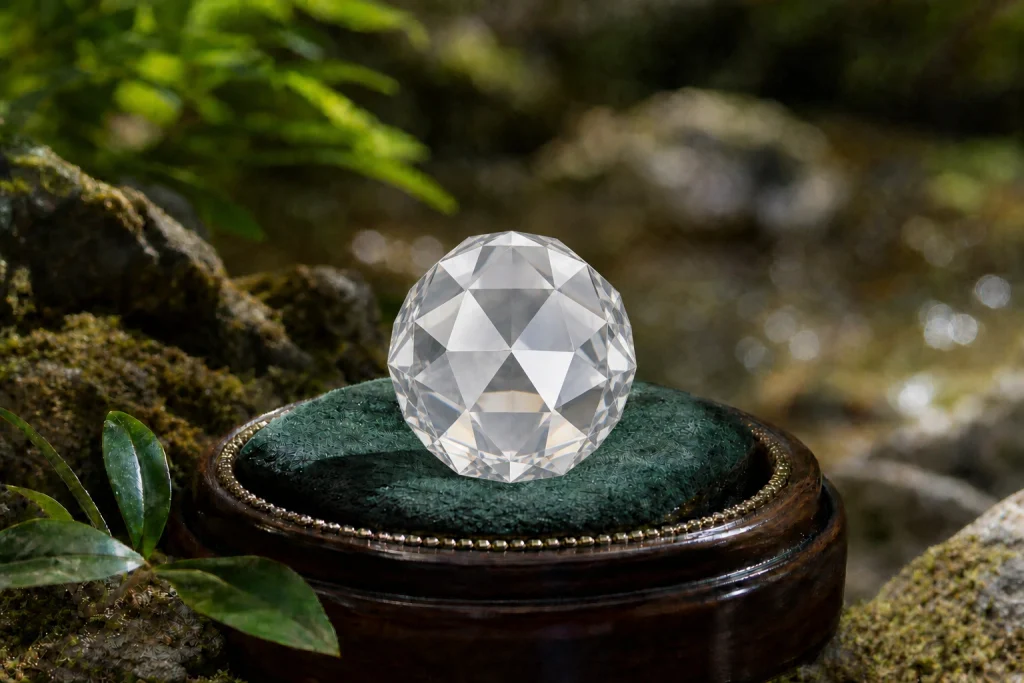
A rose cut is one of the oldest diamond cutting styles. It has a flat bottom and a domed top covered with triangular facets.
Unlike a modern brilliant cut, a rose cut does not have a traditional pavilion underneath the stone. Instead, most of the visible diamond is concentrated above the flat base.
The result is a distinctive appearance that is very different from a modern brilliant diamond.
Rose cuts are associated with antique and vintage jewelry, making them especially appealing if you want an engagement ring that feels romantic, historic, or unconventional.
Their facets tend to create broad reflections and a soft glow rather than the rapid flashes of brilliance associated with a modern round brilliant.
You can learn more about the construction and characteristics of this style in the rose cut diamond guide.
Why Choose a Rose Cut?
A rose cut can be a good choice if you care more about character than maximum sparkle.
It may appeal to you if you want:
- A vintage-inspired appearance
- A distinctive engagement ring
- A low-profile diamond
- Softer, more understated sparkle
- A diamond that looks different from the typical engagement ring
- A romantic or antique aesthetic
Rose cuts can also come in different outlines. While round rose cuts are common, the rose-cut style can be applied to other shapes as well.
What Is a Round Brilliant Diamond?
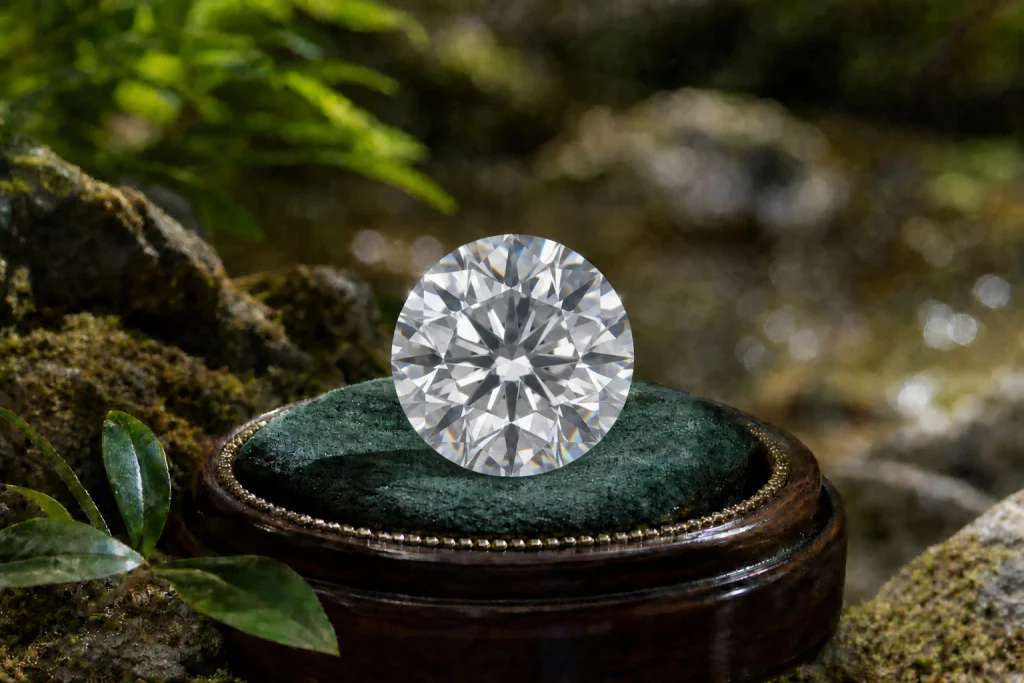
The round brilliant is the classic modern round diamond.
A standard round brilliant has 57 or 58 facets, depending on whether the culet facet is counted. These facets are arranged across the table, crown, and pavilion to help the diamond interact with light.
This carefully engineered structure is what gives a well-cut round brilliant its characteristic combination of brightness, fire, and scintillation.
GIA defines brightness as the total reflection of white light, fire as flashes of spectral colors, and scintillation as the pattern of light and dark areas and sparkle seen as the diamond or observer moves.
If you want the classic “diamond sparkle” most people picture when they think about an engagement ring, the round brilliant is difficult to beat.
For a deeper look at what to consider when buying one, see the round cut diamond guide.
Rose Cut vs Round Cut: The Biggest Differences
1. Faceting
The most obvious difference is the way the two diamonds are faceted.
A rose cut has a relatively simple domed structure with triangular facets. It has far fewer facets than a modern round brilliant.
A round brilliant has 57 or 58 facets arranged across a table, crown, and pavilion. The proportions and arrangement are designed to influence how efficiently the diamond returns light to the viewer.
This difference in construction is the foundation for nearly every other difference between the two cuts.
2. Sparkle and Brilliance
If sparkle is your top priority, the round brilliant generally wins.
The modern round brilliant was developed around light performance. Its facets work together to produce strong brightness, fire, and scintillation.
A rose cut can absolutely sparkle, but its appearance is usually softer and broader. Instead of a rapid pattern of bright flashes, you may see larger reflections and a more subtle glow.
That distinction is important because “more sparkle” does not automatically mean “better.”
Some people love the intense liveliness of a round brilliant. Others prefer the quieter appearance of a rose cut.
Think of it as two different visual styles rather than a good-versus-bad comparison.
3. Profile and Height
Rose cuts have a flat base, which allows them to sit relatively low on the finger depending on the setting.
A round brilliant has a pavilion underneath the crown. This creates a deeper stone profile but plays an important role in its light performance.
If you prefer jewelry that sits close to the finger, the low-profile construction of a rose cut may be appealing.
If maximum sparkle matters more than profile, the deeper structure of a round brilliant is usually worth the trade-off.
4. Face-Up Size
Rose cuts can look surprisingly large for their carat weight because their shallow construction places more of the diamond’s surface toward the top.
However, you should not assume that every rose cut will look larger than every round brilliant.
Carat weight measures a diamond’s mass, not its exact face-up dimensions.
When comparing two diamonds, look at the actual measurements in millimeters. A stone with greater surface area can sometimes look larger even when the carat weights are similar.
This is especially useful when comparing a rose cut with a round brilliant at the same budget.
For a broader visual reference, the diamond shape size comparison chart can help put face-up dimensions into perspective.
5. Style and Personality
This may be the most important difference of all.
A rose cut tends to feel:
- Romantic
- Antique
- Artistic
- Understated
- Unconventional
A round brilliant tends to feel:
- Classic
- Polished
- Timeless
- Bright
- Versatile
Neither aesthetic is inherently better.
If you want your engagement ring to look like a traditional diamond ring, a round brilliant is the natural choice.
If you want people to notice that your ring looks different, a rose cut gives you a much more distinctive starting point.
6. Cut Grading
Round brilliant diamonds have an important advantage when it comes to standardized cut evaluation.
GIA has a dedicated cut-grading system for standard round brilliant diamonds. Its evaluation considers factors including face-up appearance, proportions, durability, polish, and symmetry.
That makes shopping for a round brilliant somewhat easier because you have a standardized framework for comparing cut quality.
Rose cuts do not have the same standardized overall cut-grade system.
That means you should pay more attention to the individual stone’s appearance, proportions, craftsmanship, and any available grading documentation rather than relying on a single cut grade.
Which Diamond Cut Has More Sparkle?
Between a rose cut and a round brilliant, the round brilliant generally produces more obvious sparkle.
Its 57 or 58 facets and pavilion are designed to interact with light in a way that produces strong brightness, fire, and scintillation.
A rose cut has a different goal.
Its appeal comes from its broad facets, shallow structure, antique character, and softer reflections. It can be beautiful in low light and in vintage-inspired designs precisely because it does not look like a modern round brilliant.
So the better question is not simply:
Which one sparkles more?
It is:
What kind of sparkle do you prefer?
Choose a round brilliant if you want:
- Bright white sparkle
- Strong scintillation
- Noticeable flashes of light
- A traditional diamond appearance
Choose a rose cut if you prefer:
- Soft reflections
- Broad flashes
- Understated sparkle
- A vintage or romantic appearance
Are Rose Cut Diamonds Bigger Looking?
They can be.
Because a rose cut is shallow and has a flat base, more of its surface can be visible from above. This can give the diamond a larger face-up appearance relative to its carat weight.
But face-up size depends on the individual diamond.
When comparing stones, look at:
- Length
- Width
- Total depth
- Carat weight
- Face-up appearance
Do not buy based on carat weight alone.
Two diamonds with the same carat weight can look noticeably different once they are mounted in a ring.
Are Rose Cut Diamonds Cheaper Than Round Diamonds?
Not necessarily.
There is no universal rule that rose cut diamonds cost less than round brilliant diamonds.
Price depends on several factors, including:
- Carat weight
- Color
- Clarity
- Cut or craftsmanship
- Measurements
- Diamond origin
- Individual stone characteristics
- Market demand
Round diamonds can carry a premium because of their popularity and the amount of rough material that can be lost during cutting.
Rose cuts can sometimes offer a different value proposition because their shallow construction and cutting style are different from modern brilliant cuts.
But a particularly attractive antique rose cut or unusual stone can also be valuable.
The best approach is to compare the actual diamonds rather than assuming one cut is always cheaper.
Which Is Better for an Engagement Ring?
Both can make beautiful engagement rings, but they suit different priorities.
Choose a Rose Cut Engagement Ring If You Want:
Vintage character
Rose cuts naturally complement antique-inspired and vintage engagement rings.
Subtle sparkle
If intense brilliance feels too flashy, a rose cut can provide a quieter look.
A low-profile design
The flat base can work well for a close-to-the-finger ring design.
Something distinctive
Rose cuts are much less conventional than modern round brilliants.
An artistic appearance
Their irregularities and individual character can become part of the appeal.
For shoppers specifically interested in this style, there is also a dedicated rose cut lab-grown diamond engagement ring collection.
Choose a Round Brilliant If You Want:
Maximum sparkle
This is the clearest reason to choose a round brilliant.
A classic appearance
Round brilliant diamonds have a timeless look that works across generations.
Versatility
They pair easily with many engagement ring designs.
More standardized evaluation
The GIA cut-grading system provides a useful framework for evaluating standard round brilliant diamonds.
Easy comparison
Round brilliants are widely available, making it easier to compare diamonds across different sellers and specifications.
Which Ring Settings Work Best?
Your setting can change how either cut looks on the hand.
A round brilliant is particularly versatile because its symmetrical outline works naturally with settings ranging from simple solitaires to elaborate halo and three-stone designs.
A rose cut often feels especially natural in vintage-inspired, bezel, low-profile, and artistic settings.
If you are still deciding on a setting, the guide to which diamond shape works best with each ring setting can help you compare the options.
You can also consider specific setting styles such as:
- Solitaire
- Bezel
- Halo
- Three-stone
- Pavé
- Cathedral
- Vintage
The setting should support the diamond’s character rather than fight against it.
Rose Cut Diamond Pros and Cons
Pros
- Distinctive vintage appearance
- Soft and understated sparkle
- Low-profile potential
- Strong romantic character
- Can offer a large face-up appearance for its weight
- Works especially well with antique-inspired designs
Cons
- Less brilliance than a modern round brilliant
- No equivalent standardized GIA overall cut grade
- Individual stones can vary considerably
- May not satisfy someone who wants maximum sparkle
- Requires more attention to the actual stone when comparing quality
Round Brilliant Diamond Pros and Cons
Pros
- Excellent potential for brilliance
- Strong fire and scintillation
- Classic and versatile appearance
- Works with many engagement ring settings
- Standardized GIA cut grading is available for standard round brilliants
- Easy to compare across many diamonds
Cons
- Can feel less distinctive
- Often carries strong market demand
- Has a deeper profile than a rose cut
- May not provide the same face-up spread per carat as a shallow rose cut
- Cut quality can have a major effect on appearance
Rose Cut vs Round Cut: Which One Should You Choose?
The simplest way to decide is to start with your priorities.
| If you care most about… | Consider |
|---|---|
| Maximum sparkle | Round brilliant |
| Vintage character | Rose cut |
| Low profile | Rose cut |
| Classic engagement-ring style | Round brilliant |
| Subtle sparkle | Rose cut |
| Strong scintillation | Round brilliant |
| Distinctive appearance | Rose cut |
| Easy comparison between stones | Round brilliant |
| Versatility | Round brilliant |
| Antique-inspired design | Rose cut |
There is no universal winner.
A person who wants a traditional, highly brilliant engagement ring may be disappointed by a rose cut.
Someone who wants an unusual vintage-inspired ring may feel that a round brilliant is too conventional.
The right choice depends on what you want to see every time you look down at your hand.
Frequently Asked Questions
Is a rose cut diamond better than a round brilliant?
Neither is universally better. A rose cut is better suited to buyers who value vintage character, subtle sparkle, and individuality. A round brilliant is generally better for buyers who prioritize brilliance, scintillation, and classic styling.
Which diamond cut sparkles the most?
Between these two, the round brilliant generally produces more visible brilliance and scintillation because its facet arrangement and proportions are designed around light performance.
Are rose cut diamonds sparkly?
Yes. Rose cuts can produce attractive flashes and reflections, but their sparkle is generally softer and broader than the intense scintillation of a modern round brilliant.
Do rose cut diamonds look bigger?
They can appear larger face up for their carat weight because their shallow construction puts more surface area toward the top. However, actual measurements should always be checked before comparing size.
Are rose cut diamonds good for engagement rings?
Yes. They can be an excellent choice for someone who wants vintage character, understated sparkle, and a distinctive engagement ring.
Are rose cut diamonds cheaper than round diamonds?
Not always. Prices vary according to the individual diamond’s carat weight, color, clarity, craftsmanship, dimensions, and market demand. A rose cut should be compared with the actual stone rather than judged by a general price rule.
What is the main difference between a rose cut and a round brilliant?
The biggest difference is their construction. A rose cut has a flat base and domed faceted crown, while a modern round brilliant has a table, crown, girdle, and pavilion with 57 or 58 facets designed to return light efficiently.
Which is better for a vintage engagement ring?
A rose cut is usually the more natural choice if you want a strongly vintage or antique-inspired appearance. A round brilliant can still work beautifully in a vintage setting, but its visual character is more modern.
Final Verdict
The choice between a rose cut and a round brilliant is really a choice between two different kinds of beauty.
Choose a rose cut if you want vintage character, subtle sparkle, a low-profile design, and something that feels unusual and personal.
Choose a round brilliant if you want maximum sparkle, strong brilliance, classic styling, and a diamond that works with almost any engagement ring design.
Neither cut is inherently better.
The best diamond is the one whose appearance matches what you actually want from your engagement ring. If you find yourself drawn to soft reflections and antique character, the rose cut may be the right choice. If you cannot imagine an engagement ring without bright, lively sparkle, the round brilliant is probably the better fit.