If you are comparing red garnet vs ruby, you are not alone. These two red gemstones can look surprisingly similar, especially when viewed in a jewelry setting. But beneath that beautiful red color, garnet and ruby are very different gemstones.
Ruby is the red variety of corundum, while garnet is a group of silicate minerals. They also differ in hardness, color, rarity, price, optical properties, and suitability for everyday jewelry.
So, is garnet the same as ruby? No. And if you are choosing a gemstone for a ring, that difference matters.
Let’s look at the garnet vs ruby difference without the usual gemstone jargon overload.
Garnet vs Ruby at a Glance
| Feature | Garnet | Ruby |
|---|---|---|
| Mineral group | Garnet group | Corundum |
| Chemical composition | Varies by garnet species | Aluminum oxide (Al₂O₃) |
| Typical red color | Deep red, wine red, brownish or purplish red | Vivid red to slightly purplish red |
| Mohs hardness | About 6.5–7.5 | 9 |
| Birthstone | January | July |
| Everyday ring wear | Possible with appropriate care | Excellent choice |
| Price | Generally more affordable | Fine-quality stones can be very expensive |
| Treatment | Depends on stone, but garnets generally have fewer treatment concerns | Treatments are common and should be disclosed |
Ruby is a variety of corundum, and its red color comes from trace chromium. Garnet, meanwhile, is not one single mineral. It describes a mineral group that includes varieties such as pyrope, almandine, spessartine, grossular and andradite.
That is the basic garnet and ruby comparison. Now let’s look at the differences that actually matter when buying jewelry.
What Is the Difference Between Garnet and Ruby?
The biggest garnet vs ruby difference is their mineral identity.
Ruby belongs to the corundum mineral family. In its pure form, corundum is colorless, but trace chromium gives ruby its characteristic red color. GIA lists ruby’s chemical composition as Al₂O₃ and its Mohs hardness as 9.
Garnet works differently. It is a group of related silicate minerals rather than one single gemstone species. Red garnets commonly include pyrope and almandine, while other garnet varieties can appear green, orange, yellow, purple and even show color-changing effects.
So, are garnets and rubies the same? Definitely not.
They simply happen to share one very attractive feature: red color.
Red Garnet vs Ruby Color: Can You Tell the Difference?
Color is where the garnet vs ruby comparison becomes especially interesting.
Fine ruby is known for a vivid, saturated red. GIA notes that the most desirable ruby color is a pure, vibrant red to slightly purplish red. The famous trade term “pigeon’s blood” is associated with particularly desirable ruby color, although it is a trade description rather than a guarantee of quality or origin.
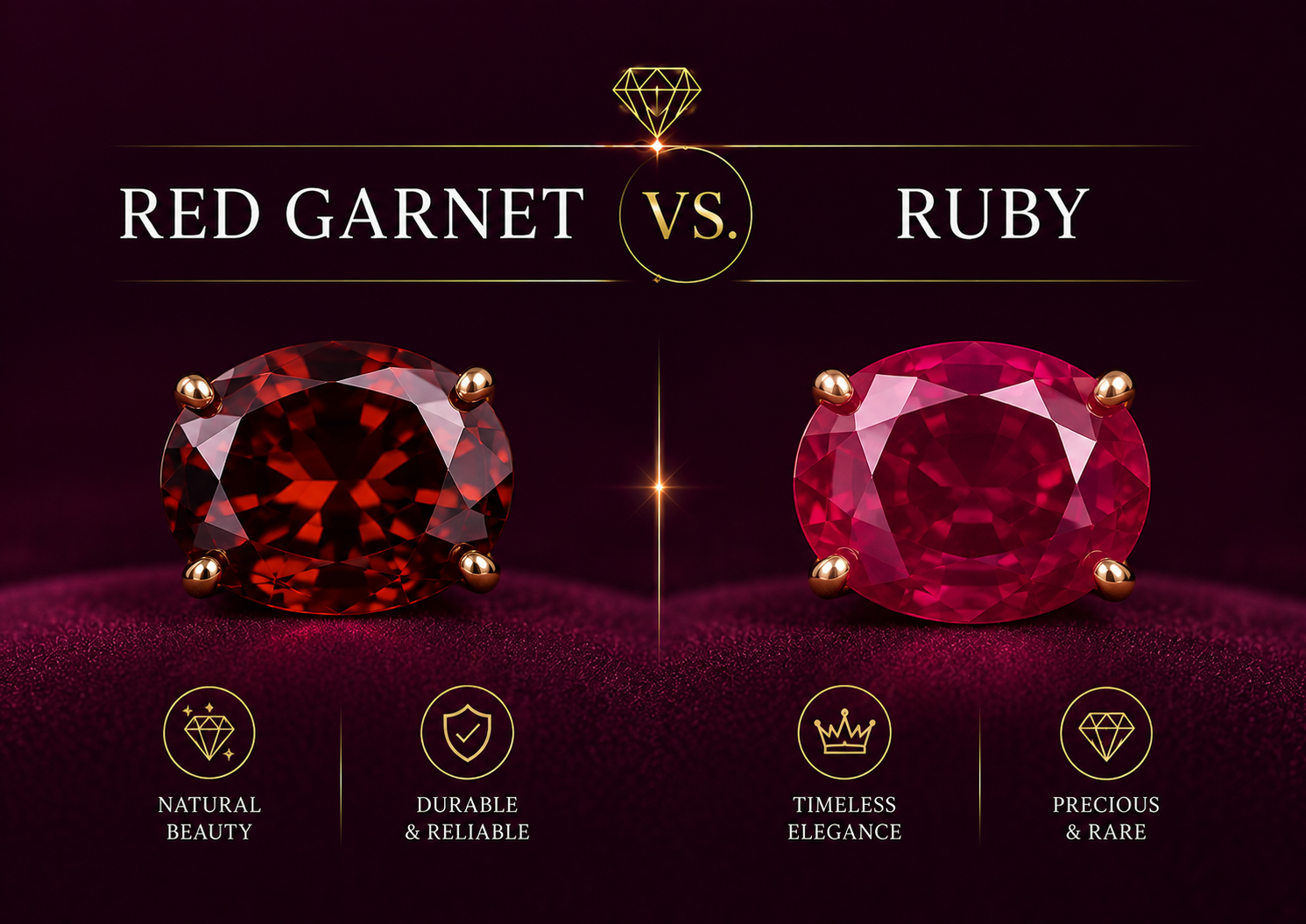
Red garnet can also be intensely beautiful, but its appearance often leans toward deeper or warmer reds. Some red garnets can have brownish components or dark tones. GIA specifically notes that garnets can occur in pure red, although larger examples of that pure red are less common.
Garnet vs Ruby Color Comparison
Think of the difference this way:
Ruby: bright, saturated and energetic red.
Red garnet: often deeper, warmer and more wine-like red.
Of course, nature does not read color charts. Individual gemstones can vary considerably, so you should not identify a stone based on color alone.
This is particularly important if you are looking at a garnet vs ruby side by side. Lighting, cut, transparency and the individual stone can all change how the red appears.
Garnet vs Ruby Hardness and Durability
If you are buying a ring, hardness deserves more attention than it usually gets.
Ruby has a Mohs hardness of 9, making it one of the hardest natural gemstones. GIA also notes that corundum has excellent toughness and no cleavage, which helps explain why ruby works well in rings and other jewelry designed for daily wear.
Garnets range from approximately 6.5 to 7.5 on the Mohs scale, depending on the variety. That does not make garnet a fragile gemstone. However, it is more susceptible to scratching than ruby. GIA therefore recommends more thought when using garnet in jewelry exposed to regular wear.
So, is ruby harder than garnet?
Yes.
Which Is More Durable, Garnet or Ruby?
For a ring that you plan to wear every day, ruby has the advantage.
A ruby for everyday wear is a strong choice because of its hardness and toughness. Garnet can also be used in rings, but its lower hardness means you should take more care with frequent wear.
If you are choosing between a garnet vs ruby engagement ring, consider your lifestyle. A ruby generally makes more sense if the ring will stay on your hand through years of everyday activity.
Garnet vs Ruby Price: Which Gemstone Costs More?
This is where many shoppers notice the biggest difference.
Ruby is generally much more expensive than common red garnet, particularly when you compare fine-quality natural stones.
But it is important not to rely on a simple “ruby costs X dollars per carat” formula. Ruby value can change dramatically based on color, clarity, size, treatment and origin. GIA states that color is the most significant quality factor for ruby and that fine-quality rubies can command exceptionally high prices.
Garnet pricing also varies because “garnet” covers several different mineral varieties. A common red garnet and a rare green garnet such as tsavorite are not comparable from a pricing perspective.
Therefore:
Is garnet cheaper than ruby? Usually, yes.
Is ruby more expensive than garnet? Fine-quality natural ruby can be dramatically more expensive.
The reason is not simply that ruby is “better.” Rarity, demand and quality all influence gemstone value.
And that leads to an important buying rule: never judge a gemstone’s identity by price alone.
Garnet vs Ruby Rarity and Value
Ruby has a reputation for rarity, particularly in fine qualities and larger sizes.
GIA notes that fine-quality rubies over one carat are extremely rare, and their price can rise significantly as size increases. Exceptional color and clarity can push values even higher.
Garnet is a different story because the garnet family is widespread and contains many varieties.
That does not mean every garnet is common or inexpensive. Some garnet varieties are genuinely rare and highly valued.
So when comparing garnet vs ruby value, the correct question is not simply “Which stone is rarer?”
Instead, ask:
- Which garnet variety is it?
- Is the stone natural?
- What is the color quality?
- How good is the clarity?
- How well is it cut?
- Has it received treatment?
- What is its size?
Those details provide a much more useful picture of gemstone value.
How to Tell Garnet from Ruby
If you already own a red gemstone and want to know how to tell garnet from ruby, avoid relying on a single visual clue.
Color can provide a hint, but it cannot reliably prove identity.
Professional gemological testing is the safest route when the identity or value of a stone matters.
Ruby has measurable optical and physical properties that distinguish it from garnet. GIA lists ruby’s refractive index at approximately 1.762–1.770, specific gravity at about 4.00, and hardness at 9.
Garnets have different properties, and those properties also vary among garnet species.
Can Garnet Look Like Ruby?
Absolutely.
That is one reason the garnet vs ruby identification question comes up so often.
A richly colored red garnet can look remarkably similar to ruby when viewed casually. However, visual similarity does not make the stones the same.
If you are asking how to tell if a red stone is ruby or garnet, the best answer is to have the gemstone examined by a qualified gemologist or reputable laboratory, especially before paying a premium ruby price.
Do not perform scratch tests at home. You could damage the gemstone or setting and still fail to identify it correctly.
Garnet vs Ruby for Rings and Engagement Rings
Both gemstones can create beautiful jewelry, but they serve slightly different needs.
A ruby for an engagement ring offers excellent hardness, strong color and a long-established place in fine jewelry. Its durability makes it particularly suitable for a ring that will be worn frequently.
A garnet engagement ring can be an attractive alternative for someone who loves a deeper red and wants to spend less on the center stone.
However, garnet’s lower hardness means it deserves more care in a ring worn every day. Protective settings can be worth considering, and regular inspection can help keep the stone secure and looking its best.
So, is garnet good for an engagement ring?
It can be, provided you understand its durability and care requirements.
And is ruby good for an engagement ring?
Yes. Ruby’s hardness and toughness make it one of the stronger colored-gemstone choices for everyday ring wear.
Garnet vs Ruby Meaning and Birthstones
Garnet and ruby also have different birthstone associations.
Garnet is the traditional birthstone for January, while ruby is the birthstone for July.
Garnet has a long history in jewelry, with red garnets used in jewelry for centuries. Its name comes from the medieval Latin word granatus, meaning “pomegranate,” a reference to its red color.
Ruby has an equally rich history. It has long been associated with passion, power and vitality, and GIA notes that ruby has traditionally been given for the 15th and 40th wedding anniversaries.
Symbolism is personal, of course. A gemstone does not need to have a particular birth month attached to it to make meaningful jewelry.
Garnet or Ruby: Which Is Better?
There is no universal winner in the garnet or ruby debate.
Choose ruby if you want:
- Higher hardness and excellent durability
- A vivid, saturated red
- A gemstone suited to frequent ring wear
- A traditional luxury gemstone
- A July birthstone
Choose garnet if you want:
- A beautiful deep red gemstone
- A generally more accessible price point
- A January birthstone
- The wider color variety offered by the garnet family
- An alternative to ruby with its own distinct character
The better gemstone is ultimately the one that fits your priorities.
If durability and fine-gem prestige sit at the top of your list, ruby has a clear advantage. If color, personality and budget matter more, garnet can be an excellent choice.
Frequently Asked Questions
How can you tell a garnet from a ruby?
Color can provide clues, but it cannot reliably identify a gemstone on its own. Ruby commonly has a vivid red appearance, while red garnet often appears deeper or warmer. For a reliable identification, a qualified gemologist or gemological laboratory can examine the stone’s physical and optical properties.
Is ruby harder than garnet?
Yes. Ruby has a Mohs hardness of 9, while garnet varieties generally range from about 6.5 to 7.5. This makes ruby more resistant to scratching and generally better suited to rings that receive frequent everyday wear.
Is garnet cheaper than ruby?
Generally, yes. Red garnet is usually more affordable than ruby, while fine-quality ruby can command very high prices. However, gemstone value depends on factors such as color, clarity, size, treatment and origin, so there is no single price that applies to every garnet or ruby.
Which is better for an engagement ring, garnet or ruby?
Ruby is generally the stronger choice for an engagement ring because its Mohs hardness of 9 provides greater resistance to scratching than garnet. Garnet can still work in an engagement ring, but it benefits from more careful wear and maintenance. The right choice ultimately depends on your budget, style and how often you plan to wear the ring.
What is the difference between garnet and ruby color?
Ruby is typically valued for vivid, saturated red color, while red garnet can show deeper wine-red, purplish-red or warmer tones depending on the garnet variety. Individual stones vary, so color should be considered alongside clarity, cut and other gemological properties.
Are garnet and ruby birthstones?
Yes. Garnet is the traditional birthstone for January, while ruby is the birthstone for July. The two gemstones therefore have different birthstone associations even though both can occur in beautiful shades of red.
Final Words: Red Garnet vs Ruby
The red garnet vs ruby comparison is really a story of two different gemstones that happen to share the same color family.
Ruby is red corundum with a Mohs hardness of 9. Garnet is a family of silicate minerals ranging from about 6.5 to 7.5 in hardness. Ruby generally offers stronger durability and commands much higher prices in fine qualities, while red garnet can provide rich color at a more accessible price.
So, is garnet the same as ruby? No.
Can garnet look like ruby? Yes.
Is ruby harder than garnet? Yes.
Is garnet cheaper than ruby? Generally, yes, although gemstone quality and variety can change the comparison.
And if you are choosing a gemstone for a ring, don’t let the price tag make the decision for you. Look at the stone’s identity, color, durability, treatment, setting and how you actually plan to wear it.
After all, the best red gemstone is not necessarily the most expensive one. It is the one you will still love every time you look down at your hand.