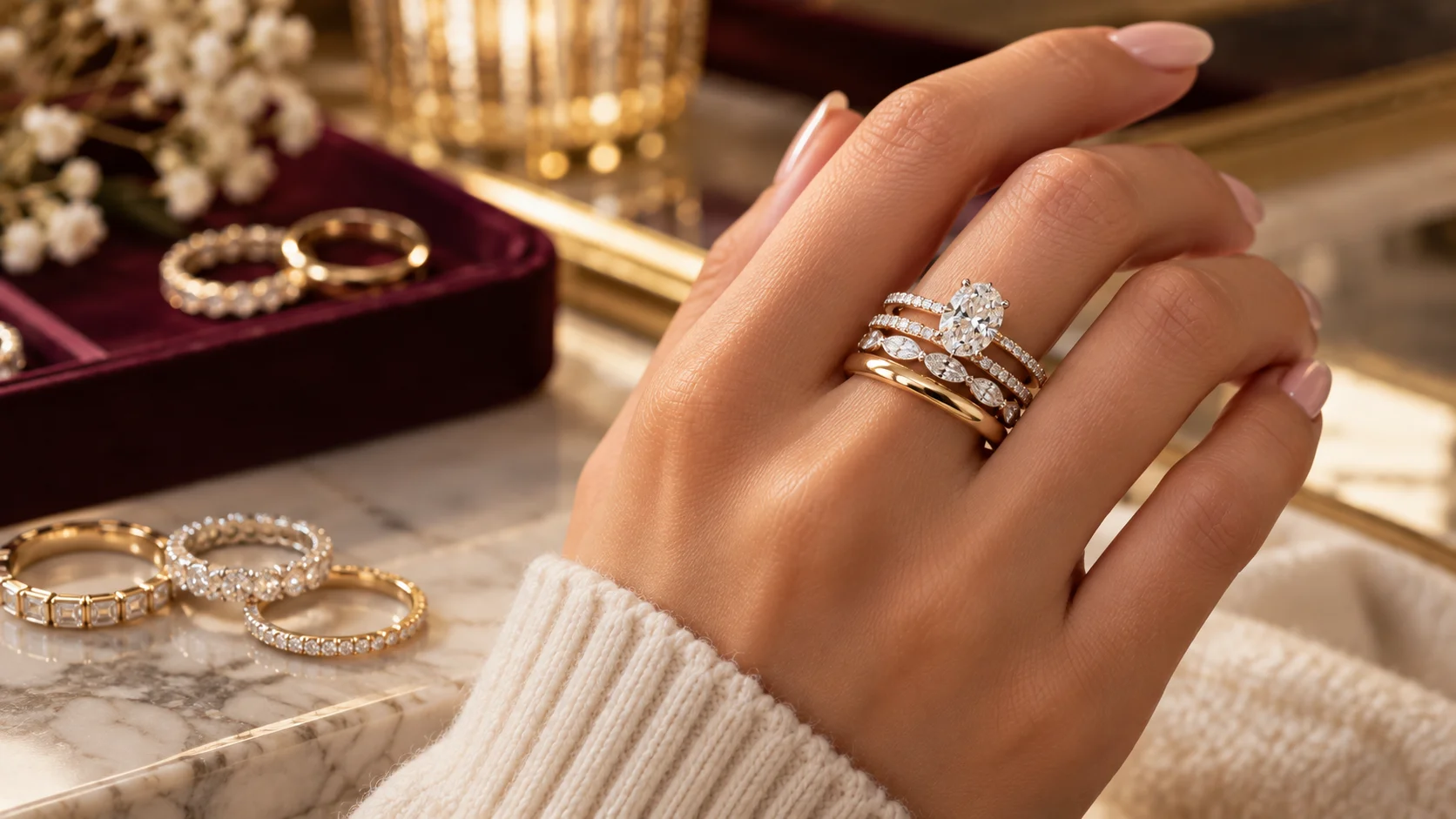
There is no fixed number of rings you need to wear for a stack to look complete. For most people, two or three rings on one finger are a simple place to start, while four or more can create a bolder layered look.
The right number depends on more than the number itself. Ring width, finger size, ring profile, comfort, spacing, and the overall style of your jewelry all affect how a stack looks and feels.
If you’re new to stacking, start with a small combination and add one ring at a time. That makes it easier to see when the stack feels balanced rather than crowded.
How Many Rings Should You Stack on One Finger?
For a single finger, two to three rings are an easy starting point.
Two rings can create a clean, understated combination. Three rings give you more room to vary widths, textures, and details without making the finger feel overly busy.
Four rings can work well when the bands are relatively slim and the designs complement each other. Five or more rings can also be worn, but the combined width and weight become much more important.
There is no universal limit. A stack that feels comfortable with three wide rings may feel crowded with five thin bands, while someone wearing very delicate rings may comfortably layer more.
The goal is not to reach a certain number. The goal is to create a combination where each ring still has room to be seen and the finger can move comfortably.
Ring Stack Ideas by Number
One Ring: Minimal
One ring is not technically a stack, but it can be the starting point for building one.
A wider band, gemstone ring, or engagement ring can serve as the foundation. Once you know what you want the main ring to look like, you can add another piece around it.
Two Rings: Simple and Easy
Two rings are a good choice if you want subtle layering.
Try combining:
- A plain band with a diamond band
- A wider band with a thin band
- An engagement ring with a wedding band
- Two bands with different textures
Two rings also make it easy to experiment with proportions without making the combination feel too heavy.
Three Rings: A Balanced Stack
Three rings give you more flexibility.
A simple formula is:
Anchor ring + thin band + supporting band
The anchor can be an engagement ring, gemstone ring, signet-style ring, or wider band. The other two pieces can be slimmer and less visually dominant.
Three rings are also useful when you want to mix textures or metals without making every ring compete for attention.
Four Rings: Layered
Four rings create a more noticeable stack.
If you choose four, pay closer attention to the combined width. Instead of using four rings with the same thickness, consider mixing a wider ring with several thinner bands.
You can also distribute the rings across two fingers rather than placing all four on one finger.
Five or More Rings: Statement Styling
Five or more rings can create a dramatic look, particularly when several pieces are thin.
At this point, spacing, proportions, and comfort become more important. If every ring is wide, highly detailed, or set with large stones, the stack can quickly become visually heavy.
A larger stack often works better when some rings are deliberately simple.
What Determines How Many Rings You Can Stack?
The number of rings you can comfortably wear depends on several factors.
1. Ring Width
Width is one of the biggest factors.
Three 1.5 mm bands occupy much less space than three 4 mm bands. As the combined width increases, the stack can feel tighter around the finger and may interfere more with natural movement.
If you want a fuller stack, using several slimmer bands can help keep the overall look lighter.
2. Finger Size and Shape
Finger length and width affect how a stack looks.
A combination that looks relatively delicate on a longer finger may appear much more substantial on a shorter finger. This does not mean there is a specific number that works for every hand. It simply means proportions matter.
Your knuckle shape also affects how rings sit and move.
3. Ring Profile
The profile of a ring matters as much as its width.
Low-profile bands tend to sit neatly beside one another. Rings with raised settings, unusual contours, or substantial stone settings may need more space.
An engagement ring can be especially important because the center setting may determine which wedding or stacking bands can sit beside it without leaving an awkward gap.
4. Comfort
A stack should still feel comfortable when you bend your finger, make a fist, type, drive, or go about your normal day.
If several rings press tightly against one another or against your finger, adding another ring is probably not improving the stack.
Comfort should be part of the decision from the beginning, not something you check after buying every piece.
5. The Look You Want
A two-ring combination can look intentional and polished. A five-ring combination can look expressive and layered.
Neither approach requires the other to be better.
Your preferred style should determine how far you take the stack.
How to Build a Balanced Ring Stack
Instead of choosing a number first, choose a visual anchor.
The anchor is usually the ring with the strongest presence. It could be your engagement ring, a wider band, a textured ring, or a ring with a prominent gemstone.
Then add simpler pieces around it.
A useful approach is:
1. Choose the anchor.
Start with the ring you want people to notice first.
2. Add a thinner ring.
A slimmer band can create contrast without competing with the anchor.
3. Add texture or sparkle if needed.
A pavé band, twisted band, milgrain edge, or textured ring can add visual interest.
4. Check the total width.
Look at the stack from the front and side. Make sure the rings are not creating unnecessary bulk.
5. Move your finger.
Bend and straighten the finger. The stack should not feel restrictive.
6. Stop when another ring no longer adds value.
You do not need to fill every available space.
For more combinations, see the complete ring stacking guide.
How Many Rings Should You Wear With an Engagement Ring?
An engagement ring can act as the centerpiece of a stack.
A traditional combination might include:
Engagement ring + wedding band
You can then add an additional band if you want more layering:
Engagement ring + wedding band + eternity band
This three-ring arrangement is one of the easiest ways to create a fuller bridal stack without putting several unrelated rings on the same finger.
The engagement ring’s setting is important, though. A straight wedding band may not sit flush against every engagement ring. A curved or contoured band may work better when the center setting extends lower toward the finger.
If your engagement ring feels tight or uncomfortable once another band is added, check the overall fit rather than simply sizing every ring up. Your engagement ring size guide can help you understand the factors involved.
Can You Stack Rings on Multiple Fingers?
Absolutely.
Ring stacking does not have to mean placing every ring on one finger. You can distribute rings across several fingers to create a more balanced look across your hand.
For example, you might wear:
- Three rings on your ring finger
- One simple band on your middle finger
- One statement ring on your index finger
This can create a layered appearance without making one finger feel overloaded.
Leaving some fingers bare can also provide visual breathing room.
How Do You Know If You Are Wearing Too Many Rings?
There is no number that automatically means you have gone too far.
Instead, look for practical signs.
Your stack may be too much for everyday wear if:
- Your finger feels compressed
- You cannot comfortably bend the finger
- Rings rub excessively against one another
- The stack catches on clothing or other objects
- The rings keep shifting because of their combined shape
- The individual designs are difficult to distinguish
- The stack feels noticeably heavy
- You find yourself removing it because it is uncomfortable
If any of these happen, try removing one ring before changing the entire combination.
Sometimes a smaller stack with better proportions looks and feels more intentional than a larger stack.
Should All the Rings in a Stack Match?
No.
Matching metals can create a cohesive appearance, but mixing metals, textures, and finishes can also work well.
For example, you could combine yellow gold with white gold or platinum. The key is to make the contrast feel intentional rather than completely random.
You can also create variation without changing the metal. Try combining:
- Polished and textured bands
- Plain and diamond-set rings
- Thin and medium-width bands
- Rounded and flat profiles
The easiest stacks usually have some element that connects the rings, even when the designs are different.
How Tight Should a Ring Stack Be?
A stacked combination should feel secure without feeling restrictive.
Remember that several rings together occupy more space than a single ring. Even if each ring feels comfortable by itself, the combined width can make the stack feel tighter.
If you are unsure about your size, use a ring size calculator and consider how the rings will fit together rather than measuring only for one band.
For wider combinations, a wide band ring size guide can also be useful.
A Simple Rule for Building Your First Stack
If you are completely new to ring stacking, keep it simple:
Start with two rings.
Wear them for a while and see how they move throughout the day. If the combination feels comfortable, add a third ring with a different width or texture.
From there, decide whether you actually need another piece.
This gradual approach makes it easier to build a stack around your real preferences instead of trying to copy a particular number.
Frequently Asked Questions
Is three rings too many to stack?
No. Three rings can create a balanced stack, especially when the widths and designs are varied. The combined size of the rings matters more than the number alone.
Is two rings enough for a ring stack?
Yes. Two rings can create a complete, understated stack. A simple band paired with an engagement ring or another statement piece is an easy starting combination.
Can you stack five rings on one finger?
Yes, provided the rings fit comfortably and their combined width does not restrict movement. Five thin bands will generally occupy less space than five wide rings.
Should stacking rings be the same size?
Rings worn on the same finger need to fit that finger comfortably, but the ideal fit can vary depending on the band’s width and profile. Do not assume that every ring should be sized identically without considering how the complete stack feels.
How many rings should you wear with an engagement ring?
A common bridal combination is an engagement ring with one wedding band. Adding an additional band creates a three-ring stack. More rings can be added if the combined fit and proportions work for you.
Do ring stacks have to use the same metal?
No. You can use the same metal for a more uniform look or mix metals for contrast. Repeating a metal elsewhere in your jewelry can help a mixed-metal combination feel more coordinated.
What is the best number of rings for beginners?
Two or three rings are a practical place to begin. They give you enough room to experiment with proportion and texture without requiring a large collection.
The Bottom Line
There is no single number of rings that everyone should stack.
For a simple starting point, try two or three rings on one finger. If you want a fuller look, you can add more rings gradually, paying attention to width, profile, spacing, and comfort.
A good stack is not about wearing as many rings as possible. It is about choosing pieces that work together and stopping when the combination feels balanced.