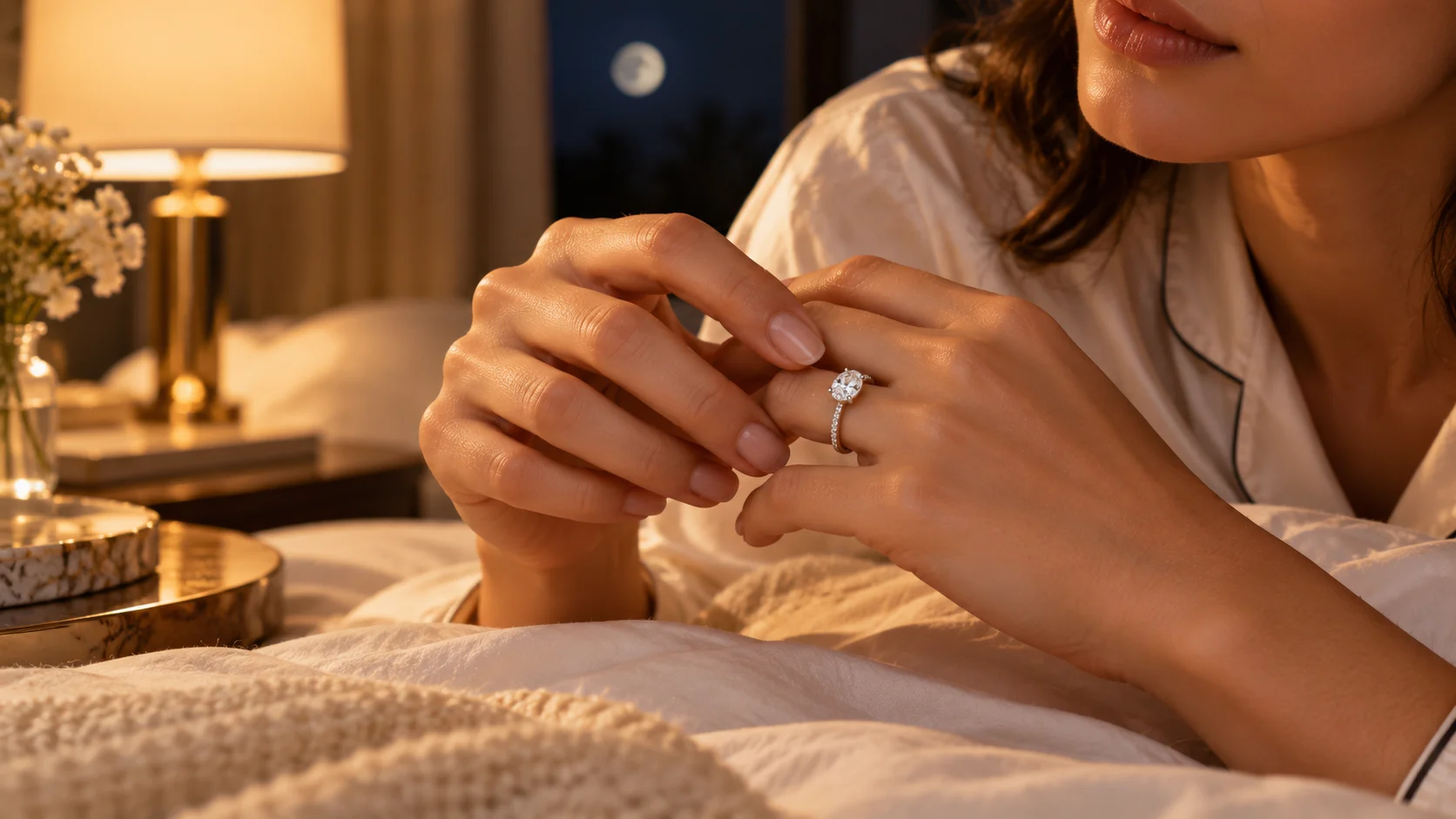
If your ring feels secure during the day but suddenly seems loose at night, you may wonder whether the ring has somehow become too big. In most cases, the ring itself has not changed. Your finger has.
Finger size can fluctuate throughout the day because of temperature, activity, circulation, hydration, and normal changes in swelling. When those factors change, the same ring can feel snug at one point and noticeably looser a few hours later.
If your ring is only slightly looser at night and still stays securely on your finger, this may simply be a normal fit change. But if it slides freely, spins constantly, or can easily come off, the ring may be too large or need a professional fit adjustment.
Is It Normal for a Ring to Feel Looser at Night?
Yes, it can be.
Your finger does not stay exactly the same size from morning to night. Temperature and changes in circulation can affect the amount of space between your finger and the inside of the ring.
For example, your fingers may be slightly swollen after certain activities or during warmer conditions. Later, when your hands cool down and that temporary swelling decreases, the ring can feel less snug.
Cold temperatures can have an especially noticeable effect because blood vessels in the fingers constrict, temporarily reducing finger volume. This can make a ring rotate or slide more easily.
So if your ring feels a little loose at night but fits securely most of the time, there may be no problem with the ring itself.
Why Does My Ring Feel Loose at Night?
1. Your Fingers May Be Smaller When Your Hands Are Cool
Temperature is one of the simplest explanations for changes in ring fit.
When your hands become cold, the blood vessels in your fingers constrict. Your fingers can temporarily become slightly smaller, leaving more room between your skin and the ring.
This can be particularly noticeable at night if you are in a cool room, sitting near air conditioning, or spending time outdoors in colder weather.
A ring that felt snug earlier may suddenly have enough room to rotate.
2. Finger Swelling Can Change Throughout the Day
Your fingers can also become temporarily swollen because of heat, physical activity, hydration, salt intake, and other everyday factors.
When that swelling decreases, your ring may feel looser.
This is why judging ring size based on a single moment isn’t always reliable. A ring that feels perfect when your finger is slightly swollen could feel loose when your finger returns to its usual size.
Likewise, a ring that feels tight at one point shouldn’t automatically be resized larger.
3. Your Finger Size Naturally Fluctuates
There isn’t one fixed finger size that remains identical all day.
Small changes in temperature, activity, and fluid levels can alter how a ring feels. Current ring-fitting guidance also recommends considering these fluctuations rather than relying on one measurement taken under unusual conditions.
If you’re unsure whether your ring is correctly sized, compare how it fits at different times under normal conditions rather than judging it only at night.
Our finger size guide covers common measurement mistakes and explains why factors such as temperature, finger shape, knuckle size, and ring width matter.
4. Your Ring May Be Slightly Too Large
Sometimes nighttime looseness is simply revealing an existing sizing issue.
A ring that is slightly oversized may feel perfectly secure when your finger is fuller. When your finger becomes smaller, however, the extra space becomes much more noticeable.
You may notice:
- The ring spins easily.
- The ring slides toward the knuckle.
- You can move it up and down with little resistance.
- It feels as though it could slip off when you shake your hand.
- The setting frequently ends up on the side or underside of your finger.
A small amount of movement isn’t necessarily a problem. Rings can rotate naturally, especially when the setting is heavier than the band. The concern is excessive movement or a realistic risk of the ring coming off.
5. A Top-Heavy Ring Can Rotate More at Night
Your ring doesn’t have to be too large to spin.
Engagement rings with large center stones, raised settings, or heavier designs can be top-heavy. When there is even a small amount of extra space around the finger, gravity can pull the heavier part downward.
This can make the ring appear much looser than it actually is.
If the ring stays securely on your finger but the diamond or setting repeatedly turns toward your palm, the issue may be balance rather than ring size.
That’s different from a ring that freely slides around your finger.
6. Your Finger Shape Can Affect the Fit
Finger shape matters just as much as the number printed on a ring-size chart.
Some people have relatively large knuckles with a narrower area at the base of the finger. A ring needs to be large enough to pass over the knuckle, but that can leave additional room once it reaches the base of the finger.
In that situation, simply choosing a smaller ring may make it difficult or uncomfortable to get over the knuckle.
Other solutions, such as sizing beads or other professional fit adjustments, may provide better stability without making the ring excessively tight.
How Do You Know if Your Ring Is Actually Too Loose?
Ask yourself what happens when the ring feels loose.
A ring may need attention if it:
- Slides over the knuckle with almost no resistance.
- Can fall off during normal hand movement.
- Spins continuously rather than occasionally.
- Moves significantly from side to side.
- Feels loose even when your hands are at a normal, comfortable temperature.
- Has become noticeably looser over several weeks or months.
By contrast, occasional rotation or a small amount of movement can be completely normal.
A properly fitted ring should feel secure without being difficult to remove. It should pass over the knuckle with some resistance but shouldn’t cause pain, numbness, or significant pressure.
For more guidance, see our guide on how tight an engagement ring should be.
Should You Resize a Ring That Is Only Loose at Night?
Not necessarily.
If your ring fits securely for most of the day and only feels slightly loose when your fingers are cold or less swollen, permanent resizing may not be necessary.
Before changing the ring size, observe the pattern for several days.
Notice:
- When the ring feels tightest.
- When it feels loosest.
- Whether temperature affects the fit.
- Whether the ring actually slides off.
- Whether the setting spins or the entire ring moves.
- Whether the fit has changed recently.
This gives you a much better idea of whether you’re seeing normal finger-size fluctuations or dealing with a genuine sizing problem.
If the ring is consistently loose under normal conditions, a jeweler can assess the fit and determine whether resizing or another adjustment makes more sense.
What Can You Do if Your Ring Keeps Spinning?
The right solution depends on why the ring is moving.
If the ring is only slightly loose, a temporary ring adjuster may provide additional security. A jeweler may also recommend sizing beads or another internal adjustment.
If the problem is caused by a top-heavy design, changing the size isn’t always the best answer. A professional may be able to stabilize the ring without making it uncomfortably tight.
If you’re wearing multiple rings together, the way they interact can also contribute to movement. Our guide to stopping rings from spinning when stacked covers that situation in more detail.
When Should You See a Jeweler?
Consider having the ring professionally checked if the looseness is new, persistent, or severe.
It’s especially worth getting an inspection if:
- Your ring suddenly became much looser.
- The ring can easily slide over your knuckle.
- The setting has started sitting differently.
- The band appears bent or damaged.
- A gemstone moves when you touch it.
- The ring catches on clothing.
- You suspect the ring has changed shape.
A sudden change in how a ring fits isn’t always a sizing issue. Physical damage or wear can sometimes change how a ring sits on your finger.
If the gemstone or setting itself appears loose, stop treating it as simply a sizing problem and have the ring inspected by a qualified jeweler.
How to Check Your Ring Fit at Home
You don’t need to make an immediate sizing decision just because your ring feels loose one evening.
Instead, check the fit under normal conditions.
Step 1: Check the ring at different times
Wear it during the morning, afternoon, and evening and notice whether the fit changes consistently.
Step 2: Check your temperature
Pay attention to whether your fingers are unusually cold or warm when the ring feels different.
Step 3: Check how it passes over your knuckle
A properly fitted ring should generally require some resistance to pass over the knuckle without becoming painful or difficult to remove.
Step 4: Check how much it moves
A little rotation is normal. Constant spinning or significant sliding deserves more attention.
Step 5: Consider the ring design
A large center stone or heavier setting can make a correctly sized ring rotate more than a simple band.
If you are trying to determine your actual ring size, avoid measuring only once or when your fingers are unusually cold or hot. Our ring size guide explains the main factors to consider.
Final Words
A ring that feels loose at night isn’t automatically a sign that it needs to be resized.
Temperature, normal changes in finger size, reduced swelling, finger shape, and the design of the ring can all affect how securely it feels. Cold hands can make the difference especially noticeable.
The key is to look at the pattern.
If your ring is only slightly looser at night but remains secure, temporary changes in finger size may explain it. If it slides freely, constantly spins, or can easily come off, the ring may need a professional fit assessment.
Rather than resizing based on one moment, compare the fit over several days and consider how your ring behaves under normal conditions.
Frequently Asked Questions
Why does my ring feel loose at night but tight in the morning?
Your finger size can change throughout the day. Temperature, activity, and temporary swelling can affect how much space there is between your finger and the ring.
Why does my ring spin more at night?
If your fingers become slightly smaller or less swollen, there may be more room for the ring to move. A top-heavy setting can make this rotation even more noticeable.
Should I make my ring smaller if it is loose at night?
Not necessarily. If the ring is secure during normal conditions and only becomes slightly loose when your hands are cold, permanent resizing may not be needed.
Is it normal for an engagement ring to move slightly?
Yes. Some movement or occasional rotation is normal. Constant spinning, significant sliding, or a ring that can easily come off may indicate a fit problem.
Can cold weather make a ring feel loose?
Yes. Cold temperatures can temporarily cause fingers to become smaller, making a ring feel less secure.
How should an engagement ring fit?
It should feel secure without being painfully tight. It should pass over the knuckle with some resistance and remain comfortable once it reaches the base of the finger.
Should I resize my ring immediately if it feels loose?
If the change is temporary, wait and observe how the ring fits under normal conditions. If it remains consistently loose, a jeweler can assess the fit and recommend an appropriate solution.