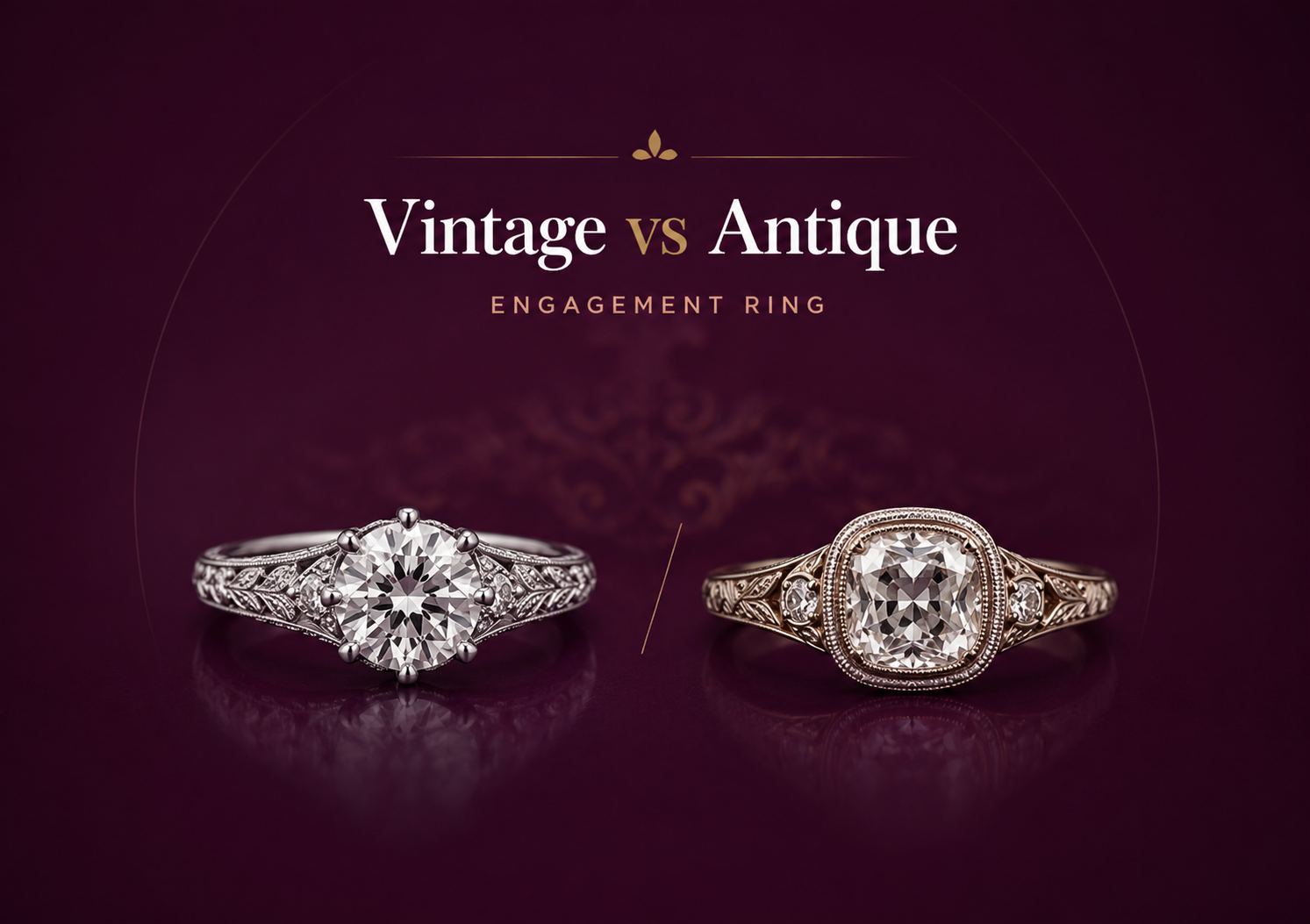
Choosing an engagement ring is exciting, but it can also raise a few questions. One of the most common is vintage vs antique engagement ring – are they the same, or do they describe two different styles?
Many people use the terms interchangeably, but they have distinct meanings. The difference goes beyond age. It includes the ring’s history, craftsmanship, design era, and even its value over time. Understanding these details can help you choose a ring that matches your style, budget, and long-term expectations.
Whether you’re looking for vintage engagement rings, antique engagement rings, or simply want to understand the difference between vintage and antique engagement rings, this guide explains everything in clear, practical terms.
An antique engagement ring is at least 100 years old, while a vintage engagement ring is generally 20 to 99 years old. Antique rings belong to historical periods such as the Georgian, Victorian, and Edwardian eras. Vintage rings often come from the Art Deco, Retro, or Mid-Century periods. Although both offer timeless beauty and unique craftsmanship, they differ in age, design, rarity, and collectability.
If you’re interested in how engagement-ring styles changed over time, our guide to the history of engagement rings provides useful context for understanding why Victorian, Edwardian, Art Deco and later designs look so different.
Vintage Engagement Ring
A vintage engagement ring is a ring that was made between 20 and 99 years ago. While there is no universal legal definition, this age range is widely accepted within the jewelry industry and by estate jewelry experts.
Unlike newly made vintage style engagement rings, a genuine vintage ring was actually crafted decades ago. It reflects the design trends, materials, and jewelry-making techniques popular during its original era.
Popular vintage periods include:
- Art Deco engagement rings (1920s–1930s)
- Retro engagement rings (1940s–1950s)
- Mid-century engagement rings (1950s–1970s)
Many vintage rings feature geometric patterns, bold settings, colorful gemstones, and handcrafted details that are difficult to replicate with modern manufacturing.
You’ll also find styles such as:
- Solitaire vintage ring
- Halo vintage ring
- Cushion cut vintage ring
- Oval vintage ring
- Emerald cut vintage ring
If you’re searching for something distinctive without choosing a century-old piece, a vintage ring often offers an ideal balance between character and wearability.
Antique Engagement Ring
An antique engagement ring is at least 100 years old. This definition is widely recognized by antique dealers, auction houses, and historical jewelry experts.
These rings were crafted during historical jewelry periods that continue to influence designers today.
Some of the most sought-after antique eras include:
- Georgian engagement rings (1714–1837)
- Victorian engagement rings (1837–1901)
- Edwardian engagement rings (1901–1915)
Many antique engagement rings feature historic diamond cuts such as the Old Mine Cut and Old European Cut. If you want to understand how these two cuts differ, see our guide to Old Mine Cut vs Old European Cut diamonds.
Because every antique ring has survived for more than a century, each piece carries its own story and history. In many cases, collectors also value the ring’s provenance, original setting, and historical significance.
Vintage Engagement Ring vs Antique Engagement Ring: Quick Comparison
| Feature | Vintage Engagement Rings | Antique Engagement Rings |
|---|---|---|
| Age | 20–99 years old | 100+ years old |
| Origin | Modern historical eras | Historical eras over a century old |
| Popular Periods | Art Deco, Retro, Mid-Century | Georgian, Victorian, Edwardian |
| Diamond Cuts | Modern and transitional cuts | Old Mine Cut, Old European Cut |
| Availability | More common | Much rarer |
| Price | Often more affordable | Usually higher due to rarity |
| Collectability | Moderate | High |
| Condition | Generally easier to maintain | May require restoration or preservation |
The Difference Between Vintage and Antique Engagement Rings
Although age is the biggest distinction, several other factors separate these beautiful rings.
1. Age
This is the simplest difference.
- Vintage rings are generally 20–99 years old.
- Antique rings are 100 years old or older.
A ring made in the 1980s could now qualify as vintage, while a Victorian ring is considered antique because of its age.
2. Design Style
Each jewelry era introduced its own design language.
Vintage engagement rings often include:
- Geometric Art Deco patterns
- Bold gemstone combinations
- Symmetrical settings
- Clean architectural lines
Antique engagement rings typically feature:
- Floral motifs
- Nature-inspired details
- Romantic scrollwork
- Delicate filigree engagement rings
- Fine milgrain engagement rings
- Hand engraved engagement rings
These handcrafted details give antique jewelry a personality that’s difficult to reproduce with modern mass production.
3. Craftsmanship
One reason collectors admire antique and vintage jewelry is the level of craftsmanship.
Older rings were usually created by skilled artisans rather than automated production systems. Many pieces were finished by hand, making each ring slightly unique.
Antique rings often showcase:
- Hand engraving
- Intricate filigree
- Milgrain edges
- Original settings
- Traditional metalworking techniques
Vintage rings also display excellent craftsmanship, although later decades introduced improved manufacturing methods that increased consistency.
4. Diamond Cuts
The diamonds themselves often reveal a ring’s age.
Many antique diamond rings contain:
- Old Mine Cut diamonds
- Old European Cut diamonds
These historical cuts are only part of the larger world of diamond cutting. If you’re comparing different stones, our guide to the different types of diamond cuts explains how major cuts and shapes differ.
If you’re comparing the visual character of modern brilliant faceting with more structured step-cut designs, our guide to step-cut and brilliant-cut diamonds can help.
For buyers who appreciate history, these rare diamond cuts often become one of the most appealing features of an antique ring.
Antique and historical jewelry can also feature rose-cut diamonds, whose faceting creates a very different look from a modern round brilliant; compare rose cut vs round cut diamonds to see the difference.
5. Value and Rarity
When comparing vintage engagement ring value and antique engagement ring value, rarity plays a major role.
Antique rings are generally harder to find because fewer have survived in excellent condition. Their age, craftsmanship, and historical importance often make them desirable among collectors.
Vintage rings can also appreciate in value, particularly pieces from well-known design periods such as Art Deco. However, they are usually easier to source than true antique jewelry.
It’s important to remember that value depends on several factors, including:
- Diamond quality
- Gemstone authenticity
- Original setting
- Condition
- Authentic hallmarks
- Ring provenance
- Brand or maker
- Historical significance
A professional ring appraisal can provide a more accurate assessment of any ring’s market value.
If resale or long-term value is part of your decision, it also helps to understand which diamond shapes hold their value, since shape, demand and overall diamond quality can influence buyer interest.
Are Vintage or Antique Engagement Rings Better?
Neither option is automatically better. The right choice depends on what matters most to you.
If you enjoy bold designs, easier maintenance, and a wider selection, vintage engagement rings may be the better fit.
If you appreciate history, exceptional craftsmanship, and owning a true piece of the past, antique engagement rings offer something few modern rings can match.
After all, wearing a ring that has celebrated love stories across generations adds a level of charm that a brand-new ring simply can’t imitate – though it might have gathered a century’s worth of compliments along the way.
Sources: Age definitions and historical jewelry periods align with guidance from the National Association of Jewellers (UK), the Gemological Institute of America (GIA), Sotheby’s Jewelry, and leading estate jewelry specialists. These organizations distinguish antique jewelry as approximately 100 years old or older and recognize vintage jewelry as originating from later historical periods.
Pros and Cons
Both vintage and antique engagement rings offer beauty that modern designs often try to recreate. Still, each comes with advantages and considerations.
Vintage Engagement Rings
Pros
- Wide variety of styles and gemstone shapes
- Often more affordable than antique rings
- Easier to resize or repair in many cases
- Excellent balance of character and durability
- More options available through reputable jewelers
Cons
- Less rare than true antiques
- Value varies depending on the era and condition
- Some pieces may have undergone repairs or modifications over the years
Antique Engagement Rings
Pros
- Genuine historical significance
- Exceptional hand craftsmanship
- Rare and often one-of-a-kind
- Highly desirable among collectors
- Beautiful examples of period jewelry
Cons
- Limited availability
- May require professional restoration or preservation
- Certain antique settings can be more delicate for everyday wear
- Resizing may not always be possible without affecting the original design
Which Is Better: Vintage or Antique Engagement Rings?
There isn’t a universal winner in the vintage engagement ring vs antique engagement ring debate. The better choice depends on your personal preferences.
Choose vintage engagement rings if you:
- Prefer bold Art Deco or Retro designs.
- Want more choices within your budget.
- Plan to wear the ring every day.
- Like older jewelry without purchasing a century-old piece.
Choose antique engagement rings if you:
- Love history and heirloom jewelry.
- Appreciate historical craftsmanship.
- Want a collectible engagement ring.
- Value rarity over trends.
If your goal is a timeless ring with character, both options can be excellent choices. The key is buying from a trusted jeweler who provides accurate information about the ring’s age, condition, and authenticity.
Are Antique Engagement Rings Worth It?
Many buyers ask, “Are antique engagement rings worth it?”
For the right buyer, the answer is often yes.
An antique ring offers something that cannot be recreated – a genuine connection to another era. From hand-cut diamonds to handcrafted settings, every detail reflects the jewelry-making techniques of its time.
However, value should not be measured only by age.
When considering an antique engagement ring value, experts often evaluate:
- Historical period
- Diamond quality
- Gemstone authenticity
- Original setting
- Authentic hallmarks
- Ring provenance
- Overall condition
- Quality of previous restoration work
Some antique rings become highly collectible, while others hold primarily sentimental value.
Regardless of the ring’s age, the diamond itself still deserves careful evaluation. Our guide to the 4Cs of diamond quality explains the key factors to consider when assessing a diamond.
Do Vintage Engagement Rings Hold Their Value?
Many shoppers also wonder, “Do vintage engagement rings hold value?”
In many cases, they can.
Well-preserved vintage rings from desirable periods like the Art Deco era often remain popular because of their distinctive designs and limited availability.
That said, no engagement ring should be viewed as a guaranteed financial investment. The resale value depends on market demand, craftsmanship, gemstone quality, and condition.
Buying a ring because you genuinely love its design is usually the best approach.
How Can You Tell if an Engagement Ring Is Antique?
Whether you’re shopping in person or browsing antique engagement rings online, authentication matters.
Here are several things experienced jewelers examine:
Authentic Hallmarks
Hallmarks can indicate:
- Metal purity
- Country of origin
- Manufacturer
- Approximate production period
While hallmarks provide useful clues, they shouldn’t be the only factor used to determine age.
Ring Provenance
If available, provenance documents help establish a ring’s ownership history. Strong provenance can increase both buyer confidence and collectability.
Diamond Cut
Older rings frequently feature:
- Old Mine Cut diamonds
- Old European Cut diamonds
These cuts have larger facets and a softer sparkle than modern round brilliant diamonds.
Craftsmanship
Look for handmade details such as:
- Fine filigree
- Milgrain borders
- Hand engraving
- Original settings
These characteristics often indicate authentic historical craftsmanship rather than modern reproductions.
Professional Appraisal
Before purchasing an expensive ring, consider an independent ring appraisal from a qualified gemologist. An appraisal can help confirm materials, condition, and estimated value.
Tips for Buying Vintage or Antique Engagement Rings
Whether you want to buy vintage engagement rings or buy antique engagement rings, following a few best practices can help you shop with confidence.
Buy From a Trusted Seller
Choose reputable jewelers who specialize in estate jewelry or certified antique jewelry. Ask questions about the ring’s history, condition, and any repairs.
Request Documentation
Ask for:
- Professional appraisal
- Diamond grading report (when available)
- Authentication documents
- Details about previous restoration
Check the Ring’s Condition
Older jewelry naturally shows signs of age.
Pay close attention to:
- Loose stones
- Worn prongs
- Thin bands
- Previous repairs
- Structural stability
A qualified jeweler can determine whether the ring is suitable for everyday wear.
Consider Your Lifestyle
If you live an active lifestyle, discuss durability with your jeweler before purchasing.
Some delicate antique settings may require extra care compared to more robust vintage or modern designs.
Vintage-Inspired Rings vs Genuine Vintage Rings
This is another area where buyers often get confused.
A vintage-inspired engagement ring is newly made but designed to resemble jewelry from earlier eras.
A genuine vintage engagement ring was actually crafted decades ago.
Similarly, antique style engagement rings borrow design elements from historical periods without being over 100 years old.
Neither option is better – they simply appeal to different buyers.
If you love the appearance of older jewelry but prefer newly manufactured materials, vintage-inspired designs may offer the best of both worlds.
Frequently Asked Questions
Is a vintage engagement ring considered antique?
No. A vintage engagement ring is not automatically considered antique. Most jewelry experts classify vintage rings as 20–99 years old, while antique rings must be at least 100 years old.
Which is better: a vintage or an antique engagement ring?
Neither is universally better. Vintage engagement rings offer more variety and are often easier to maintain, while antique engagement rings provide historical significance, exceptional craftsmanship, and greater rarity. The best choice depends on your style, budget, and lifestyle.
Are antique engagement rings worth more than vintage rings?
They can be. Antique engagement rings are often more valuable because of their rarity, age, craftsmanship, and historical importance. However, a ring’s value also depends on its condition, diamond quality, provenance, and overall demand.
How can you tell if an engagement ring is antique?
Check for authentic hallmarks, historical design features, hand-crafted details, Old Mine Cut or Old European Cut diamonds, and any available provenance. A professional jewelry appraisal can also help verify a ring’s age and authenticity.
Are vintage engagement rings a good investment?
Some vintage engagement rings retain or increase their value over time, especially rare Art Deco or designer pieces. However, they should be purchased primarily for their craftsmanship, beauty, and uniqueness rather than as guaranteed financial investments.
Can antique engagement rings be resized?
Many antique engagement rings can be resized, but it depends on the design, metal, and condition of the band. Delicate or historically significant rings should always be resized by an experienced jeweler.
What diamond cuts are common in antique engagement rings?
Antique engagement rings often feature Old Mine Cut and Old European Cut diamonds. These hand-cut diamonds have larger facets and a softer sparkle compared to modern brilliant-cut diamonds.
What are vintage-inspired engagement rings?
Vintage-inspired engagement rings are newly made rings that recreate the look of historical jewelry styles. Unlike genuine vintage rings, they are manufactured using modern materials and techniques.
Where should you buy a vintage or antique engagement ring?
Buy from reputable jewelers or estate jewelry specialists who provide authentication, professional appraisals, and transparent information about the ring’s history, condition, and any restoration work.
Final Thoughts
Understanding the difference between vintage and antique engagement rings helps you shop with greater confidence.
If you want bold geometry, distinctive character, and a wider range of options, vintage engagement rings are an excellent choice.
If you’re drawn to history, exceptional craftsmanship, and genuine rarity, antique engagement rings offer an unmatched sense of heritage.
Whichever direction you choose, focus on authenticity, craftsmanship, and overall condition rather than age alone. A beautiful ring isn’t valuable simply because it’s old – it becomes meaningful because of the story it tells and the memories it will continue to create.