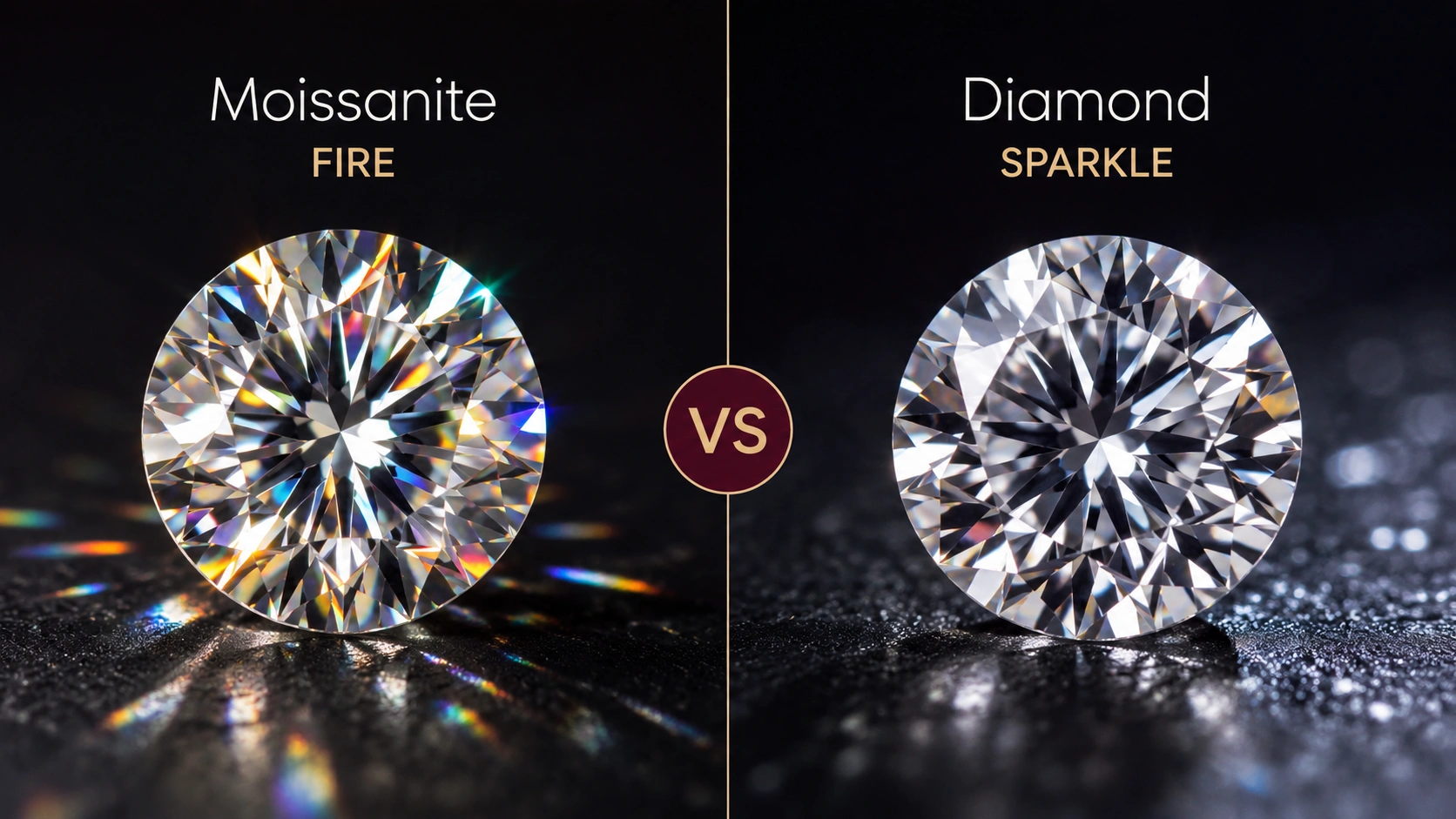
If you compare moissanite and diamond side by side, you may notice something interesting: they do not sparkle in exactly the same way.
Moissanite is famous for its intense flashes of rainbow color. Diamond is known for a crisp combination of bright white reflections, subtle color flashes, and scintillation. So, when it comes to moissanite fire vs diamond sparkle, which one actually shines more?
The honest answer is: it depends on what you mean by “sparkle.”
Moissanite has higher dispersion than diamond, which creates noticeably stronger fire, or rainbow flashes. Diamond, however, can produce a balanced combination of brightness, fire, and scintillation, especially when it has a well-executed cut.
That difference explains why some people love the colorful sparkle of moissanite, while others prefer the classic white sparkle of diamond.
What Is the Difference Between Moissanite Fire and Diamond Sparkle?
Before comparing the two, it helps to separate three terms that people often use interchangeably.
Brightness refers to the white light reflected back toward your eyes.
Fire is the dispersion of white light into spectral colors, creating flashes of red, blue, yellow, and other rainbow hues.
Scintillation describes the flashes and changing pattern of light and dark areas you see when the stone, your head, or the light source moves.
The Gemological Institute of America (GIA) uses brightness, fire, and scintillation as important parts of diamond appearance and cut evaluation.
So “sparkle” is not one single optical property.
Think of it like a great meal. Brightness is the main dish, fire is the seasoning, and scintillation is the little surprise that keeps things interesting.
Moissanite vs Diamond Sparkle at a Glance
| Feature | Moissanite | Diamond |
|---|---|---|
| Refractive index | About 2.65–2.69 | About 2.42 |
| Dispersion | 0.104 | 0.044 |
| Fire | Strong, colorful | More restrained |
| Brilliance/brightness | Very bright | Very bright |
| Scintillation | Depends heavily on cut | Depends heavily on cut |
| Optical character | Doubly refractive | Singly refractive |
| Typical visual impression | Colorful, fiery flashes | Crisp white sparkle with subtle fire |
GIA reports refractive indices of 2.648 and 2.691 for synthetic moissanite, with a dispersion of 0.104. GIA lists diamond’s refractive index at about 2.42, while its research gives a dispersion value of 0.044.
The numbers explain a lot of what your eyes see.
Does Moissanite Sparkle More Than Diamond?
This is probably the most common question in the moissanite vs diamond sparkle debate.
If by “sparkle” you mean rainbow fire, moissanite can produce considerably more.
GIA states that moissanite has more than twice the fire of diamond and slightly more brilliance. GIA also notes that the intense fire can become particularly noticeable in larger stones, where some observers describe the effect as a “disco ball” appearance.
But that does not mean every moissanite will look brighter or more beautiful than every diamond.
Cut matters.
A well-cut diamond can show excellent brightness, fire, and scintillation. A poorly cut stone can look dull regardless of its material. GIA’s research emphasizes that appearance depends on facet proportions, symmetry, contrast, lighting, and how the stone performs as it moves.
So the better answer to does moissanite sparkle more than diamond is:
Moissanite usually shows more colorful fire, while a well-cut diamond can provide a very crisp and balanced combination of brightness, fire, and scintillation.
That is a much more useful comparison than simply declaring a winner.
Moissanite vs Diamond Fire: Why the Rainbow Flashes Are Different
The biggest optical difference appears when you compare moissanite vs diamond fire.
Fire comes from dispersion.
When white light enters a faceted gemstone, different wavelengths bend by slightly different amounts. This separates some of the white light into spectral colors.
Moissanite has a dispersion value of approximately 0.104, while diamond’s is approximately 0.044. That means moissanite has substantially greater dispersive power.
This is why moissanite can show stronger red, blue, green, yellow, and other rainbow flashes.
Diamond has fire too. It is not a fire-free gemstone.
The difference is in the amount and character of those flashes.
A well-cut diamond generally gives you a balanced light show, with bright white reflections mixed with flashes of spectral color. Moissanite tends to make those colored flashes more obvious.
That is why someone shopping for a traditional diamond look may describe moissanite as “more colorful,” while someone who loves dramatic sparkle may see the same characteristic as its biggest advantage.
Does Moissanite Have More Fire Than Diamond?
Yes.
This is one of the clearest scientific differences between the two materials.
GIA reports that synthetic moissanite has a dispersion of 0.104, compared with 0.044 for diamond. GIA also specifically describes moissanite as having more than twice the fire of diamond.
This higher dispersion produces stronger rainbow flashes when the stone interacts with suitable light.
You may notice the effect especially under direct or point-source lighting, where individual flashes become easier to see.
However, lighting changes how any gemstone looks.
GIA explains that a diamond can appear quite different under different lighting environments because its facets reflect the surrounding environment. The same principle applies when judging the appearance of other faceted gemstones.
So don’t judge a stone from one photograph under one spotlight.
A gemstone has a whole lighting career to perform.
Moissanite vs Diamond Brilliance: Is Moissanite Brighter?
The answer needs a little more care.
Moissanite has a higher refractive index than diamond. GIA reports values of approximately 2.65–2.69 for synthetic moissanite, compared with about 2.42 for diamond.
A higher refractive index affects how light behaves inside a gemstone and contributes to its strong visual brightness.
But refractive index alone does not tell you which stone will look better.
This is an important point that many comparison articles skip.
GIA’s research explains that brightness, brilliance, contrast, pattern, fire, and scintillation all contribute to how people perceive a diamond. It also notes that a stone returning more light does not automatically look better because the distribution of bright and dark areas matters too.
So when comparing moissanite vs diamond brilliance, avoid thinking of the higher refractive index as an automatic beauty score.
The material matters.
The cut matters too.
Why Does Moissanite Have More Rainbow Fire?
The simple answer is its higher dispersion.
Moissanite is synthetic silicon carbide, and its optical properties differ from diamond. GIA’s gemological research lists moissanite with a dispersion of 0.104 and diamond with 0.044.
That larger difference in refractive behavior across wavelengths causes more separation of white light into spectral colors.
The result is the moissanite rainbow sparkle many people notice immediately.
This is also why larger moissanites can sometimes look particularly colorful.
GIA notes that in stones around one carat or above, the intense fire can make moissanite easier to recognize as something other than diamond. In very large stones, the effect may become especially pronounced.
Some shoppers love this.
Others want something quieter.
Neither preference is wrong.
Moissanite Double Refraction vs Diamond
There is another important optical difference: double refraction.
Diamond is singly refractive, while moissanite is doubly refractive.
GIA has documented obvious double refraction in synthetic moissanite and explains that its optical character helps gemologists distinguish it from diamond.
What does that mean visually?
When viewed under magnification, some facet junctions or edges in moissanite can appear doubled. This can contribute to a slightly different visual character compared with diamond.
You may not notice it immediately while wearing a ring.
But under a loupe, the difference becomes much easier for a trained observer to recognize.
So if you’re asking how can you tell moissanite and diamond apart, sparkle alone can provide clues, but gemological testing gives a much more reliable answer.
Can You Tell Moissanite and Diamond Apart by Sparkle?
Sometimes, yes.
But sparkle should not be treated as a foolproof identification method.
A trained jeweler or gemologist may notice that moissanite produces stronger rainbow flashes or shows a different optical character. Larger stones can make those differences more noticeable.
GIA specifically notes that moissanite’s higher dispersion can create more obvious fire, while its double refraction provides another identifying characteristic.
However, photographs and videos can be misleading.
Lighting, camera exposure, movement, stone size, facet design, and surrounding surfaces can all change what you see.
If you need to know whether a stone is actually diamond or moissanite, professional gemological testing is the safer route.
Why Does Moissanite Look Different From Diamond?
It comes down to the combination of optical properties.
Moissanite has:
- A higher refractive index
- Much higher dispersion
- Double refraction
- Strong colorful fire
Diamond has:
- A refractive index of about 2.42
- Lower dispersion than moissanite
- No birefringence
- A distinctive combination of brightness, fire, and scintillation
GIA lists diamond as having no birefringence and a refractive index of about 2.42.
These differences create two recognizable sparkle personalities.
Moissanite: colorful, energetic, and fire-forward.
Diamond: crisp, bright, balanced, and more restrained in its rainbow flashes.
Neither description means one stone is objectively prettier.
It means they behave differently with light.
Moissanite Rainbow Sparkle vs Diamond White Sparkle
This is where personal taste becomes important.
If you love rainbow flashes, moissanite can be very appealing.
Its higher dispersion creates stronger spectral flashes, giving the stone a lively and colorful appearance.
If you prefer white sparkle, diamond may be closer to what you’re looking for.
A well-cut diamond can create strong brightness and scintillation without the same level of rainbow color that you may notice in moissanite.
The difference can be especially noticeable when you move the stone under changing light.
Moissanite may throw colorful flashes across the room.
A diamond may give you sharp white flashes with smaller bursts of color.
One is not “better.” They simply put on different shows.
Is Moissanite Too Sparkly Compared to Diamond?
For some people, yes.
For others, absolutely not.
This is one of those questions where personal preference matters more than a laboratory number.
The stronger fire of moissanite can create the disco ball effect that some buyers actively want. GIA acknowledges this appearance in larger moissanites.
If you prefer a traditional diamond appearance, you may find that amount of rainbow fire more noticeable than expected.
If you want your engagement ring to catch attention with vivid flashes of color, that same characteristic may be exactly what you want.
The best choice depends on your visual preference, not on which gemstone wins a theoretical sparkle competition.
Which Has More Fire: Moissanite or Diamond?
Moissanite has more fire.
Its dispersion is approximately 0.104, compared with approximately 0.044 for diamond.
That difference is large enough to produce a noticeable visual effect.
So if your priority is strong rainbow flashes, moissanite has the advantage.
Which Has More Brilliance: Moissanite or Diamond?
This question is more complicated.
Moissanite has a higher refractive index and is widely recognized for strong brilliance. GIA describes moissanite as having slightly more brilliance than diamond.
But you should not judge brilliance from refractive index alone.
Cut quality, facet arrangement, symmetry, polish, proportions, lighting, and contrast all influence appearance.
GIA’s research makes this clear: light performance is not simply a race to return the most light. The pattern and distribution of light and dark areas also influence what the eye perceives.
That is why a beautifully cut diamond can look spectacular next to a poorly cut moissanite, and vice versa.
Which Has Better Sparkle for an Engagement Ring?
Choose moissanite if you love:
- Strong rainbow flashes
- Noticeable fire
- A bright and colorful appearance
- A more dramatic sparkle personality
- The distinctive visual character of moissanite
Choose diamond if you prefer:
- Crisp white sparkle
- A more restrained display of rainbow fire
- The traditional diamond appearance
- A balanced combination of brightness, fire, and scintillation
And remember: cut quality matters enormously.
GIA states that cut affects how a diamond’s facets interact with light and influences its brightness, fire, and scintillation.
The same practical lesson applies when shopping for a faceted moissanite: don’t focus only on the material. Look at the actual stone.
Frequently Asked Questions
Does moissanite sparkle like a diamond?
Yes, but the sparkle has a different character. Moissanite generally produces stronger rainbow fire, while diamond can show a balanced combination of white brightness, fire, and scintillation.
Does moissanite have rainbow flashes?
Yes. Moissanite has substantially higher dispersion than diamond, which produces stronger flashes of spectral colors. GIA reports dispersion of 0.104 for synthetic moissanite compared with 0.044 for diamond.
Why does moissanite sparkle more than diamond?
Moissanite’s higher refractive index and much higher dispersion contribute to its strong visual brightness and colorful fire. However, cut quality and lighting also influence how much sparkle you actually see.
Can you tell moissanite from diamond by sparkle?
Sometimes an experienced observer can notice differences, especially the stronger rainbow fire and optical effects of moissanite. However, sparkle alone should not be treated as definitive identification. Professional gemological testing provides a more reliable answer.
Is moissanite too sparkly compared to diamond?
That depends on your taste. Moissanite can produce stronger rainbow flashes, especially in larger stones. If you prefer colorful fire, this can be a major advantage. If you prefer a more restrained diamond appearance, you may find it excessive.
Which has more fire, moissanite or diamond?
Moissanite has more fire. Its reported dispersion of 0.104 is more than twice diamond’s 0.044, which explains its stronger rainbow flashes.
Which has more brilliance, moissanite or diamond?
Moissanite has a higher refractive index and GIA describes it as having slightly more brilliance than diamond. However, brilliance and overall visual appeal depend on more than refractive index alone, including cut and facet arrangement.
Final Verdict: Moissanite Fire vs Diamond Sparkle
So, moissanite fire vs diamond sparkle is not really a battle between sparkle and no sparkle.
Both stones can look exceptionally bright.
The difference is the type of light show they create.
Moissanite has significantly higher dispersion, which gives it stronger rainbow fire. Its higher refractive index also contributes to its bright appearance. GIA confirms that moissanite can show more than twice the fire of diamond and may display an especially intense effect in larger sizes.
Diamond offers its own distinctive combination of brightness, fire, and scintillation. A well-cut diamond can produce crisp white reflections, colorful flashes, and strong movement across its facets.
So, does moissanite sparkle more than diamond?
If you mean more colorful fire, generally yes.
If you mean which stone looks better, there is no scientific winner.
If you love rainbow sparkle, moissanite may be your perfect match.
If you want classic white brilliance with more restrained fire, diamond may suit you better.
The best gemstone is ultimately the one whose sparkle makes you look down at your hand one more time than necessary.
And honestly, that’s a pretty good problem to have.