Emerald cut diamonds have a look that is difficult to confuse with other diamond shapes. Their long, clean facets create broad flashes of light instead of the rapid sparkle associated with round brilliant diamonds.
That difference is part of their appeal, but it also changes how you should shop for one.
The large, open facets of an emerald cut can make inclusions, body color, symmetry issues, and poor proportions easier to see. Instead of choosing a stone based only on its carat weight or grading report, it is worth paying close attention to how the actual diamond looks.
This emerald cut diamond guide explains the shape, its advantages and disadvantages, the most important quality factors, popular settings, and what to check before buying.
What Is an Emerald Cut Diamond?
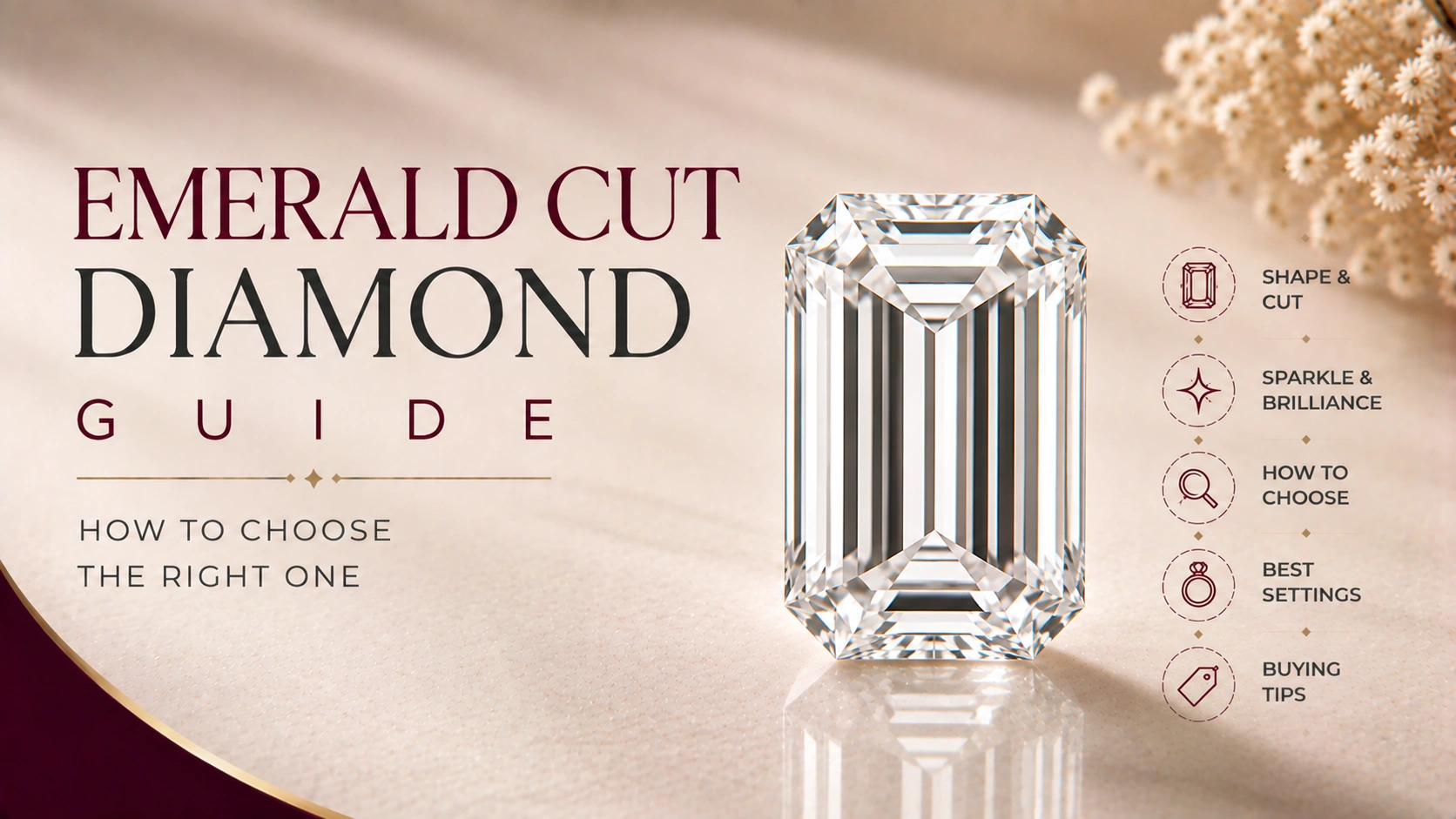
An emerald cut diamond is a rectangular step-cut diamond with clipped corners and long, parallel facets arranged in a staircase-like pattern.
Unlike brilliant cuts, which use many smaller facets to maximize scintillation and sparkle, a step cut uses larger facets. The result is a calmer pattern of broad reflections sometimes described as a hall-of-mirrors effect.
The shape is usually rectangular, although some emerald cuts have proportions that make them appear relatively square.
The name comes from the cutting style originally associated with emerald gemstones. The step-cut design helped reduce the visibility of inclusions and made the stone’s color easier to appreciate. The style later became strongly associated with the geometric jewelry of the Art Deco era.
Today, emerald cut diamonds are popular in engagement rings because they combine a distinctive shape with a clean, sophisticated appearance.
What Does an Emerald Cut Diamond Look Like?
An emerald cut typically has:
- A rectangular outline
- Four clipped or beveled corners
- Straight, parallel sides
- A large table
- Long step-cut facets
- Broad flashes of light
- Less rapid sparkle than a brilliant-cut diamond
The large facets are one of the defining characteristics of the shape.
When the proportions and facet arrangement work well together, the diamond can appear bright, crisp, and almost mirror-like. When they do not, the stone may look overly dark, watery, or transparent in parts of the center.
This is why two emerald cut diamonds with the same carat weight and similar grading information can look surprisingly different.
What Is the Hall-of-Mirrors Effect?
The hall-of-mirrors effect describes the broad, elongated reflections produced by an emerald cut’s step facets.
Instead of seeing countless tiny flashes, you may see larger bands of light moving across the stone as it changes position.
This creates a more understated appearance than a round brilliant.
If you love:
- Clean geometric lines
- Broad flashes rather than intense glitter
- A vintage or Art Deco-inspired appearance
- A sophisticated, understated look
an emerald cut may be a particularly good fit.
If maximum sparkle and fire are your priorities, a brilliant-cut shape may suit you better.
Emerald Cut vs. Brilliant Cut
The biggest difference is the way the facets are arranged.
Emerald cut: step cut with large, elongated facets and broad reflections.
Brilliant cut: many triangular and kite-shaped facets designed to create intense sparkle and scintillation.
This does not make one objectively better than the other. They simply create different visual effects.
An emerald cut tends to look more architectural and restrained, while brilliant cuts tend to look more lively and sparkly.
The difference is important when comparing an emerald cut with shapes such as round, oval, radiant, or cushion.
For a broader explanation of diamond faceting, see the guide to diamond cuts.
Emerald Cut Diamond Pros and Cons
Pros
Elegant appearance: The clean rectangular outline has a timeless quality.
Distinctive faceting: The hall-of-mirrors effect gives the stone a look that differs significantly from brilliant cuts.
Large face-up appearance: Emerald cuts can look substantial across the finger because of their broad surface area.
Finger-elongating effect: An elongated rectangular shape can visually lengthen the appearance of the finger.
Versatile styling: Emerald cuts work with minimalist solitaire rings as well as more elaborate three-stone and halo designs.
Strong vintage connection: The geometric shape works particularly well with Art Deco-inspired jewelry.
Cons
Clarity is more challenging: The large facets can make inclusions easier to see.
Color can be more noticeable: Step-cut faceting does not disguise body color as effectively as many brilliant cuts.
Less sparkle: Buyers who want maximum scintillation may prefer a brilliant cut.
Proportions matter: An emerald cut can look unattractive if its shape, symmetry, or light performance is poor.
No single perfect set of proportions: Emerald cuts are more dependent on visual evaluation than a simple numerical formula.
How to Choose an Emerald Cut Diamond
The most important thing to remember is that emerald cuts should be evaluated as individual diamonds.
A grading report provides valuable information, but two stones with similar grades can perform differently.
1. Pay Close Attention to Clarity
Clarity is one of the most important considerations when buying an emerald cut.
Its large table and open step facets provide a relatively unobstructed view into the diamond. Inclusions that might be difficult to notice in a brilliant-cut diamond can be easier to spot in an emerald cut.
For many buyers, VS2 or better is a sensible starting point, while VS1 can provide additional peace of mind.
But clarity grade alone should not determine your purchase.
Look at where the inclusion is located.
An inclusion beneath the center of the table can be much more noticeable than one closer to the edge. This means an eye-clean VS2 can be a better choice than a higher-graded diamond with an inclusion in an obvious position.
The goal is not necessarily to buy the highest clarity grade. The goal is to buy a diamond that looks clean to the naked eye.
You can learn more about the grading factor in the guide to diamond clarity.
2. Consider Diamond Color Carefully
Emerald cuts can show body color more readily than many brilliant-cut diamonds.
Because the facets are large and open, there are fewer small reflections to disguise a slight yellow or brown tint.
For a white-metal setting such as platinum or white gold, many buyers prefer an emerald cut in the G to H range or higher.
However, there is no universal requirement.
A warmer color can work beautifully with yellow or rose gold, and personal preference matters.
If you are comparing diamonds close in price, view them side by side rather than assuming that a one-grade difference will automatically be obvious.
For more detail, see the guide to diamond color.
3. Choose a Length-to-Width Ratio You Actually Like
The length-to-width ratio determines how elongated the diamond appears.
It is calculated by dividing the diamond’s length by its width.
For example, a diamond measuring 7.2 mm by 5.0 mm has a ratio of:
7.2 ÷ 5.0 = 1.44
Common emerald cut proportions often fall around 1.30 to 1.50, although longer and narrower stones are also available.
A rough visual guide:
| Ratio | Appearance |
|---|---|
| Around 1.30 | Shorter and wider |
| Around 1.40 | Balanced rectangular appearance |
| Around 1.45–1.50 | Classic elongated look |
| Above 1.50 | Longer and narrower |
These numbers are guidelines rather than rules.
Some people prefer a relatively wide emerald cut, while others love a long, slender shape.
The best ratio is the one that looks right to you.
4. Examine the Table and Depth
Table and depth percentages can help narrow down your options, but they should not be treated as a rigid recipe.
Various buying guides commonly place emerald cut tables roughly in the low-to-upper 60% range and depths around the low-to-high 60% range.
What matters more is how those proportions interact with the rest of the diamond.
A diamond that falls within a commonly recommended numerical range can still look dull or poorly balanced.
Use measurements as a screening tool, then inspect the actual diamond.
5. Check Symmetry
Symmetry is particularly noticeable on a geometric shape like an emerald cut.
Look at:
- Whether the sides appear parallel
- Whether the corners are evenly clipped
- Whether the step facets appear balanced
- Whether the center appears properly aligned
- Whether the outline looks even from end to end
Excellent or Very Good symmetry is a useful starting point, but the diamond should still be examined visually.
A technically acceptable grade does not guarantee that the stone will look perfectly balanced to your eye.
6. Look for Good Light Performance
This is one of the most important steps.
An emerald cut should not simply look bright in one photograph.
Look at videos or images from different angles and under different lighting conditions when possible.
Pay attention to:
- Bright areas
- Dark areas
- Transparent or “windowed” sections
- Broad flashes
- Whether the center stays attractive as the diamond moves
A permanently dark center can make a stone appear less lively.
Likewise, an overly transparent-looking area can make the diamond appear washed out.
This is one reason visual inspection is so important when choosing an emerald cut. There is no single universally accepted set of measurements that guarantees the best appearance for every stone.
7. Buy From a Diamond With Reliable Certification
A reputable grading report gives you an independent record of the diamond’s characteristics.
Look for the report before making a purchase and compare it with the actual stone.
Certification is particularly useful when comparing diamonds from different sellers because it gives you a consistent framework for evaluating carat weight, color, clarity, measurements, and other characteristics.
For a broader explanation of diamond quality, see the 4Cs of diamond quality.
Emerald Cut Diamond Sizes
Carat weight does not tell you exactly how large an emerald cut will look from above.
Two diamonds with the same carat weight can have different millimeter dimensions because of differences in proportions and depth.
For that reason, check the diamond’s actual measurements in addition to its carat weight.
For example, a 1-carat emerald cut may appear relatively different from another 1-carat emerald cut depending on how the weight is distributed.
This is especially important if your goal is a larger-looking stone rather than a specific carat number.
See the guide to diamond carat weight for more information about carat and physical size.
Best Settings for Emerald Cut Diamonds
Emerald cuts work with many engagement ring settings, but some designs are particularly well suited to the shape.
Solitaire
A solitaire keeps the focus on the diamond.
Because emerald cuts already have a strong geometric identity, a simple setting can look especially elegant.
Three-Stone
Three-stone rings can add presence without covering up the center stone.
Baguettes, trapezoids, or other complementary side stones can emphasize the emerald cut’s clean lines.
Halo
A halo can add additional sparkle around the center diamond and create a more decorative appearance.
It can also make the center stone appear larger.
Bezel
A bezel setting gives the ring a sleek, contemporary appearance while surrounding the diamond with metal.
The clean lines of a bezel can work particularly well with the geometric character of an emerald cut.
When choosing a setting, consider how much of the diamond you want visible and how high or low you want the ring to sit on the finger.
What Finger Shape Looks Best With an Emerald Cut?
There is no rule saying an emerald cut is only suitable for a particular finger shape.
However, its elongated outline can create a lengthening visual effect.
A longer, narrower emerald cut can emphasize this effect, while a wider ratio creates a more balanced and substantial appearance.
If you are specifically comparing diamond shapes for finger proportions, see the guide to the best diamond shapes for long fingers.
Emerald Cut Diamond vs. Radiant Cut
Emerald and radiant cuts can both have elongated rectangular silhouettes, but their faceting is very different.
An emerald cut uses step-cut facets and produces broad, mirror-like flashes.
A radiant cut uses brilliant-style faceting designed to create significantly more sparkle.
Choose an emerald cut if you prefer:
- Clean lines
- Broad flashes
- A more understated appearance
- Geometric styling
Choose a radiant cut if you prefer:
- More sparkle
- More scintillation
- A livelier appearance
- A look closer to brilliant-cut diamonds
For a direct comparison, see radiant cut vs. emerald cut.
Emerald Cut Diamond vs. Princess Cut
Both shapes can create a clean, geometric appearance, but they have very different silhouettes.
An emerald cut is rectangular with clipped corners and step-cut faceting.
A princess cut is generally square or slightly rectangular and uses brilliant-style faceting.
The choice ultimately comes down to whether you prefer the elongated geometry and broad reflections of an emerald cut or the sharper sparkle and square profile of a princess cut.
See the comparison of emerald cut vs. princess cut for a more detailed look.
How Much Does an Emerald Cut Diamond Cost?
There is no single price for an emerald cut diamond.
Price depends on factors including:
- Carat weight
- Color
- Clarity
- Cut quality and proportions
- Certification
- Natural or lab-grown origin
- Shape and measurements
- Overall visual performance
Emerald cuts can sometimes cost less per carat than round brilliant diamonds, although the difference varies considerably depending on the individual stones being compared.
A lower price does not automatically mean better value.
For an emerald cut, spending more on a diamond with better clarity, balanced proportions, and attractive light performance may make more sense than simply buying the largest carat weight available.
Are Emerald Cut Diamonds a Good Choice?
An emerald cut can be an excellent choice if you appreciate elegance over maximum sparkle.
It is particularly appealing to buyers who want a diamond that feels:
- Sophisticated
- Classic
- Geometric
- Understated
- Distinctive
- Vintage-inspired
However, it may not be the best choice if you want intense sparkle or if you prefer a diamond that is more forgiving of inclusions.
The shape rewards careful shopping.
A well-chosen emerald cut can look exceptionally elegant, but a poorly chosen one can reveal issues that would be much harder to notice in a brilliant-cut diamond.
Emerald Cut Diamond Buying Checklist
Before buying, check the following:
- Shape: Do you prefer a wider or more elongated rectangle?
- Length-to-width ratio: Does the outline look balanced to your eye?
- Clarity: Is the stone eye-clean, especially beneath the center?
- Color: Does the diamond look sufficiently white for your setting?
- Symmetry: Are the sides, corners, and step facets balanced?
- Polish: Is the finish high quality?
- Light performance: Does the stone remain attractive as it moves?
- Center: Is there an obvious dark or transparent area?
- Measurements: Does the face-up size match what you want?
- Certification: Does the diamond come with a reliable grading report?
- Setting: Will the ring design complement the diamond’s geometry?
Emerald Cut Diamond FAQs
Is emerald cut a good diamond shape?
Yes. Emerald cuts are an excellent choice for buyers who prefer clean geometry, broad reflections, and understated elegance. They are less suitable for someone whose main priority is maximum sparkle.
What clarity is best for an emerald cut diamond?
VS2 is a practical starting point for many buyers, while VS1 can offer additional reassurance. The actual appearance matters more than the grade alone because inclusion location is especially important in a step-cut diamond.
What is the best color for an emerald cut diamond?
G or H is a common starting point for a white-metal setting, although the best choice depends on your tolerance for warmth and the color of the setting. Yellow and rose gold can work well with slightly warmer diamonds.
What is the best length-to-width ratio for an emerald cut?
Around 1.40 to 1.50 is a popular range for a classic elongated appearance, but there is no universally perfect ratio. Choose based on how wide or slender you want the diamond to look.
Do emerald cut diamonds sparkle?
Yes, but they sparkle differently from brilliant cuts. Emerald cuts produce broader flashes and reflections rather than the rapid scintillation associated with round brilliant and other brilliant-style cuts.
Are emerald cut diamonds more expensive?
Not necessarily. Price depends primarily on the diamond’s carat weight, color, clarity, origin, certification, and overall quality. Emerald cuts can sometimes have a lower price per carat than round brilliants, but individual stones vary.
Do emerald cut diamonds look bigger than other shapes?
They can have a substantial face-up appearance because of their elongated shape and broad surface area. However, actual visible size depends on the diamond’s millimeter measurements, proportions, and depth rather than carat weight alone.
Are emerald cut diamonds durable?
The diamond itself is extremely hard, but the clipped corners and exposed edges still deserve attention when choosing a setting. A secure setting can help protect the stone during everyday wear.
Final Takeaway
An emerald cut diamond is less about maximum sparkle and more about proportion, clarity, symmetry, and visual balance.
The large step facets create its signature hall-of-mirrors appearance, but they also make the diamond less forgiving. Inclusions, body color, and cutting issues can be easier to notice than they are in many brilliant-cut shapes.
Start with the overall shape you like, then evaluate clarity, color, proportions, symmetry, and light performance together. Most importantly, judge the actual diamond rather than relying on a single “ideal” number.
When those factors come together, an emerald cut can deliver a distinctive combination of clean geometry, vintage character, and understated elegance.