A round diamond is one of the most classic choices for an engagement ring, but choosing the right one involves more than picking a carat weight and a color grade.
The round brilliant cut is designed to maximize the way a diamond interacts with light. Its symmetrical shape, carefully arranged facets, and standardized cut grading make round diamonds relatively straightforward to compare. But even two diamonds with the same carat weight, color, and clarity can look noticeably different if their cut quality differs.
This round cut diamond guide explains what makes round diamonds special, what to look for in the 4Cs, how to balance quality and budget, and which details matter most when you’re shopping.
What Is a Round Cut Diamond?
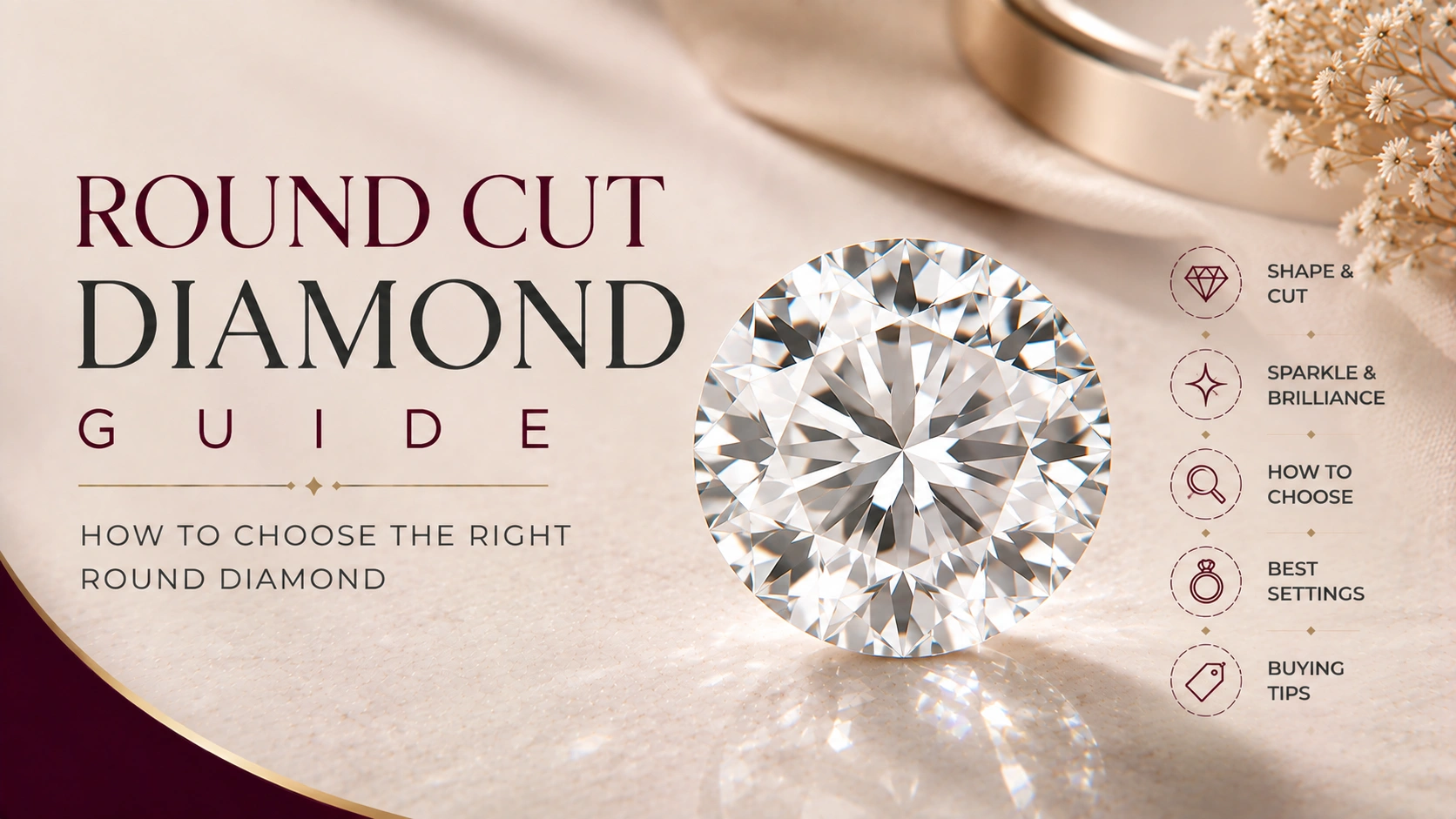
A round cut diamond is a circular diamond shape, most commonly seen in the round brilliant cut.
The modern round brilliant has 57 or 58 facets, depending on whether a culet is included. These facets are arranged across the table, crown, and pavilion to help return light to the viewer.
The result is the distinctive combination of:
- Brilliance: white light reflected back from the diamond
- Fire: flashes of spectral colors such as red, blue, and yellow
- Scintillation: flashes and patterns of light that appear as the diamond or light source moves
The round brilliant is particularly notable because it is the only standard diamond shape that receives an official GIA cut grade.
This makes round diamonds easier to compare than many fancy-shaped diamonds, where laboratories generally don’t provide the same standardized overall cut grade.
Why Are Round Diamonds So Popular?
Round diamonds have remained popular because they combine strong light performance with a timeless appearance.
Their symmetrical outline works with almost any engagement-ring design, including solitaire, halo, three-stone, pavé, cathedral, and vintage-inspired settings.
Another advantage is flexibility. A round diamond can look understated in a simple solitaire or dramatically larger when surrounded by a halo or accented with side stones.
The shape is also relatively forgiving when it comes to some color and clarity characteristics. Its numerous facets can help disguise small inclusions and some body color compared with diamond cuts that have large, open facets.
That doesn’t mean you should ignore color or clarity. It simply means you may have more flexibility in those areas when your primary goal is maximizing appearance.
Round Brilliant vs. Other Round Diamond Cuts
“Round” describes the shape, while round brilliant describes the cutting style.
Most shoppers looking for a modern round engagement-ring diamond are looking for a round brilliant.
There are also historical round cuts, including:
- Old European cuts
- Single cuts
- Eight cuts
These can have noticeably different facet patterns and visual personalities.
A modern round brilliant is generally the choice for someone who wants maximum brilliance and a contemporary, highly symmetrical appearance.
For historical alternatives, Diamiv’s collection also includes dedicated guides to other diamond cuts, including the old European cut diamond guide and single cut diamond guide.
How Do Round Diamonds Sparkle?
A round brilliant’s sparkle comes from the interaction between its facets, proportions, and the light entering the stone.
The major visual effects are:
Brilliance
Brilliance is the amount of white light returned to the viewer.
A well-cut round diamond can appear bright across much of its face, while a poorly cut stone can appear noticeably dull even if it has a high carat weight.
Fire
Fire refers to flashes of spectral colors produced when white light is dispersed by the diamond.
You may notice fire as small flashes of blue, red, yellow, or other colors as the stone moves.
Scintillation
Scintillation describes the flashes and patterns of light that appear as either the diamond, observer, or light source moves.
A visually attractive round diamond generally has a balanced pattern of bright and dark areas rather than large distracting dark zones.
This is why looking only at carat weight can be misleading. A heavier diamond isn’t automatically a more beautiful diamond.
The 4Cs of a Round Diamond
The four major quality factors are:
- Cut
- Color
- Clarity
- Carat weight
For a round brilliant, cut deserves particular attention because it has such a strong influence on the diamond’s light performance.
You can learn more about the broader grading system in the 4Cs of diamond quality guide.
1. Cut: The Most Important Factor to Watch
Cut describes how effectively a diamond has been fashioned to interact with light.
It is different from shape.
A round diamond’s shape is circular. Its cut quality describes how well its proportions and craftsmanship contribute to its appearance.
The GIA cut-grading system for standard round brilliant diamonds ranges from:
- Excellent
- Very Good
- Good
- Fair
- Poor
GIA’s system considers factors including face-up appearance, proportions, durability, polish, and symmetry.
What cut grade should you choose?
For most engagement-ring shoppers, Excellent or Very Good is a sensible starting point.
Excellent-cut diamonds are particularly attractive when maximum light performance is a priority.
However, don’t assume that every diamond within one grade will look identical. GIA notes that there isn’t one universal set of proportions that defines a well-cut round brilliant. Diamonds with different proportions can receive the same overall cut grade while producing somewhat different visual patterns.
That makes the actual diamond important, not just the grade printed on the report.
2. Color: How White Does a Round Diamond Need to Be?
Diamond color is graded from D to Z, with D representing the highest colorless grade.
For many shoppers, the most important question isn’t whether a diamond has the highest possible color grade. It’s whether the diamond looks white in the setting and lighting where you’ll wear it.
Round brilliant diamonds can be relatively forgiving with color because their brilliance can help reduce the visibility of subtle body color.
A practical starting point
G-H color can be an attractive balance between appearance and price for many buyers.
Higher grades such as D-F make sense if:
- You strongly prefer a very icy appearance
- You’re buying a larger diamond
- You’re using a setting where color is easier to notice
- Budget is less important than maximizing color grade
GIA notes that larger diamonds can reveal color more readily, so color becomes increasingly relevant as carat weight increases.
The metal color matters, too. White metals can make differences in diamond color more noticeable, while yellow or rose gold settings can provide additional visual warmth.
For more detail, see the best diamond color for an engagement ring guide.
3. Clarity: How Clean Does a Round Diamond Need to Be?
Clarity measures the presence of internal inclusions and external blemishes.
The GIA clarity scale ranges from:
- Flawless
- Internally Flawless
- Very, Very Slightly Included
- Very Slightly Included
- Slightly Included
- Included
For an engagement ring, you don’t necessarily need a Flawless or Internally Flawless diamond.
What matters most is whether the diamond looks eye-clean at normal viewing distance.
GIA notes that many diamonds graded VS2 or higher don’t have inclusions visible to the naked eye, while some SI1 diamonds can also appear eye-clean.
This creates an opportunity to save money by focusing on appearance rather than paying for a higher clarity grade that doesn’t produce a visible difference.
What should you look for?
Pay particular attention to:
- The location of inclusions
- Their size
- Their color
- Their type
- Whether they can be seen through the table
A small inclusion hidden near the edge may be much less noticeable than a similar inclusion directly beneath the table.
For a deeper look at clarity choices, see the best diamond clarity for an engagement ring guide.
4. Carat Weight: How Big Will a Round Diamond Look?
Carat measures weight, not visual diameter.
One carat equals 0.20 grams, but two diamonds with the same carat weight can have different face-up dimensions depending on how they are cut.
A poorly proportioned diamond can carry more weight in its depth without looking proportionally larger from above.
That’s why a well-cut 0.90-carat diamond can sometimes be a more attractive choice than a poorly cut 1.00-carat diamond.
Should you buy exactly 1 carat?
Not necessarily.
Popular benchmark sizes such as:
- 0.50 ct
- 1.00 ct
- 1.50 ct
- 2.00 ct
can carry pricing premiums because many shoppers specifically target those weights.
Buying just below a popular threshold may sometimes provide better value without creating a meaningful difference in visual size.
For example, a well-proportioned 0.90 or 0.95-carat diamond may be worth considering alongside a 1.00-carat stone rather than automatically choosing the round number.
If you’re deciding what size fits your budget, the best carat size for an engagement ring guide can help put the decision into context.
Round Diamond Proportions: What Should You Look For?
Round brilliant diamonds are often discussed in terms of measurements such as:
- Table percentage
- Depth percentage
- Crown angle
- Pavilion angle
- Girdle thickness
- Culet
- Symmetry
- Polish
These measurements influence how the diamond handles light.
However, there is an important distinction between using proportions as a screening tool and treating a specific set of numbers as a guarantee of beauty.
GIA’s research found that multiple proportion combinations can produce attractive round brilliant diamonds, and diamonds with different proportions can receive the same cut grade.
So don’t reject a diamond simply because it doesn’t match one internet-supplied “ideal” formula.
Instead, use the grading report and proportions to narrow your choices, then evaluate the actual diamond’s visual performance.
What Is an Ideal Cut Round Diamond?
You’ll often see terms such as:
- Ideal cut
- Super ideal
- Triple Excellent
- Hearts and Arrows
These terms aren’t interchangeable.
“Triple Excellent” commonly refers to a GIA diamond receiving Excellent grades for cut, polish, and symmetry.
“Super ideal” and similar marketing terms can have different meanings depending on the seller or grading laboratory.
The important thing is to identify who graded the diamond and what the stated grade actually represents.
A reputable grading report is more useful than relying solely on a retailer’s marketing label.
Best Settings for Round Diamond Engagement Rings
One reason round diamonds remain popular is that they work with almost every major engagement-ring style.
Solitaire
A solitaire places the round diamond at the center of attention.
It’s one of the simplest ways to showcase the symmetry and brilliance of the stone.
Halo
A halo surrounds the center diamond with smaller diamonds.
This can make the center stone appear larger and create additional sparkle around it.
Three-Stone
A round center diamond can be paired with two side stones.
This style provides a more substantial appearance while giving the center stone a strong focal point.
Pavé
Small diamonds set along the band add additional sparkle without competing heavily with the round center stone.
Cathedral
A cathedral setting raises the center diamond above the shoulders of the ring, often creating an elegant and traditional appearance.
Bezel
A bezel surrounds the diamond’s perimeter with metal.
It offers a more modern appearance and provides additional protection around the stone.
If you’re comparing setting designs, the hidden halo vs. solitaire ring guide can help with one of the most common style decisions.
How Many Prongs Should a Round Diamond Have?
Four- and six-prong settings are particularly common for round diamonds.
Four prongs
Four prongs can create a cleaner, more minimalist appearance and expose more of the diamond.
Six prongs
Six prongs provide additional security and create a more traditional look.
The choice is partly aesthetic and partly practical.
The shape of the prongs can also subtly influence how the round diamond appears. GIA notes that four-prong settings can make a round diamond look somewhat squarer from certain angles.
For more information about why settings use prongs, see why engagement rings have prongs.
Round Diamond Pros and Cons
Pros
Exceptional sparkle:
Round brilliant diamonds are designed specifically for strong light performance.
Timeless appearance:
The circular shape has remained popular across generations.
Highly versatile:
Round diamonds work with modern, classic, vintage, minimalist, and elaborate settings.
Easy to compare:
The round brilliant is the only standard diamond shape with a formal GIA cut grade.
Can be forgiving on color and clarity:
Its faceting can help conceal some characteristics that may be more visible in other shapes.
Cons
Often more expensive:
Round diamonds can command a premium compared with some fancy shapes.
More rough diamond is lost during cutting:
The circular outline typically requires more rough material to be removed than some shapes designed to maximize weight retention.
Popular rather than distinctive:
If you want an unusual or highly individual shape, a round diamond may feel too traditional.
Cut quality matters enormously:
A poor cut can significantly reduce the visual appeal of a round diamond.
Round vs. Princess Cut Diamonds
Round and princess diamonds offer very different visual personalities.
| Feature | Round Brilliant | Princess |
|---|---|---|
| Shape | Circular | Square or rectangular |
| Faceting | Brilliant | Brilliant |
| Sparkle | Very high | Very high |
| Style | Classic and versatile | Modern and geometric |
| Cut grading | Formal GIA cut grade | No equivalent overall GIA cut grade |
| Corners | No sharp corners | Four corners |
| Appearance | Soft and symmetrical | Crisp and angular |
If you’re deciding between the two, the princess cut vs. round cut diamond comparison is a natural next step.
Is a Round Diamond a Good Choice for an Engagement Ring?
For many shoppers, yes.
A round brilliant is particularly appealing if you want:
- Maximum sparkle
- A traditional engagement-ring appearance
- A shape that works with almost any setting
- A diamond that’s relatively easy to compare
- Strong resale-market recognition
- A classic look that is unlikely to feel dated
It may be less appealing if your priority is maximizing face-up size for your budget or choosing a less common shape.
The best diamond is ultimately the one that balances appearance, budget, durability, and personal style.
How to Get Better Value When Buying a Round Diamond
You don’t have to maximize every quality grade.
A better approach is to prioritize the characteristics that create a visible difference.
1. Prioritize cut
Don’t sacrifice cut simply to move up in carat weight.
2. Look for eye-clean clarity
If inclusions aren’t visible without magnification, paying for a much higher clarity grade may not improve the appearance enough to justify the cost.
3. Compare nearby carat weights
Don’t automatically assume that 1.00 carat is dramatically better than 0.95 carat.
4. Consider slightly lower color grades
A well-cut G or H diamond can appear very white while costing less than a D or E diamond.
5. Compare actual diamonds
Two diamonds with identical grading information can still have different visual appearances.
Whenever possible, examine videos or high-quality images and look for:
- Brightness
- Balanced contrast
- Even sparkle
- Dark areas
- Transparency
- Visible inclusions
- Face-up size
Round Diamond Buying Checklist
Before purchasing a round diamond, check the following:
- Is it a round brilliant?
- Does it have a reputable grading report?
- What is the cut grade?
- How are the polish and symmetry graded?
- Does the diamond look bright?
- Does it have distracting dark areas?
- Is the clarity eye-clean?
- Does the color suit your setting?
- Does the face-up size match its carat weight?
- Have you compared it with diamonds at nearby carat weights?
- Does the price make sense for its overall quality?
- Is the girdle appropriate for the setting and intended use?
- Does the diamond fit your preferred ring style?
Frequently Asked Questions
What is the most popular round diamond cut?
The round brilliant cut is the dominant modern round diamond style. It is designed around a symmetrical arrangement of facets that produces strong brilliance, fire, and scintillation.
Is round brilliant the same as round cut?
Not exactly. Round describes the diamond’s shape, while brilliant describes the faceting style. In engagement rings, “round cut” usually refers to a modern round brilliant diamond.
What is the best cut grade for a round diamond?
Excellent is generally the strongest GIA cut grade, while Very Good can also provide attractive light performance. The actual diamond should still be evaluated rather than relying on the grade alone.
Is 1 carat a good size for a round diamond?
One carat is a popular benchmark, but there is no universally correct carat size. Your budget, finger size, setting, and personal preferences matter more than reaching a specific number.
Is a round diamond more expensive than other shapes?
Often, yes. Round diamonds can carry a premium because of demand and the amount of rough material typically lost during cutting.
What color is best for a round diamond?
G-H can be a practical balance for many shoppers, while D-F may be preferable if you want a more strongly colorless appearance. The right choice also depends on carat size and ring-metal color.
What clarity should a round diamond have?
There is no single required clarity grade. The goal should be an eye-clean diamond at a sensible price rather than automatically choosing the highest clarity available.
Do round diamonds sparkle more than other diamond shapes?
Round brilliant diamonds are specifically designed for strong light performance and are widely regarded as exceptionally brilliant. Other shapes can also be highly sparkly, but their facet arrangements and visual patterns differ.
What setting looks best with a round diamond?
Round diamonds are unusually versatile. Solitaire, halo, three-stone, pavé, cathedral, bezel, and many vintage-inspired settings can all work well.
Final Takeaway
A round diamond is a strong choice if you want a timeless shape with exceptional sparkle and broad setting versatility.
The biggest mistake is focusing on carat weight alone. For a round brilliant, cut quality has a major effect on how much light the diamond returns and how attractive it looks.
Start with a well-cut stone, then balance color and clarity based on what you can actually see. Compare diamonds at nearby carat weights, review the grading report, and consider the setting before deciding how to spend your budget.
The goal isn’t to buy the diamond with the highest grades across every category. It’s to find a round diamond that looks beautiful to you while putting your money toward the qualities that make the biggest visible difference.