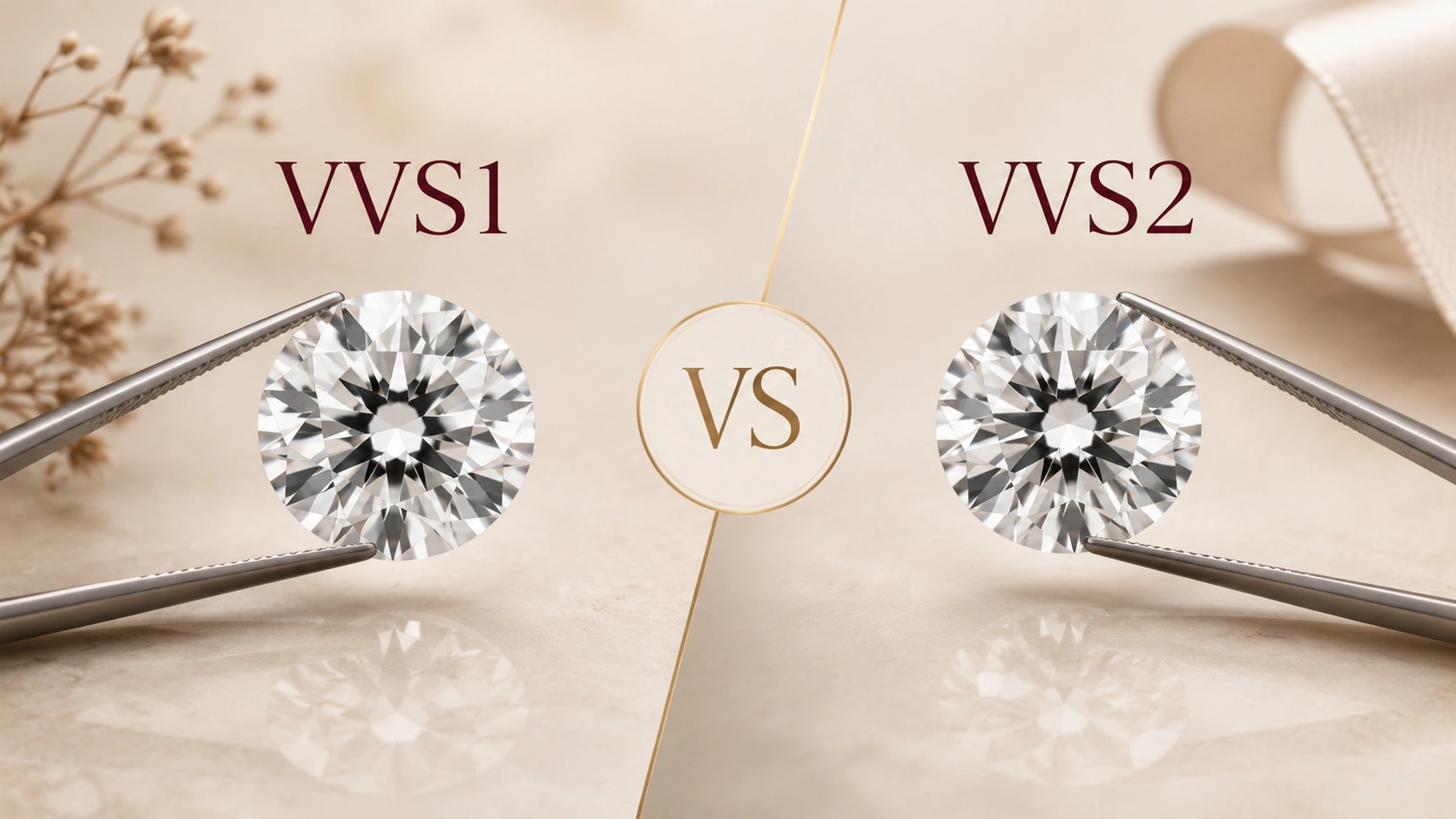
If you’re comparing VVS1 vs VVS2 diamonds, you’re already looking at two of the highest clarity grades available on the standard diamond clarity scale.
Both VVS1 and VVS2 fall into the Very, Very Slightly Included category. Their inclusions are extremely difficult for a skilled grader to see under 10× magnification. The difference between the two grades is subtle, and in most cases, neither will show visible inclusions to the naked eye.
So, is VVS1 actually worth paying more for?
Not necessarily.
For many engagement-ring shoppers, a well-selected VVS2 can provide essentially the same visible appearance as a VVS1 while costing less. On the other hand, VVS1 can make sense if you’re buying a large stone, a clarity-sensitive shape, or simply place a high value on having a higher clarity grade.
The important thing is to understand what you’re actually paying for.
You’re generally not paying for noticeably more sparkle. You’re paying for a higher clarity grade and greater rarity.
VVS1 vs VVS2 at a Glance
| Feature | VVS1 | VVS2 |
|---|---|---|
| Full name | Very, Very Slightly Included 1 | Very, Very Slightly Included 2 |
| Clarity category | VVS | VVS |
| Position | Higher | Lower |
| Inclusions under 10× | Extremely difficult to see | Very difficult to see |
| Naked-eye appearance | Typically eye-clean | Typically eye-clean |
| Sparkle difference | Not inherently greater | Not inherently lower |
| Price | Usually higher | Usually lower |
| Best for | Buyers prioritizing maximum clarity | Buyers wanting VVS quality with better value |
| Automatically worth the premium? | No | Often the value choice |
The biggest takeaway is simple:
VVS1 is technically higher clarity, but VVS2 can offer almost the same real-world appearance.
That distinction is important when you’re spending a significant amount on an engagement ring.
What Does VVS1 Diamond Clarity Mean?
VVS1 stands for Very, Very Slightly Included 1.
It sits near the top of the GIA clarity scale, below Flawless and Internally Flawless.
A VVS1 diamond contains extremely small clarity characteristics that are extremely difficult for a skilled grader to see under 10× magnification. The exact inclusion type, position, size, color, and relief all contribute to the final grade.
VVS1 diamonds can contain characteristics such as:
- Pinpoints
- Needles
- Internal graining
- Tiny clouds
- Very small feathers
- Other minute characteristics
The important point is that these characteristics are extremely difficult to locate during professional examination.
And if they’re difficult for an experienced grader to find under magnification, they’re certainly not something you’re normally going to notice while wearing the ring.
Is VVS1 a Good Clarity Grade?
Absolutely.
VVS1 is an exceptionally high clarity grade.
But there’s an important question to ask:
Do you need that level of clarity?
For most engagement-ring shoppers, the answer is no.
A VVS1 diamond can be an excellent choice if you personally value clarity, rarity, or the reassurance that comes with purchasing a very high clarity grade.
However, moving from VVS2 to VVS1 generally doesn’t create a dramatic visual improvement.
That’s because both grades are already extremely clean.
What Does VVS2 Diamond Clarity Mean?
VVS2 stands for Very, Very Slightly Included 2.
It is the second grade within the VVS category and sits immediately below VVS1.
The inclusions in VVS2 diamonds are still very difficult for a skilled grader to see under 10× magnification. They are simply somewhat easier to locate than the characteristics responsible for a VVS1 grade.
This is where many buyers misunderstand the grading system.
VVS2 does not mean the diamond has obvious flaws.
It is still an exceptionally high clarity grade.
A VVS2 diamond can appear completely clean without magnification.
In fact, the difference between a VVS1 and VVS2 may be practically irrelevant to someone wearing the diamond.
What Is the Difference Between VVS1 and VVS2?
The technical difference is relatively small.
Both grades belong to the same VVS category.
The distinction primarily comes down to the difficulty of seeing the diamond’s clarity characteristics under 10× magnification.
In simple terms:
- VVS1: inclusions are extremely difficult to see.
- VVS2: inclusions are very difficult to see.
The grading process considers factors such as the size, nature, position, color or relief, and quantity of clarity characteristics.
So the difference isn’t simply “VVS1 has fewer inclusions.”
An individual diamond’s characteristics and where they are located matter as well.
That’s why two diamonds with different VVS grades can sometimes look virtually identical in everyday viewing.
Can You See the Difference Between VVS1 and VVS2 With the Naked Eye?
In most cases, no.
This is probably the most important thing to understand before paying a premium for VVS1.
Both VVS1 and VVS2 diamonds are generally considered eye-clean because their clarity characteristics are extremely difficult to locate even under 10× magnification.
You won’t normally see the difference:
- Across a room
- While wearing the ring
- Under normal indoor lighting
- Outdoors
- In everyday photographs
- During normal conversation
- While looking at the ring on your hand
The distinction exists primarily at the grading level.
That’s why you shouldn’t assume that a VVS1 diamond will automatically look more beautiful than a VVS2.
Does VVS1 Sparkle More Than VVS2?
No, not simply because it has a higher clarity grade.
This is one of the most important concepts in diamond buying.
Clarity tells you about inclusions and blemishes.
Sparkle is strongly influenced by factors such as:
- Cut quality
- Proportions
- Faceting
- Symmetry
- Polish
- Light return
A VVS1 diamond with mediocre cut quality isn’t automatically going to outperform a beautifully cut VVS2 diamond.
In other words:
Higher clarity does not equal more sparkle.
If you’re trying to understand how cut affects a diamond’s visual performance, this diamond cut guide is a useful place to start.
You can also learn how clarity fits alongside cut, color, and carat in this guide to the 4Cs of diamond quality.
VVS1 vs VVS2 Price: Is VVS1 Worth Paying More For?
This is where the decision becomes much more interesting.
VVS1 generally commands a higher price than VVS2 when other major characteristics are comparable.
But the premium can vary significantly depending on:
- Carat weight
- Color
- Shape
- Cut quality
- Natural vs lab-grown origin
- Certification
- Market conditions
There isn’t one fixed percentage that applies to every VVS1 and VVS2 comparison.
The more important question is:
Can you actually see what you’re paying extra for?
If two diamonds look equally clean to you, the VVS2 may offer better overall value.
You could potentially use the savings toward:
- A larger diamond
- Better cut quality
- Higher color
- A different shape
- A more elaborate setting
- A higher-quality wedding band
This is particularly relevant because even differences between high clarity grades can produce substantial price differences despite being difficult or impossible to see without magnification. GIA notes that clarity differences that are difficult to detect visually can still have a meaningful effect on price.
Which Is Better: VVS1 or VVS2?
Neither is universally better for every buyer.
Choose VVS1 if:
- You want one of the highest clarity grades available.
- Clarity is one of your top priorities.
- You are comfortable paying the premium.
- You’re buying a large diamond and want additional clarity confidence.
- You’re considering a shape where clarity deserves extra scrutiny.
- You simply prefer the idea of owning a VVS1 diamond.
Choose VVS2 if:
- You want exceptional clarity without paying as much.
- The diamond is eye-clean.
- You would rather put your budget toward cut, carat, or color.
- You’re comparing two stones and can’t see a meaningful difference.
- You’re focused on overall value rather than the highest possible clarity grade.
For many shoppers, VVS2 is the more sensible choice.
That doesn’t make VVS1 a bad purchase.
It simply means you should understand that you’re paying for a grading distinction that may not create a visible difference.
When Is VVS1 Worth the Extra Money?
There are situations where VVS1 can make sense.
1. You’re Buying a Large Diamond
Larger diamonds deserve more careful clarity evaluation.
As the stone gets larger, clarity characteristics can become easier to examine because you have more diamond surface to observe.
That doesn’t mean VVS2 automatically becomes visibly inferior.
Rather, the individual stone becomes more important.
If you’re comparing a large VVS1 and VVS2 and the VVS1 has a particularly attractive inclusion profile, paying more may be reasonable.
2. You’re Choosing a Step-Cut Shape
Step-cut diamonds can deserve more careful clarity consideration.
Emerald and Asscher cuts use broad, open facets that can make certain inclusions easier to notice than they might be in a heavily faceted brilliant-cut diamond.
If you’re interested in how these faceting styles differ, compare step-cut and brilliant-cut diamonds.
For a clarity-sensitive shape, the extra margin offered by VVS1 can sometimes provide greater peace of mind.
3. You Want Maximum Clarity
Sometimes the reason is simply personal.
If owning a very high-clarity diamond is important to you and the additional cost doesn’t interfere with your other priorities, VVS1 can be perfectly reasonable.
Not every purchase has to be optimized solely for maximum value.
4. You’re Comparing Two Nearly Identical Stones
Suppose you find two diamonds with:
- Same shape
- Same carat weight
- Same color
- Similar cut
- Similar proportions
- Similar certification
One is VVS1 and one is VVS2.
If the VVS1 premium is relatively small, choosing it may make sense.
But if the difference is substantial, you should ask whether the higher grade actually improves your experience.
When Is VVS2 the Better Choice?
VVS2 often wins when the price difference is significant and both diamonds look equally clean.
Imagine this comparison:
Diamond A
- VVS1
- 1.00 carat
- G color
- Excellent cut
- Higher price
Diamond B
- VVS2
- 1.10 carats
- G color
- Excellent cut
- Lower price
If both are visually clean, many buyers would prefer the second stone.
Why?
Because the extra budget may have produced something you can actually see: more size.
The same principle applies to cut and color.
If paying for VVS1 forces you to compromise on an important visible characteristic, VVS2 may be the smarter overall purchase.
Does Diamond Shape Affect the Choice?
Yes.
Diamond shape can influence how you should approach clarity.
Round Brilliant
Round brilliant diamonds have numerous facets that can create strong visual activity.
A VVS2 round diamond is already an exceptionally clean choice.
For many shoppers, moving to VVS1 may provide little practical benefit.
Oval
Oval diamonds combine brilliance with an elongated outline.
The individual stone should still be evaluated rather than choosing clarity purely by grade.
You can learn more about how different diamond shapes compare in this diamond shape guide.
Cushion
Cushion diamonds can have different facet arrangements, so clarity should be evaluated on the actual stone.
A VVS2 cushion will generally provide an exceptionally clean appearance.
Emerald
Emerald cuts deserve more attention.
Their broad step facets can make certain inclusions easier to identify, particularly when they are positioned beneath the table.
This is one situation where a higher clarity grade can provide additional reassurance.
Asscher
Asscher cuts also use step-cut faceting.
As a result, clarity should be evaluated carefully instead of assuming that the grade alone tells the whole story.
VVS1 vs VVS2 for Lab-Grown Diamonds
The basic clarity principles apply to lab-grown diamonds as well.
A lab-grown diamond can have a VVS1 or VVS2 clarity grade, and the same fundamental distinction applies: the grade reflects the visibility of clarity characteristics under magnification.
The bigger question is whether paying more for VVS1 makes sense for your particular budget.
If you’re shopping for a lab-grown engagement diamond, you may have more flexibility to allocate your budget toward:
- Carat weight
- Cut quality
- Color
- Setting
- Overall ring design
If you’re comparing diamond types rather than just clarity, this guide to lab-grown, natural diamonds, and moissanite can help you understand the bigger picture.
VVS1 vs VVS2 for Natural Diamonds
For natural diamonds, the same buyer-focused approach applies.
VVS1 and VVS2 represent exceptionally high clarity grades, but clarity is still only one part of the diamond’s overall quality.
You should consider:
- Cut
- Color
- Carat
- Shape
- Clarity
- Certification
- Inclusion characteristics
- Price
If you’re choosing between two natural diamonds and one is VVS1 while the other is VVS2, don’t automatically assume the VVS1 is the better purchase.
Look at the actual stones.
A beautifully cut VVS2 may be a more satisfying purchase than a VVS1 that costs significantly more without giving you a visible advantage.
Does Carat Weight Change the Decision?
It can.
As diamond size increases, examining clarity becomes more important.
A tiny characteristic that is practically irrelevant in a smaller stone may deserve more attention in a much larger diamond.
However, carat weight isn’t the only factor.
The type, position, color, relief, and nature of the inclusion all matter. GIA’s grading system considers these characteristics when determining clarity.
If you’re still learning how carat weight affects diamond buying decisions, this diamond carat guide provides useful background.
What Should You Look for in a VVS2 Diamond?
Don’t assume that buying VVS2 means you can completely ignore the individual diamond.
You should still examine the stone.
Inclusion Type
Look at the characteristics identified on the grading report.
A VVS2 grade can result from different types of inclusions.
Inclusion Location
Location matters.
An inclusion in a less noticeable position may be easier to overlook than one positioned in a visually prominent area.
Inclusion Relief
The contrast between an inclusion and the surrounding diamond can influence how noticeable it is under magnification.
Diamond Shape
The same clarity characteristics can behave differently depending on the diamond’s faceting pattern.
High-Resolution Images
If you’re shopping online, inspect photographs, videos, and 360-degree views when available.
Don’t rely on the clarity grade alone.
Should You Choose VVS1 or VVS2 for an Engagement Ring?
For most engagement-ring shoppers, the better choice is the diamond that gives you the strongest combination of:
eye-clean appearance + excellent cut + suitable color + appropriate carat weight + sensible price.
That could be VVS1.
It could also be VVS2.
But because both grades are already extremely clean, VVS2 frequently offers a compelling balance between high clarity and price.
If the VVS1 premium is small and you personally value the higher grade, there’s nothing wrong with choosing VVS1.
But if choosing VVS1 means giving up carat weight or cut quality, VVS2 may be the better decision.
VVS1 vs VVS2 vs VS1
It helps to understand where these grades sit on the clarity scale.
From higher to lower clarity:
FL → IF → VVS1 → VVS2 → VS1 → VS2 → SI1 → SI2 → I1 → I2 → I3
VVS1 and VVS2 sit above the VS category.
GIA describes VVS1 and VVS2 as having inclusions that are difficult for a skilled grader to see at 10× magnification, while VS1 and VS2 contain minor inclusions ranging from difficult to somewhat easy to see under the same magnification.
This means a VVS2 is still significantly higher on the clarity scale than a VS2.
But here’s the interesting part:
A higher clarity grade doesn’t necessarily produce a proportionally better-looking diamond.
That’s why many buyers should consider whether moving from VS to VVS actually provides a visible benefit.
If you’re specifically comparing the two VS grades, you can also read this guide on VS1 and VS2 clarity to understand where that category fits into the overall scale.
VVS1 vs VVS2 vs VVS Clarity: What Are You Really Paying For?
This is perhaps the most useful way to think about the decision.
When you move from VVS2 to VVS1, you’re generally not buying:
- More sparkle
- More brilliance
- A visibly cleaner diamond
- A dramatically different appearance
Instead, you’re paying for:
- A higher clarity grade
- Greater rarity
- A smaller or more difficult-to-locate clarity characteristic
- Personal preference
- Additional grading confidence
That’s perfectly legitimate.
But it’s important to understand the difference between rarity and visible beauty.
A diamond can be rarer without looking noticeably different.
Common Mistakes When Comparing VVS1 and VVS2
Mistake 1: Assuming VVS1 Sparkles More
Clarity and sparkle are not the same thing.
Cut quality has a much more direct influence on light performance.
Mistake 2: Assuming VVS2 Isn’t “Clean Enough”
VVS2 is already an exceptionally high clarity grade.
It’s not a compromised clarity grade.
Mistake 3: Paying a Large Premium Without Comparing Stones
If two diamonds look equally clean, don’t automatically assume the higher grade is worth a large premium.
Mistake 4: Ignoring Cut
A high clarity grade cannot rescue mediocre cut quality.
Mistake 5: Focusing Only on the Certificate
The grading report is important, but you should still evaluate the individual stone.
Mistake 6: Treating Every Shape the Same
An emerald-cut diamond may require a different clarity strategy from a round brilliant.
How to Decide Between VVS1 and VVS2
Use this simple process before making your decision.
Step 1: Set Your Budget
Know your maximum budget before getting emotionally attached to a particular clarity grade.
Step 2: Choose Your Shape
Decide whether you’re looking for a round, oval, cushion, emerald, princess, or another shape.
Step 3: Prioritize Cut
For brilliant-cut diamonds, don’t sacrifice cut quality just to reach VVS1.
Step 4: Compare Actual Diamonds
Look at the stones rather than comparing only the certificates.
Step 5: Compare the Price Difference
Ask yourself how much extra you’re paying to move from VVS2 to VVS1.
Step 6: Ask What the Extra Money Could Buy
Could the same budget give you:
- More carat weight?
- Better color?
- Better cut?
- A better setting?
- A more desirable shape?
Step 7: Decide Whether the Higher Grade Matters to You
If clarity itself is important, VVS1 may be worth it.
If overall value matters more, VVS2 may be the better choice.
Final Verdict: VVS1 or VVS2?
For most engagement-ring shoppers, VVS2 is the better value when the individual diamond is well-cut and visually clean.
VVS1 offers a higher clarity grade and can make sense for buyers who prioritize maximum clarity, are purchasing a larger or clarity-sensitive diamond, or simply prefer owning a higher-grade stone.
But don’t confuse a higher clarity grade with more sparkle.
The best diamond isn’t necessarily the one with the highest clarity grade.
It’s the one that gives you the best combination of:
beauty + cut quality + size + color + clarity + price.
If a VVS2 diamond looks just as good to you as a VVS1, the lower grade may leave more money available for characteristics you can actually see.
And if the VVS1 premium fits comfortably within your budget and gives you greater satisfaction, there’s nothing wrong with choosing it.
The goal isn’t to buy the highest clarity possible.
The goal is to buy the diamond that gives you the appearance and confidence you want at a price that makes sense.
For a broader understanding of clarity grades, see this guide to understanding diamond clarity.
Frequently Asked Questions
Is VVS1 better than VVS2?
Yes, VVS1 is technically the higher clarity grade. Its inclusions are more difficult for a skilled grader to see under 10× magnification. However, the visual difference between VVS1 and VVS2 is usually not noticeable to the naked eye.
Is VVS2 good enough for an engagement ring?
Absolutely. VVS2 is an exceptionally high clarity grade and can be an excellent choice for an engagement ring. For many buyers, it offers a better balance between clarity and price than VVS1.
Can you see the difference between VVS1 and VVS2?
Usually not without magnification. Both grades contain characteristics that are very difficult to see under 10× magnification, and they are generally eye-clean.
Does VVS1 sparkle more than VVS2?
No. A higher clarity grade does not automatically create more sparkle. Cut quality, proportions, faceting, symmetry, and light performance are much more important factors.
Is VVS1 worth the extra money?
It can be, but not automatically. If you value maximum clarity and the premium fits comfortably within your budget, VVS1 can make sense. Otherwise, VVS2 may provide better overall value.
Is VVS2 better value than VVS1?
For many buyers, yes. Because both grades are exceptionally clean, VVS2 can provide a very similar everyday appearance while costing less.
Is VVS1 good for a 1-carat diamond?
Yes. VVS1 is more than sufficient for a 1-carat diamond. However, you should still compare its price against VVS2 and consider whether the additional money would be better spent on cut, color, or another characteristic.
Is VVS2 good for a large diamond?
Yes, but larger diamonds deserve more careful individual inspection. The type and location of clarity characteristics matter, particularly for shapes with broad, open facets.
Should I choose VVS1 or VVS2 for a lab-grown diamond?
The same principles apply. Compare the actual stones and determine whether the VVS1 premium is worthwhile. Depending on your budget, you may prefer putting the difference toward carat weight, cut, color, or the setting.
Does VVS1 have better resale value than VVS2?
You shouldn’t choose VVS1 solely for expected resale value. Resale depends on the complete diamond and market conditions, not just one clarity grade.
Should I prioritize VVS clarity over diamond cut?
Generally, no. If moving to VVS1 forces you to compromise on cut quality, a well-cut diamond with a lower clarity grade may be the better purchase. Clarity should be evaluated as part of the complete diamond rather than in isolation.