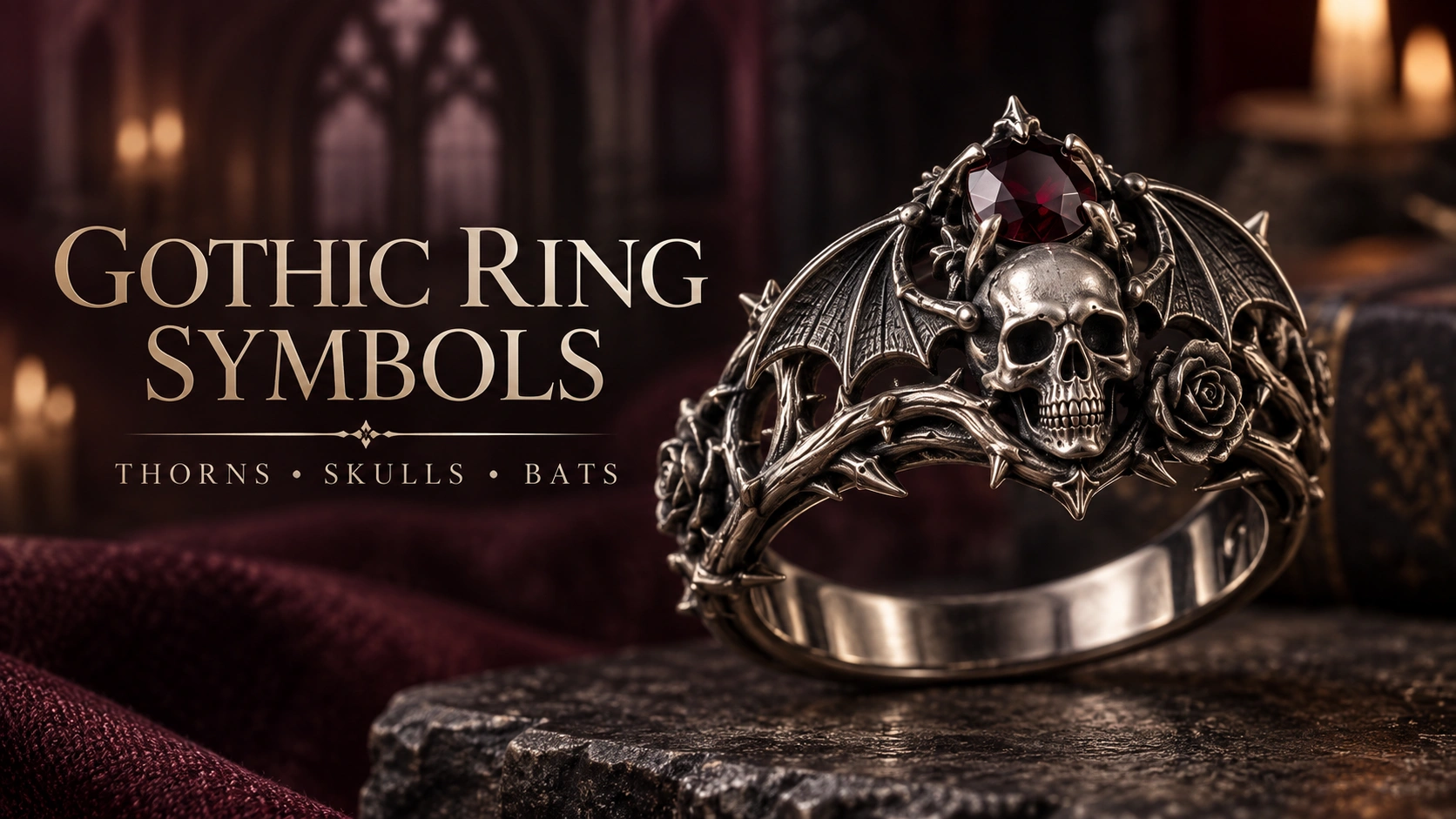
Gothic rings are often recognized by their dark metals, dramatic details, and unusual motifs. But the symbols themselves can carry just as much meaning as the design.
A skull can represent mortality or remembrance. Thorns can suggest love that survives pain. A bat can evoke the night, mystery, transformation, or the gothic fascination with the unknown. Roses, serpents, crosses, coffins, ravens, and other motifs can add another layer of meaning.
Importantly, gothic ring symbolism isn’t a universal dictionary. The same symbol can mean different things depending on its historical context, the design surrounding it, and what the wearer wants it to represent.
That flexibility is part of what makes gothic rings especially interesting for engagement rings and other meaningful jewelry.
What Do Gothic Ring Symbols Mean?
Gothic jewelry has a recognizable visual vocabulary built around darkness, mystery, mortality, romance, religion, nature, and the supernatural. Common motifs include skulls, bats, crosses, spiders, serpents, roses, and other macabre or symbolic imagery.
Some of these associations have genuine historical roots.
For example, skull imagery has a long connection with memento mori, a tradition centered on remembering mortality. Museums document memento mori rings from the Renaissance and later periods featuring skulls, skeletons, coffins, and inscriptions reminding the wearer of life’s temporary nature.
Modern gothic jewelry builds on that history but doesn’t have to reproduce it literally. A contemporary wearer might choose a skull because it represents remembrance, resilience, individuality, or simply a love of gothic aesthetics.
The meaning ultimately depends on the wearer.
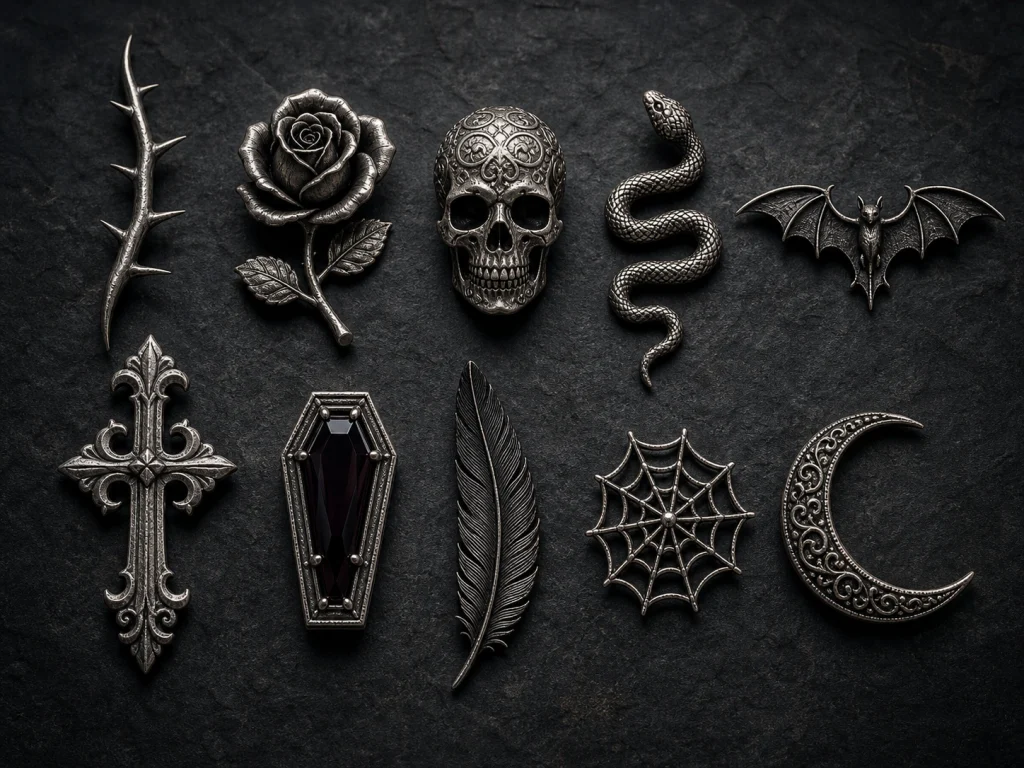
Gothic Ring Symbols at a Glance
| Gothic symbol | Common associations | Possible romantic meaning |
|---|---|---|
| Thorns | Protection, pain, endurance | Love that survives hardship |
| Skull | Mortality, remembrance, memento mori | Love beyond a lifetime |
| Bat | Night, mystery, transformation | Embracing an unconventional love |
| Rose | Beauty, passion, imperfection | Deep romantic love |
| Snake | Eternity, renewal, transformation | Everlasting commitment |
| Cross | Faith, devotion, spirituality | Shared beliefs or devotion |
| Coffin | Mortality, permanence, gothic identity | “Until death” commitment |
| Raven | Mystery, intelligence, transition | A bond with depth and individuality |
| Spider/web | Fate, creativity, connection | Two lives woven together |
| Moon | Cycles, mystery, change | Love through different seasons of life |
These are common interpretations rather than universal meanings. The same symbol can communicate something completely different to another wearer.
Thorn Rings: Love, Pain & Protection
Thorns are one of the most natural symbols for gothic romance because they combine two seemingly opposite ideas: beauty and danger.
A thorn can protect something beautiful while also causing pain. That makes thorn motifs particularly appropriate for people who see love as something powerful but not necessarily effortless.
In a ring, thorns may appear as:
- A thorn-covered band
- A crown of thorns
- Thorn details surrounding a gemstone
- Thorn-and-rose designs
- Twisted thorn-like metalwork
For an engagement ring, the symbolism can become especially personal.
A thorn band might represent protecting a relationship, surviving difficult periods, or accepting that lasting love can require strength and resilience.
A thorn motif doesn’t have to mean suffering. It can simply represent boundaries, protection, and the idea that something precious deserves to be guarded.
Skull Rings: Mortality, Remembrance & Living Fully
The skull is probably the most recognizable gothic ring symbol.
At first glance, it may seem to represent death alone. Historically, however, skull imagery in jewelry has often had a more reflective purpose.
Memento mori jewelry emerged prominently during the Renaissance, using images of death and decay to remind people of life’s temporary nature. The Metropolitan Museum of Art notes that memento mori jewelry encouraged viewers to reflect on mortality and the fleeting nature of earthly life.
Historical rings provide direct evidence of this tradition. The British Museum has several documented memento mori rings featuring skulls, including a 16th-century gold signet ring and 17th-century examples.
The skull can therefore communicate ideas such as:
- Remembering that life is finite
- Living intentionally
- Remembrance of someone who has died
- Acceptance of mortality
- Defiance of conventional ideas of beauty
- The connection between love and life’s impermanence
For an engagement ring, the most romantic interpretation may be love that matters precisely because life is temporary.
The symbolism becomes even more interesting when a skull is paired with a heart, rose, diamond, or hidden engraving. The Met documents a historic skull ring containing a concealed ruby, creating a visual relationship between love and death.
For another perspective on this motif, see our guide to skull engagement ring meaning.
Bat Rings: Night, Mystery & Transformation
Bats are closely associated with gothic aesthetics because they belong to the nighttime world that has become central to gothic visual culture.
In gothic jewelry, bats can suggest:
- The night
- Mystery
- The unknown
- Independence
- Transformation
- Vampire and supernatural imagery
Their meaning is often more atmospheric than philosophical.
A bat ring can simply communicate that the wearer is drawn to nighttime, mystery, alternative culture, or supernatural aesthetics.
For an engagement ring, a bat can also represent choosing a relationship outside conventional expectations.
A small bat detail can create a gothic mood without making the entire ring look theatrical. This can work particularly well when combined with a dark gemstone or delicate vintage-style metalwork.
Rose Rings: Beauty, Passion & Imperfection
Roses are not exclusively gothic, but they become much darker and more dramatic when combined with gothic design.
A rose can symbolize:
- Love
- Passion
- Beauty
- Romance
- Fragility
- The contrast between beauty and pain
Adding thorns changes the visual message.
A rose without thorns can feel traditionally romantic. A rose surrounded by thorns feels more complicated, suggesting that love can be beautiful and difficult at the same time.
Blackened metal, dark gemstones, or detailed engraving can push the rose toward a gothic-romantic aesthetic without losing its connection to traditional engagement-ring symbolism.
Snake Rings: Eternity, Renewal & Transformation
Snake rings have a long history in jewelry and can carry several overlapping meanings.
The snake’s ability to shed its skin naturally lends itself to ideas of:
- Renewal
- Transformation
- Rebirth
- Continuity
- Eternity
A snake wrapped around a band is particularly effective because the animal can visually form a continuous circle.
For an engagement ring, that makes the snake an interesting alternative to more traditional eternity symbolism. Instead of simply representing an endless circle, the snake can suggest a relationship that continually changes while remaining connected.
Snake symbolism can also have associations with temptation, danger, wisdom, or spirituality depending on the cultural and religious context.
That’s why it is better to look at the complete design rather than assigning one automatic meaning to the motif.
Crosses & Religious Gothic Symbols
Crosses are another major part of gothic jewelry, but their interpretation requires more care because the symbol has strong religious significance.
A cross can represent:
- Christian faith
- Devotion
- Sacrifice
- Protection
- Spiritual identity
Within gothic fashion, crosses may also be heavily stylized or combined with darker imagery. That can create a tension between traditional religious symbolism and alternative aesthetics.
If you’re choosing a gothic engagement ring featuring a cross, the most important question is what you want the symbol to communicate.
For one couple, it may represent shared faith. For another, it may simply be an architectural or historical reference.
Coffin & Skeleton Symbols
Coffins and skeletons push gothic symbolism toward its most explicit association with mortality.
But these motifs can still have a surprisingly romantic interpretation.
Historic jewelry demonstrates that death and love were not always treated as opposing themes. The British Museum documents coffin jewelry combining skeleton imagery with symbols of love, including clasped hands.
That tradition helps explain why modern gothic engagement rings can use imagery such as:
- Coffins
- Skeletons
- Crossed bones
- Death’s heads
- Hourglasses
For some couples, these symbols express the idea of commitment until death rather than an obsession with death itself.
That interpretation is especially relevant when choosing a gothic engagement ring with a darker romantic aesthetic.
You can explore the related symbolism in our guide to coffin ring meaning.
Raven, Spider & Other Gothic Symbols
Gothic ring symbolism extends well beyond the most familiar skulls and bats.
Ravens
Ravens often evoke:
- Mystery
- Intelligence
- Death
- Prophecy
- The unknown
They work particularly well for gothic designs influenced by literature and dark romanticism.
Spiders and Webs
Spider and web motifs can suggest:
- Fate
- Creativity
- Connection
- Patience
- Mystery
A web can be especially interesting as a metaphor for a relationship because individual threads become stronger through connection.
Moon & Stars
Celestial motifs can soften a gothic ring while keeping its mysterious character.
The moon can suggest:
- Cycles
- Change
- Mystery
- Night
- Emotional depth
Stars can add themes of guidance, destiny, and the idea of finding someone who feels uniquely significant.
Coffins and Hourglasses
These motifs reinforce the memento mori side of gothic design.
An hourglass emphasizes the passage of time, while a coffin makes mortality explicit. Together with a romantic symbol such as a rose or heart, they can create a visual statement about love existing within the limited time of human life.
Gothic Symbols Don’t Have One Fixed Meaning
One of the biggest mistakes when interpreting gothic jewelry is assuming every symbol has exactly one definition.
A skull does not automatically mean someone is fascinated by death.
A bat does not automatically mean someone identifies with vampires.
A cross does not automatically tell you the wearer’s religious beliefs.
And a thorn does not necessarily mean suffering.
Symbols accumulate meanings through history, culture, fashion, religion, literature, and personal experience.
Even historical rings show this complexity. Memento mori rings could be connected to mourning, devotion, remembrance, or broader reflections on mortality.
That is why the best way to interpret a gothic ring is to consider the entire design and the person wearing it.
How to Choose a Gothic Ring Symbol
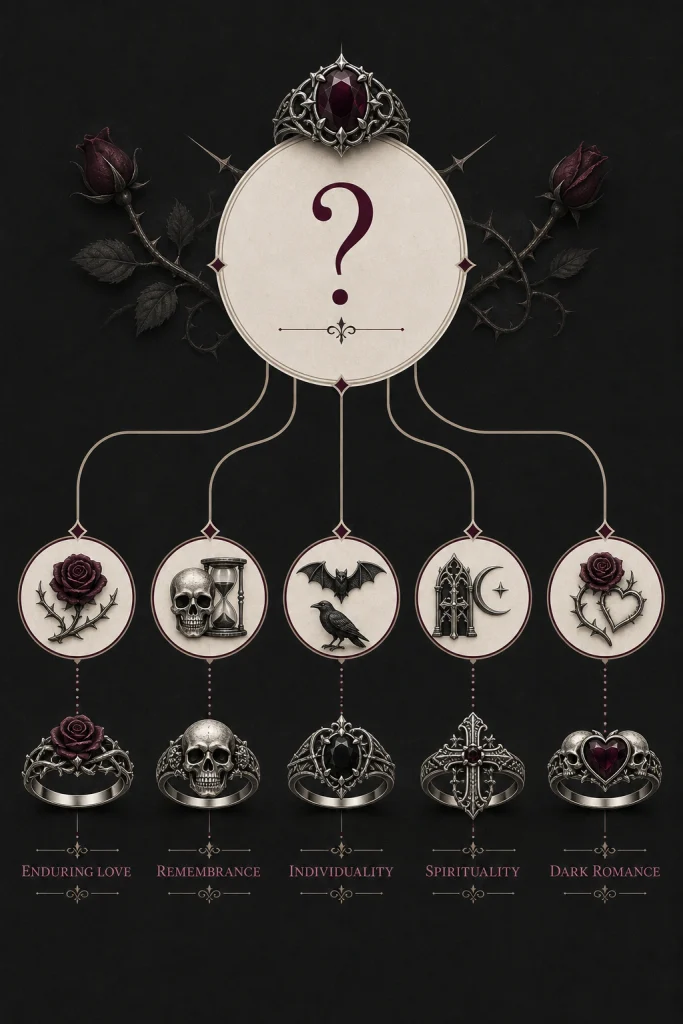
If you’re choosing a gothic ring because you want the symbolism to mean something, start with the message rather than the appearance.
For enduring love
Consider:
- Thorns
- Roses
- Snakes
- Eternity-inspired designs
These can communicate permanence, passion, resilience, or continuity.
For remembrance
Consider:
- Skulls
- Skeletons
- Hourglasses
- Coffin motifs
These work particularly well when the ring has a personal connection to someone or something you want to remember.
For individuality
Consider:
- Bats
- Ravens
- Spiders
- Unusual architectural details
These symbols make the ring feel more alternative without necessarily making it overtly macabre.
For spirituality
Consider:
- Crosses
- Gothic cathedral-inspired details
- Angels
- Celestial motifs
The specific interpretation will depend heavily on your personal beliefs.
For dark romance
Consider combining contrasting motifs.
For example:
- Rose + thorns
- Skull + heart
- Black diamond + floral details
- Coffin + gemstone
- Snake + gemstone
- Bat + moon
The contrast is often what makes gothic symbolism feel romantic rather than simply dark.
Gothic Symbols in Engagement Rings
Gothic symbolism can work particularly well in engagement rings because an engagement ring already carries a powerful symbolic role.
Instead of choosing a ring only for its shape or gemstone, you can use its details to tell a story.
A couple might choose a thorn motif because their relationship survived difficult circumstances. Someone might choose a skull because the design represents living fully together. Another person might choose a bat simply because nighttime and gothic culture are part of their identity.
This is one reason gothic engagement rings don’t have to look like costume jewelry.
A subtle gothic ring might use:
- Cathedral-inspired filigree
- Darkened metal details
- A single thorn motif
- A rose-cut diamond
- A black diamond
- Marquise or coffin-inspired geometry
- Hidden engraving
For more background, our gothic engagement ring guide covers the broader style, while what makes an engagement ring gothic focuses on the design characteristics that create the aesthetic.
You can also compare different directions with gothic vs. alternative engagement rings or explore gothic engagement rings for nontraditional brides.
How to Make Gothic Symbolism Feel Elegant
You don’t need every gothic symbol on the same ring.
In fact, restraint often makes symbolic jewelry feel more sophisticated.
A single thorn running along a band can be more effective than covering the entire ring in skulls, bats, crosses, and spiders.
Likewise, a subtle black diamond paired with delicate gothic filigree can create a darker mood without making the ring look like a costume piece.
Consider balancing:
One strong symbol + refined metalwork + an intentional gemstone
rather than:
Every gothic symbol at once.
For example, a marquise diamond with thorn-like prongs can create a gothic impression through shape and structure alone. A black diamond with architectural detailing can create a darker look without relying on an obvious skull motif.
If you’re considering a black center stone, our black diamond engagement ring guide is a useful next step.
Frequently Asked Questions
What is the most common gothic ring symbol?
The skull is one of the most recognizable gothic jewelry motifs. Its historical connection to memento mori gives it a deeper meaning than simply representing death.
What does a skull ring symbolize?
A skull ring can symbolize mortality, remembrance, living intentionally, or rebellion against conventional ideas of beauty. Its meaning depends on the historical and personal context.
What do thorn rings symbolize?
Thorns commonly suggest protection, endurance, pain, or the relationship between beauty and hardship. When paired with roses, they can represent romantic love that includes both beauty and difficulty.
What does a bat ring mean?
A bat ring often evokes nighttime, mystery, transformation, supernatural imagery, and gothic identity. It can also simply be an aesthetic choice for someone attracted to nocturnal or alternative imagery.
Are gothic rings appropriate for engagement rings?
Yes. Gothic engagement rings can be meaningful choices for couples who want something outside traditional bridal styles. Symbolic details can make the ring feel personal rather than simply unconventional.
Do gothic rings always symbolize death?
No. Death and mortality are important themes within gothic jewelry, particularly through memento mori imagery, but gothic symbolism also includes romance, spirituality, nature, transformation, mystery, individuality, and beauty.
Can a gothic ring be elegant?
Absolutely. Gothic design can be subtle. Filigree, architectural details, dark gemstones, unusual diamond shapes, and restrained symbolic elements can create an elegant gothic aesthetic without making the ring overly theatrical.
Final Thoughts
Gothic ring symbolism is most interesting when you look beyond the surface.
A skull can represent mortality, but it can also represent remembrance and living fully. Thorns can represent pain, but they can also represent protection and endurance. A bat can represent darkness, yet it can also represent mystery, independence, and transformation.
And when these symbols become part of an engagement ring, they can take on an even more personal meaning.
The best gothic ring isn’t necessarily the one with the most dramatic symbols. It’s the one where the design, symbolism, gemstone, and story behind the ring all make sense together.
Whether that means a thorn-wrapped band, a subtle skull, a nocturnal bat, a dark rose, or a completely unconventional combination, gothic jewelry gives couples room to define commitment on their own terms.