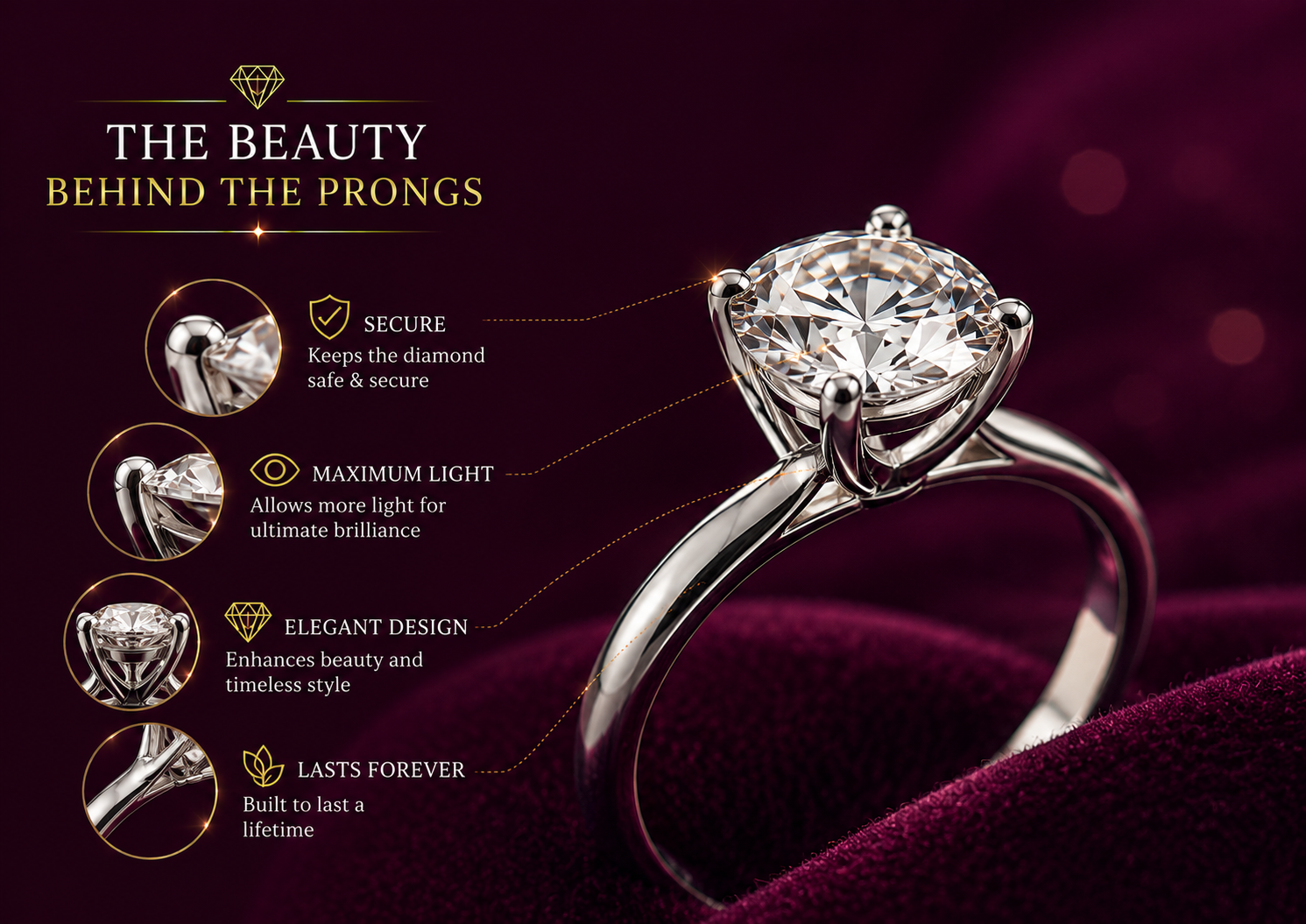
If you look closely at an engagement ring, you’ll usually see small pieces of metal holding the center diamond in place. These are called prongs, and they play an important role in both the security and appearance of the ring.
So, why do engagement rings have prongs?
Engagement rings have prongs to hold the center stone securely while leaving much of the diamond exposed. This open design lets you see more of the stone and allows light to reach it from multiple directions, while the prongs grip the diamond around its edge.
Prongs are especially common because they offer a practical balance between stone security, diamond visibility, and a lightweight appearance. However, they are not the only way to secure a diamond, and the right setting depends on the diamond’s shape, size, and how the ring will be worn.
What Are Prongs on an Engagement Ring?
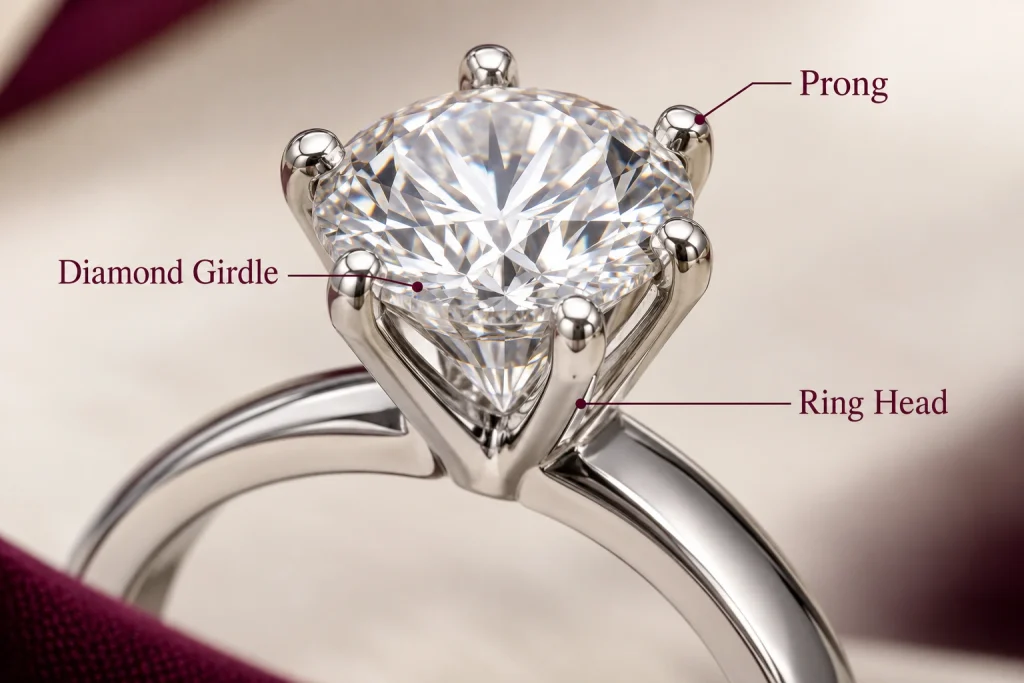
Prongs are small metal supports that extend upward from the ring’s setting and bend over the edge of the diamond or gemstone.
Think of them as small metal claws holding the stone in position.
Most traditional engagement rings use four or six prongs, although other designs can use different numbers or specialized prong shapes. The prongs grip the diamond around its girdle, keeping the stone seated inside the ring’s head.
The head is the part of the mounting that holds the center stone. It can use prongs, a bezel, or another type of setting to secure the gemstone.
Prongs are therefore not just decorative details. They are part of the ring’s structural system.
Why Do Engagement Rings Use Prongs?
There are three main reasons prongs are so common.
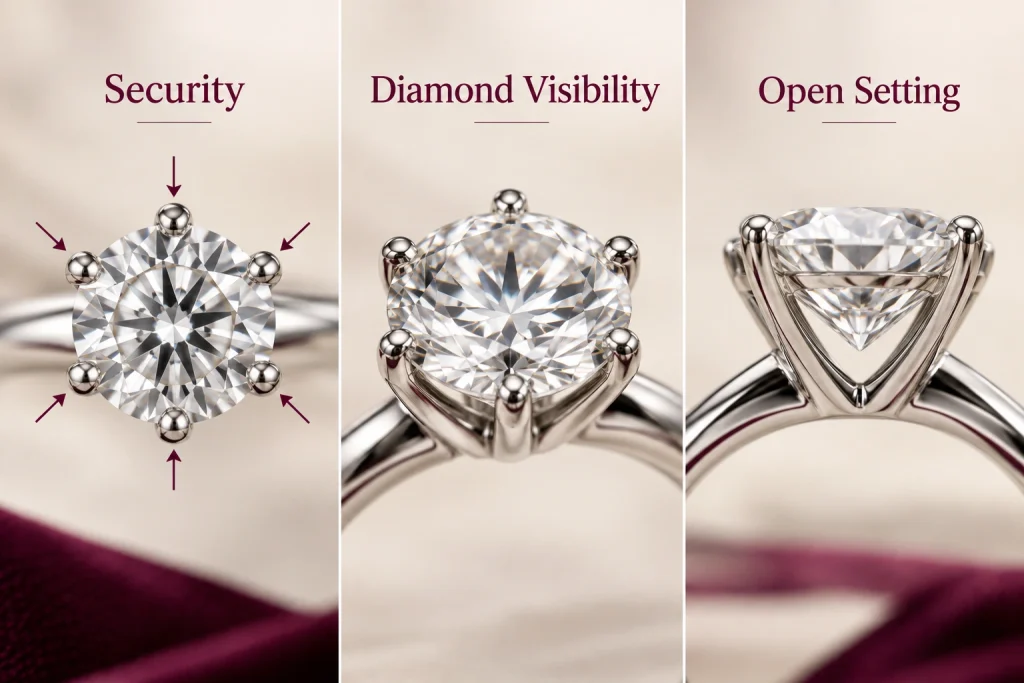
1. They Hold the Diamond Securely
The most important job of a prong is to keep the center stone from moving or falling out.
The diamond rests against specially shaped seats in the setting, while the prongs are positioned over parts of the stone’s edge. When properly made and maintained, this creates a secure mechanical hold.
This matters because even a very durable diamond can still be damaged or lost if its setting is compromised.
GIA describes prongs as narrow metal supports that hold gemstones in their mountings, commonly using four or six prongs.
2. They Leave More of the Diamond Visible
Unlike a bezel setting, which surrounds the diamond’s edge with a continuous rim of metal, prongs cover only small sections of the stone.
That means more of the diamond’s outline remains visible.
This is particularly useful for engagement rings where the center diamond is meant to be the visual focus. A relatively small amount of metal can secure the stone without surrounding it with a heavy-looking border.
3. They Allow an Open Setting Design
Because prongs use relatively little metal around the stone, they create an open appearance.
This can make the center diamond look more prominent and lets you see more of its shape from different angles.
The open construction can also make cleaning and inspecting the stone easier because more of the diamond is accessible.
Do Prongs Make a Diamond Sparkle More?
Not directly.
This is an important distinction.
A diamond’s brilliance and sparkle are primarily determined by its cut quality, rather than simply by whether it has four, six, or another number of prongs. GIA specifically notes that the number of prongs does not determine a diamond’s sparkle.
However, a prong setting can leave more of the diamond exposed than some other setting styles.
So it is more accurate to say:
Prongs can help showcase a diamond’s brilliance by minimizing the amount of metal covering the stone, but they do not improve the diamond’s cut.
This is one reason prong settings are so popular for solitaire engagement rings.
How Do Prongs Hold a Diamond?
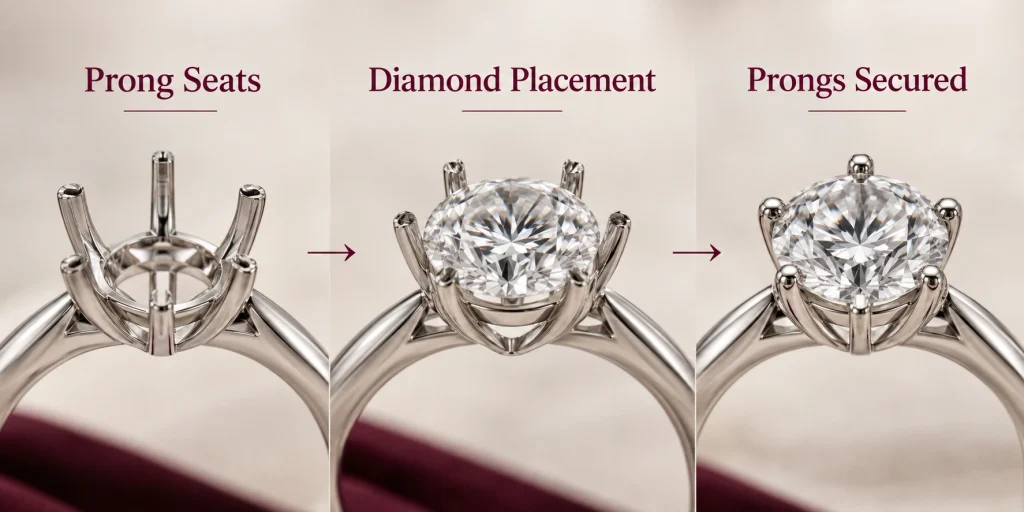
A prong setting isn’t simply a diamond glued into a ring.
The setting is carefully prepared so the diamond rests in the correct position. Small seats or grooves are made in the prongs or setting, allowing the stone to sit securely.
The jeweler then positions and shapes the prongs over the edge of the diamond.
The goal is to create enough pressure to hold the stone securely without putting unnecessary stress on it.
Because the setting process requires precision, the quality of the craftsmanship matters just as much as the basic design.
Four Prongs vs. Six Prongs
Four- and six-prong settings are two of the most common options you’ll encounter.
Four-Prong Settings
A four-prong design uses four points of contact around the stone.
Its main visual advantage is that there is less metal around the diamond. This can create a clean, open appearance and leave more of the stone visible.
Four prongs can also work particularly well with square or rectangular diamond shapes because the positioning of the prongs can complement the shape.
The trade-off is redundancy.
If one prong becomes damaged, there are fewer remaining prongs supporting the stone than there would be in a six-prong design.
Six-Prong Settings
Six prongs provide two additional points of support.
GIA notes that six-prong settings can offer greater security than four-prong settings and provide additional protection around the diamond’s girdle.
Six prongs are particularly associated with round diamonds and classic solitaire designs.
They also create a slightly different visual effect. Because the prongs are distributed around the stone, they can emphasize the round outline of a round brilliant diamond.
If you want to compare the two designs in more detail, see the guide to four prongs vs. six prongs.
Do More Prongs Always Mean a Safer Ring?
Not necessarily.
Adding more prongs can provide additional points of support, but the quality and condition of the setting still matter.
A poorly made or badly worn six-prong setting isn’t automatically safer than a properly constructed four-prong setting.
The prongs need to be appropriately sized and positioned for the specific stone. They also need to remain in good condition throughout the life of the ring.
This is why regular inspection is important.
Do All Engagement Rings Have Prongs?
No.
Prongs are common, but they are only one way of securing a center stone.
Other setting types include:
- Bezel settings
- Tension settings
- Channel settings
- Pavé settings
- Flush settings
- Bead settings
A bezel setting, for example, uses a rim of metal around the stone rather than individual prongs.
That gives the diamond’s edge more protection from accidental impacts, but it also covers more of the stone.
The choice is therefore not simply about which setting is “better.” Different designs prioritize different combinations of security, visibility, style, and wearability.
What Types of Prongs Are Used on Engagement Rings?
Not all prongs look the same.
Claw Prongs
Claw prongs have pointed tips that resemble small claws.
They are popular because their narrow shape can create a delicate, refined appearance while leaving much of the diamond visible.
Rounded Prongs
Rounded prongs have smoother, dome-like tips.
They tend to have a softer, more traditional appearance and can be less likely to catch on clothing than sharply pointed tips.
For a closer comparison, see claw prongs vs. rounded prongs.
V-Prongs
V-prongs are designed to protect pointed corners or tips.
They are particularly useful for diamond shapes such as pear, marquise, princess, and heart cuts, where exposed corners can be more vulnerable to damage.
For example, a pear-shaped diamond has a pointed tip that needs careful protection. V-prongs can sit over that point and help shield it.
You can learn more about V-prongs for pear diamonds and V-prongs for marquise diamonds.
Double Prongs
Double prongs use two closely positioned prongs in an area where a single prong might otherwise be used.
They can provide additional support and are sometimes used for larger stones or particular diamond shapes.
Are Prong Settings Good for Everyday Wear?
They can be, provided the setting is properly designed and maintained.
The main consideration is that the diamond is relatively exposed.
That is part of the appeal of a prong setting, but it also means the prongs themselves can be exposed to knocks, friction, and everyday wear.
GIA notes that prong settings should be checked periodically and that raised prongs can sometimes catch on fabrics.
If you regularly work with your hands, participate in activities that could impact the ring, or frequently catch the ring on clothing, the setting deserves particular attention.
A lower-profile or more protective setting may also be worth considering depending on your lifestyle.
Can Engagement Ring Prongs Break?
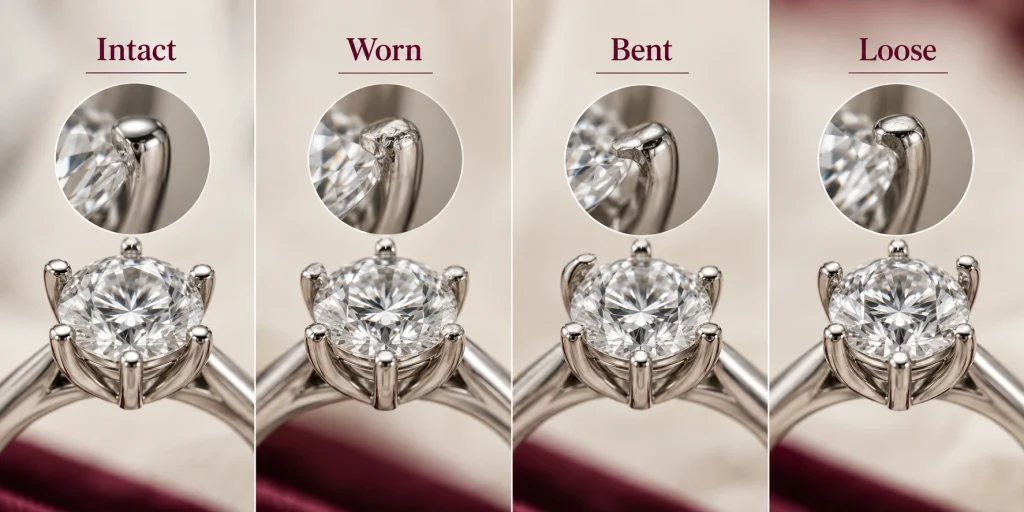
Yes.
Prongs can bend, wear down, loosen, or break over time.
Daily wear exposes them to repeated contact with clothing, furniture, tools, and other objects. A damaged prong can eventually allow the diamond to move.
If you notice that a prong looks thinner than the others, feels sharp, appears bent, or no longer seems to sit correctly against the diamond, have the ring inspected by a qualified jeweler.
You can also read about whether diamond prongs can break.
How Often Should Engagement Ring Prongs Be Checked?
There isn’t one universal inspection schedule that applies to every ring, because wear depends on the ring, setting, metal, and how frequently it is worn.
However, regular professional inspections are a sensible part of ring maintenance.
It’s also worth looking at the prongs yourself occasionally.
Watch for:
- A prong that looks shorter than the others
- A bent or damaged prong
- A loose center stone
- A new sharp edge
- The diamond moving when gently touched
- A prong that catches repeatedly on clothing
If something seems different, don’t wait for the diamond to become visibly loose before having it checked.
For more detailed maintenance guidance, see how often ring prongs should be checked.
Why Are Prongs So Common on Solitaire Engagement Rings?
Prongs are particularly well suited to solitaire rings because the entire design is built around the center stone.
A solitaire has no surrounding halo of diamonds to share attention with the center stone. The prongs can therefore secure the diamond while keeping the setting visually minimal.
This is also why classic solitaire designs often pair naturally with four- or six-prong settings.
If you’re comparing solitaire designs, you may also want to explore the different diamond shapes that work with a solitaire setting.
Frequently Asked Questions
Why do engagement rings have prongs?
Engagement rings use prongs primarily to hold the center stone securely while leaving much of the diamond exposed. This gives the ring an open appearance and allows more of the stone to remain visible.
Do prongs protect a diamond?
Prongs help secure the diamond and can protect certain areas of the stone, particularly when they are positioned over vulnerable corners. However, a prong setting generally leaves more of the diamond exposed than a bezel setting.
Are four or six prongs better?
Neither is universally better. Four prongs leave slightly less metal around the stone, while six prongs provide additional points of support. The appropriate choice depends on the diamond’s shape and size, the ring design, and the wearer’s priorities.
Do more prongs mean more sparkle?
No. The number of prongs does not determine a diamond’s cut quality or directly create more sparkle. Fewer prongs may leave slightly more of the stone visible, but the diamond’s cut is the major factor in its brilliance.
Can a diamond fall out if one prong breaks?
It can, depending on the setting. A damaged prong can reduce the security of the stone. In a six-prong setting, the additional prongs may help keep the diamond in place if one prong fails, but a damaged setting should still be repaired promptly.
Are prong settings safe?
A properly designed and maintained prong setting can securely hold a diamond for everyday wear. Because the prongs are exposed to wear, they should be inspected periodically.
Why do some diamonds have V-prongs?
V-prongs are commonly used to protect pointed corners or tips on diamond shapes such as pear and marquise cuts. The V-shaped metal surrounds the vulnerable point instead of leaving it exposed.
Final Thoughts
Engagement rings have prongs because they solve a simple but important design problem: how to hold a diamond securely without covering most of it with metal.
That balance explains their popularity.
Prongs keep the center stone in position while leaving much of its shape visible. They work with a wide range of diamond shapes and ring designs, from classic solitaire rings to more elaborate settings.
The number and style of prongs still matter, though. Four and six prongs create different balances between metal coverage and support, while specialized designs such as V-prongs can provide protection for vulnerable diamond corners.
Most importantly, prongs are not a set-it-and-forget-it part of the ring. They experience wear over time, so regular inspection helps catch problems before a small setting issue becomes a lost diamond.