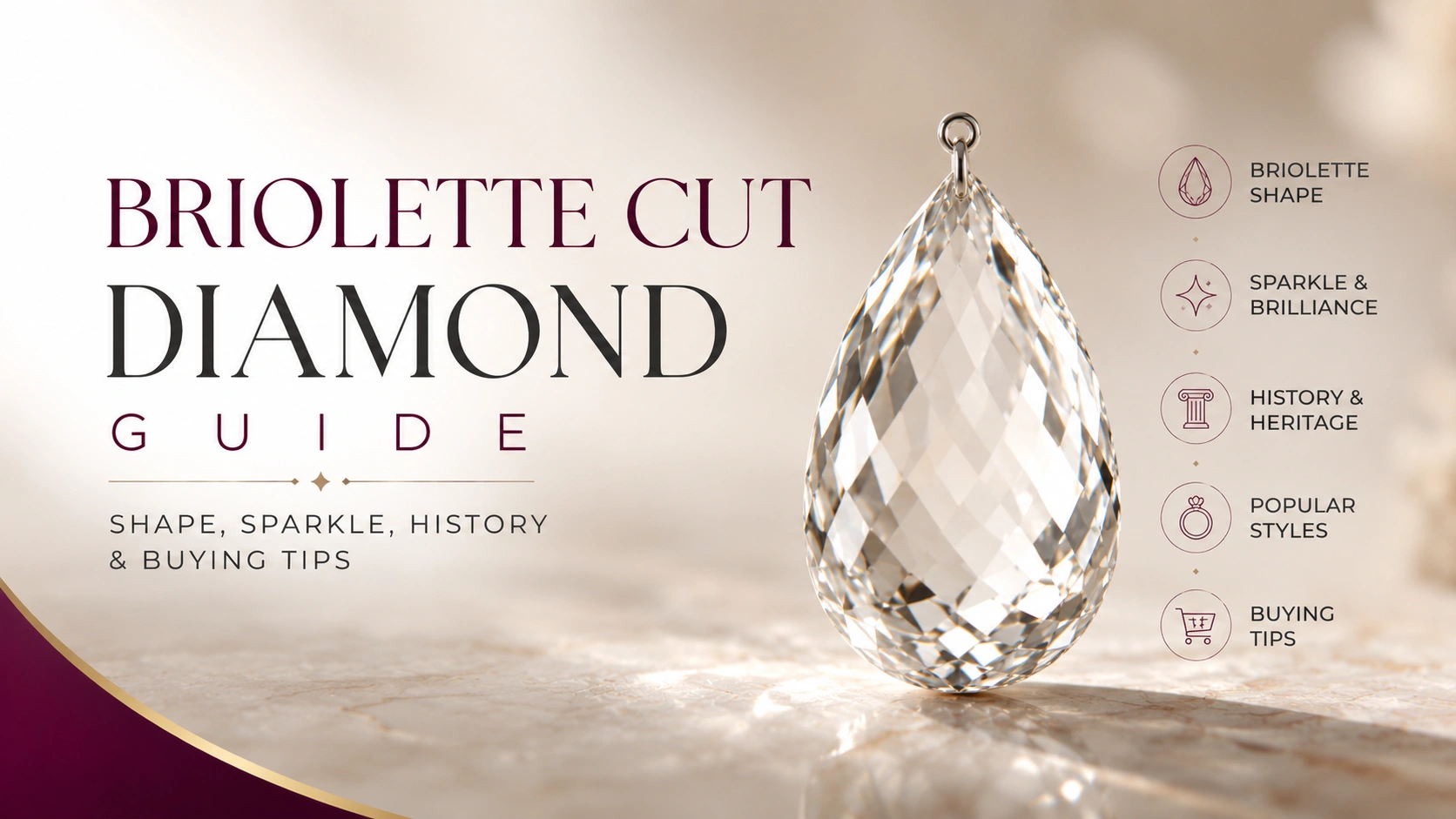
A briolette cut diamond is one of the most unusual diamond cuts you can find. Unlike conventional diamonds designed to be viewed face-up, a briolette is a fully three-dimensional stone with facets covering its entire surface. Its elongated teardrop or oval-like body is usually designed to hang freely, allowing the diamond to move and reflect light from different directions.
Because of its unusual construction, a briolette diamond does not have the flat table, conventional crown, pavilion, or girdle found on most modern diamond cuts. Instead, its facets wrap around the stone, creating a distinctive all-around shimmer.
Briolette diamonds are especially associated with pendants, earrings, necklaces, and other jewelry where the stone can move. They are considerably less common as engagement-ring center stones.
What Is a Briolette Cut Diamond?
A briolette cut is a fully faceted, three-dimensional drop-shaped cut. The classic outline resembles a teardrop, although some examples are shorter and more oval-like.
The defining characteristic is not simply the outline. A pear-shaped diamond can look similar from the front, but a true briolette is faceted around its entire body.
Instead of having a flat table on top, a briolette has facets that continue across the curved surface. It generally has:
- No traditional table
- No conventional crown-and-pavilion structure
- No flat back
- No traditional girdle
- Facets covering the entire stone
- A tapered end that can be used for suspension
- A three-dimensional form intended to be viewed from multiple directions
Many briolettes are drilled near the narrow end so that a fine wire, loop, or other fitting can pass through the stone. This allows the diamond to hang and move freely.
That construction is what makes a briolette fundamentally different from a conventional pear-shaped diamond.
What Does a Briolette Diamond Look Like?
A briolette usually has a rounded or elongated body that gradually tapers toward one end.
From a distance, it can look like a faceted pear. The difference becomes much clearer when the stone is viewed from the side or rotated.
A traditional pear-shaped diamond is fundamentally a face-up stone. Its table and pavilion create a front-facing visual orientation.
A briolette, on the other hand, is designed as a complete faceted object. There is no single “front” that needs to face the viewer.
This gives the stone a more fluid appearance, particularly when it is suspended from an earring or pendant and allowed to move.
Key Features of the Briolette Cut
1. Full-surface faceting
The entire body of a briolette is covered with facets. These may be triangular, diamond-shaped, or variations depending on the stone and cutting style.
This continuous faceting is one of the easiest ways to distinguish a true briolette from a polished drop or a conventional pear cut.
2. Three-dimensional shape
A briolette is not intended to have a flat viewing surface. Its rounded body is designed to remain attractive as it turns.
3. Tapered end
The stone normally narrows toward one end. This creates its characteristic drop-like appearance and provides a natural point for suspension.
4. No conventional table
Most modern diamond cuts rely heavily on a table as part of their optical design. A briolette does not.
Instead, light interacts with the many facets distributed around the stone.
5. Often drilled for jewelry
Briolettes are frequently drilled near the narrow end so they can be suspended from a wire or loop. This is particularly common in earrings and pendant designs.
How Does a Briolette Diamond Sparkle?
The sparkle of a briolette is different from the face-up brilliance of a round brilliant or other modern brilliant-style diamond.
Because the stone has facets on all sides, its appearance changes as it moves. Light can produce small flashes across different parts of the body rather than concentrating the visual effect on one principal viewing surface.
This makes movement an important part of the briolette’s appeal.
A suspended briolette can rotate slightly as the wearer moves, causing different facets to catch light. The result is often a fluid, scattered shimmer rather than the more predictable face-up flashes associated with traditional diamond cuts.
This does not necessarily mean that a briolette will have greater brilliance than a well-cut modern diamond. It simply produces light in a different way.
Briolette vs. Pear Cut Diamond
Briolette and pear cuts are easy to confuse because both can have a teardrop-like outline.
The biggest difference is cut architecture.
| Feature | Briolette | Pear Cut |
|---|---|---|
| Overall form | Three-dimensional drop | Face-up pear shape |
| Table | No conventional table | Yes |
| Crown/pavilion | No conventional division | Yes |
| Faceting | Covers the entire body | Primarily arranged around the face-up design |
| Flat back | No | Typically has a pavilion |
| Typical mounting | Drilled and suspended | Prongs, bezel, or other conventional settings |
| Viewing orientation | Multiple directions | Primarily face-up |
| Common jewelry use | Earrings, pendants, necklaces | Engagement rings and other jewelry |
A pear-shaped diamond can therefore resemble a briolette from the front without actually being a briolette.
If you want to explore the more conventional teardrop diamond, see the pear cut diamond guide.
How Are Briolette Diamonds Set?
Briolette diamonds are generally mounted differently from traditional engagement-ring diamonds.
Because there is no flat underside designed to sit against a setting, conventional prongs are not usually the natural choice.
Instead, the diamond may be:
- Drilled and suspended from a wire
- Attached to a small loop
- Suspended from a fine chain
- Held by a cap-and-loop fitting
- Used as a dangling accent in earrings
- Incorporated into a pendant or necklace
The goal is usually to leave as much of the stone exposed as possible.
This is particularly important because the cut is designed to be seen from multiple directions. Heavy metal coverage can hide the very feature that makes a briolette distinctive.
Where Are Briolette Diamonds Used?
Briolette diamonds are most naturally suited to jewelry that allows the stone to hang and move.
Common applications include:
Earrings
Drop earrings are an especially good match because the stones can move naturally as the wearer walks.
Pendants
A single briolette can work as a simple pendant, while multiple stones can create a more elaborate layered or fringe effect.
Necklaces
Briolettes can be used as dangling accents along necklaces and other articulated designs.
Vintage and antique jewelry
The cut has a long association with historic jewelry, including pieces made for royalty and other prominent collectors. Historical examples demonstrate why movement and suspension are so important to the style.
Why Are Briolette Diamonds So Rare?
Briolettes are relatively uncommon, particularly in diamonds.
One reason is that the cut demands an unusually high level of precision. Since practically the entire surface remains visible, there are fewer places to hide imperfections in symmetry, proportions, facet arrangement, or clarity.
The cutter also has to shape the stone as a coherent three-dimensional object rather than optimizing a single face-up view.
Another challenge is rough-diamond yield. Briolette cutting can sacrifice a substantial amount of the original rough, making it less attractive when the goal is to maximize finished carat weight.
The result is a cut that is better suited to specialized craftsmanship than mass-market diamond production.
That helps explain why you are much more likely to encounter briolettes in unusual jewelry pieces or special commissions than in mainstream engagement-ring inventories.
Briolette Diamond History
The history of the briolette is closely connected with early gemstone cutting and historic jewelry.
Some sources credit the development of the briolette style to European diamond-cutting traditions, while historical accounts also point to India as an important early center for fully faceted drop-shaped stones. Modern references often connect the style with early gemstone-cutting techniques that predate today’s standardized diamond cuts.
The style became particularly associated with historic jewelry because a suspended, fully faceted stone worked beautifully in necklaces, earrings, and other pieces where movement could activate the facets.
One of the most famous examples is the Briolette of India, a historic diamond associated with important jewelry collections. Another notable example is the diamond necklace presented by Napoleon to Empress Marie Louise, which included briolette-shaped stones.
The history helps explain why the cut still has a strong association with antique-inspired and collector jewelry today.
Are Briolette Diamonds Good for Engagement Rings?
A briolette diamond can certainly be incorporated into an engagement ring, but it is not the most practical choice for a traditional center stone.
The main issue is the way the stone is designed to be viewed and mounted.
Most engagement-ring diamonds are placed securely in a setting with a defined face-up orientation. A briolette is fundamentally different. It is intended to be appreciated as a complete three-dimensional object and is often drilled for suspension.
That makes it more naturally suited to earrings and pendants.
However, a creative jeweler could incorporate a briolette into an unconventional engagement-ring design, particularly as a side stone or dangling accent.
If you are choosing a traditional center diamond, you may want to compare it with other options in the diamond shape guide or browse the broader collection of diamond cut guides.
What to Look for When Buying a Briolette Diamond
Because briolette diamonds are unusual, evaluating one requires looking beyond the standard measurements used for conventional diamonds.
Examine the entire stone
Do not judge a briolette only from one photograph.
Look at it from multiple angles to make sure the shape remains balanced and the facets continue consistently around the body.
Check symmetry
The tapered end, body, and facet pattern should work together visually.
Minor irregularities can occur, especially in older or hand-finished examples, but obvious asymmetry can detract from the stone.
Inspect the facet pattern
Look for a coherent arrangement of facets across the entire surface.
The stone should not look heavily faceted on one side and poorly finished on another.
Check the drilling
If the stone is drilled, inspect the hole carefully.
The drilling should be clean and appropriately positioned for the intended mounting. Because the stone is suspended from this area, the drill location is both a design and structural consideration.
Consider clarity carefully
Since the entire stone can be viewed from different directions, inclusions may be visible from more angles than they would be in a heavily mounted conventional diamond.
Do not automatically choose the highest clarity grade, though. What matters is whether inclusions are noticeable in the actual stone.
For more context on evaluating diamond clarity, see the best diamond clarity for an engagement ring guide.
Judge the actual stone rather than carat weight alone
Briolette proportions can make two diamonds with the same carat weight look quite different.
Because the weight is distributed through a three-dimensional body, the stone may not appear as large face-up as a conventional diamond with the same carat weight.
For that reason, photographs, videos, measurements, and the actual proportions are especially important.
Pros and Cons of Briolette Cut Diamonds
Pros
- Extremely distinctive appearance
- Fully faceted three-dimensional design
- Sparkle changes as the stone moves
- Excellent choice for unique earrings and pendants
- Strong connection with historic and vintage jewelry
- Rare and collectible
- Minimal metal can be used to display the stone
Cons
- Relatively difficult to find
- Diamonds in this cut can be expensive
- Limited availability compared with mainstream cuts
- Not naturally suited to traditional engagement-ring settings
- Drilling requires careful craftsmanship
- Shape and proportions can be difficult to evaluate from a single image
- May appear smaller than a conventional diamond of the same carat weight
Frequently Asked Questions
Is a briolette diamond the same as a pear diamond?
No. They may have similar teardrop outlines, but their construction is different. A pear diamond has a conventional table, crown, and pavilion and is designed primarily for face-up viewing. A briolette is a three-dimensional, fully faceted form without a conventional table.
Does a briolette diamond have a table?
A traditional briolette does not have a conventional flat table. Its facets extend across the entire surface of the stone.
Are briolette diamonds rare?
Yes. Briolette diamonds are much less common than mainstream diamond cuts. The difficulty of cutting them, lower rough yield, and limited demand all contribute to their scarcity.
Can a briolette diamond be used in an engagement ring?
Yes, but it is unconventional. The cut is generally better suited to earrings, pendants, and necklaces because it is designed as a suspended three-dimensional stone.
How is a briolette diamond attached to jewelry?
Many briolettes are drilled near the narrow end so that a wire, loop, or other fitting can suspend the stone. Other designs may use a cap or specialized mounting.
Why does a briolette sparkle differently?
Its facets cover the entire stone rather than being concentrated around a face-up table-and-pavilion design. As the stone moves, different facets catch light, producing a changing, all-around effect.
Is a briolette cut good for a pendant?
Yes. A pendant is one of the most natural applications for a briolette because the stone can hang freely and its three-dimensional faceting remains visible.
Final Thoughts
The briolette cut diamond is less about conventional face-up brilliance and more about movement, craftsmanship, and three-dimensional beauty.
Its defining feature is the combination of a tapered drop-like form and continuous faceting around the entire stone. That makes it visually different from a pear cut, even though the two can look similar at first glance.
For shoppers who want a traditional engagement-ring center stone, more conventional diamond shapes will usually be easier to source and set. But for earrings, pendants, necklaces, vintage-inspired jewelry, or a truly unusual custom design, a briolette can be an exceptional choice.
Its rarity is part of the appeal. Rather than following the standardized approach of many modern diamond cuts, the briolette celebrates the diamond as a complete object that interacts with light from every direction.