A shield cut diamond is one of the more unusual diamond shapes available today. Its broad upper edge and tapered point give it a distinctive geometric outline that resembles a traditional shield. Unlike familiar shapes such as round, oval, or princess, shield diamonds are relatively uncommon and can vary significantly in their proportions and faceting.
That rarity is part of the appeal. A shield diamond can give an engagement ring a look that feels architectural, vintage-inspired, and distinctly different from mainstream diamond shapes.
Shield diamonds can be used as center stones, but they are also popular as accent stones beside a larger center diamond. Their broad shape can create an interesting transition between a center stone and the ring’s band.
If you’re considering one for an engagement ring, understanding the shape, faceting, proportions, setting options, and potential drawbacks is important before buying.
What Is a Shield Cut Diamond?
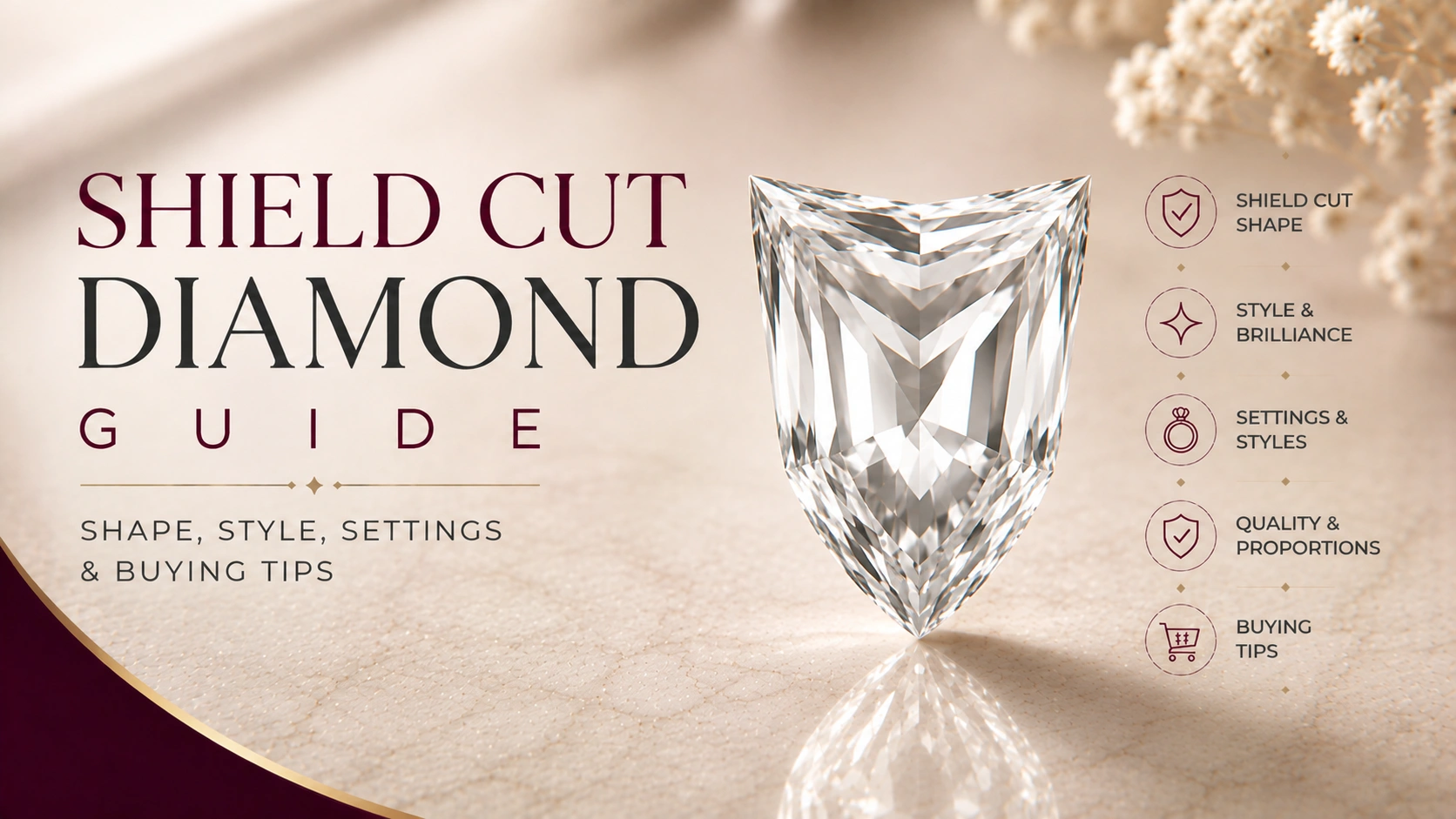
A shield cut diamond is a fancy-shaped diamond with a shield-like outline. The shape is generally wider toward the top and narrows toward a pointed or sometimes softly curved bottom.
The exact outline isn’t completely standardized. Some shield diamonds have crisp, straight edges, while others have gently curved sides. Some are relatively wide and compact, while others are elongated and slender.
The result is a diamond that combines elements of several geometric shapes without looking exactly like any of them.
A typical shield diamond has:
- A broad upper edge
- Angled or curved shoulders
- A tapered lower section
- A pointed or slightly rounded bottom
- A generally five-sided appearance
- A distinctive geometric silhouette
Because shield diamonds are fancy shapes, the individual stone’s proportions and faceting deserve close attention rather than relying on a single set of ideal measurements.
For a broader explanation of how diamond shapes differ, see this guide to diamond shapes.
What Does a Shield Cut Diamond Look Like?
From above, a shield diamond has a strong, graphic outline. The broad top gives the stone visual width, while the tapered bottom creates a directional appearance.
Depending on its proportions, a shield diamond can look:
- Wide and dramatic
- Long and elegant
- Compact and architectural
- Soft and curved
- Sharp and geometric
This variation is one reason photographs can be misleading when shopping online. Two diamonds can both be described as shield cut while looking noticeably different in person.
The faceting also changes the appearance. Some shield diamonds use larger, more step-like facets that produce broader flashes of light, while other examples have more brilliant-style faceting. Rose-cut versions can have an especially different appearance, with a flatter profile and more subtle sparkle.
How Are Shield Cut Diamonds Faceted?
There isn’t one universal faceting arrangement for every shield diamond.
Depending on the stone, you may encounter shield diamonds with:
- Step-style faceting
- Brilliant-style faceting
- Rose-cut faceting
- Mixed or customized faceting
This matters because two diamonds with nearly identical outlines can have completely different visual personalities.
Step-style faceting generally emphasizes larger, broader reflections and a more understated appearance. Brilliant-style faceting can create more lively flashes of light. Rose cuts typically have a flatter appearance and a softer, more antique-inspired look.
If sparkle is especially important to you, don’t judge a shield diamond solely by its shape. Look closely at videos or photographs under different lighting conditions and evaluate the actual stone.
For more context on the difference between major faceting approaches, see the comparison of step-cut and brilliant-cut diamonds.
A Brief History of Shield Cut Diamonds
Shield-shaped diamonds have a long association with geometric jewelry design and became particularly noticeable during the Art Deco era of the 1920s and 1930s.
Their angular appearance fit naturally with the period’s preference for architectural lines and geometric motifs. Shield shapes were used in different forms of jewelry, including rings, earrings, pendants, and bracelets.
Today, the shape is being reinterpreted for contemporary engagement rings. Designers may use it as a center stone, place it east-west, set it at an angle, or use matching shield diamonds as side stones.
That combination of vintage influence and modern design is part of what makes the shape appealing to buyers who want something outside the traditional engagement-ring styles.
Why Are Shield Cut Diamonds So Rare?
One of the biggest challenges with shield diamonds is availability.
Unlike highly standardized shapes that are produced in enormous numbers, shield diamonds require rough material suitable for their particular outline. Their unusual geometry also means there is less standardized inventory available.
This can make finding a matching pair of shield diamonds particularly challenging when they are intended to be used as side stones.
Rarity can be a benefit if uniqueness is your priority, but it can also make comparison shopping more difficult. You may have fewer stones to compare at the same carat weight, color, clarity, and price.
That’s why it can be more important to judge the individual diamond than to search for a generic “ideal” shield-cut specification.
Shield Cut Diamond as a Center Stone vs Side Stone
Shield Cut as a Center Stone
A shield diamond can make a striking center stone for an unconventional engagement ring.
As a center stone, the shape becomes the primary design feature. A simple setting can allow the outline to take center stage, while a more elaborate setting can emphasize its vintage or architectural character.
A shield center stone can work particularly well for someone who wants a ring that doesn’t resemble the standard round, oval, or cushion engagement ring.
Shield Cut as a Side Stone
Shield diamonds have traditionally been especially useful as accent stones.
Their broad end can sit near the center diamond while the pointed end follows the direction of the band. This creates a natural transition from the center stone toward the shank.
They can work particularly well in three-stone and multi-stone designs.
As side stones, shield diamonds can add geometric character without overpowering the center stone.
Pros and Cons of Shield Cut Diamonds
Pros
Distinctive appearance:
A shield diamond immediately looks different from the most common engagement-ring shapes.
Geometric style:
Its angular outline works especially well with modern, Art Deco, and architectural designs.
Versatile orientation:
Designers can experiment with traditional north-south positioning, east-west settings, or angled arrangements.
Excellent for accent designs:
The shape can create a visually interesting transition between a center stone and the band.
Potentially large face-up appearance:
Because shield diamonds can be relatively broad, some examples may appear substantial for their carat weight.
Cons
Limited availability:
There are generally fewer shield diamonds to choose from than popular shapes.
Inconsistent proportions:
There is no single silhouette that defines every shield diamond.
Harder to compare:
Because stones can differ substantially in outline and faceting, simple carat-to-carat comparisons aren’t always useful.
Point protection matters:
A pointed bottom can require thoughtful setting design to reduce exposure to accidental impact.
Potentially difficult to match:
Finding two shield diamonds with closely matched dimensions and appearance can take more effort.
Best Ring Settings for Shield Cut Diamonds
The right setting depends on whether the shield is being used as a center stone or as an accent.
Prong Setting
Prongs can showcase more of the diamond’s outline because less metal surrounds the stone.
For a shield with a pronounced point, the jeweler should carefully consider how that point is protected.
Bezel Setting
A bezel surrounds the stone with metal and can provide additional protection around the edges.
It can also create a sleek, contemporary appearance. Bezel settings are particularly interesting for shield diamonds because they emphasize the geometric outline.
Three-Stone Setting
Three-stone rings are one of the most natural applications for shield side stones.
A larger center diamond can be paired with two shield-shaped accents, creating a structured silhouette that feels more distinctive than a conventional three-stone design.
East-West Setting
Instead of positioning the shield vertically, a designer can rotate it horizontally.
An east-west shield setting can produce a more contemporary appearance and make the ring feel less traditional.
Asymmetrical Setting
Because the shield shape is already unconventional, an asymmetrical setting can push the design even further.
This approach works particularly well for buyers who want a custom-looking or artistic engagement ring.
When considering the setting, it’s also worth understanding why engagement rings have prongs and how different setting choices affect the appearance and protection of a stone.
How to Buy a Shield Cut Diamond
Because shield diamonds don’t have the same standardized evaluation framework as round brilliant diamonds, shopping requires a slightly different approach.
1. Start With the Shape
Look at the diamond face-up and decide whether you actually like its outline.
Pay attention to:
- Overall symmetry
- Width
- Length
- Shoulder shape
- Point shape
- Curvature of the edges
A diamond can have excellent color and clarity but still not be attractive to you if its proportions don’t suit your taste.
2. Check Symmetry
Symmetry is particularly important with an unusual geometric shape.
Look at whether the two sides appear balanced. An intentionally asymmetrical design is different from a poorly proportioned diamond.
If the shield is being used as a center stone, noticeable asymmetry can become a major visual feature.
3. Examine the Faceting
Don’t assume every shield diamond will have the same level or type of sparkle.
Ask whether the stone is step cut, brilliant cut, rose cut, or another variation.
Then examine how it performs in different lighting conditions.
4. Consider the Point
The bottom point is one of the defining features of a shield diamond.
It is also an area that deserves attention when choosing a setting. A well-designed setting should take the shape and exposed edges into account rather than treating the stone like a standard round diamond.
5. Evaluate Color
Fancy-shaped diamonds can sometimes reveal body color differently from round brilliant diamonds, depending on their faceting and proportions.
If you’re choosing a white diamond, compare stones side by side when possible rather than assuming a particular color grade will automatically look best.
You can learn more about diamond color with this diamond color guide.
6. Evaluate Clarity
The amount of clarity you need depends on the specific stone and how visible its inclusions are.
Large facets can make some inclusions easier to see, particularly in stones with step-style faceting.
Rather than automatically paying for the highest clarity grade, inspect the actual diamond and determine whether inclusions are visible to the naked eye.
For more guidance, see the diamond clarity guide.
7. Compare Measurements, Not Just Carat Weight
Two shield diamonds with the same carat weight can have different face-up dimensions.
Compare the actual measurements and overall shape.
A wider stone may appear larger from above, while a deeper stone may carry more of its weight below the girdle.
8. Ask About Certification
For a significant diamond purchase, an independent grading report can provide useful information about the stone’s characteristics.
The report should be reviewed alongside your own inspection of the diamond rather than treated as a substitute for evaluating its appearance.
You can also review the broader 4Cs of diamond quality before comparing individual stones.
Shield Cut vs Other Diamond Shapes
Shield diamonds are easy to confuse with other geometric fancy shapes, but the outlines are different.
Shield vs Kite Cut
A kite cut generally has a four-sided kite-like outline, while a shield shape typically has a broader upper section and a tapered lower point.
The shield generally looks more like a crest or heraldic shield, whereas the kite has a more directional diamond-like silhouette.
For another unusual geometric option, explore the kite cut diamond guide.
Shield vs Trillion Cut
A trillion or trilliant diamond is fundamentally triangular, while a shield has a modified top that creates its characteristic shield-like outline.
Trillion cuts are often used as side stones, making them a natural alternative when comparing accent-stone designs.
See the trillion cut diamond guide for more information.
Shield vs Baguette
Baguette diamonds are generally long and rectangular with step-cut faceting.
Shield diamonds have a more dramatic taper and a pointed lower end.
Baguettes tend to create a clean linear appearance, while shields introduce more directional geometry.
Shield vs Half-Moon
Half-moon diamonds have a curved outer edge and a relatively straight inner edge, making them especially useful beside certain center stones.
Shield diamonds are more angular and pointed.
If you’re choosing side stones for a three-stone ring, comparing these shapes can help determine which silhouette works best with your center diamond.
How Much Does a Shield Cut Diamond Cost?
There isn’t one standard price for a shield cut diamond.
The price of an individual stone depends on factors such as:
- Carat weight
- Color
- Clarity
- Cut and faceting
- Polish
- Symmetry
- Proportions
- Natural vs lab-grown origin
- Overall visual appeal
- Rarity and availability
Because shield diamonds are less standardized and less commonly stocked, availability can also influence what you pay.
For that reason, it isn’t useful to assume that a shield diamond will always be cheaper or more expensive than a round or another fancy shape. Compare actual stones with similar characteristics rather than relying on shape alone.
If you’re planning an engagement-ring budget, you can also use an engagement ring budget calculator.
How to Care for a Shield Cut Diamond
Shield diamonds can generally be cared for like other diamond jewelry, but the specific setting deserves attention.
If the stone has a pointed bottom, avoid activities that could expose that point or the surrounding edges to unnecessary impact.
For everyday care:
- Remove the ring during activities where it could be struck.
- Clean the diamond regularly to remove oils and buildup.
- Check the setting periodically.
- Have the prongs or bezel inspected if the ring receives regular wear.
- Store the ring separately from jewelry that could scratch or damage its setting.
The setting is especially important because a unique diamond shape may require a custom-designed mounting rather than a generic setting.
Are Shield Cut Diamonds Good for Engagement Rings?
Yes, a shield cut diamond can be an excellent engagement-ring choice if you value individuality over convention.
It is particularly appealing if you want:
- An unusual center stone
- A geometric or architectural design
- A vintage or Art Deco influence
- A distinctive three-stone ring
- Unique side stones
- A custom-looking engagement ring
However, it may not be the best choice if you want a diamond with abundant standardized inventory, easy stone-to-stone comparisons, or a widely established set of proportion guidelines.
The biggest advantage of a shield diamond is also its biggest challenge: there is no single “right” shield shape.
You need to find a particular stone whose proportions, faceting, symmetry, and overall appearance appeal to you.
Final Thoughts
A shield cut diamond offers something that many traditional engagement-ring shapes can’t: a genuinely unusual silhouette.
Its broad top, tapered point, and geometric character can work beautifully as either a center stone or an accent. The shape also gives designers plenty of freedom to experiment with orientation, settings, and combinations with other diamonds.
But shield diamonds require a more individual approach to shopping. Instead of searching for one universal ideal proportion, focus on the actual stone. Examine its outline, symmetry, faceting, measurements, color, clarity, and setting requirements.
If you want an engagement ring that feels personal, architectural, and different from the usual choices, a shield cut diamond is worth considering.
Frequently Asked Questions
Is a shield cut diamond rare?
Yes. Shield diamonds are considerably less common than popular shapes such as round, oval, and princess. Their unusual rough requirements and lower demand make them less widely available.
Are shield cut diamonds good for engagement rings?
They can be. Shield diamonds work particularly well for unconventional, vintage-inspired, Art Deco, and custom engagement-ring designs.
Can a shield cut diamond be a center stone?
Yes. Although shield diamonds are commonly used as side stones, modern designers increasingly use them as center stones in distinctive engagement rings.
Are shield cut diamonds step cut?
Not always. Shield diamonds can use different faceting arrangements, including step-style, brilliant-style, rose-cut, and customized designs.
Are shield diamonds durable?
Diamond itself is extremely hard, but the pointed and exposed geometry of a shield shape means the setting should be designed carefully to protect vulnerable areas.
Do shield cut diamonds sparkle?
They can, but the appearance of sparkle depends heavily on the individual stone’s faceting, proportions, and cut quality. Some shield diamonds produce broad, subtle flashes rather than the intense scintillation associated with a round brilliant.
Can shield diamonds be used as side stones?
Yes. This is one of their most established uses. Their broad end can sit beside a center stone while the pointed end tapers toward the band.
What diamond shapes look good with shield side stones?
Shield side stones can work with a variety of center stones, especially designs where their geometric outline complements the center diamond. The best pairing ultimately depends on the proportions and silhouette of the individual stones.
Should I prioritize color or clarity in a shield diamond?
There is no universal answer. Start with how the individual diamond looks to your eye. Larger facets can sometimes make inclusions or body color more noticeable, so inspect the actual stone before paying for a higher grade.