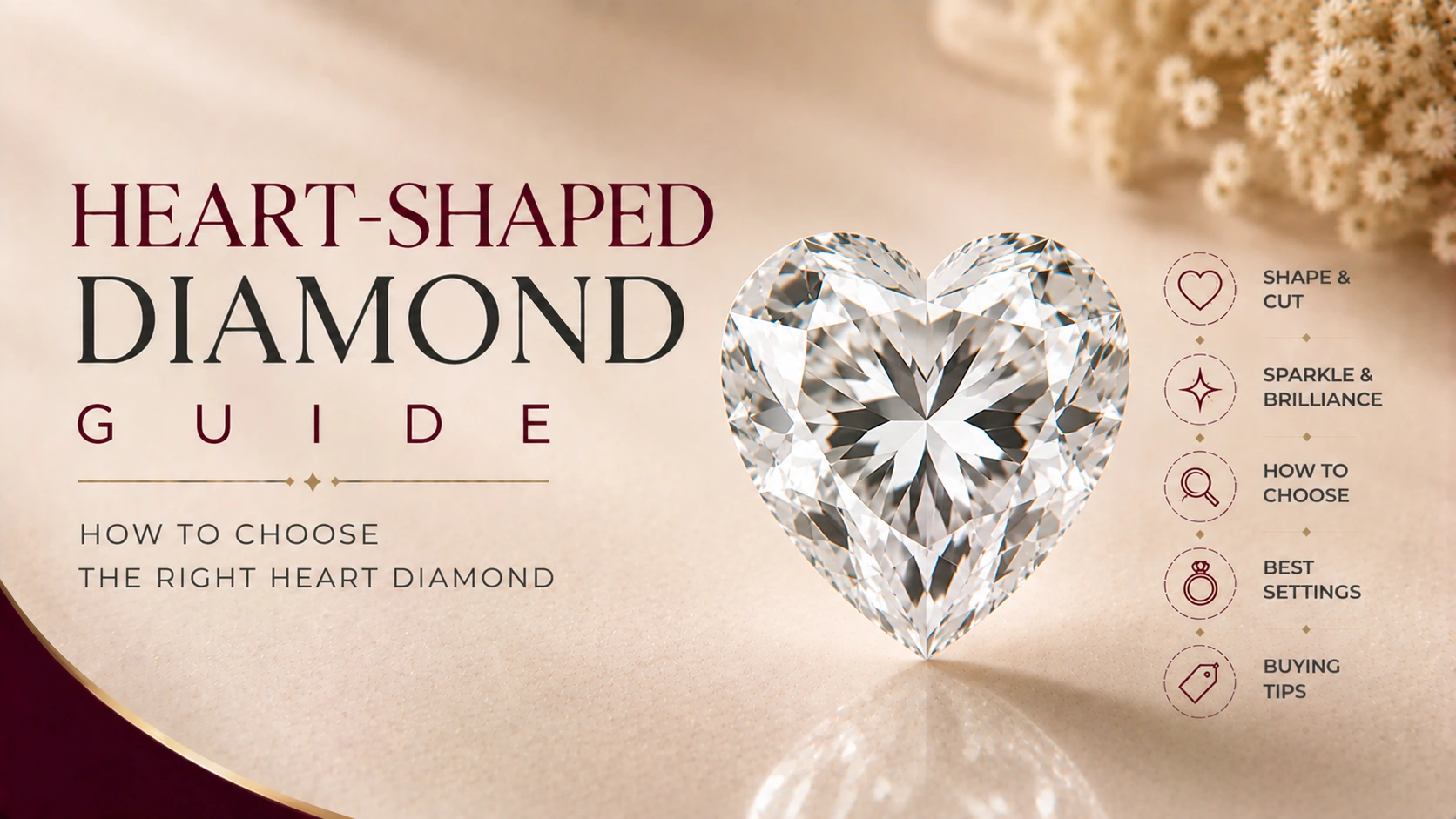
A heart-shaped diamond is one of the most distinctive and romantic diamond shapes you can choose for an engagement ring. Its outline features two rounded lobes, a defined cleft at the top, and a pointed tip at the bottom, creating an unmistakable heart silhouette.
But heart-shaped diamonds are not as simple to shop for as their romantic appearance might suggest. Because the shape is highly dependent on symmetry, even small differences between the two sides can make a diamond look uneven or poorly proportioned.
If you’re considering a heart-shaped diamond, this guide explains what to look for, which proportions matter, how the 4Cs apply, what size works best, and how to protect the pointed tip.
What Is a Heart-Shaped Diamond?
A heart-shaped diamond is a fancy diamond shape designed to resemble a traditional heart. It is generally cut in a brilliant style, giving it plenty of sparkle while maintaining its distinctive outline.
The shape consists of several important features:
- Lobes: The two rounded sections at the top of the heart.
- Cleft: The indentation between the two lobes.
- Wings: The curved sides that extend from the lobes toward the bottom.
- Point: The sharp tip at the bottom of the diamond.
A well-cut heart should look balanced from top to bottom, with the cleft centered directly above the point.
Heart-shaped diamonds are particularly unforgiving when it comes to asymmetry. With a round diamond, small differences can be difficult to notice. With a heart, your eyes immediately recognize when one side looks different from the other.
Why Choose a Heart-Shaped Diamond?
The biggest reason to choose a heart diamond is its symbolism.
Unlike most diamond shapes, the heart has an immediately recognizable meaning. It is strongly associated with love, affection, romance, and commitment.
It can also be a good option if you want an engagement ring that feels more personal and unconventional than a traditional round diamond.
Heart-shaped diamonds also use brilliant-style faceting, which can provide strong brightness and sparkle when the stone is well cut.
For shoppers comparing different diamond shapes, it can be helpful to first understand how diamond shapes differ overall. You can explore the different diamond shapes before narrowing your choice to a heart.
Heart-Shaped Diamond Anatomy
Understanding the anatomy of a heart diamond makes it easier to evaluate one when shopping.
Lobes
The lobes are the two rounded curves at the top of the heart.
They should be similar in size, height, and shape. One lobe should not appear noticeably larger, flatter, or higher than the other.
Cleft
The cleft is the indentation between the two lobes.
A defined cleft helps the diamond immediately read as a heart. If the cleft is too shallow or poorly centered, the diamond may look more like a rounded pear shape.
Wings
The wings are the curved sections that extend downward from the lobes.
They should create a smooth and balanced transition toward the bottom point. Uneven wings can make an otherwise attractive diamond appear lopsided.
Point
The point is the bottom tip of the heart.
It should sit directly below the center of the cleft. It is also one of the most vulnerable areas of the diamond, which is why the setting needs to provide adequate protection.
How to Choose a Heart-Shaped Diamond
When shopping for a heart-shaped diamond, don’t begin with carat weight alone.
A better approach is to evaluate the stone in this order:
- Symmetry
- Shape and outline
- Bow-tie effect
- Length-to-width ratio
- Face-up size
- Color and clarity
- Setting and point protection
1. Look for Excellent Symmetry
Symmetry is arguably the most important consideration for a heart-shaped diamond.
Imagine drawing a vertical line from the center of the cleft through the point. The two halves should look like mirror images.
Look for:
- Even-sized lobes
- A centered cleft
- Matching wing curves
- A centered point
- A balanced overall outline
GIA specifically recommends looking for two identical halves, a distinct cleft, and even lobes when evaluating a heart-shaped diamond.
A diamond can have a favorable symmetry grade on its report and still look less attractive than another stone when viewed face-up. That’s why photographs or videos of the actual diamond are valuable.
2. Check the Shape From Directly Above
Always inspect a heart diamond face-up.
Looking at the diamond from an angle can make it difficult to judge whether the lobes and point are properly aligned.
If possible, compare several stones side by side. You may notice that one heart looks fuller and more balanced while another looks narrow, flat, or slightly crooked.
The better-looking diamond isn’t necessarily the one with the highest carat weight.
3. Pay Attention to the Bow-Tie Effect
Heart-shaped diamonds can show a bow-tie effect, which appears as a darker area across the middle of the stone.
Some contrast is normal in fancy brilliant shapes. The problem is a large, persistent dark area that remains noticeable as the diamond moves.
When shopping online, use a 360-degree video or other high-quality footage if available. Tilt the diamond and watch how the center reacts to changing light.
A strong bow-tie can reduce the stone’s visual brightness even when its grading report looks acceptable.
4. Consider the Length-to-Width Ratio
Length-to-width ratio describes how long a diamond is compared with its width.
For a heart-shaped diamond, a ratio close to 1:1 generally produces a balanced, classic heart. A commonly cited range is approximately 0.90 to 1.10, although personal preference matters.
A wider heart can look fuller and more rounded, while a higher ratio can create a narrower, more elongated appearance.
Don’t choose a ratio solely because a chart calls it “ideal.” Look at the actual outline because two diamonds with similar measurements can still look different.
What Is the Best Carat Size for a Heart-Shaped Diamond?
There is no universal best carat weight, but size matters more than usual with a heart-shaped diamond because the shape itself needs enough surface area to be recognizable.
GIA notes that the heart shape can be difficult to perceive in diamonds below about 0.50 carat.
For an engagement ring, around 0.50 carat can be considered a practical starting point, while a larger stone can make the heart silhouette much easier to appreciate.
When comparing stones, look at their actual millimeter measurements rather than relying only on carat weight. Two diamonds with the same carat weight can have different face-up dimensions because of how their weight is distributed.
For more information about choosing diamond size, see the diamond carat guide.
Heart-Shaped Diamonds and the 4Cs
The traditional 4Cs are color, clarity, cut, and carat weight. They all matter, but heart-shaped diamonds require a slightly different approach.
Cut
Fancy-shaped diamonds do not receive the same overall cut grading system used for round brilliant diamonds.
That makes visual evaluation especially important.
For a heart, examine:
- Symmetry
- Proportions
- Light performance
- Bow-tie effect
- Shape definition
The actual appearance of the diamond should carry significant weight in your decision.
You can learn more about diamond cutting in the diamond cut guide.
Color
Heart-shaped diamonds can show color differently depending on their size, proportions, and setting.
If you’re choosing a white diamond, don’t automatically pay for the highest color grade. Instead, compare diamonds visually and consider the metal used for the ring.
A yellow or rose gold setting may also change how much body color is noticeable.
For a broader explanation of diamond color, see the diamond color guide.
Clarity
Heart-shaped diamonds are brilliant-style cuts, which can help disguise some inclusions through their sparkle.
That doesn’t mean clarity should be ignored.
Pay particular attention to inclusions that are visible from the top of the stone, especially those located in visually important areas.
Rather than paying for a very high clarity grade automatically, compare the actual diamonds and determine whether the stone looks clean to the naked eye.
The diamond clarity guide explains how clarity grades work and what to look for.
Carat
Carat measures weight, not visual beauty or face-up dimensions.
A larger heart isn’t automatically better if its proportions or symmetry are poor.
If you’re working within a fixed budget, it can make sense to prioritize a well-shaped heart with strong symmetry over simply choosing the highest carat weight available.
How Much Does a Heart-Shaped Diamond Cost?
The price of a heart-shaped diamond depends on much more than carat weight.
Important factors include:
- Natural or lab-grown origin
- Carat weight
- Color
- Clarity
- Symmetry
- Cut quality
- Proportions
- Certification
- Current market conditions
Heart-shaped diamonds can sometimes cost less per carat than round brilliant diamonds because round diamonds are especially popular and have different cutting requirements. However, an unusually well-proportioned heart can still command a premium relative to other stones of the same shape.
For a realistic budget, compare diamonds based on the complete combination of characteristics rather than assuming a particular percentage discount or premium.
If you’re researching the overall cost of an engagement ring, the engagement ring cost calculator can help with budgeting.
Best Settings for Heart-Shaped Diamonds
The setting isn’t just a style decision with a heart-shaped diamond. It also plays an important role in protecting the stone.
V-Prong Setting
A V-shaped prong around the point is one of the most useful choices for a heart diamond.
The pointed tip is vulnerable to accidental impact, and a V-prong helps protect it.
GIA specifically recommends a V-shaped prong when using a prong setting for a pointed fancy diamond, including heart-shaped stones.
Bezel Setting
A bezel setting surrounds the diamond with metal and can provide substantial protection.
It can also create a sleek, modern appearance, although the metal surrounding the stone can slightly change how clearly the heart outline is seen.
Solitaire Setting
A solitaire can make a heart-shaped diamond the obvious focal point of the ring.
Because there are fewer surrounding stones competing for attention, a well-proportioned heart can make a strong statement.
Three-Stone Setting
A heart can also work in a three-stone design, particularly when the side stones complement rather than overpower the center diamond.
The setting should still protect the center stone’s point.
Halo Setting
A halo can make a heart diamond appear larger and more dramatic.
However, the surrounding stones need to follow the heart’s outline carefully. A poorly designed halo can make the center stone’s shape less obvious.
Pros and Cons of Heart-Shaped Diamonds
Pros
- Strong romantic symbolism
- Immediately recognizable shape
- Distinctive alternative to traditional shapes
- Brilliant-style faceting can provide strong sparkle
- Can make a highly personal engagement ring
- Available in both natural and lab-grown diamonds
Cons
- Symmetry problems are easy to notice
- Poor proportions can weaken the heart outline
- Bow-tie effects can affect visual performance
- Smaller stones may not clearly read as hearts
- The pointed tip needs protection
- High-quality examples can be harder to find than more common shapes
Heart-Shaped vs. Other Diamond Shapes
A heart is not necessarily better or worse than another diamond shape. It depends on what matters most to you.
Heart vs. Round: Choose a heart if symbolism and uniqueness matter more than traditional popularity. Choose a round if you want a classic shape with a highly standardized cut-grading system.
Heart vs. Pear: Both have a pointed end, but a heart has two distinct lobes and a cleft. A pear has a rounded end and a single point.
Heart vs. Oval: An oval offers an elongated silhouette, while a heart has a more compact and symbolic outline.
Heart vs. Marquise: A marquise is long and narrow with points at both ends. A heart has rounded upper lobes and one point at the bottom.
For more shape-specific comparisons, you can explore other diamond shape guides, including oval, pear, marquise, cushion, radiant, and other cuts.
How to Buy a Heart-Shaped Diamond
Before purchasing, use this checklist:
1. Inspect the outline
Look directly at the diamond from above.
Does it immediately look like a heart?
2. Check symmetry
Make sure the two lobes, wings, cleft, and point are balanced.
3. Look for a defined cleft
The cleft should be noticeable and centered.
4. Check the point
The point should align with the center of the cleft and should not look crooked or excessively blunt.
5. Review the length-to-width ratio
Start around 0.90 to 1.10 if you want a classic heart, then adjust according to your preferred appearance.
6. Watch the diamond move
Use a video or view the stone in person to check for a distracting bow-tie and overall light performance.
7. Compare face-up measurements
Don’t assume two diamonds with identical carat weights will look identical on the finger.
8. Consider the 4Cs together
Balance color, clarity, cut quality, and carat weight rather than maximizing a single grade.
9. Protect the point
Choose a setting that provides adequate protection, particularly around the bottom tip.
10. Check the grading report
Make sure the diamond comes with an appropriate grading report and that the information corresponds to the stone you’re buying.
Are Heart-Shaped Diamonds Good for Engagement Rings?
Yes, a heart-shaped diamond can be an excellent choice for an engagement ring if you genuinely like its appearance and symbolism.
It is especially appealing for someone who wants the meaning of the diamond to be immediately obvious.
The key is to choose the stone carefully. A beautiful heart-shaped diamond should have balanced lobes, a centered cleft, symmetrical wings, a properly aligned point, attractive proportions, and good overall light performance.
The shape is less forgiving than many other diamond cuts, so don’t rush the selection simply because the outline looks romantic.
Frequently Asked Questions
Is a heart-shaped diamond a good choice?
Yes. Heart-shaped diamonds offer strong symbolism, a distinctive appearance, and brilliant-style sparkle. The main challenge is finding one with excellent symmetry and attractive proportions.
What is the ideal ratio for a heart-shaped diamond?
A length-to-width ratio around 1:1 is generally associated with a classic, balanced heart. A range of approximately 0.90 to 1.10 is commonly used as a starting point, but personal preference should guide the final choice.
What is the smallest heart-shaped diamond that still looks like a heart?
Around 0.50 carat is a useful minimum starting point for a center stone. Below that size, the cleft and lobes can become difficult to distinguish clearly once the diamond is mounted. GIA makes a similar observation about smaller heart-shaped diamonds.
Do heart-shaped diamonds have a bow-tie?
They can. The effect appears as a darker area across the center of the stone. A small amount of contrast can be normal, but a strong, persistent bow-tie can negatively affect the diamond’s appearance.
Should a heart-shaped diamond have a V-prong?
A V-prong is strongly recommended when using a prong setting because it helps protect the pointed tip of the diamond.
Are heart-shaped diamonds more expensive than round diamonds?
Not necessarily. Heart-shaped diamonds can sometimes have a lower price per carat than round diamonds, but the final price depends on the diamond’s origin, quality, proportions, certification, and market conditions.
What clarity is best for a heart-shaped diamond?
There is no single best clarity grade. A diamond that looks clean to the naked eye can often provide better value than paying for an extremely high clarity grade that makes little visible difference.
Are heart-shaped diamonds good for solitaire rings?
Yes. A solitaire setting can work particularly well because it keeps attention on the distinctive outline of the heart.
Final Thoughts
A heart-shaped diamond is one of the most meaningful choices for an engagement ring, but its romantic silhouette should not be the only thing you consider.
Start with symmetry. Make sure the lobes match, the cleft is centered and defined, the wings are balanced, and the point sits directly below the cleft. Then evaluate the diamond’s proportions, bow-tie effect, face-up size, color, clarity, and overall sparkle.
Finally, choose a setting that protects the pointed tip.
When you find a heart diamond that combines a beautiful outline with strong visual performance, the result can be an engagement ring that feels both distinctive and deeply personal.