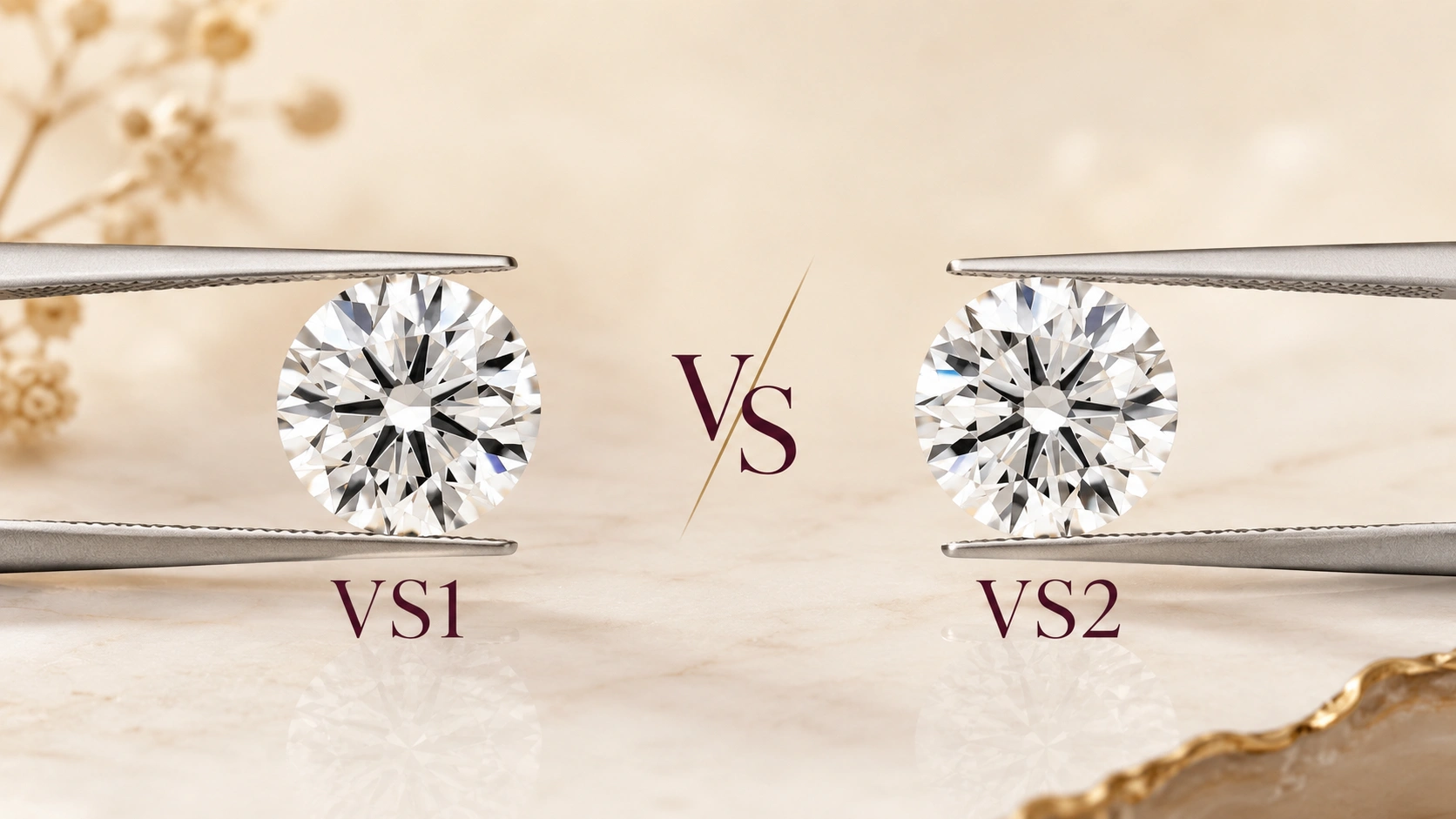
If you’re comparing VS1 and VS2 diamonds, you’re already looking at two clarity grades that can offer an excellent balance between appearance and price.
Both VS1 and VS2 fall within the “Very Slightly Included” range on the diamond clarity scale. The main difference is how easily a trained grader can see the inclusions under 10× magnification.
In everyday wear, a well-selected diamond from either grade can look completely clean to the naked eye.
So, is VS1 actually worth paying more for?
Usually, not automatically.
For many engagement-ring shoppers, a carefully selected VS2 can deliver essentially the same visual appearance while leaving more of the budget available for carat weight, color, or a higher-quality cut. However, VS1 can make more sense for certain diamond shapes, larger stones, or buyers who want extra confidence about clarity.
The key is to evaluate the individual diamond rather than choosing a clarity grade based on the label alone.
VS1 vs VS2 at a Glance
| Feature | VS1 | VS2 |
|---|---|---|
| Clarity category | Very Slightly Included | Very Slightly Included |
| Position on clarity scale | Higher | Lower |
| Inclusions under 10× | More difficult to see | Somewhat easier to see |
| Usually eye-clean | Yes, in most well-selected stones | Often, but individual inspection matters |
| Naked-eye appearance | Usually indistinguishable from VS2 | Usually indistinguishable from VS1 |
| Price | Usually higher | Usually lower |
| Best for | Buyers wanting more clarity margin | Buyers prioritizing value |
| Should you choose it automatically? | No | No |
The biggest takeaway is simple: the higher clarity grade isn’t necessarily the better purchase.
What matters is how the actual inclusions affect the diamond’s appearance, along with its cut, shape, size, color, and price.
What Does VS1 Diamond Clarity Mean?
VS1 stands for Very Slightly Included 1.
It is one of the two grades in the VS category, with VS1 sitting above VS2 on the clarity scale.
A VS1 diamond contains minor inclusions that are difficult for a skilled grader to see under 10× magnification. The inclusions can vary considerably from one diamond to another in terms of type, size, location, and visibility.
That last point is important.
Two diamonds can both receive a VS1 grade but have very different inclusion plots. One may have a tiny inclusion positioned near the edge of the stone, while another may have a different inclusion closer to the center.
The certificate grade tells you the overall clarity grade. It does not tell you everything about how the individual diamond will look.
Is VS1 a Good Clarity Grade?
Yes.
VS1 is generally considered a high-quality clarity grade and is more than sufficient for most engagement-ring buyers who want a clean-looking diamond without moving into VVS or Flawless clarity.
But there’s a catch: you don’t necessarily see the extra clarity with your eyes.
If a VS1 and VS2 diamond are similarly well-cut and both are eye-clean, the difference may be virtually impossible to notice once the stones are set in a ring.
That is why paying a premium for VS1 should be a deliberate choice rather than an automatic upgrade.
What Does VS2 Diamond Clarity Mean?
VS2 stands for Very Slightly Included 2.
It sits immediately below VS1 in the clarity scale.
VS2 diamonds have minor inclusions that are somewhat easier for a trained grader to locate under 10× magnification. However, that does not mean the inclusions will necessarily be visible when you look at the diamond normally.
Many well-selected VS2 diamonds can appear completely clean to the naked eye.
The important word is well-selected.
A VS2 grade alone does not guarantee that every diamond will look identical.
The type, size, color, and position of an inclusion can influence what you see.
For example, a small inclusion near the edge may be much less noticeable than a darker inclusion positioned directly beneath the table.
This is why comparing actual diamond images or videos can be more useful than simply comparing the clarity grades printed on certificates.
What Is the Difference Between VS1 and VS2?
The technical difference is relatively small.
Both grades belong to the same “Very Slightly Included” category. The distinction is based on how difficult or easy the inclusions are for a skilled grader to see under 10× magnification.
In simple terms:
- VS1: inclusions are more difficult to see under 10× magnification.
- VS2: inclusions are somewhat easier to see under 10× magnification.
That doesn’t mean VS2 looks visibly worse.
In fact, a well-cut VS2 can look just as beautiful as a VS1 when viewed without magnification.
The difference becomes more important when you examine the actual inclusion plot, especially for larger stones and shapes that can make inclusions easier to notice.
Can You See the Difference Between VS1 and VS2 With the Naked Eye?
In many well-selected diamonds, no.
This is one of the biggest misconceptions about clarity grades.
VS1 and VS2 describe what a trained grader sees under magnification, not necessarily what an engagement-ring wearer sees during normal use.
You generally won’t inspect your ring with a 10× loupe while wearing it.
Instead, you’ll see the diamond:
- Across a room
- On your hand
- In normal indoor lighting
- Outdoors
- In photographs
- Under jewelry-store lighting
If both stones are eye-clean, their clarity difference can effectively disappear in everyday viewing.
That is why clarity should be considered together with cut quality and the individual diamond’s inclusion characteristics.
Does VS1 Sparkle More Than VS2?
Not simply because it has a higher clarity grade.
This is another important distinction.
A diamond’s sparkle is influenced heavily by its cut quality, proportions, faceting, symmetry, polish, and how it interacts with light.
Clarity primarily describes inclusions and blemishes.
So, if you compare:
- A beautifully cut VS2 diamond
- A poorly cut VS1 diamond
the VS2 can easily look more brilliant.
This is why you shouldn’t sacrifice cut quality just to move from VS2 to VS1.
If you’re still learning how cut differs from the other diamond quality factors, this diamond cut guide explains why cut deserves so much attention when evaluating sparkle.
You can also see how clarity fits into the complete diamond-quality picture in this overview of the 4Cs of diamond quality.
VS1 vs VS2 Price: Is VS1 Worth Paying More For?
VS1 diamonds will generally cost more than comparable VS2 diamonds because VS1 represents the higher clarity grade.
But the price difference isn’t the only thing you should consider.
The more useful question is:
What are you getting for the extra money?
If upgrading from VS2 to VS1 produces no visible improvement to your eye, the additional money may be better spent elsewhere.
For example, instead of paying a large premium for a higher clarity grade, you may prefer to put that budget toward:
- A better cut
- A slightly larger carat weight
- A more desirable diamond shape
- A better color grade
- A more suitable setting
- A higher-quality ring design
There isn’t a universal percentage that applies to every VS1-versus-VS2 comparison because diamond pricing depends on many variables.
Two stones with the same carat weight and clarity can have very different prices because of shape, color, cut quality, certification, proportions, fluorescence, and other characteristics.
So don’t assume:
VS1 = automatically worth the premium.
Instead ask:
Does this particular VS1 look meaningfully better than the VS2 alternatives I’m considering?
Which Is Better: VS1 or VS2?
Neither is universally better.
Choose VS1 if:
- You want a higher clarity grade for peace of mind.
- You’re comfortable paying more for the additional clarity margin.
- You’re buying a larger diamond where inclusion visibility deserves extra attention.
- You’re considering a shape where inclusions can be easier to notice.
- You’ve compared the actual stones and prefer the VS1.
- The price premium is small enough that it doesn’t compromise other priorities.
Choose VS2 if:
- You want strong value.
- The diamond is clearly eye-clean.
- You would rather spend your budget on cut, carat, or color.
- The inclusion is small, well-positioned, and unobtrusive.
- You’re comfortable evaluating the individual diamond rather than relying on the grade alone.
For many shoppers, a well-selected VS2 is the smarter value choice.
But that doesn’t make VS1 a bad purchase. It simply means that a higher clarity grade isn’t automatically visible or financially worthwhile.
When Is VS1 Worth the Extra Money?
VS1 can make more sense in a few situations.
1. You’re Buying a Larger Diamond
As diamond size increases, inclusions can become more noticeable because you’re looking at a larger stone with more visual surface area.
That doesn’t mean every large VS2 will show inclusions.
It means you should pay more attention to the individual stone rather than assuming the grade guarantees an eye-clean appearance.
For a larger engagement diamond, moving up to VS1 may provide additional confidence if you find two stones that are otherwise similar.
2. You’re Choosing a Step-Cut Diamond
Step-cut shapes can be less forgiving about inclusions because their broad, open facets can make certain clarity characteristics easier to see.
Emerald and Asscher cuts are classic examples.
If you’re considering an emerald-cut diamond, don’t evaluate clarity solely by the VS1 or VS2 label.
Look closely at the actual stone.
This comparison of step-cut and brilliant-cut diamonds explains why these two faceting styles can create very different visual experiences.
3. The VS1 Has a Better Inclusion Plot
Sometimes the answer isn’t really VS1 versus VS2.
It’s this VS1 versus that VS2.
A VS2 with a tiny, low-contrast inclusion in an unobtrusive location may be a better purchase than a VS1 with a characteristic you personally find distracting under magnification.
Always evaluate the individual stone.
4. You Value Clarity More Than Maximum Size
Some buyers simply prefer knowing they purchased a higher clarity diamond.
That’s a perfectly reasonable preference.
If the premium doesn’t strain your budget and clarity gives you greater satisfaction, VS1 can be worth choosing.
When Is VS2 the Better Choice?
VS2 often makes the most sense when the individual diamond is eye-clean and the price difference is meaningful.
Imagine you’re comparing two diamonds:
Diamond A
- VS1
- Slightly smaller
- Same color
- Similar cut
- Higher price
Diamond B
- VS2
- Slightly larger
- Same color
- Similar cut
- Eye-clean
- Lower price
If Diamond B looks just as good to you, the VS2 may offer better overall value.
This is especially relevant for engagement-ring shoppers working within a fixed budget.
Instead of spending heavily on microscopic clarity differences, you may be able to improve something you can actually see.
Does Diamond Shape Affect the Choice?
Absolutely.
Clarity doesn’t exist in isolation.
Different diamond shapes have different facet patterns, and those patterns can affect how easily inclusions are noticed.
Round Brilliant
Round brilliants are often forgiving because their faceting creates strong light return and visual activity.
A well-selected VS2 can be an excellent choice.
Oval
Ovals can offer a beautiful combination of length and brilliance, but the individual stone should still be checked for visible inclusions.
This diamond shape guide provides useful background on how shape influences appearance.
Cushion
Cushion diamonds can vary significantly in facet pattern, making individual inspection especially useful.
Emerald
Emerald cuts deserve more careful clarity evaluation because their broad step facets can make inclusions easier to notice.
Princess
Princess-cut diamonds have a distinctive faceting pattern and sharp corners, so clarity should be evaluated together with the stone’s proportions and setting.
If you’re deciding between a princess and round diamond specifically, this guide to princess-cut and round diamonds offers a useful comparison.
VS1 vs VS2 for Lab-Grown Diamonds
The same basic clarity principles apply when comparing VS grades in lab-grown diamonds.
A lab-grown diamond can receive clarity grades using the same general grading terminology used for diamond clarity assessment.
So the question remains:
How does the individual diamond look, and what are you paying for the clarity grade?
Don’t assume that lab-grown diamonds automatically make higher clarity grades more worthwhile.
Because lab-grown diamonds can provide different budget opportunities, you may be able to allocate more money toward carat weight, cut, or color instead.
If you’re deciding between diamond types as well as clarity, this comparison of lab-grown, natural diamonds, and moissanite can help put those choices into perspective.
VS1 vs VS2 for Natural Diamonds
For natural diamonds, the same buyer-focused approach applies.
The clarity grade is one characteristic among several.
You should consider:
- Clarity
- Cut
- Color
- Carat
- Shape
- Certification
- Inclusion type
- Inclusion location
- Overall appearance
- Price
If you’re comparing natural and lab-grown stones, don’t let the clarity grade become the only deciding factor.
A beautiful, well-cut VS2 natural diamond may be a better choice for you than a higher-clarity stone that forces you to compromise elsewhere.
Does Carat Weight Change the Decision?
It can.
A VS2 diamond that looks completely clean at a smaller size may deserve more careful inspection as carat weight increases.
Larger stones can make inclusions easier to evaluate because there is more surface area to observe.
But carat weight alone doesn’t determine whether an inclusion will be visible.
Inclusion type and location still matter.
For a broader understanding of how carat weight affects diamond buying decisions, see this diamond carat guide.
What Should You Look for in a VS2 Diamond?
Don’t simply filter a diamond-search tool to “VS2” and buy the first result.
Look at the individual stone.
Pay attention to:
Inclusion Type
Some inclusions are less visually concerning than others.
The inclusion plot and high-resolution imagery can help you understand what you’re buying.
Inclusion Location
An inclusion close to the center of the table may deserve more attention than one tucked near the edge.
Inclusion Color
Dark inclusions can sometimes attract more attention than transparent or low-contrast characteristics.
Diamond Cut
Strong light performance can help make minor inclusions less noticeable.
Video and Magnified Images
If you’re buying online, use available photographs, videos, and 360-degree views when possible.
Don’t judge the stone solely from the certificate.
Should You Choose VS1 or VS2 for an Engagement Ring?
For most engagement rings, the better choice is the diamond that gives you the best combination of:
eye-clean appearance + strong cut + suitable color + appropriate carat weight + sensible price.
That could be VS1.
It could also be VS2.
For many buyers, VS2 will provide an excellent balance because you’re not paying for clarity that may be impossible to see without magnification.
But if you find a VS1 that has an attractive price and an inclusion profile you prefer, there is nothing wrong with choosing it.
The goal isn’t to buy the lowest clarity grade possible.
The goal is to buy the lowest clarity grade that gives you the appearance and confidence you want.
VS1 vs VS2 vs VVS2
It’s also useful to understand where these grades sit relative to VVS.
From higher to lower clarity, the relevant portion of the scale is:
VVS1 → VVS2 → VS1 → VS2 → SI1 → SI2
VVS grades contain inclusions that are more difficult to see under 10× magnification than VS grades.
But moving higher on the clarity scale doesn’t necessarily produce a proportional improvement in everyday appearance.
For an engagement ring, you should consider whether you’re paying for something you can actually see.
If your budget is limited, a VS2 diamond with excellent cut quality can often be more appealing than spending heavily on VVS clarity while compromising on other characteristics.
Is VS1 Better Than VS2 for Resale Value?
Don’t choose VS1 solely because you expect a dramatically better resale outcome.
Diamond resale is influenced by many factors, and the original retail price does not translate directly into resale value.
The difference between a VS1 and VS2 grade should therefore be considered primarily in terms of the diamond you’re buying today:
- How it looks
- What it costs
- How confident you feel about the stone
- Whether the clarity premium is justified
- Whether the diamond fits your overall budget
If resale is one of your concerns, it’s better to think about the entire diamond rather than assuming one clarity grade guarantees stronger future value.
Common Mistakes When Comparing VS1 and VS2
Mistake 1: Assuming VS1 Always Looks Better
A higher clarity grade does not automatically create a visible improvement.
Mistake 2: Ignoring Cut Quality
A great clarity grade cannot compensate for poor light performance.
Mistake 3: Buying Based Only on the Certificate
The certificate is important, but it doesn’t replace evaluating the actual stone.
Mistake 4: Assuming Every VS2 Is Eye-Clean
Many are, but individual diamonds vary.
Mistake 5: Paying a Large Premium for VS1 Without Comparing Stones
If you cannot see a meaningful difference, the additional money may be better used elsewhere.
Mistake 6: Using the Same Clarity Strategy for Every Shape
Round, oval, cushion, emerald, princess, radiant, and other shapes can behave differently.
How to Decide Between VS1 and VS2
Use this simple decision process.
Step 1: Start With Your Budget
Know how much you want to spend before comparing clarity grades.
Step 2: Prioritize Cut
For brilliant-style diamonds, cut quality can have a major influence on appearance.
Step 3: Choose Your Shape
Your preferred shape will affect how you evaluate clarity.
Step 4: Compare VS1 and VS2 Stones Side by Side
Don’t compare only the labels.
Look at the actual diamonds.
Step 5: Check the Inclusion Location
Look carefully at the inclusion plot and available imagery.
Step 6: Decide Whether You Can See a Difference
If both stones look equally clean to you, ask whether the VS1 premium is justified.
Step 7: Put the Remaining Budget Where It Matters
Depending on your priorities, that could mean:
- Better cut
- Larger carat
- Higher color
- Different shape
- Better setting
Final Verdict: VS1 or VS2?
For most engagement-ring shoppers, VS2 is the better value when the individual diamond is eye-clean and well-cut.
VS1 gives you a higher clarity grade and may be worth the additional cost when you’re buying a larger stone, choosing a clarity-sensitive shape, comparing two otherwise similar diamonds, or simply valuing the extra clarity margin.
But there is no universal winner.
The smartest choice is not:
“Always buy VS1.”
It isn’t:
“Always buy VS2.”
It’s:
“Buy the individual diamond that looks clean to you and gives you the best overall combination of beauty, quality, and price.”
If you want to understand clarity in the broader context of diamond buying, explore this guide to understanding diamond clarity.
Frequently Asked Questions
Is VS1 better than VS2?
VS1 is technically the higher clarity grade, but that doesn’t mean it will look better to the naked eye. Both can appear eye-clean, so the individual diamond and its price matter more than the grade alone.
Is VS2 good enough for an engagement ring?
Yes. A well-selected VS2 can be an excellent choice for an engagement ring, particularly when the stone is eye-clean and well-cut.
Can you see VS1 vs VS2 with the naked eye?
Usually not when comparing well-selected, eye-clean stones. The primary grading distinction concerns how easily inclusions can be seen under 10× magnification.
Does VS1 sparkle more than VS2?
Not inherently. Sparkle is strongly influenced by cut quality and light performance. A well-cut VS2 can sparkle more than a poorly cut VS1.
Is VS1 worth the extra money?
Sometimes, but not automatically. If the VS1 doesn’t provide a visible improvement and requires you to compromise on cut, size, color, or another priority, the premium may not be worthwhile.
Is VS2 clarity good for a 1-carat diamond?
VS2 can be an excellent choice for a 1-carat diamond, provided the individual stone is eye-clean. The inclusion’s type and location matter more than the grade by itself.
Which diamond shapes are more clarity-sensitive?
Step-cut shapes such as emerald and Asscher can require more careful clarity evaluation because their broad facets may make certain inclusions easier to notice. Individual stone inspection is still important for every shape.
Should I buy VS1 or VS2 for a lab-grown diamond?
The same basic principle applies: evaluate the actual diamond rather than buying the higher clarity grade automatically. A well-cut, eye-clean VS2 can offer excellent value.
Is VS1 or VS2 better for value?
VS2 often offers stronger value when it is eye-clean and visually comparable to a VS1. However, the actual price difference and quality of the individual diamonds should be compared before deciding.
Does VS1 have better resale value than VS2?
A higher clarity grade does not guarantee better resale results. Resale depends on the overall diamond and market conditions, so VS1 shouldn’t be purchased solely as a resale strategy.